

Партнерка на США и Канаду по недвижимости, выплаты в крипто
- 30% recurring commission
- Выплаты в USDT
- Вывод каждую неделю
- Комиссия до 5 лет за каждого referral
УДК 004:338.48(477.8)
М. Grytsiuk, Yu. Grytsiuk
Lviv state University of life safety
METHODS FOR COMPREHENSIVE ASSESSMENT OF OPTIONS FOR THE STRATEGIC DEVELOPMENT OF THE TOURISM INDUSTRY
The methods of a complex evaluation of permissible variants of strategic of tourism development were analysed which are based on the formation of the corresponding parameter whose value in aggregate form displays the certain purposes of chosen strategy. It was found that among people who take the final decision was very popular the method of forming a parameter of complex criteria evaluation based on constructing a hierarchical structure (tree) of criteria. At each level of this hierarchy is the construction of parameter an aggregated evaluation of criteria of the previous level. The peculiarity of hierarchical structure is the aggregation in each node of tree only of two criteria or parameter of their evaluation, which is the main advantage of this method. The peculiarity of hierarchical structure is the aggregation in each node of tree only of two criteria or parameter of their evaluation, which is the main advantage of this method.
Keywords: the tourism industry, the strategy of development, the indicators of aggregated and complex evaluation of criteria, the expert evaluation, the method of linear clotting of criteria, the method of hierarchical structure of criteria, the system of decision making.
Introduction
To take into account several key goals of the strategic development of tourism in the Carpathian region [3, 4], we have to solve the multicriteria problem of search of the optimal variant of [9]. As a rule, the objectives of the strategic development of the tourism industry is mainly contradictory among themselves [5]. So, the achievement of financial and economic plans often leads to an increase of ecological danger to the environment. The high cost of increasing the level of life (social objectives) a significant impediment to the achievement of financial and economic goals etc. Therefore, the task of creating the optimal strategic development of tourism taking into account social, economic and environmental objectives belongs to the tasks багаток-ритеріальної optimization [9, 15]. There are several approaches to solving this class of problems, most of which are somehow connected with the formation of complex evaluation index of a valid choice, value of which in aggregate form reflects the specific objectives стратегі-economic development [5].
The purpose of the work consists in the analysis of methods of complex estimation of variants of strategy of technical development of the tourism industry in the region. To implement this goal, it is necessary to solve the following main tasks: identify the advantages and disadvantages of the method of linear agreed ртання selection criteria; to find out the features of the method for the hierarchical structure of criteria from Bora, realization of algorithm for its construction; provide examples of choosing optimal variants of strategic development of the tourism industry; to draw the appropriate conclusions.
1. The linear convolution of criteria for selection.
Let variants of strategic development of the tourism industry are measured at m criteria. Denote by  – value of i-th criterion. The easiest way to get the value of the indicator of integrated assessment (F) variants of strategic development is linear convolution of criteria of selection of [2, 9], namely:
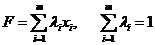 , (1)
, (1)
where  – weight (importance) of the i-th criterion whose value is generally determined based on expert opinions [6]. The disadvantage of a linear convolution there is a danger of loss of effective variants of the Pareto set [14]. It is considered that option is effective (Pareto optimal)if there is no other option, which is not worse at all the criteria. We assume that any two variants of strategic development should be of at least one criterion.
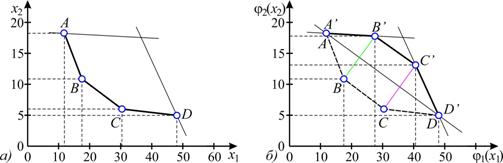
Fig. 1. A graphical representation of a linear convolution of criteria: a) the risk of loss of effective options;
b) nonlinear transformation scales
Danger of loss of effective variants of the Pareto set is clearly illustrated by Fig. 1, and. Clear that whatever weighting coefficients l1 and l2 we have not taken into account, will still be selected or option A or option B, but never will be selected options B and C. To avoid this risk, you can apply a nonlinear transformation of the scales, which in the new space coordinates of the points effective options will be located as shown on Fig. 1, b). With this arrangement, points to any effective version of the strategic development there will always be the weighting coefficients 1 and 2, which will be selected this option. Note that the nonlinear conversion scales can be done in various ways [9]. However, this significantly complicated the work of the experts for definition of weight of the criteria in the new coordinate space [8], if they don't have enough good content interpretation. In this case, the weighting coefficients can be determined on the basis of expert information on the comparative efficiency of selected basic versions of the Pareto set [12].
Consider this technique of linear convolution of criteria for the selection of a specific example.
Example 1. Let you select four basic variants A, B, C, D (Fig. 2) strategic development of the tourism industry and experts found such comparative effectiveness: D > C > A > B. Results of the estimation of variants of strategic development of the two criteria in the transformed space coordinates are given in table. 1.
Table. 1. Results of the estimation of variants of strategic development of the two
criteria in the transformed coordinate space
Options | A | B | C | D |
Criterion j1(x1) | 11,9 | 27,5 | 40,6 | 48,1 |
Criterion j2(x2) | 18,3 | 17,8 | 13,2 | 5,0 |
Obviously, the weighting coefficients l1 і l2 should be such that performed this sequence of inequalities:
 . (2)
. (2)
Having these irregularities, let's try to solve such a task of linear programming: calculate the maximum value of the objective function
 (3)
(3)
subject to the following limitations
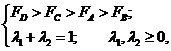 (4)
(4)
where: 
As a result of its solutions, we obtain the following results of calculation of indicators of the comprehensive evaluation of variants of strategic development of the tourism industry (table. 2): the maximum value of the objective function is Se = 20,41; weighting coefficients – l1 = 0,521, l2 = 0,479. Under obtained values of the weighting coefficients, the values of indicators of the comprehensive evaluation of variants of strategic development will be as follows: FA = 14,943, FB = 22,851, FС = 27,445, FD = 27,445.
Table. 2. The results of calculation of indicators of integrated assessment options
Basic options | Criteria | Indicators of integrated assessment | Discrepancies | |||||||
x1 | x2 | l1x1 | l2x2 | S | e | |||||
D | 48,1 | 5,0 | FD= | 25,049 | + | 2,396 | = | 27,445 | ||
C | 40,6 | 13,2 | FC= | 21,143 | + | 6,302 | = | 27,445 | |FD – FC| | 0,000 |
A | 11,9 | 18,3 | FA= | 6,197 | + | 8,746 | = | 14,943 | |FC – FA| | 12,502 |
B | 27,5 | 17,8 | FB= | 14,321 | + | 8,530 | = | 22,851 | |FA – FB| | 7,908 |
Weighting coefficients | l1,2= | 0,521 | 0,479 | = | 1,000 | Se= | 20,410 |
From this table that the indices of the FD and WWF identical to each other, this means that the ex-пертні assessment of options for the strategic development of two criteria are contradictory. However, VNA, reflecting the decision of a problem of linear programming, we obtained the values of weight коефіцієн tov, in which this contradiction reduced to a minimum. In other words, the system of inequalities (4) no solution, but we have found a solution with a minimum binding.
Note that such a conflict does not arise if the experts just named the best option from the set of feasible. Let it be a option B, that is, experts had established such comparative efficiency: B > A, B > C, B > D. Then we obtain the following problem of linear programming: calculate the maximum value of the objective function

|
Из за большого объема этот материал размещен на нескольких страницах:
1 2 3 4 5 |
