


Партнерка на США и Канаду по недвижимости, выплаты в крипто
- 30% recurring commission
- Выплаты в USDT
- Вывод каждую неделю
- Комиссия до 5 лет за каждого referral
В конце семестра студентам (каждому индивидуально) необходимо подготовить и представить презентацию проекта, посвященного одной из тем (микро-, макроэкономика).
Текущий и итоговый контроль результатов изучения дисциплины
Целью текущего контроля знаний студентов является проверка ритмичности их работы, оценка усвоения теоретического, практического материала и приобретенных знаний, навыков и умений.
Текущий контроль обеспечивается:
· опросом студентов на занятиях,
· уровнем и качеством выполнения домашних работ,
· аттестации студентов по результатам их работы на занятиях.
По дисциплине составлен рейтинг-план, в соответствии с которым результаты текущей аттестации подаются в деканат ФТИ.
ТЕКУЩИЙ И ИТОГОВЫЙ КОНТРОЛЬ РЕЗУЛЬТАТОВ ИЗУЧЕНИЯ ДИСЦИПЛИНЫ
Контроль производится по рейтинг – плану дисциплины
Projects for 3th-year Applied Math and Informatics Students.
Academic Year 2014/2015
Rating Score List and Timetable
Total – 100 points, including 1) Classroom Activities – 25 points (25%)2) Case Studies – 50 points (50%) 3) Individual Assessment – 25 points (25%) |
По дисциплине разработан комплекс домашних заданий и варианты контрольных (зачетных) заданий. Образцы лекционных и контролирующих материалов прилагаются.
Учебно-методическое обеспечение дисциплины:
Eric Doviac, Lecture notes on the principles of microeconomics, 2005 Robert S. Pindyck, Daniel L. Rubinfeld, Microeconomics, 2001 Ariel Rubinstein, Lecture notes in microeconomics theory, 2002 N. Georgy Mankiw, Principles of macroeconomics, 2003 Nouriel Roubini and David Backus, Lectures in Macroeconomics, 2003 John C. Hull, Options, futures and other derivatives, 2004 Paul Wilmott, Derivatives: the theory and practice of financial engeneering, 2000 D. Salvatore, D. Reagle, Statistics and econometrics, 2002 D. S.G. Pollock ECONOMETRIC THEORY, 200510. D. S.G. Pollock, LECTURES IN TIME-SERIES ANALYSIS AND FORECASTING, 2005
Образцы контролирующих материалов
Home work № 1 (Economic sytems)
1. What type of economy does the country you live in have?
2. Why are most modern economies mixed?
3. Most economic systems have important goals. Some examples are freedom, equity, security, employment, stability, and economic growth:
(a). Choose two of the goals listed above.
(b). Which of the four economic systems (traditional, command, market, or mixed) is most able to achieve the two goals you chose? Give details to support your statements (no less than 10 sentences).
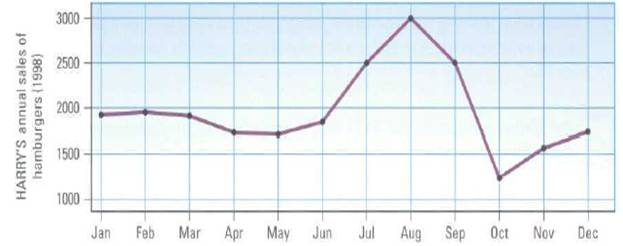
4. What does the graph shows below?*
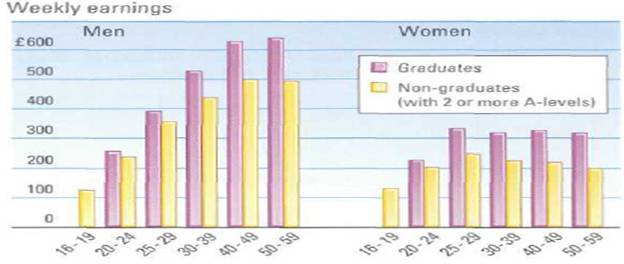
5. Describe the diagram*
Home work № 3 (Demand, supply and elastisity)
1. In the table below you can see some goods (column 1). In column 2 there are events that took place in the market of these goods. In column 3 please point the reasons of the change of demand. In column 4 please show the shift of demand curve which takes place as a result of this event.
1 | 2 | 3 | 4 |
Good | Event | Reason | Shift of demand curve |
Automobiles | Increase of petrol price | ||
Video tape recorders | Increase of price on video tapes | ||
Leather coats | Leather becomes very fashionable | ||
Audio cassettes | Decrease of price on CDs | ||
Coca-Cola | Presents from the Coca-Cola company | ||
School text books | Summer holidays | ||
Pet food | Increase of the pet owners | ||
VHS tape recorders | Customers expect digital recorders to appear in the market. | ||
Washing machines | Consumers expect the decrease of prices on washing machines | ||
Tooth paste | Intensive TV advertising of tooth paste | ||
TV sets | Increase in income of the population |
2. In the table below you can see some goods (column 1). In column 2 there are events that took place in the market of these goods. In column 3 please point the reasons of the change of supply. In column 4 please show the shift of supply curve which takes place as a result of this event.
1 | 2 | 3 | 4 |
Good | Event | Reason | Shift of demand curve |
Electrical energy | Implementation of new technology that allows to save more energy | ||
Corn | Very dry weather during the summer | ||
Chocolate | A new tax on the producers of the chocolate | ||
Foods for children | State subsidies for the producers of the food for children | ||
Computer tables | Grow of demand on computers | ||
Tours to Europe | Producers expect the bigger income of the population | ||
Batteries | Decrease of price on players | ||
Shoes | The new shoe factory was opened in this region | ||
Furniture | Increase of price on timber | ||
Video cassettes | Increase of demand on video tape recorders. |
I. You have the following demand schedule.
|
Price of CD($) | Demand on CD |
12 | 50 |
10 | 70 |
8 | 80 |
6 | 95 |
II. If the price of a videocassette rises from 5$ to 6$ the quantity of demand decreases from 15 to 10 videocassettes.
1. Find how will the total revenue change.
2. Is the demand elastic or inelastic?
III. If the price of chocolate falls from 10$ to 9$ the quantity of demand increases from 100 to 110 videocassettes.
3. Find how will the total revenue change.
4. Is the demand elastic or inelastic?
IV. The price of good B rises from 7$ to 10$. The quantity of demand on good A decreases from 76 to 56.
1. Find coefficient of cross elasticity
2. Are good A and good B compliments or substitutes?
V. You have the following information about the income of a family
Years | Monthly income | Quantity of potato consumed per month | Quantity of meat consumed per month |
The first year | 1000 | 15 | 6 |
The second year | 1500 | 10 | 9 |
Find income elasticity of demand.
VI. You have the following supply schedule.
|
Price of CD($) | Supply on CD |
12 | 100 |
10 | 90 |
8 | 80 |
6 | 50 |
VII. If the price of a of good A changes from 4$ to 3$ the quantity of supply of good B decreases from 100 to 75 videocassettes.
3. Find coefficient of cross elasticity
4. Are good A and good B compliments or substitutes?
Образцы лекционных материалов
Some vocabulary
Economy - хозяйство, экономика, народное хозяйство
Household – домашнее хозяйство
Scarce resources – редкие ресурсы
Output – продукция; продукт, изделие
Scarсity – недостаток, нехватка, дефицит; недостаточное количество
Economics – экономика; народное хозяйство экономическая теория, экономическая наука
Microeconomics – микроэкономика
Macroeconimics – макроэкономика
Unemployement – безработица
Effeciency - эффективность
Equity – справедливость, беспристрастность
Growth – рост
Stability – стабильность

|
Из за большого объема этот материал размещен на нескольких страницах:
1 2 3 4 |
