

Партнерка на США и Канаду по недвижимости, выплаты в крипто
- 30% recurring commission
- Выплаты в USDT
- Вывод каждую неделю
- Комиссия до 5 лет за каждого referral
What was the EU response to the IMF’s Italian forecast? Only a reminder that “state support” for individual businesses or economic sectors, i. e. political influence on the economy, was prohibited except in an extreme crisis and that a two decade recession does not qualify.
As Greece has shown us, however, the EU is perfectly comfortable using supranational authority to sell off a nation’s public assets to multinational companies and private capital.
It seems it is better a people starve than dare to disrupt a market that has been imbued with an almost religious salvational power.
“The British Referendum Has Struck This Market Worshipping EU Its First Major Blow”
The British referendum has struck this market worshipping EU its first major blow.
This blow, the “Leave” vote, signals the first major power shift back towards political organizations at the expense of financial institutions and the dictates of commercial efficiency since the neoliberalization of the world economy [1] – an objective sought and fought for over the course of two decades by a broad world coalition of labor, indigenous activists, students, peasants, intellectuals and radicals of all stripes.
After a period of decreased contestation in the aftermath of the wave of occupations known as the movement of the squares, [2] the end of which was perceived by many as a sign of a fatal ennui, the project of this coalition is at last coming to fruition against all expectations, as if out of thin air, in a wraith like resurgence of the anti-globe movement.
Finally an objective is in sight, however distant. An end to enforced austerity. An end to business as the driver of policy and politics.
An end to the conditions that made it impossible for even the most mild of Social Democrats to enact significant redistributive economic policies.
All welcome signs that “The End of History” was announced a bit prematurely.
But this hopeful turn was not noticed by the very people who set it in motion.
The very same radical left, even the very same individuals who were deeply enmeshed in the struggle against “free trade” and globalization, have instead joined the chorus of cosmopolitan outrage that has followed “Brexit,” eagerly and passionately.
British liberals in particular cannot restrain themselves or their class phobias, calling the referendum a “peasants’ revolt” in print and decrying a vote in which the “uneducated” can decide the fate of nations.
This response, which looks suspiciously like a defense of the once hated status quo, is symptomatic of a larger malady afflicting the left, particularly its radicals and anti-capitalists.
In the thinking of the contemporary electoral left ambiguity is an asset. Principles, positions, vital stakes, are all best kept close to the chest. The unstated theory is that votes must be accrued today, and ideology cultivated tomorrow.
This type of mentality leads Pablo Iglesias of Podemos to pronounce that they’re “neither left nor right,” cultivate the language of nationalism (“I am a patriot”) and to denounce old militants as “bitter” people with “infectious cynicism,” even as he accepts the communist party into his electoral coalition.
In Europe, Varoufakis has been cheerleading for a similarly obfuscatory line, giving TED talk style speeches on the need for a revival of the amorphous concept of Grecian democracy in European governance. While out of one mouth he says that he is an anti-capitalist, out of the other he informs the audience that in practice he assiduously hides it (see his piece “How I Became an Erratic Marxist”).
Europe, he says, is in the grip of right-wing reaction and must be saved from itself. The left must not do anything to weaken the center.
Implicitly he suggests that we are already defeated, despite all of the evidence to the contrary. This is the story that, in the absence of a counter-narrative, inevitably makes it to print.
Words like class, capitalism, egalitarianism, revolution, socialism, expropriation, nationalization, communism, and anarchism become anathema, provocations to be religiously avoided, even by figures with demonstrably anti-capitalist personal beliefs.
Former militants find themselves speaking in dull tones about the ever uncontroversial plight of the middle classes.
How is all of this relevant to Brexit?
Just take a look at the lukewarm “Remain” speeches given by leftist leaders. “No one would leave a fair and united Europe.”[4] “Labour is clear that we should remain in the EU. But we too want to see reform.”[5]
While parties like UKIP offered a coherent, consistent (reactionary) message, the left again behaved “tactically” and thought nothing of telling supporters who had campaigned savagely and relentlessly in the anti-globe movement that they must instead fight to save one of our era’s premier neoliberal institutions.
Supporters and potential supporters were left with no ground to press their own agendas in the context of referendum. The cumulative weight of this cynicism robbed us of headlines that could have affirmed the vote as a rejection of inequality, of markets run rampant, of austerity and racism, if only these principles were given voice.
Leftists, whether in electoral or extra-parliamentary camps, must now try to emerge from a cultivated schizophrenia that is preventing recent political gains from being articulated into a coherent force. If we are to translate ephemeral protest politics, as represented by parties like Podemos, into an enduring social movement we must propagandize clearly and without pandering at every opportunity.
We must be unafraid to mouth our own core perspectives.
No –
to austerity.
to governance by finance and markets.
to technocracy.
No to capitalism without adjectives. Not only no to “savage” capitalism, or “crony” capitalism, but to capital itself.
Yes –
to a red so obstinate it is again our own.
to a black so thick it is unashamed.
to a time where nothing is bought or sold.
We, the red and the black, need only to remove our masks and speak.
****************************************************************************
[1] A necessary precondition for the growth of the left, opening “breathing room” for the radical left to develop as a public, social and even revolutionary force.
A succinct analysis of this power shift in reverse was offered by Jeremy Corbyn himself in 1993 when he was a marginal figure and much lesser known.
Corbyn said that the Maastricht treaty “takes away from national parliaments the power to set economic policy and hands it over to an unelected set of bankers who will impose the economic policies of price stability, deflation and high unemployment throughout the European Community.”
[2] This “movement of the squares” included a breadth of movements and occupied central squares ranging from Gezi in Turkey, to Occupy in America, to Syntagma in Greece, and the Indignados in Spain.
[3] “In communist society, where nobody has one exclusive sphere of activity but each can become accomplished in any branch he wishes, society regulates the general production and thus makes it possible for me to do one thing today and another tomorrow, to hunt in the morning, fish in the afternoon, rear cattle in the evening, criticize after dinner, just as I have a mind, without ever becoming hunter, fisherman, herdsman or critic.” – Marx, The German Ideology (1845).
[4] Pablo Iglesias of Podemos.
[5] Jeremy Corbyn of Labour.
“For All The Differences, There Are Striking Parallels Between The Twenty-First-Century Occupation Of Afghanistan And That Of 1839—42”
“‘Whoever Comes To Afghanistan, Even Now, They Will Face The Fate Of Burnes, McNaughton And Dr. Brydon,’ Agreed Mohammad Khna, Our Host In The Village”
“Everyone Nodded Sagely Into Their Rice: The Names Of The Fallen Of 1842, Long Forgotten In Their Home Country, Were Still Common Currency Here”
“In Truth, All The Americans Here Know Their Game Is Over. It Is Just Their Politicians Who Deny This”
[Part 2]
I talked about my great-great-uncle, Cohn Mackenzie, who had been taken hostage nearby, and I asked if they saw any parallels with the current situation.
“It is exactly the same,” said Jagdalak. “Both times the foreigners have come for their own interests, not for ours. They say, ‘We are your friends, we want to help.’ But they are lying.”
“Whoever comes to Afghanistan, even now, they will face the fate of Burnes, McNaughton and Dr. Brydon,” agreed Mohammad
Another Popalzai ruler lacking a real power base, Hamid Karzai — astonishingly, from the same sub-tribe as Shah Shuja [in 1842]—faces the brunt of concerted guerrilla attacks led by the eastern Ghilzai who today make up the footsoldiers of the Taliban.
They are directed by another Ghilzai tribal leader from the Hotak ruling clan, in this case Mullah Omar. (Mullah Omar is a distant relative of the first Afghan ruler of southern Afghanistan, Mir Waiz Hotaki.)
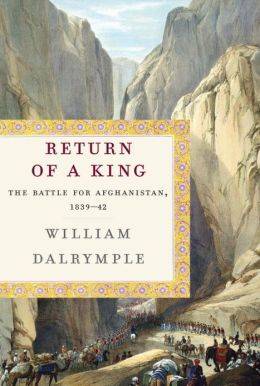
Excerpts from
RETURN of a KING
The Battle for Afghanistan, 1839—42
By William Dalrymple,
ALFRED A. KNOPE;
NEW YORK 2013
At the end of Kim, Kipling has his eponymous hero say, “When everyone is dead, the Great Game is finished. Not before.”
In the 1980s it was the Russians’ Withdrawal from their failed occupation of Afghanistan that triggered the beginning of the end of the Soviet Union.
Less than twenty years later, in 2001, British and American troops arrived in Afghanistan, where they proceeded to begin losing what was, in Britain’s case, its fourth war in that country.
As before, in the end, despite all the billions of dollars handed out, the training of an entire army of Afghan troops and the infinitely superior weaponry of the occupiers, the Afghan resistance succeeded again in first surrounding then propelling the hated Kafirs into a humiliating exit.
In both cases the occupying troops lost the will to continue fighting at such cost and with so little gain.

|
Из за большого объема этот материал размещен на нескольких страницах:
1 2 3 4 5 |
