

Партнерка на США и Канаду по недвижимости, выплаты в крипто
- 30% recurring commission
- Выплаты в USDT
- Вывод каждую неделю
- Комиссия до 5 лет за каждого referral
Recognition of ego-states
There are 4 ways in which the ego states (Parent – CP/NP); Child (AC/ FC) and Adult (A) can be recognised. That is, through (1) behavioural, (2) social, (3) historical and (4) phenomenological messages from each of the ego-states. Lets explain:
(1) Behavioural messages
Behaviour contains spoken words, voice tones, facial expressions, bodily postures and attitudes. To view examples of these in relation to the different ego-states (see Table 1).
Table 1: Examples of typical words, voice tones, behaviours and attitudes expressed by the
differing ego-states during communication.
Ego state | Typical words/phrases | Typical voice tone | Typical behaviour | Typical attitudes |
Critical Parent (CP) | That is disgraceful. | Angry | Furrowed brow Pointed finger Pounding on table | Judgemental Authoritarian |
Nurturing Parent (NP) | I will sort it out for you. | Sympathetic | Consoling touch | Caring Understanding |
Adult (A) | When? | Calm Enquiring | Relaxed Attentive and aware Level eye contact | Non-judgemental |
Adapted Child (AC) | I will try hard. Thank you. | Placating | Downcast eyes Vigorous head nodding | Passive |
Free Child (FC) | That is great. | Expressive | Clear demonstration of feelings | Spontaneous |
(2) Social messages
The social context provides the stimulus to a particular recurring ego state in the same individual. For example, a bossy ward sister who repeatedly shouts and finds fault
(CP - Critical Parent) when dealing with problems within the clinical environment. Such stimuli may in turn provoke a subordinate’s Adapted Child (AC) submissive response.
(3) Historical messages
The ego state an individual adopts is an echo of learned behaviour from the past. When a person acts like their parents would in a particular situation, they are operating from the Parent (P) ego state (CP or NP). Similarly, when a person becomes over-excited about a purchase, as they did when they acquired a new toy in childhood, they are operating from the Child (C) ego state Free Child (FC).
(4) Phenomenological messages
A phenomenological ego-state occurs when a person reflects on their feelings, thoughts and behaviour and attempts to determine whether they operated from Adult (A), Parent (CP/NP) or Child (AC/FC) during a communication transaction. That is, they purposely examine where an episode of communication went well or ch analysis occurs in a therapeutic situation with a TA counsellor (Lapworth & Sills, 1993). The aim is for the analyst to identify and resolve recurring errors within an individual’s communication scripts, to facilitate more constructive future collaboration with others. The aspiration is to de-construct negative and dysfunctional scripts replayed in the person’s communication style.
Positive and negative aspects of ego-states
An ego state is neither good or bad, since both Parent (P) and Child (C) positions can have outcomes that are positive or negative, dependent upon the situation (see Table 2).
Table 2: Positive/negative communications from the different ego states
1. | Positive (NP) | Cares for another person when they need or want it. |
2. | Negative (NP) | Does things for others when not needed or ch interference may de-skill or repress the other person. |
3. | Positive (CP) | Stands up for their rights in an assertive manner without putting others down. Constructively criticises. |
4. | Negative (CP) | Disapproving in a style that affects the self-worth of another. Destructively criticises. |
5. | Positive (AC) | Behaves in line with social expectations. Saying “please”, “thank you”, “sorry”. |
6. | Negative (AC) | Self-destructive behaviour that is out of line with social expectations. Persistent lateness, over confidence or rebellion. |
7. | Positive (FC) | Expresses thoughts, enjoys the moment in a way that does not harm others. Is endearing, demonstrative and spontaneous. |
8. | Negative (FC) | Expresses thoughts that may harm others. Is self-centred and egotistical. |
Ego-grams which typify communication styles of others
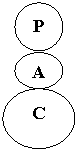
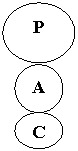
An ego-gram is a graphic illustration of the extent to which a person presents in the different ego states. The bigger the circle, the greater the individual’s dependence on that particular ego state (see Figure 3).
 |  |
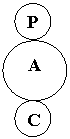 |
Fig. 3: Graphic illustration of how a person may present in the different ego-states
Individual differences in personality
Everyone has a Parent (P), Adult (A) and Child (C) ego-state. Similarities exist within cultures exposed to an analogous environment, with proverbial stimuli determining national characteristics. Simultaneously, each person is unique as a result of their differing individual experiences. Hence the “content” of each person’s ego-gram differs.
Contamination of ego states
Contamination is intrusion of the Parent (P) or Child (C) into the Adult (A) (see Figures 4 & 5).
 | |


 |
Ideal Contaminated
(4) (5)
Fig. 4: Graphic illustration of an ideal ego-gram
Fig. 5: Graphic illustration of a contaminated ego-gram
Parent (P) contamination results in prejudice and tenacious opinions that are not corrected by exposure to accurate corrective input from outside. Prejudice stems from acceptance of Parent (P) values in early life. Contamination reduces the Adult’s (A) effectiveness at computing data in a rational and logical fashion (Widdowson, 2010). For example, the individual surrounds their prejudice with irrational arguments that stand in support of their position. The only way to remove prejudice is to give facts and separate the Parent from the Adult so that the Adult can function more effectively (Stewart, 2007).
In contrast, child contamination of the Adult results in delusions grounded in fear. For example, a subordinate who feels they are not capable of taking on a new job or accepting promotion. Both types of contamination result in the Adult treating inaccurate information as fact. TA counselling is aimed at separating the ego states in attempts to improve communication. In essence, TA is an analytical tool to aid understanding and improve a person’s communication skills by analysing their transactions with other people (Sills & Hargaden, 2002).
Process of stroke balancing
The concept of stroking is the act of recognising another person’s presence. For example, saying “hello” or a non-verbal recognition such as “waving”, “nodding”, “smiling, or “frowning” (Harris, 2004). TA involves giving and receiving of psychological strokes (Harris & Harris, 1995). There is a fundamental assumption that negative strokes are better than no strokes at all. That is, people seek negative strokes in preference to being ignored. For example, a positive stroke is praise for a job well done, encouragement for making a special effort, bonus payment for exceeding targets etc. In comparison, negative strokes involve being told off for poor quality work, being downgraded or moved to a less desirable job. The healthiest strokes are positive strokes, which serve to increase an individual’s performance efforts (Tilney, 1998). The stroke classification is not discreet, since such comments may combine elements of both types of stroke. For example, “you are capable of much better work than this”. The classification of strokes depends on what the receiver “hears”, as opposed to the intention of the sender of the strokes.

|
Из за большого объема этот материал размещен на нескольких страницах:
1 2 3 4 5 |
