

Партнерка на США и Канаду по недвижимости, выплаты в крипто
- 30% recurring commission
- Выплаты в USDT
- Вывод каждую неделю
- Комиссия до 5 лет за каждого referral
Stroke balance and stroke reservoir
In early life a person may experience predominantly positive or negative strokes. That is stroke patterns to which they become accustomed and feel comfortable and familiar with (Steiner, 1990). An assumption made in TA, is that people seek to recreate the balance experienced in early life during their adulthood. This explains why some individuals set themselves up for difficulties by inviting negative strokes (Berne, 1996). A stroke reservoir is a credit balance, which when depleted causes discomfort and ignites a need to readdress the old familiar stroke balance (Berne, 2001).
Transactions
The unit of social intercourse is a transaction. Each transaction consists of a stimulus and a response. The stimulus and response patterns may be verbal or non-verbal and progress in chains. Transactions in communication can be classified as complementary, crossed or ulterior (Berne, 1996).
Complementary transactions
A complementary transaction is Adult-to-Adult and occurs when the agent receives the response they expect (James & Jongeward, 1996) (see Figure 6)
 | |


 Stimulus
Response


 |
Agent Respondent
Midwife asks for syntometrine Student places it in her hand
Fig 6: Graphic illustration of a complementary transaction
Communications proceed smoothly as long as transactions are complementary. Difficulties in communication arise when vectors cross out of Adult-to-Adult to Parent-to-Child or Child-to-Parent (Widdowson, 2010).
Crossed transactions
A crossed transaction is parent-to-child and occurs when the agent or respondent does not produce expected stimuli. As a result communication problems arise. Vectors cross and adult communication ceases until vectors are re-aligned between adult-to-adult (see Fig. 7).
 | |


 Response
Stimulus
| |
 | |
Agent (sister) Respondent (midwife)
Do you know where the duty rota is? Are you blaming me for loosing it?
Fig. 7: Graphic illustration of a parent-to-child crossed transaction
Another crossed transaction may be a parent response to an adult stimulus (see Figure 8):
 |
|
 Response
Stimulus

|
|
|
Agent (midwife) Respondent (sister)
Do you know where the duty rota is? How irresponsible. Have you lost it?
Figure 8: Graphic illustration of a parent response to adult stimulus crossed transaction
Ulterior transactions
Ulterior transactions consist of an on-the-surface message with ulterior meaning (see
Figure 9).
 |
|
Stimulus



 Response

 Ulterior stimulus
 | |
Ulterior response
|
Agent (sister) Respondent (midwife)
Are you up to the job? I am well able to do it.
(implying ineptitude)
Fig. 9: Graphic illustration of an ulterior transaction
At both levels the transaction is complementary, since the midwife’s reply is accepted at face value as an Adult (A) transaction. In general, transactions follow 3 rules (Berne, 1996)
(1) As long as the transactions are complementary (Adult-to-Adult), communication
may continue indefinitely.
(2) If there is a change to a crossed transaction (Parent-to-Child / Child-to-Parent), a
break in the flow of conversation will occur.
(3) The outcome of ulterior transactions are determined at a psychological rather
than social level.
Procedures, rituals and scripts
Transactions proceed in sequenced steps and are programmed from either Parent (P),
Adult (A) or Child (C). A procedure is a series of complementary Adult (A) transactions that are evaluated in terms of “efficiency” and “effectiveness” in relation to outcome. If the Adult (A) is contaminated by Parent (P) or Child (C), the efficiency and effectiveness of the communication will be reduced. That is, poor quality communication will result (Lapworth & Sills, 1993).
A ritual is a stereotypical pre-programmed series of complementary transactions. The form of the ritual is determined by convention. A ritual like the following is not intended to communicate information:
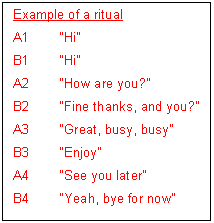
This ritual is a trading of “strokes” (Harris, 2004). For example, on the first meet of the day, each person owes one another a set of strokes (in the above scenario 4 each). In the event that these individuals’ paths cross again during the same day, acknowledgement may consist of merely a nod of recognition (1 stroke each). At the initial meet of the day, if B does not reciprocate to A’s greeting of “Hi”, B is likely to reflect on whether or not there is a problem with the relationship. Procedures and rituals follow characteristic patterns, which upon initiation follow a chain of predictable transactions that lead to a predetermined conclusion.
A script is a person’s individual programming. Each personal script dictates repetitions in action, speech and behaviour of that character when presented with analogous circumstances and stimuli (James & Jongeward, 1996). Each person is their own playwright, director, producer and central character in communication scripts. An individual may write catastrophic, humorous or dramatic scripts (Steiner, 1990). Scripts are formulated during childhood from parental messages, e. g., “do not” messages, such as “do not be emotional” or “do not be demonstrative”. Such messages influence a person’s self-concept (Harris & Harris, 1995).
Stroke Economy
“Stroke economy” follows 5 basic rules:

|
Из за большого объема этот материал размещен на нескольких страницах:
1 2 3 4 5 |
