


Партнерка на США и Канаду по недвижимости, выплаты в крипто
- 30% recurring commission
- Выплаты в USDT
- Вывод каждую неделю
- Комиссия до 5 лет за каждого referral
D Lisa is a local student. Olaf and Sasha are foreign students
10 What does Lisa think of Sasha's last seminar paper?
A it was like a lecture
В it was professional
С it was rather boring
D she couldn't believe it
ACADEMIC VOCABULARY IN USE
1. Read the following text and decide which answer (A, B, C or D) best fits each gap.
Why Can't Our Children Read?The new national reading programme for beginners, aimed at reversing the decline in literacy, emphasizes rules and sounds of individual words. Traditionalists will no doubt heave a …(1)… of relief at what they will regard as a turn to the good old …(2)… . Their opponents argue, however, that the texts used for this purpose years ago …(3)… no relationship to real life and …(4)… short of the basic requirement for any learning materials: they should …(5)… interest in what is being taught. Educators must not lose …(6)… of the fact that teaching rules without taking this into account will not solve the problem. | |||||
1 | A groan | B sob | C sigh | D breath | |
2 | A period | B days | C times | D years | |
3 | A bore | B carried | C held | D kept | |
4 | A dropped | B fell | C ran | D failed | |
5 | A arise | B arouse | C raise | D rise | |
6 | A grasp | B regard | C vision | D sight |
2. Underline the correct word to complete each sentence.
1.All applications must include the names and addresses of two academic referees / arbitrators / evaluators.
2.The overseer / supervisor / administrator of your thesis will advise you on what kind of content is appropriate for your introduction.
3.As a travelling / visiting / touring professor in sociology he spends much of his time abroad.
4.If you think your work has been graded unfairly, file a complaint with the head / chief / leader of the department.
5.Students’ performance will be judged by external prefects / graders / assessors to ensure objectivity.
6.Your careers director / analyst / adviser is there to help you make the best choice for your future.
7.As an office trainee / learner / novice, she was expected to follow the lead of the more experienced secretaries.
8.The successful entrant / applicant / finalist will serve a three-month trial period before being offered a permanent position.
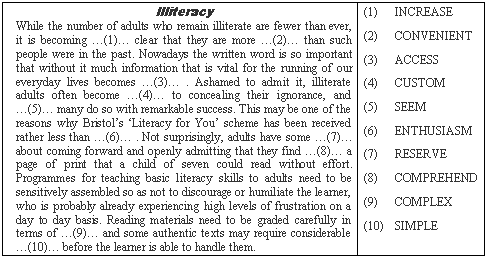
3. 
1
In other words, we face a world in which intelligible communication is likely to become a rarity. A logical conclusion, perhaps, but it must be borne in mind that the death of language has been predicted many times in the past by such respected figures as George Bernard Shaw. Nevertheless, most parents would find it hard not to agree with Wells's basic message.
2 |
It is a worrying trend, not just for those who lose an ability to use language, he says, but for the fate of the planet as a whole. Robbed of an ability to follow and sustain complex arguments, more and more humans will simply give up trying to understand or influence the world around them, including the key international challenges we face like global warming and cloning.
3 |
Indeed, it is a particularly alarming prospect for a species that is distinguished by its communication skills. Language has been found in every one of the thousands of societies documented by scientists and is used by every neurologically normal member of humanity. As Steve Parker, director of the Centre of Cognitive Neuroscience at Massachusetts Institute of Technology, says: 'Language is so tightly woven into human experiences that it is scarcely possible to imagine life without it.'
4 |
The observation suggests that the root of human language is social, not intellectual, and that its usefulness in communicating complex notions came relatively late in our evolutionary history. For most of our time on Earth, language has had the equivalent role of grooming among monkeys, strengthening social bonds between individuals and cementing tribes together.
5 |
Only relatively late in the story of Homo Sapiens has language emerged in its current mature version. Recent work by Simon Fisher at the Welcome Trust Centre for Human Genetics in Oxford and Svante Paabo, at the Max Planck Institute of Evolutionary Anthropology in Leipzig, Germany, has dated key mutations in genes involved in neurone activity to about 200,000 years ago. These, they say, may have been crucial to our acquisition of sophisticated speech.
6 |
It is precisely at this time, of course, that modern Homo Sapiens evolved in an area of sub-Saharan Africa. Armed with a new linguistic sophistication, they poured out of Africa and by 40,000 years ago had reached the edge of Europe, then the stronghold of massive, cold-adapted Neanderthals, who nevertheless succumbed to these African interlopers, even though the continent was then in the grip of the last Ice Age. Above all, it was our ability to exchange complex data that gave us an advantage in those harsh days.
7 |
In short, language has been a mixed blessing for humanity. But it is what defines us as a species and it is hard to imagine us losing our prowess in the long term. In any case, just because our kids grunt at us, it doesn't mean to say they cannot communicate,' says Dunbar. 'It probably just means they don't want to talk to adults.
A It is a worrying vision, summed up by one senior education expert - Alan Wells, director of the government's Basic Skills Agency - who warned that youngsters now communicate in monosyllables, mainly because parents have lost the art of talking and playing with their children. 'At the age when they come into school, many children have very few language skills at all and that clearly has an impact on their learning,' he told an education conference.
В 'I have got to admit that I feel more than a twinge of sympathy,' said linguistic expert, Professor Robin Dunbar of Liverpool University. 'Judging from my own kitchen table, intelligent speech does sometimes seem to be at a premium among youngsters these days.'
С Intriguingly, recent research suggests that language may have developed in combination with the use of music and singing. 'Our work suggests early humans engaged in a lot of chanting and choral singing,' he says. 'It is the equivalent of tribal singing on football terraces or Welsh community singing - that sort of thing. It was a way of identifying ourselves.'
D As well-meaning parents, we try to compensate for this lack of communication. Every now and then, we attempt to engage our children in friendly dialogue, only to be met with baleful stares or goggle-eyed incomprehension, and something along the lines of 'er, neugh, ugh.'
E After that, humanity slowly conquered all the nooks and crannies of the planet, from the tip of South America to the islands of Polynesia. To every one of these outposts, we brought language. Then around 10,000 years ago, agriculture was invented and in its wake the ability to write down words, which were needed to record the corn, wheat and oxen we began to trade in. At the same time, social ranks, possessions and war also appeared. As Aldous Huxley said: 'Thanks to words, we have been able to rise above the brutes - and thanks to words, we have often sunk to the level of the demons.’
F 'Essentially, more and more people will give up thinking and following these issues and leave them in the hands of eloquent experts, who will take on the roles of shamans. That is hardly a healthy development,' said Dunbar.
G 'We have studied a gene called FOXP2, which is known to have a role in brain development,' says Fisher. It is found in mammals from mice to chimpanzees with hardly any variation between any two species except for humans. Our version has several key alterations and, by studying their frequency among different tribes, we have shown that these mutations appeared about 200,000 years ago. Most probably, these changes would have enhanced early humans' ability to control the muscles of their mouth and face, crucial in the development of speech.'
H The importance of speech in our lives is revealed by the fact that a person may utter as many as 40,000 words in a day. However, the intriguing point, as uncovered by Dunbar, is that most of these are about trivial monitoring common-room chat, Dunbar discovered that 86 per cent of our daily conversations are about personal relationships and experiences, TV programmes and jokes. We may be able to outline the theory of relativity or the ideas of Freud, but we rarely bother to do so. Most of the time, we use language to gossip. 'It is what makes the world go round,' Dunbar says.
LISTENING
Listen to the first part of the recording. Answer the questions. Write NO MORE THAN THREE WORDS for each answer.
1. Where was Solomon Asch born? ____________________________________________________
2. Which area of interest made Asch take up psychology? _________________________________
3. What was the name of Asch's famous experiment? ____________________________________
4. Who were the majority of participants in each experiment? ___________________________
Listen to the recording and answer Questions 5 to 8
Questions 5 and 6
Choose TWO letters A-E.
Which two features changed the results of the experiment?
A a bigger group
В the number of lines
С more time
D gender
E privacy
Questions 7 and 8
Choose TWO letters A-E.
Subjects explained their conformity as a desire to
A keep the experimenter happy.
В give a good impression.
С leave early.
D please the other participants.
E appear clever
ACADEMIC VOCABULARY IN USE
1. Circle the two suitable words in italics which best complete each sentence correctly.
1. When she saw the spider, she let out a piercing scream / yelp / shout / shriek.
2. When reading, you have more time to appreciate the shadows / subtleties / nuances / tones of meaning than when you’re listening.
3. It is sometimes difficult to absorb / interest / capture / comprehend all the necessary information if someone is talking too fast.
4. Some people like the straightforward / shortcut / modest / minimalist style of Internet conversations.
5. I like her novel, although her verbose / long-winded /elongated / stretched-out style bored me at times.
6. She mumbled / muttered / stuttered /spluttered something under her breath about being bored and walked out of the lecture hall.
7. His tendency / pitch / expression / tone was sarcastic; he obviously thought very little of his colleagues.
8. I have read through his work and I haven’t found any clear / clean / hard / striking examples of a text which is hard to understand.
2. Fill in each gap with one suitable word.
Communication
НЕ нашли? Не то? Что вы ищете?
Реклама
Реклама на сайте, общая информация Контент-маркетинг Поддержите проект! Copyright © 2009-2026 Pandia. Все права защищены. Мнение редакции может не совпадать с мнениями авторов. Автоответчик: +7 495 7950139 228504 Написать письмо: [email protected] 
❮
❯
|