


Партнерка на США и Канаду по недвижимости, выплаты в крипто
- 30% recurring commission
- Выплаты в USDT
- Вывод каждую неделю
- Комиссия до 5 лет за каждого referral
As Russia stands poised to embark on these reforms, a number of recent studies in economics and political economy have raised questions about previously accepted wisdom and practices in the area of fiscal federalism. Many of the relatively new ideas concern precisely developing or transition countries that are still in the process of building market institutions, while at the same time struggling to achieve lasting stabilisation and growth. An important strand in this literature proposes that a properly designed decentralisation in fiscal federalist relations can effectively serve as an engine for market reform and growth (Weingast (1995), Monitola, Qian, and Weingast, (1995)). On the other hand, a number of other studies warn of the dangers of decentralisation, again often focusing precisely on problems in developing or transition economies (Tanzi (1995), Prud’homme (1995), Fukasaku and de Mello Jr. (1998)). The relative advantages and disadvantages of decentralisation also underlie current policy debates within Russia. Is the cure for poor economic policies and behaviour of regional and local administrations a crackdown by the central government or a more effective and rational decentralisation? Recent Russian reform documents and initiatives contain an often confusing mix of proposals for greater subnational autonomy and measures aimed at increasing central control. Indeed, the appropriate reform in Russia would most likely involve a certain combination of the two. But how should they be optimally combined?
This paper considers the question posed above through an examination of the current state of fiscal federalist relations in Russia and an evaluation of basic reform options in light of the relevant literature. We conclude that the Russian system of interbudgetary relations indeed stands to profit greatly from an explicit decentralisation in decision-making authority. But the particular characteristics of the Russia economy suggest accompanying this decentralisation with a package of additional measures to ensure overall financial control, the achievement of basic social policy goals, and the proper alignment of incentives for state organs. This entails a dual approach that simultaneously creates genuine autonomy and responsibility at lower levels of government, while centralising to the federal level a greater share of resources, particularly in the short and medium term. A longer-term strategy should gradually increase in the share of resources in subnational budgets, as institutions for subnational finance and responsibility become stronger, more durable macroeconomic stability is achieved, and social distress among the population subsides. The strategy outlined in this paper is consistent with, and builds on, recommendations in OECD (2000b) and the general directions set out in the Economic Programme of the Russian government (Программа …2000).
The following section briefly describes the state of fiscal federalist relations in Russia, drawing upon both OECD (2000b) and more recent information. The next section turns to the general question of decentralisation for the case of Russia. Final sections outline a comprehensive direction of reform and discuss current strategies and measures of the Russian government.
II) The state of fiscal federalist relations in Russia
The ministerial product-line hierarchy of the Soviet system left little room for any sort of regional or local autonomy. In effect, all state revenue was first centralised and then allocated according to the national bnational administrations began to play an increasing role in resource allocation with the weakening of the product-line ministries in the 1980s. This process intensified during the transition to a market economy in the 1990s, leading to a significant devolution of effective power and authority to the regional (Subject of the Federation) level of and large, this devolution of power did not follow a specific plan or central legislation, instead deriving from strong autonomous centrifugal forces that followed a weakening of the central government and its corresponding inability to meet a large part of former expenditure obligations. In a rather chaotic environment, regions lobbied for greater shares and control of revenue through bilateral agreements with the centre, while the federal government continually pushed expenditure responsibilities downward.
Official legislation evolved along with this process, but generally opposed this chaotic decentralisation process through measures aimed at bringing regional and local finance under greater central control. One important accomplishment since the mid-1990s has been the creation of somewhat more uniform rules for revenue sharing and expenditure assignments for all Subjects of the Federation. These rules have, to a large degree, replaced the separate bilateral agreements of the past.[3] But legislation and actual practice in Russian fiscal federalist relations still remain rather far apart in many areas. Therefore, an understanding and assessment of the state of fiscal federalism in Russia requires a distinction between the system as it exists on paper, according to various laws and regulations, and how it actually works in practice. A much more detailed treatment of a number of the issues in this section can be found in OECD (2000b). In theory, the current system of fiscal federalist relations is distinguished by an extremely high degree of central control over subnational budgets. In practice, subnational administrations have ample means to circumvent this control. The nature of this game accounts for important distortions in the incentives of state officials at regional and local levels.
The Russian fiscal federalist system now consists of three main levels: federal, 89 regions (Subjects of the Federation), including 9 autonomous okrugs that are considered part of larger subjects, and several thousand local administrations. In various contexts, however, the system may need to be viewed as something between a 2 and 4-5 tier hierarchy. On the one hand, there is federal legislation that refers to “consolidated (regional and local) budgets of Subjects of the Federation” as one legal entity. On the other hand, actual administrative structure varies from region to region, with some Subjects of the Federation interacting directly with a series of local (third-tier) municipalities and other regions where only larger cities and districts have municipality status, along with a possible subdivision into smaller subordinate administrations. A mixture of these two models is also possible.[4] A typical Russian region will have one or two strong cities or districts that supply the vast majority of tax revenue, while most of the remaining districts, usually without any sort of real tax base, are financed primarily by the regional budget.[5]
Figure 1: The share of subnational budgets in consolidated state revenue (before transfers) and expenditures in selected countries 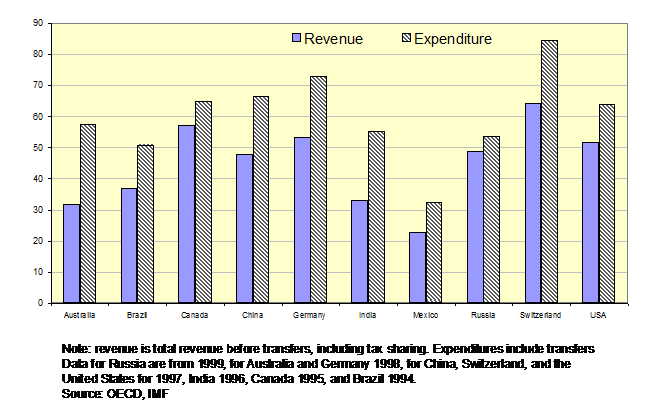
The two most commonly employed measures of fiscal decentralisation in applied economic studies are the share of subnational budgets in consolidated revenue and expenditures and the degree to which subnational budgets consist of revenue raised on their territories as opposed to both of these (aggregate) measures, the Russian system appears rather decentralised (Figures 1 and 2), at least at the regional (Subject of the Federation) level. In the 1990s, the share of consolidated subnational revenue (before transfers) in all state revenue gradually increased from 40 to 56 per cent in 1998, before falling back to 49 per cent in 1999. This share has decreased somewhat again in 2000, due in large part to higher federal revenues from export taxes and some recent changes in tax legislation, but remains well above 40 per cent. As shown in Figure 1, this places Russia close to China and a number of developed federations, such as Germany and the United States, and above Brazil, India, and Mexico. The comparative share of subnational expenditures is lower, reflecting a relatively low average share of transfers in subnational revenue (Figure 2). The share of federal transfers in aggregate subnational (consolidated regional) revenue stood at roughly 15 per cent in 1999. This can be contrasted with India, China, and Mexico, where transfers account for over 30 per cent of subnational revenue, as well as Brazil where they account for over 25 per cent. But a rather high degree of variance does exist across different Subjects of the Federation according to this measure. While transfers account for less than 10 per cent of the revenues of many Subjects of the Federation, this measure reaches 50-60 per cent for over 20 of the least developed regions. The variance in local transfers is even greater, with a number of rural municipalities receiving transfers accounting for over 80 per cent of revenue.
Figure 2: The share of transfers in consolidated regional state revenues in selected countries 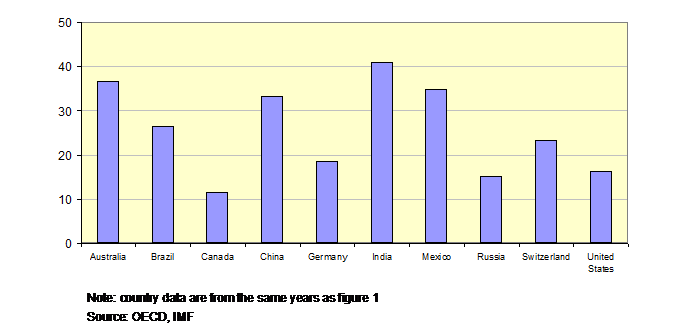
Measures of decentralisation according to (formal) subnational autonomy tell another story altogether. Here, the legacy of the over-centralised Soviet system survives, further bolstered by a number of measures in the second half of the 1990s that place even further limitations on the autonomy of subnational administrations. The vast majority of subnational revenue and expenditure obligations are determined by laws and regulations determined by a higher level of government, most notably the federal level. A single federal tax body (ministry) collects all taxes, transferring the majority of this revenue to the federal treasury, where it is then allocated to various budgets. The federal government sets the rates and sharing rules of the major taxes as a part of the annual federal budget law. As shown in Table 1, only roughly 15 per cent of regional and local (explicit) revenue derives from taxes over which the relevant administrations have any sort of real decision-making authority, and even these taxes are usually rigidly regulated from above or subject of federal ceilings. The new Tax Code of 1999 (Part I) and 2000 (Part II) reinforced the narrow limits on subnational autonomy, restricting subnational taxes and their methodology to a short possible list. The government further plans to replace the former federal ceiling on the regional profit tax rate of 19 per cent to a fixed rate of the same amount, and also severely limit the rights of regional and local organs to offer exemptions on tax rates for their shares of federal (shared) taxes, including the profit tax.

|
Из за большого объема этот материал размещен на нескольких страницах:
1 2 3 4 5 6 7 8 9 10 11 12 13 14 15 16 17 18 19 |
