


Партнерка на США и Канаду по недвижимости, выплаты в крипто
- 30% recurring commission
- Выплаты в USDT
- Вывод каждую неделю
- Комиссия до 5 лет за каждого referral
The main difference between the Russian fiscal federalist system as it exists on paper and practice is the fact that subnational administrations do exercise a high degree of autonomy in their jurisdictions, particularly at the level of the Subject of the Federation.[12] The actual system is significantly decentralised with respect to autonomy as well as resources. Given the highly centralised nature of the formal system, however, this autonomy is realised primarily in an informal manner. As argued below, this fundamental contradiction between formal centralisation and informal autonomy is the source of many of the distortions and incentive problems that plague interbudgetary relations in Russia today.
Subnational organs have a number of means for gaining influence and leverage over economic organisations and financial institutions operating on their territories.[13] This includes direct participation in their capital, “indirect” participation through affiliated companies, control of utilities, control of various inspections empowered to administer penalties and fines, close ties with the courts and federal anti-trust or tax bodies, licensing, and the rveys of Russian businesses continue to emphasise good relations with regional and local administrations as a prerequisite for success. Federal organs operating in the regions typically have close relations with the regional administration, depending on the latter for a number of reasons, sometimes even for the provision of office space. Federal organs in the regions are typically staffed by local officials with a background in the regional administration. Until recently, the regional governor had informal veto power over the selection of some federal representatives, most notably the head of the branch of the tax ministry. Only in the context of recent administrative reforms, including new rules for the Council of the Federation (upper house of parliament) and the creation of 7 new administrative macro-districts in the federal hierarchy, has the influence of regional governors over federal structures perhaps begun to decline.
In this context, regional administrations almost always make direct use of enterprises and financial institutions on their territories for the provision of public goods and services. First, most large industrial enterprises inherited social infrastructures such as housing, hospitals, and nursery schools. Many of these firms, particularly those that are profitable, continue to finance this infrastructure, even in the event that ownership has been formally transferred to the municipality More fundamentally, it is quite typical for profitable enterprises to be burdened with the provision of subsidies to the region in many various forms, such as entire networks of retail consumer goods outlets (operated at a loss), housing, road work, monuments, sports stadiums, and the like. In return, these firms can receive various special privileges or protection from the administration, including explicit or implicit tax exemptions, debt restructuring, and protection from bankruptcy or plicated bilateral agreements of this sort between administrations and large “budget-generating (biudzetoobrazuiushchie)” enterprises are the general rule. Administrations themselves, or their affiliates, are often significant shareholders in these firms as well, and the activation of (tax) debt restructuring, debt/equity swaps and bankruptcies during 1998-2000 appears to have increased the extent of this shareholding. External management of financially distressed firms is often at least implicitly under the control of administrations. A primary advantage for administrations in relying on such bilateral bargaining and the direct provision of public goods is the avoidance of the ubiquitous tax sharing and rigid central regulations on expenditures in the formal system. The region effectively becomes a 100 per cent marginal claimant on (implicit) taxes and exercises complete control over the allocation of “expenditures.” Lower profits due to the provision of regional public services offer the enterprise an advantage as well, lowering its tax obligations to the federal government. Many regions also have one or more “authorised” commercial banks that can hold various funds of the administration, offer deficit finance, and issue bills of exchange for use in fiscal policy. Analytically, it is quite difficult to distinguish the actual “budgets” of administrations from those of their affiliated firms and financial institutions.
Various extra-budgetary funds represent another informal tool of fiscal policy for subnational administrations. While these funds are technically illegal, numerous loopholes exist. For example, such funds can be set up as independent non-profit organisations with a murky shareholding structure that disguises administration ownership. “Volunteer” contributions can then be solicited from economic organisations. Small businesses have complained in particular of extortion by state organs through pressure to make donations to such funds.[14] These funds again offer the dual advantage of avoiding revenue sharing and maintaining full control over expenditures. In addition to such informal funds are subnational branches of the explicit national extra-budgetary funds. Regions have typically exercised a greater degree of control over some of these funds than the explicit budget, although recent measures are due to bring explicit extra-budgetary funds under federal control and shift their administration to the Federal Tax Ministry.[15] Subnational administrations also possess their own special accounts (Sumy po porucheniiu), which contain various fines, other off-budget payments, and some “excess” budgetary funds from economising on certain expenditure categories. These accounts hold something close to the equivalent of 5 per cent of resources in the explicit budget on average, and for some regions much more. They share the advantages of extra-budgetary funds and the direct provision of public goods through economic organisations stressed above.
The OECD Economic Survey of 2000 (OECD (2000)) also placed particular emphasis on money surrogates, particularly debt offsets, as primary tools for the conduct of relatively independent fiscal policies at the subnational level. This includes direct control over resource allocations (through the arrangement of barter chains), various means of keeping a greater part of shared revenue in the region, an inherent lack of transparency in accounting that allows for “creative book-keeping,” the difficulty of monitoring such arrangements by federal bodies, and the freedom for individualised tax treatment in the spirit of the bilateral relations described above. This continues to be the case, despite the fact that several factors have supported a significant decline in the share of surrogates in reported subnational tax revenue in 2000. In late 1999 and early 2000, the Ministry of Finance signed (and extended) agreements with the majority of regional administrations that linked their eligibility for federal transfers to a number of conditions, including a substantial reduction of the share of surrogates in tax revenue. In addition, due to changes in the way taxes are accounted and divided by the federal treasury since 2000, subnational administrations became practically unable to collect their shares of federal taxes in surrogates in 2000. A greater amount of cash in the regional economy and higher enterprise profitability after the depreciation of the rouble and strengthening of export prices has also facilitated a greater use of cash in budgetary operations. Figure 3 illustrates the changes in the share of reported money surrogates in subnational tax revenue from 1995 to the first half of 2000. The average fell all the way to 12 per cent in the first half of 2000, although it remains over 30 per cent in a number of regions.
Figure 3: The share of money surrogates in federal and consolidated regional tax revenue 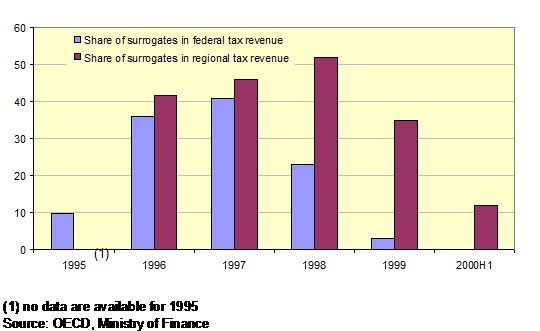
While the reliance of subnational administrations on money surrogates has certainly dropped in 2000, OECD missions to Russian regions in 2000 have led us to suspect that the official figures in Figure 3 significantly exaggerate the extent of this decline. As the agreements between the Ministry of Finance and Subjects of the Federation concern only the reports of the tax ministry, regions now employ schemes that allow them to reduce the share of reported surrogates while continuing to make wider use of them in practice. Some such schemes involve the use of short-term credits by “authorised” commercial rrogates may very well be higher on the expenditure side of budgets than in officially reported tax revenue in many regions. One example is as follows: A regional administration is required, perhaps due to a federal regulation or norm, to make expenditures of amount K to organisation A. Instead of paying cash to A, however, the administration transfers money to a broker firm that it owns or controls. The broker buys “commodity bills of exchange” from firm B. A commodity bill of exchange may be presented to firm B at any time for the delivery of an equivalent value of goods. Due to the limited liquidity of these bills, however, they sell on the market at a discount. The broker is therefore able to purchase a delivery of value K at only (1-r)K. These goods could then be delivered either directly to the budgetary recipient A (and written off as an amount K of budgetary outlays) or a barter chain is set up. In such a chain, Firm B would deliver the goods to firm C, who makes a delivery to firm D…until a budgetary recipient finally receives a delivery valued at K. As the administration has only paid (1-r)K, but has written off expenditures of K, it can effectively divert the equivalent of rK to the informal budget under its control. The administration also sets the prices of goods and services delivered in the barter chain, allowing it to directly affect distribution in the process.
The typical unfeasibility of fulfilling all federal norms and mandates for budgetary expenditures offers another important fiscal policy tool for subnational administrations: the selective sequestration of expenditure categories. For example, the 25 most important mandates identified by regions in the survey of 1999 were reportedly fulfilled on average by only 31 per cent.[16] The choice itself of what extent to fulfil each category of expenditure obligations grants an obvious degree of discretion to subnational authorities. While the aggregate consolidated regional budget deficit on a cash basis was close to 1.0 per cent of GDP between 1996-98, OECD (2000b) roughly estimates that the corresponding deficit on a accruals basis, which accounts for the underfulfilment of 25 most important mandates, would be at least 5.5 per cent.

|
Из за большого объема этот материал размещен на нескольких страницах:
1 2 3 4 5 6 7 8 9 10 11 12 13 14 15 16 17 18 19 |
