


Партнерка на США и Канаду по недвижимости, выплаты в крипто
- 30% recurring commission
- Выплаты в USDT
- Вывод каждую неделю
- Комиссия до 5 лет за каждого referral
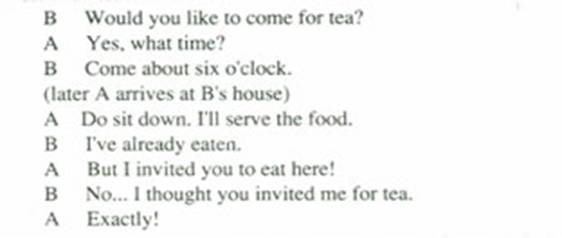
In this situation, A is an Arabic speaker, a visitor to Britain. She was only expecting a cup of tea and was puzzled by the offer of food. The British hostess (B) was upset that A had already eaten since she had, she thought, specifically invited A for food. The source of the misunderstanding is the word ‘tea’ which in Britain, especially among lower social classes, often means an early evening light meal. Although A speaks excellent English and is, in fact, an experienced university English teacher in her own country, she had not realized that a simple word like ‘tea’ can have different cultural meanings. Similarly, ‘simple’ common words used in idioms can often catch out learners who are used to concentrating on ‘difficult’ words. The word ‘house’, for instance, takes on a variety of unexpected meanings in such examples as ‘The comedian really set the house on fire’ (the comedian got a good response from the audience, or ‘house’), “The drinks are on the house tonight” (the owner or manager will pay for all the customers’ drinks), ‘After the minister’s speech the House rose at nine’ (the members of the House of Commons, in the British Parliament, went home at nine o’clock).
Grammar can often present unexpected difficulties in cross-cultural communication when learners of another language have not worked out the relationship between grammatical form and language function. This happened in the following example in Britain where a British person (B) wants to visit a Chinese student (C) in her room.
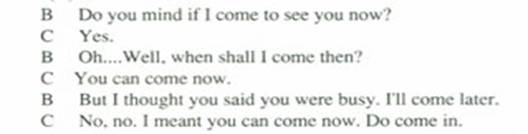
The problem here is that the expression ‘do you mind it’ is a polite form of a request which anticipates a negative response, ‘No, I don’t mind...’. C realizes that this is a request but responds only to the function, ‘Yes’ (meaning ‘Yes, do come in’). Since C has not responded with the expected negative grammatical form this leaves B to understand that she is busy (‘Yes, I do mind, I am busy at the moment’).
Clearly when words are mispronounced this can also cause problems in cross-cultural communication. This usually happens when speakers have poor pronunciation or confuse words. Less obvious problems can crop up when fluent speakers of English, for instance, are influenced by local varieties of the language. This would be perfectly acceptable in local situations but can cause difficulties when English is used in international contexts. For example, Malaysian speakers of English may stress the second syllables of words like ‘colleague’ or ‘management’ where speakers of other varieties of English expect to hear the stress on the first syllable. Since the difference in stress is also accompanied by changes in the pronunciation of stressed or unstressed vowels this can cause momentary confusion. More seriously, hearers’ perceptions of speakers of a language like English are influenced by the fact that stress and intonation commonly convey attitudes. Thus in English a heavy falling intonation can mean definiteness, abruptness or rudeness. Unfortunately, Arabic speakers who learn English have often not been taught this and they transfer Arabic falling intonation patterns to English. One result is that English hearers sometimes perceive the other group (wrongly) as being aggressive or pushy. A solution is to raise the learners’ awareness of the meanings of various intonation patterns in English and the attitudes which might be interpreted from their use.
Another problem is that the same gestures or body language may express quite different meanings in different cultures. In Northern Europe ‘yes’ is generally signalled by a downward head movement or up-and - down nodding. In contrast, in Turkey and neighbouring countries a common gesture for ‘no’ is an upward movement of the head, easily mistaken for the European ‘yes’ by those who are unfamiliar with Turkish people. Further scope for misunderstanding arises because the Turkish ‘no’ is often accompanied by a click of the tongue. This noise and the upward head movement means ‘you are stupid’ in Britain!
There are cultural differences in the use of space, e. g. how close to others people expect to stand or sit. Many Latin Americans or people from the Middle East prefer to come quite close to their hearers when talking. This shows friendliness and solidarity. North Americans or Northern Europeans, on the other hand, tend to keep more space between themselves and hearers. This shows their awareness of the other person’s individuality and need for personal space. When speakers from the USA and Saudi Arabia, for example, come together they may feel uncomfortable without knowing the reason. Both parties unconsciously try to maintain their own natural polite and friendly distances. The American may feel the Arab is aggressive or pushy when the latter comes close, while the Arab may believe the American is unfriendly or untrustworthy if that person keeps moving away.
Further cross-cultural mismatches can occur in eye contact. Whether and how listeners look at a speaker’s eyes varies from culture to culture. One contrast seems to be that in Britain and the Middle East listeners gaze at a speaker’s eyes to show that they are listening and showing respect whereas in many parts of Africa and Asia this can signify disrespect or anger and be interpreted as insulting. On the other hand, the African or Asian manner of showing politeness, respect and honour to a speaker - by lowering one’s gaze or looking below the other’s eyes - can be interpreted as disinterest, suspicion or guilt by British or Middle Eastern listeners.
Even a smile can cause problems, as an American teacher in Taiwan discovered. One of her students arrived late. He was smiling. She became angry and said, ‘You are late and it’s not funny. Take that smile off your face. He then became very upset because she had publicly become angry with him. Later she realized that a smile is not always a sign of humour - the student was smiling with ch potential sources of difficulty are not likely to be pointed out by participants in cross - cultural situations. Openly drawing attention to misunderstandings may be thought impolite or over-direct unless the speakers are well known to each other.
Speakers from different cultures make use of different discourse patterns in the way they structure information or interpret what others say. Even silence is used to structure discourse: participants know by the length of a pause that a speaker has finished speaking and they can take a turn. However, the exact timing of such turn taking can vary. Among many Greek speakers the pauses between turns are minimal; speakers alternate rapidly and overlaps between one speaker and the next are common and are accepted as showing solidarity between speakers who understand each other. In contrast, in Scandinavia and Finland such pauses are often one or two seconds longer as members of those cultures show respect and perhaps think carefully about what they want to say. In cross-cultural situations between these two different groups it is very likely that English will be used as a common language of communication. Greek speakers report that they feel there are long silences between themselves and Scandinavians, which leads them to wonder if they have said something wrong or (given that Scandinavians are often highly competent in English) whether they have made a language mistake. As a result the Greeks feel rather insecure (unnecessarily). The Scandinavians meanwhile feel that the Greeks keep interrupting them. They feel (wrongly) that the Greeks are aggressive.
Important cultural differences can emerge when we consider where a speaker puts the main point. Chinese speakers frequently put the main point near the end of what they say. First they establish common ground and give relevant background information before they lead the hearer up to the main point. Sometimes this point only gets a brief mention - after all, it will be clear to the listener familiar with this discourse pattern where the argument is going. This kind of inductive discourse pattern seems to be oriented to the hearer. Many British and American speakers, in contrast, use a more deductive discourse pattern which is more oriented to the speaker in this second pattern the speaker usually gives an early indication of what is to come. Often the main point comes right at the beginning, especially if the speaker is answering a question in a formal situation. The idea seems to be to get to the heart of the matter quickly. Background information or supporting arguments follow. Since the hearer already has a good idea of the main point, it is clear how this background information will be relevant. Each of these contrasting discourse patterns is completely valid and can he taken for granted in its own cultural context. In cross-cultural situations the differences can cause problems. British people listening to Chinese speakers expect the main point to come quickly. Not hearing one, the British may become impatient or lose concentration and miss the point when it finally comes. Some British listeners report that they think the Chinese keep ‘beating around the bush’, they go round and round but don’t seem to get to the point. Chinese listeners expecting the background first often feel they do not get this information from British speakers so they sometimes miss the significance of the main point or do not see the logic behind it. It would help if both sides realized that for the British the background comes from the main point, while for the Chinese the background leads upto the main idea.
Sociolinguistic uses of language relate closely to discourse patterns, but there is greater emphasis on the social context and variation. For instance, to ask a person’s age, how much they earn or whether they are married is acceptable in all cultures, but in very different circumstances. To ask such questions of a stranger is normal in Turkey or China hut quite unexpected in Britain, America or Australia. Western tourists in Turkey or China may not appreciate the friendliness behind such questions. Instead they may think that local people are too curious about what they think are private matters or questions for job interviews. They would prefer to talk about the weather or their jobs (but these may not be such interesting topics in Turkey or China).

|
Из за большого объема этот материал размещен на нескольких страницах:
1 2 3 4 5 6 7 8 9 10 11 12 13 14 15 16 17 18 19 20 21 22 23 24 25 26 27 28 29 30 31 32 33 34 35 36 37 38 39 40 41 42 43 44 45 46 47 48 |
