

Партнерка на США и Канаду по недвижимости, выплаты в крипто
- 30% recurring commission
- Выплаты в USDT
- Вывод каждую неделю
- Комиссия до 5 лет за каждого referral
Lithium Cobalt Oxide: LiCoO2 cathode (~60% Co), graphite anode | |
Voltages | 3.60V nominal; typical operating range 3.0–4.2V/cell |
Specific energy (capacity) | 150–200Wh/kg. Specialty cells provide up to 240Wh/kg. |
Charge (C-rate) | 0.7–1C, charges to 4.20V (most cells); 3h charge typical. Charge current above 1C shortens battery life. |
Discharge (C-rate) | 1C; 2.50V cut off. Discharge current above 1C shortens battery life. |
Cycle life | 500–1000, related to depth of discharge, load, temperature |
Thermal runaway | 150°C (302°F). Full charge promotes thermal runaway |
Applications | Mobile phones, tablets, laptops, cameras |
Comments | Very high specific energy, limited specific power. Cobalt is expensive. Serves as Energy Cell. Market share has stabilized. |
Table 3: Characteristics of lithium cobalt oxide.
Lithium Manganese Oxide (LiMn2O4)
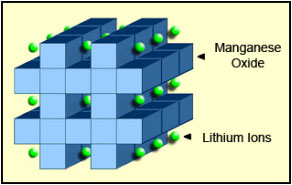
Li-ion with manganese spinel was first published in the Materials Research Bulletin in 1983. In 1996, Moli Energy commercialized a Li-ion cell with lithium manganese oxide as cathode material. The architecture forms a three-dimensional spinel structure that improves ion flow on the electrode, which results in lower internal resistance and improved current handling. A further advantage of spinel is high thermal stability and enhanced safety, but the cycle and calendar life are limited.
Low internal cell resistance enables fast charging and high-current discharging. In an 18650 package, Li-manganese can be discharged at currents of 20–30A with moderate heat buildup. It is also possible to apply one-second load pulses of up to 50A. A continuous high load at this current would cause heat buildup and the cell temperature cannot exceed 80°C (176°F). Li-manganese is used for power tools, medical instruments, as well as hybrid and electric vehicles.
Figure 4 illustrates the formation of a three-dimensional crystalline framework on the cathode of a Li-manganese battery. This spinel structure, which is usually composed of diamond shapes connected into a lattice, appears after initial formation.
|
Figure 4: Li-manganese structure. |
Li-manganese has a capacity that is roughly one-third lower than Li-cobalt. Design flexibility allows engineers to maximize the battery for either optimal longevity (life span), maximum load current (specific power) or high capacity (specific energy). For example, the long-life version in the 18650 cell has a moderate capacity of only 1,100mAh; the high-capacity version is 1,500mAh.
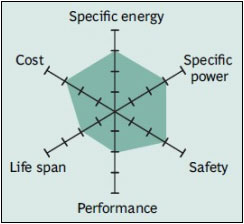
Figure 5 shows the spider web of a typical Li-manganese battery. The characteristics appear marginal but newer designs have improved in terms of specific power, safety and life span. Pure Li-manganese batteries are no longer common today; they may only be used for special applications.
|
Figure 5: Snapshot of a pure Li-manganese battery. |
Most Li-manganese batteries blend with lithium nickel manganese cobalt oxide (NMC) to improve the specific energy and prolong the life span. This combination brings out the best in each system, and the LMO (NMC) is chosen for most electric vehicles, such as the Nissan Leaf, Chevy Volt and BMW i3. The LMO part of the battery, which can be about 30 percent, provides high current boost on acceleration; the NMC part gives the long driving range.
Li-ion research gravitates heavily towards combining Li-manganese with cobalt, nickel, manganese and/or aluminum as active cathode material. In some architecture, a small amount of silicon is added to the anode. This provides a 25 percent capacity boost; however, the gain is commonly connected with a shorter cycle life as silicon grows and shrinks with charge and discharge, causing mechanical stress.
These three active metals, as well as the silicon enhancement can conveniently be chosen to enhance the specific energy (capacity), specific power (load capability) or longevity. While consumer batteries go for high capacity, industrial applications require battery systems that have good loading capabilities, deliver a long life and provide safe and dependable service.
Summary Table
Lithium Manganese Oxide: LiMn2O4 cathode. graphite anode | |
Voltages | 3.70V (3.80V) nominal; typical operating range 3.0–4.2V/cell |
Specific energy (capacity) | 100–150Wh/kg |
Charge (C-rate) | 0.7–1C typical, 3C maximum, charges to 4.20V (most cells) |
Discharge (C-rate) | 1C; 10C possible with some cells, 30C pulse (5s), 2.50V cut-off |
Cycle life | 300–700 (related to depth of discharge, temperature) |
Thermal runaway | 250°C (482°F) typical. High charge promotes thermal runaway |
Applications | Power tools, medical devices, electric powertrains |
Comments | High power but less capacity; safer than Li-cobalt; commonly mixed with NMC to improve performance. |
Table 6: Characteristics of Lithium Manganese Oxide.
Lithium Nickel Manganese Cobalt Oxide (LiNiMnCoO2 or NMC)
One of the most successful Li-ion systems is a cathode combination of nickel-manganese-cobalt (NMC). Similar to Li-manganese, these systems can be tailored to serve as Energy Cells or Power Cells. For example, NMC in an 18650 cell for moderate load condition has a capacity of about 2,800mAh and can deliver 4A to 5A; NMC in the same cell optimized for specific power has a capacity of only about 2,000mAh but delivers a continuous discharge current of 20A. A silicon-based anode will go to 4,000mAh and higher but at reduced loading capability and shorter cycle life. Silicon added to graphite has the drawback that the anode grows and shrinks with charge and discharge, making the cell mechanically unstable.
The secret of NMC lies in combining nickel and manganese. An analogy of this is table salt in which the main ingredients, sodium and chloride, are toxic on their own but mixing them serves as seasoning salt and food preserver. Nickel is known for its high specific energy but poor stability; manganese has the benefit of forming a spinel structure to achieve low internal resistance but offers a low specific bining the metals enhances each other strengths.
NMC is the battery of choice for power tools, e-bikes and other electric powertrains. The cathode combination is typically one-third nickel, one-third manganese and one-third cobalt, also known as 1-1-1. This offers a unique blend that also lowers the raw material cost due to reduced cobalt content. Another successful combination is NCM with 5 parts nickel, 3 parts cobalt and 2 parts manganese (5-3-2). Other combinations using various amounts of cathode materials are possible.
Battery manufacturers move away from cobalt systems toward nickel cathodes because of the high cost of cobalt. Nickel-based systems have higher energy density, lower cost, and longer cycle life than the cobalt-based cells but they have a slightly lower voltage.
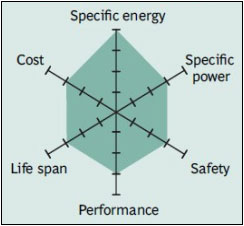
New electrolytes and additives enable charging to 4.4V/cell and higher to boost capacity. Figure 7 demonstrates the characteristics of the NMC.
|
Figure 7: Snapshot of NMC. |
There is a move towards NMC-blended Li-ion as the system can be built economically and it achieves a good performance. The three active materials of nickel, manganese and cobalt can easily be blended to suit a wide range of applications for automotive and energy storage systems (EES) that need frequent cycling. The NMC family is growing in its diversity.
Summary Table

|
Из за большого объема этот материал размещен на нескольких страницах:
1 2 3 4 5 |
