

Партнерка на США и Канаду по недвижимости, выплаты в крипто
- 30% recurring commission
- Выплаты в USDT
- Вывод каждую неделю
- Комиссия до 5 лет за каждого referral
Lithium Nickel Manganese Cobalt Oxide: LiNiMnCoO2. cathode, graphite anode | |
Voltages | 3.60V, 3.70V nominal; typical operating range 3.0–4.2V/cell, or higher |
Specific energy (capacity) | 150–220Wh/kg |
Charge (C-rate) | 0.7–1C, charges to 4.20V, some go to 4.30V; 3h charge typical. Charge current above 1C shortens battery life. |
Discharge (C-rate) | 1C; 2C possible on some cells; 2.50V cut-off |
Cycle life | 1000–2000 (related to depth of discharge, temperature) |
Thermal runaway | 210°C (410°F) typical. High charge promotes thermal runaway |
Applications | E-bikes, medical devices, EVs, industrial |
Comments | Provides high capacity and high power. Serves as Hybrid Cell. Favorite chemistry for many uses; market share is increasing. |
Table 8: Characteristics of lithium nickel manganese cobalt oxide (NMC).
Lithium Iron Phosphate(LiFePO4)
In 1996, the University of Texas (and other contributors) discovered phosphate as cathode material for rechargeable lithium batteries. Li-phosphate offers good electrochemical performance with low resistance. This is made possible with nano-scale phosphate cathode material. The key benefits are high current rating and long cycle life, besides good thermal stability, enhanced safety and tolerance if abused.
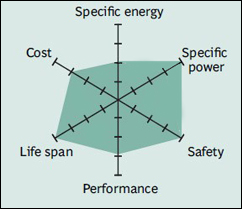
Li-phosphate is more tolerant to full charge conditions and is less stressed than other lithium-ion systems if kept at high voltage for a prolonged time. As a trade-off, its lower nominal voltage of 3.2V/cell reduces the specific energy below that of cobalt-blended lithium-ion. With most batteries, cold temperature reduces performance and elevated storage temperature shortens the service life, and Li-phosphate is no exception. Li-phosphate has a higher self-discharge than other Li-ion batteries, which can cause balancing issues with aging. This can be mitigated by buying high quality cells and/or using sophisticated control electronics, both of which increase the cost of the pack. Cleanliness in manufacturing is of importance for longevity. There is no tolerance for moisture, lest the battery will only deliver 50 cycles. Figure 9 summarizes the attributes of Li-phosphate.
Li-phosphate is often used to replace the lead acid starter battery. Four cells in series produce 12.80V, a similar voltage to six 2V lead acid cells in series. Vehicles charge lead acid to 14.40V (2.40V/cell) and maintain a topping charge. With four Li-phosphate cells in series, each cell tops at 3.60V, which is the correct full-charge voltage. At this point, the charge should be disconnected but the topping charge continues while driving. Li-phosphate is tolerant to some overcharge; however, keeping the voltage at 14.40V for a prolonged time, as most vehicles do on a long road trip, could stress Li-phosphate. Time will tell how durable Li-Phosphate will be as a lead acid replacement with a regular vehicle charging system. Cold temperature also reduces performance of Li-ion and this could affect the cranking ability in extreme cases.
|
Figure 9: Snapshot of a typical Li-phosphate battery. |
Summary Table
Lithium Iron Phosphate: LiFePO4 cathode, graphite anode | |
Voltages | 3.20, 3.30V nominal; typical operating range 2.5–3.65V/cell |
Specific energy (capacity) | 90–120Wh/kg |
Charge (C-rate) | 1C typical, charges to 3.65V; 3h charge time typical |
Discharge (C-rate) | 1C, 25C on some cells; 40A pulse (2s); 2.50V cut-off (lower that 2V causes damage) |
Cycle life | 1000–2000 (related to depth of discharge, temperature) |
Thermal runaway | 270°C (518°F) Very safe battery even if fully charged |
Applications | Portable and stationary needing high load currents and endurance |
Comments | Very flat voltage discharge curve but low capacity. One of safest |
Table 10: Characteristics of lithium iron phosphate.
Lithium Nickel Cobalt Aluminum Oxide (LiNiCoAlO2)
Lithium nickel cobalt aluminum oxide battery, or NCA, has been around since 1999 for special applications. It shares similarities with NMC by offering high specific energy, reasonably good specific power and a long life span. Less flattering are safety and cost. Figure 11 summarizes the six key characteristics. NCA is a further development of lithium nickel oxide; adding aluminum gives the chemistry greater stability.
|
Figure 11: Snapshot of NCA. |

Summary Table
Lithium Nickel Cobalt Aluminum Oxide: LiNiCoAlO2 cathode (~9% Co), graphite anode | |
Voltages | 3.60V nominal; typical operating range 3.0–4.2V/cell |
Specific energy (capacity) | 200-260Wh/kg; 300Wh/kg predictable |
Charge (C-rate) | 0.7C, charges to 4.20V (most cells), 3h charge typical, fast charge possible with some cells |
Discharge (C-rate) | 1C typical; 3.00V cut-off; high discharge rate shortens battery life |
Cycle life | 500 (related to depth of discharge, temperature) |
Thermal runaway | 150°C (302°F) typical, High charge promotes thermal runaway |
Applications | Medical devices, industrial, electric powertrain (Tesla) |
Comments | Shares similarities with Li-cobalt. Serves as Energy Cell. |
Table 12: Characteristics of Lithium Nickel Cobalt Aluminum Oxide.
Lithium Titanate (Li4Ti5O12)
Batteries with lithium titanate anodes have been known since the 1980s. Li-titanate replaces the graphite in the anode of a typical lithium-ion battery and the material forms into a spinel structure. The cathode can be lithium manganese oxide or NMC. Li-titanate has a nominal cell voltage of 2.40V, can be fast charged and delivers a high discharge current of 10C, or 10 times the rated capacity. The cycle count is said to be higher than that of a regular Li-ion. Li-titanate is safe, has excellent low-temperature discharge characteristics and obtains a capacity of 80 percent at –30°C (–22°F).
LTO (commonly Li4Ti5O12) has advantages over the conventional cobalt-blended Li-ion with graphite anode by attaining zero-strain property, no SEI film formation and no lithium plating when fast charging and charging at low temperature. Thermal stability under high temperature is also better than other Li-ion systems; however, the battery is expensive. At only 65Wh/kg, the specific energy is low, rivalling that of NiCd. Li-titanate charges to 2.80V/cell, and the end of discharge is 1.80V/cell. Figure 13 illustrates the characteristics of the Li-titanate battery. Typical uses are electric powertrains, UPS and solar-powered street lighting.
|
Figure 13: Snapshot of Li-titanate. |

Summary Table
Lithium Titanate: Can be lithium manganese oxide or NMC; Li4Ti5O12 (titanate) anode | |
Voltages | 2.40V nominal; typical operating range 1.8–2.85V/cell |
Specific energy (capacity) | 70–80Wh/kg |
Charge (C-rate) | 1C typical; 5C maximum, charges to 2.85V |
Discharge (C-rate) | 10C possible, 30C 5s pulse; 1.80V cut-off on LCO/LTO |
Cycle life | 3,000–7,000 |
Thermal runaway | One of safest Li-ion batteries |
Applications | UPS, electric powertrain (Mitsubishi i-MiEV, Honda Fit EV), |
Comments | Long life, fast charge, wide temperature range but low specific energy and expensive. Among safest Li-ion batteries. |
Table 14: Characteristics of lithium titanate.
Figure 15 compares the specific energy of lead-, nickel - and lithium-based systems. While Li-aluminum (NCA) is the clear winner by storing more capacity than other systems, this only applies to specific energy. In terms of specific power and thermal stability, Li-manganese (LMO) and Li-phosphate (LFP) are superior. Li-titanate (LTO) may have low capacity but this chemistry outlives most other batteries in terms of life span and also has the best cold temperature performance. Moving towards the electric powertrain, safety and cycle life will gain dominance over capacity. (LCO stands for Li-cobalt, the original Li-ion.)

Figure 15: Typical specific energy of lead-, nickel - and lithium-based batteries.
NCA enjoys the highest specific energy; however, manganese and phosphate are superior in terms of specific power and thermal stability. Li-titanate has the best life span.
Courtesy of Cadex
Last updated: 2017-09-05

|
Из за большого объема этот материал размещен на нескольких страницах:
1 2 3 4 5 |
