


Вместе с тем, проявились различия между мужчинами и женщинами. В целом, мужчины менее склонны соглашаться с идеей СЕ, чем женщины. Сравнение уровня этноцентризма у мужчин и женщин по U-критерию Манна-Уитни показало достоверное различие на уровне p < 0,001 (см. Рисунок 8).
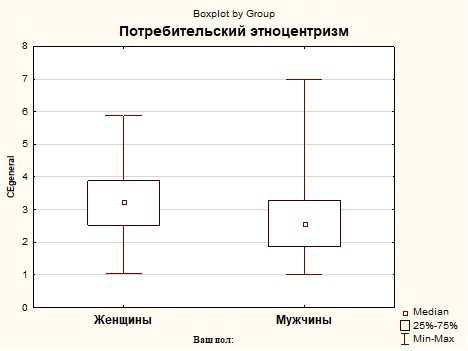
Это может быть следствием более критичного отношения и в целом устойчивости мужчин к пропаганде. Женщины в меньшей степени интересуются политикой, экономикой, а значит можно предположить некую склонность принимать информацию менее критично.
Ценностные предикторы потребительского этноцентризма
На первом этапе анализа были выделены потенциальные ценностные предикторы СЕ. Для этого был проведен корреляционный анализ с применением корреляций Пирсона и сформирован список ценностных ориентаций, достоверно связанных с потребительским этноцентризмом. Эти ценностные ориентации вошли в исходный перечень независимых переменных в множественный регрессионный анализ.
Регрессионный анализ ценностных ориентаций на СЕ позволил выделить несколько достоверных предикторов потребительского этноцентризма (см. Таблицу 12):
Таблица 12. Показатели уравнения множественной регрессии ценностных ориентаций на СЕ. Примечание: R2 = 0,27
b* | Std. Err. | b | Std. Err. | t(197) | p-value | Valid | |
Intercept | 3,16 | 0,28 | 11,14 | 0,000000 | |||
Конформность | 0,44 | 0,06 | 0,14 | 0,02 | 6,73 | 0,000000 | 201 |
Самостоятельность | -0,35 | 0,07 | -0,14 | 0,03 | -5,36 | 0,000000 | 201 |
Универсализм | 0,15 | 0,07 | 0,05 | 0,02 | 2,23 | 0,026735 | 201 |
Общие выводы
Респонденты в среднем оценивают Яндекс несколько ниже, чем Google – как в целом, так и при сравнении по функциональным и имиджевым компонентам Основной вклад в предпочтение исследованных поисковых интернет-брендов вносит более высокая оценка их функционального компонента Основной вклад в предпочтение исследованных музыкальных сервисов вносит более положительное отношение к соответствующим интернет-брендам Основным предиктором отношения к Яндексу является оценка его функционального компонента, в то время как основными предикторами отношения к Google являются оценки и имиджевого, и функционального компонентов Более высокий уровень потребительского этноцентризма приводит к снижению оценки зарубежных интернет-брендов. Основными ценностными предикторами потребительского этноцентризма у исследованной группы респондентов являются конформность и несамостоятельность.Список литературы
оведение потребителей. СПб.: Питер, 2007. Домнин бренда – ключевой фактор влияния бренда на потребительский спрос и рыночные показатели фирмы // Бренд-менеджмент. – 2009ю - №3. – 133-144. , Баринова управления брендами BrandAsset Valuator (Young&Rubicam) // Бренд-менеджмент. – 2007. - №1. – 14-23. Карандашев Шварца для изучения ценностей личности: концепция и методическое руководство. СПб.: Речь, 2004. сихология оценки и принятия решений. М.: Информационно-издательский дом “Филинъ”, 1998. Современная психология: Справочное руководство / Под ред. . М., 1999. Aaker L. J. Dimensions of Brand personality // Journal of Marketing research, v. 36, 1997, 347-356. Abrams D. Social identity on a national scale: Optimal distinctiveness and young people’s self-expression through musical preference // Group Processes and Intergroup Relations, v. 12 (3). pp. 303-317. American Marketing Association – http://www. ama. org Ajzen I. From intentions to actions: a theory of planned behavior // Action-control: From cognition to behavior, eds. J. Kuhl & J. Beckman. Heidelberg, Germany: Springer, 1985, pp. 11 – 39. Cheng H. K., Sims R. R., Teegen H. To purchase or pirate software: an empirical study // Journal Management Information System, 1997, v. 13(4), pp. 49 – 60. Conner M., Armitage C. Extending the theory of planned behavior: a review and avenues for further research // Journal of Applied Social Psychology, 1998, v. 28(15), pp. 1429 – 1464. Cronan T. P., Al-Rafee S. Factors that influence the intention to pirate software and media // Journal of Business Ethics, 2008, v. 57, pp. 527 – 545. D’Alessandro F. David, «Brand Warfare: 10 Rules for Building the Killer Brand», 2009. Fishbein M., Ajzen I. Attitude, Intention, and Behavior: An Introduction to Theory and Research. Reading, MA, 1975. Gregory R. James, «Leveraging the Corporate Brand», 2003. Gopal R. L. Sanders. Preventive and deterrent controls for software piracy // Journal of Management Information Systems, 1997, v. 4, pp. 29 – 47. Hall C. C., Ariss L., Todorov A. The illusion of knowledge: When more information reduces accuracy and increases confidence // Organizational Behavior and Human Decision Processes, 2007, v. 103, pp. 277 – 290. Havlena W. J., DeSarbo W. S. On the measurement of perceived consumer risk. Decision science, 1991, v. 22, pp. 927– 939. Higgins G. E., Makin D. A. Does social learning theory condition the effects of low self-control on college students' software piracy? // Journal of Economic Crime Management, 2004, v. 2(2), pp. 1 – 22. Kahneman D, Tversky A. Advances in prospect theory: cumulative representation of uncertainty // Journal of Risk and Uncertainty, 1992, v. 5, pp. 297 – 323. Kahneman D., Tversky A. Prospect theory: an analysis of decision under risk // Econometrica, 1979, v. 47(2), pp. 263 – 291. Koklic et al. The study of perceived adverse effects of digital piracy and involvement: insights from adult computer users // Behaviour & Information Technology, 2014, v. 33(3), pp. 225 – 236. Lalovic G., Reardon S. A., Vida I., Reardon J. Consumer decision model of intellectual property theft in emerging markets // Organizations and Markets in Emerging Economies, 2012, v. 3, no. 1(5), pp. 58 – 74. Lee J., Downie rvey of music information needs, uses and seeking behaviors // Proc. of the 5th International Society for Music Information Retrieval (ISMIR) Conference, 2004, pp. 441 – 446. Li, Hairong, Terry Daugherty, and Frank Biocca (2002), “Impact of 3-D Advertising on Product Knowledge, Brand Attitude, and Purchase Intention: The Mediating Role of Presence,” JA, 29 (3), 43-57; Limayem M., Khalifa M., Chin W. W. Factors motivating software piracy: a longitudinal study // IEEE Transactions on Engineering Management, 2004, v. 51(4), pp. 414 – 425. Makkonen M., Halttunen V., Frank L. Exploring the acquisition and consumption behaviour of modern recorded music consumers: findings from a Finnish interview study // International Journal of Computer Information Systems and Industrial Management Applications, 2011, v.3, pp. 894 – 904. Milgram S. Obedience to authority. New York: Harper & Row, 1987. Morton N., Koufteros X. Intention to commit online music piracy and its antecedents: an empirical investigation // Structural Equation Modeling, 2008, v. 15(3), pp. 491 – 512. Nehemkis P. Business payoffs abroad: Rhetoric and reality // California Management Review, 1975, v. 18(2), pp. 5 – 20. Nill A., Schibrowsky J. A. The impact of corporate culture, the reward system, and perceived moral intensity on marketing students' ethical decision making // Journal of Marketing Education, 2005, v. 27, pp. 68 – 80. Peace A. G., Galletta D. F., Thong J. Y.L. Software piracy in the workplace: a model and empirical test // Journal of Management Information Systems, 2003, v. 20(1), pp. 153–177. Schwartz S., Tessler R. A Test of a Model for Reducing Measured Attitude-Behavior Discrepancies // Journal of Personality and Social Psychology, 1972, v. 42(2), pp. 225– 236. Siamagka T-N, Balobanis G. Revisiting Consumer Ethnocentrism: Review, Reconceptualization, Empirical Testing // Journal of International Marketing, v. 23 (3), 2015, pp. 66-86. Sicilia, Maria, Salvador Ruiz, and Jose L. Munuera (2005), “Effects of Interactivity in a Web Site,” JA, 34 (3), 31-45. Simon H. A. Rationality as Process and as Product of Thought. Richard T. Ely Lecture // American Economic Review, May 1978, v. 68(2), pp. 1 – 16. Singhapakdi A., Vitell S. J., George R. Franke. Antecedents, consequences and mediating effects of perceived moral intensity and personal moral philosophies // Journal of the Academy of Marketing Science, 1999, v. 27(1), pp. 19 – 36. Sirkeci I., Magnusdottir L. B. Understanding illegal music downloading in the UK: A multi-attribute model // Journal of Research in Interactive Marketing, 2011, v. 5(1), pp. 90 – 110. Smith, Daniel C. and C. Whan Park (1992), “The Effects of Brand Extensions on Market Share and Advertising Efficiency,” JMR, 29 (August), mner W. G. Folkways. New York: Blaisdell Publishing Co., 1905. Taylor S. A., Implicit attitudes and digital piracy, Journal of Research in Interactive Marketing, Volume 6, Number 4, 2012, Pages 281-297. Tan B. Understanding consumer ethical decision making with respect to purchase of pirated software // Journal of Consumer Marketing, 2002, v. 19(2), pp. 96 – 111. Trevino, L. K. Ethical Decision Making in Organizations: A Person-Situation Interactionist Model // Academy of Management Review, 1986, v. 11 (3), pp. 601 – 617. Triandis H. C. Values, attitudes, and interpersonal behavior // Nebraska Symposium on Motivation, 1979, pp. 195 – 260. Williams P., Nicholas D., Rowlands I., The attitudes and behaviours of illegal downloaders, Journal of Research in Interactive Marketing, Volume 62, Number 3, 2010, Pages 283-301. Wright S. A., Dinsmore J., B., Kellaris J. J., How Group Loyalties Shape Ethical Judgment and Punishment Preferences, Psychology and Marketing, Volume 30 (3), March, 2013, Pages 203-210. Zaichkowsky J. L. Research notes: the personal involvement inventory: reduction, revision, and application to advertising // Journal of Advertising, 1994, v. 23(4), pp. 59 – 70.

|
Из за большого объема этот материал размещен на нескольких страницах:
1 2 3 4 5 6 7 8 9 |
