


Партнерка на США и Канаду по недвижимости, выплаты в крипто
- 30% recurring commission
- Выплаты в USDT
- Вывод каждую неделю
- Комиссия до 5 лет за каждого referral
БЛАГОДАРНОСТИ
Работа выполнена при поддержке РФФИ, грант № 10-04-00891-а.
СПИСОК ЛИТЕРАТУРЫ
, , 2010. Сравнительное исследование способности врановых птиц к решению задачи на подтягивание подвешенной приманки // Журн. высш. нервн. деят. Т. 60. № 3. С. 321–329.
, Смирнова З. А., 2010. Врановые способны понимать логическую структуру задач на подтягивание закрепленной на нити приманки // Журн. высш. нервн. деят. Т. 60. № 5. С. 543–551.
1930. Исследование интеллекта человекоподобных обезьян. М.: Комакадемия, 207 с.
Ладыгина-, 1959. Конструктивная и орудийная деятельность высших обезьян. М.: Наука, 1959. 399 с.
Мальчевский A. C., , 1983. Певчие птицы. Птицы Ленинградской области и сопредельных территорий. История, биология, охрана. Ленинград: Издательство Ленинградского Университета.
, 2010. Развитие интеллектуальной основы деятельности приматов. М.: МОДЭК. 304 с.
, 1980. Орудийные действия животных. М.: Знание. 64 с.
Adams D. K., 1929. Experimental studies of adaptive behavior in cats // Comparative Psychology Monograph. V. 6(1). P. 1–128.
Auersperg A. M., Gajdon G. K., Huber L., 2009. Kea (Nestor notabilis) consider spatial relationships between objects in the support problem // Biology Letter. V. 5(4). P. 455–458.
Balasch J., Sabater P., Padrosa T.,1974. Perceptual learning ability in Mandrillus sphinx and Cercopithecus nictitans // Rev. Esp. Physiology, V.30. P. 15–20.
Bluff L. A., Weir A. A.S., Rutz C., Wimpenny J. H., Kacelnik A., 2007. Tool-related cognition in New Caledonian Crows // Comparative Cognition & Behavior Reviews. V. 2. P. 1–25.
Cha J., King J. E., 1969. The learning of patterned strings problems by squirrel monkeys // Animal Behavior. V.17. P. 64–67.
Dьcker G., Rensch B., 1977. The solution of patterned string problems by birds // Behaviour. V. 62. P. 164–173.
Emery N. J., 2006. Cognitive ornithology: the evolution of avian intelligence // Phil. Trans. R. Soc. B. V. 361. P. 23–43.
Emery N. J., Clayton N. S., 2004. The mentality of crows: convergent evolution of intelligence in corvids and apes // Science. V. 306. P. 1903–1907.
Finch G., 1941. The solution of patterned string problems by chimpanzees // Journal of Comparative Psychology. V. 32. P. 83–90.
Fischer G. J., Kitchener S. L., parative learning in young gorillas and orangutans // Journal of Genetic Psychology V. 107. P. 337–348.
Funk M. S., 2002. Problem solving skills in young yellow–crowned parakeets (Cyanoramphus auriceps) // Animal cognition. V.5. P. 167–176.
Halsey L. G., Bezerra B. M., Souto A. S., 2006. Can wild common marmosets (Callithrix jacchus) solve the parallel strings task? // Animal cognition. V.9. P. 229–233.
Harlow H. F., Settlage P. H., parative behavior of primates. VII. Capacity of monkeys to solve patterned string tests // Journal of Comparative Psychology. V.18. P. 423–435.
Hauser M. D., Kralik J., Botto-Mahan C., 1999. Problem solving and functional design features: experiments on cotton-top tamarins, Saguinus oedipus // Animal Behavior. V. 57. P. 565–582.
Heinrich B., 1995. An experimental investigation of insight in common ravens (Corvus corax) // Auk. V. 112. P. 994–1003.
Heinrich B., Bugnyar T., 2005. Testing problem solving in ravens: String-pulling to reach food // Ethology V.111. P. 962–976.
Huber L., Gajon G. K., 2006. Technical intelligence in animal: the kea model // Animal cognition. V. 9. P. 295–305.
Krasheninnikova A., Ralf W., 2010. String-pulling in spectacled parrotlets (Forpus conspicillatus) // Behaviour. V. 147(5-6). P. 725–739.
Osthaus B., Lea S., Slater, A., 2005. Dogs (Canis lupus familiaris) fail to show understanding of means–end connections in a string–pulling task // Animal Cognition. V. 8. P. 37–47.
Pepperberg I. M., 2004. "Insightful" string-pulling in grey parrot (Psitacus erithacus) is affected by vocal competence // Animal Cognition. V. 7. P. 263–266.
Portmann A., 1947. Etudes sur la cerebralisation chez les oiseaux // Alauda. V. 14. P. 2–20.
Rehkamper G., Frahm H. D., Zilles Z., 1991. Quantitative development of brain and brain structure in birds (Galliformes and Passeriformes) compared to that in mammals (insectivores and primates) // Brain Behavior and Evolution. V. 37. P. 125–143.
Seibt U., Wickler W., 2005. Individuality in problem solving: string pulling in two carduelis species (Aves: Passeriformes) // Ethology. V. 112. P. 493–502.
Schuck-Paim C., Borsari A., Ottoni E. B., 2009. Means to an end: neotropical parrots manage to pull strings to meet their goals // Animal Cognition. V. 12. P. 287–301.
Taylor A. H., Hunt G. R., Medina F. S., Gray, R. D., 2009. Do New Caledonian crows solve physical problems through causal reasoning? // Proc. Biol. Sci. V. 276. P. 247–254.
Taylor A. H., Medina F. S., Holzhaider J. C., Hearne L. J., Hunt, G. R., 2010. An investigation into the cognition behind spontaneous string pulling in New Caledonian crows // PLoS ONE, 5(2): e9345. doi:10.1371/journal. pone.0009345
Tomasello M., Call J., 1997. Primate Cognition. New York: Oxford University Press.
Vince M. A., 1961. “String – pulling” in birds. III: The successful response in greenfinches and canaries // Behavior. V. 17. P. 103–129.
Werdenich D., Huber L., 2006. A case of quick problem solving in birds: string pulling in keas, Nestor notabilis // Animal Behavior. V. 71. P. 855–863.
Whitt E., Douglas M., Osthaus B., Hocking I., 2009. Domestic cats (Felis catus) do not show causal understanding in a string–pulling task // Animal cognition. V. 12(5). P. 739–743.
Таблица 1. Результаты решений задач 2 – 5 воронами, лазоревками, клестами (число правильных выборов за 20 последовательных предъявлений) и неясытями (число правильных выборов за 15 последовательных предъявлений). * и ** – р≤0,05
Птица | Задача 2 | Задача 3 | Задача 4 | Задача 5 |
Вороны | ||||
1С | 10* | 17* | 10 | 15* |
2С | 6 | 10 | - | - |
3С | 18* | 11 | 11 | 17* |
4С | - | - | 8 | 15* |
5С | - | - | 9 | 15* |
6С | - | - | 5** | 13 |
7С | - | - | 6** | 16* |
8С | - | - | - | - |
9С | 9* | 17* | - | - |
10С | - | - | 9 | 16* |
11С | - | - | 9 | 13 |
Лазоревки | ||||
1Р | 20* | - | - | - |
2Р | 20* | 20* | 5** | - |
3Р | 20* | 16* | 8 | 13 |
4Р | 20* | 18* | 5** | 7 |
5Р | 20* | 18* | 6** | - |
Клесты | ||||
1L | 16* | 10 | 2** | 10 |
2L | 18* | 16* | 2** | 8 |
3L | 20* | 16* | 4** | - |
4L | 20* | 17* | 3** | - |
Неясыти | ||||
1S | - | - | - | 10 |
2S | - | - | - | 12* |
3S | - | - | - | 10 |
4S | - | - | - | 7 |
5S | - | - | - | 9 |
Рис. 1. Схема расположения нитей в задачах 1 – 5. В задаче 1 для всех трех видов птиц использовали подвешенную приманку. В задачах 2 – 5 нити располагали в горизонтальной плоскости для ворон и в вертикальной плоскости для клестов и лазоревок.

Рис. 2. Обстановка эксперимента с воронами: задача 2.
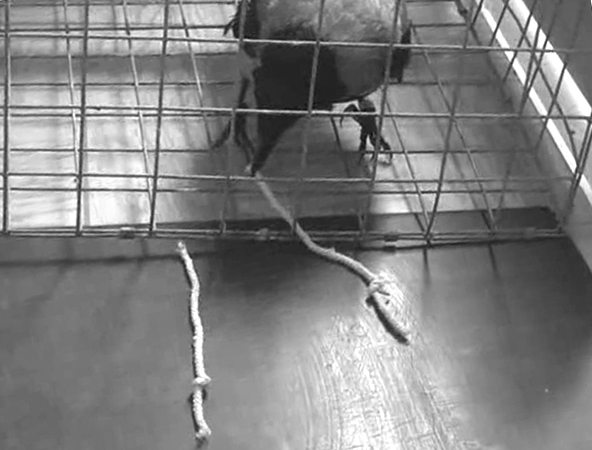
Рис. 3. Обстановка эксперимента с клестами: задача 1.
Рис. 4. Обстановка эксперимента с лазоревками: задача 1 и 3.
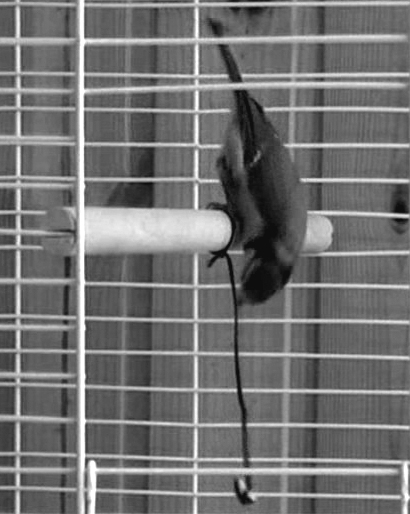
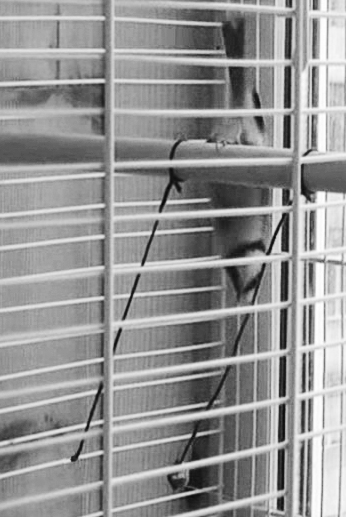
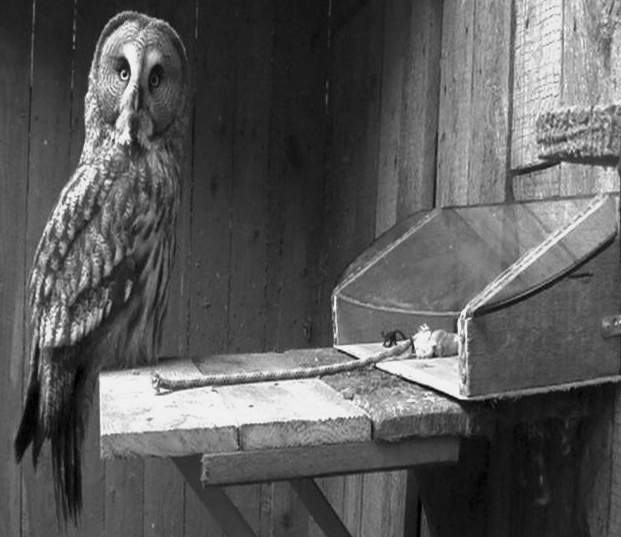
Рис. 5. Обстановка эксперимента с совами: задача 1.
COMPARATIVE ESTIMATION OF PASSERINE BIRDS ABILITY TO SOLVE THE COMPLEX OF TESTS FOR GETTING OF THE SUSPENDED BAIT
@2011 T. A.Obozova, M. S.Bagotskaya, A. A.Smirnova, Z. A.Zorina
The Lomonosov Moscow State University, Moscow 119991
e-mail: *****@***ru
A complex of special tests usually is used to estimate cognitive abilities of animals. String-pulling task is one of the widely applied classical tests. Varying quantity and a relative positioning of strings and baits, we can find out, whether animals are able to comprehend means-end relations. In this work three species of passerine birds with the different levels of brain complexity (hooded crows, Corvus cornix L.; common crossbills, Loxia curvirostra; blue tits, Cyanistes caeruleus) were offered a series tasks on pulling bait. Consequently, out of the three species, only hooded crows, which have a higher level of brain complexity compared to other birds, are probably able to apprehend the means-end relationships between the components of the tasks.

|
Из за большого объема этот материал размещен на нескольких страницах:
1 2 3 4 |
