


Партнерка на США и Канаду по недвижимости, выплаты в крипто
- 30% recurring commission
- Выплаты в USDT
- Вывод каждую неделю
- Комиссия до 5 лет за каждого referral
budjet | students | cost/student | compared to Mean | |
suburban unit 1 | 491 501,00 € | 53 | 9 273,60 € | 116 % |
suburban unit 2 | 510 156,00 € | 21 | 24 293,14 € | 304 % |
Lyceum | 2 476 387,00 € | 341 | 7 262,13 € | 91 % |
Art high-school | 2 008 954,00 € | 272 | 7 385,86 € | 92 % |
all high-schools | 5 486 998,00 € | 687 | 7 986,90 € | 100 % |
Table 1. Costs per student at Savonlinna senior secondary schools
In Russia, nation-wide tests are being used in a large scale. In 2009, after nearly a ten year period of experiments, the Unified State Exam became the only form of graduation examinations in schools and the main criteria for admission to universities all over Russia. There are two mandatory exams – Russian language and Mathematics. Also Russian students may take some other USE, depending on the subjects they might need in case they decide to go on studies. They chose from the following: Foreign languages (English, German, French, Spanish and Chinese (since 2016)), Physics, Chemistry, Biology, Geography, Literature, History, Computing science and basics of Social studies. The exams in each subject are taken simultaneously all over the country in accordance with the time zones. The exams are assessed by teams of specially trained independent experts; students’ names are coded so that the assessors do not know whose test they evaluate. In Finland the national tests are organized by the Matriculation Examination Board. The evaluation of the Abitur tests are made by university teachers. Marks and scores will be given as follows:
Marks in Latin | Score | Meaning | Amount % |
laudatur | 7 | excellent | 5 % |
eximia cum laude approbatur | 6 | praiseworthy | 15 % |
magna cum laude approbatur | 5 | good | 20 % |
cum laude approbatur | 4 | satisfactory | 24 % |
lubenter approbatur | 3 | fair | 20 % |
approbatur | 2 | passable | 11 % |
improbatur | 0 | abandoned | 5 % |
Table 2. The assessment of the Finnish Abitur-test (final exam after the senior secondary studies
After the Abitur-tests the scores of students will be added together and the mean of the results will be calculated. During the academic year 2015-2016 the average score in all Savonlinna high-school units was 3, 91 and in the whole country the result was 4, 22. There are small differences in scores in the whole country and between Savonlinna units with no statistically significant differences.
On the other hand, there are big differences in quality-price ratio in costs per student score in Savonlinna, as can be seen in Figure 3.
After all, the Abitur-test needs a lot of work in Finnish schools, and it is also a very expensive test. Its importance is highly overvalued because new tests are awaiting most of the students who are applying the university just after finishing the Abitur.
In that perspective, the Russian way does not differ greatly. Unified State Exams, that senior secondary school students take in Russia, are also extremely expensive, time and effort consuming, as well as subjected to criticism among the educational community and the Russian society in general. A lot has been done by Russian Federation Ministry of Education through mass media to create a more positive attitude towards State Exams. The situation is getting better: the 2015 polls show [WCIOM, 2013,2016] that 80% of Russian teachers who work in senior secondary school and 62% of senior secondary school students trust the State Exams as relevant, that is 53% higher than in 2013. There is still a lot to be done, and the sustainability studies we are discussing, might well be of some help.
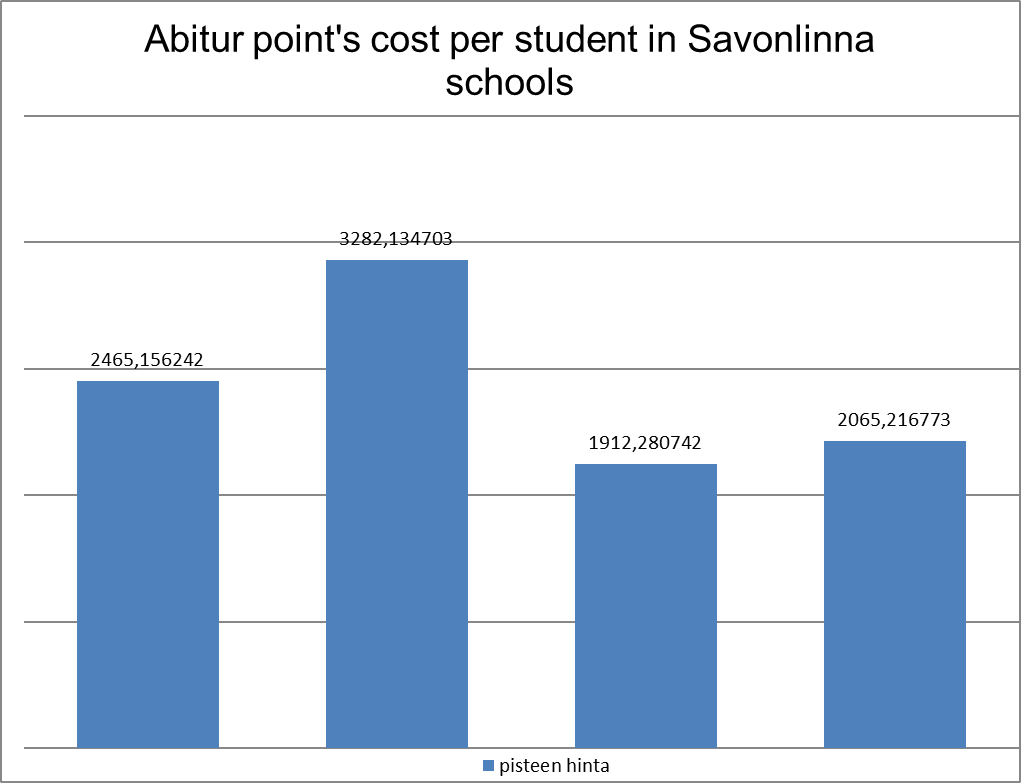
Figure 3. Abitur point’s cost effectivity in Savonlinna senior secondary schools.
ConclusionsOur attempt to develop sustainability studies is heavily reliant on cooperation with Russian partners, partner schools and State University of Economics staff. Each step taken in this direction should help educational systems in both countries meet the challenges of the time. Its goals are also dealing with effectivity on economic aspects and with the quality of good teaching and learning. The authors believe that later on we will able to improve our access to find a balanced framework to compare the costs between Finnish and Russian schooling.
Still our main concern in both countries is to demonstrate that education is the most important task of the mankind. The results of education come up slowly but through cooperation we can reach more national and international credibility on teaching and learning outcomes. Our next common goal will be to join our efforts to get the EU-funding money so that we can design both educational and financial innovations.
REFERENCES:
Book
Harrй R. & Secord, P. 1972. The explanation of social behavior. Oxford, UK: Basil Blackwell.
OECD report (2010). Finland: Slow and steady reform for consistently high results.
Peirce, C. S. 1976. New elements of mathematics, by Charles S. Peirce (C. Eisele (Ed.), Vols. 1-4). The Hague & Paris: Mouton.
Vygotsky, L. 1962. Thought and language. Cambridge, MA: MIT Press.
Documents
Committee of Education. (2016).Research program of Pedagogical Laboratory on Methodology of sustainable development for successful educational institutions, URL: http://gymn32.ru/docs/oer/Zayavka. pdf
Model method of per capita standards in secondary education in Russia, 2006, Ministry of Education, URL: http://минобрнауки. рф/документы/731
Timofeev, F. V. 2015 The pattern of Finnish educational “miracle” to the theory of institutions and institutional changes. Na putyah k novoy shkole (On a way to new school), Saint-Petersburg, Educational centre “Uchastie”(“Patricipation”).
WCIOM. (2016)USE: Objectiveness and effectiveness, URL: http://wciom. ru/index. php? id=236&uid=115550 WCIOM. (2013).Russians on USE: monitoring, URL: http://wciom. ru/index. php? id=236&uid=114253
Journal
Kankkunen, M. 2001. Concept mapping and Peirce’s semiotic paradigm meet in the classroom environment. Learning Environments Research 4: 287-324.
Conference paper or contributed volume
Binkley, M., Erstad, O., Herman, J., Raizen, S., Ripley, M., Miller-Ricci, M., Rumble, M. 2012. Defining Twenty-First Century Skills. In P. Griffin, B. McGaw, and E. Care (eds.), Assessment and teaching of 21st century skills. New York: Springer. pp. 17-66.
Decoupling indicators, basket-of-products indicators, waste management indicators - framework, methodology, data basis and updating procedures. 2010. European Commission, JRC
Kankkunen, M. 2004. How to acquire ”the habit of changing habits”: the marriage of Charles Peirce’s semiotic paradigm and concept mapping. In A. J. Canas, J. D. Novak and F. M. Gonzales (eds.), Concept Maps: Theory, methodology, technology. Proceedings of the first international conference on concept mapping, Vol. 1, pp. 375-383. Conference in Pamplona, Navarra: Universidad Publica de Navarra, 375-383. ISBN: 84-9769-064-8.
Kankkunen, M. 2010. Doing more with less – an entrepreneurial Municipality Approach in Etela-Savo, Finland. The Center of Knowledge and Innovation Research (CKIR), Aalto University School of Economics, Finland.
Kankkunen, M., Mдkitalo-Siegl, K. & Voronov, A. 2013. Generatin for sustainability: illusio or reality? STE 2013. stainability-conf. org, UPM, Kuala Lumpur, Maleysia.
1 Routti, J., & Ylд-Anttila, P. (2006). Finland as a knowledge economy. Elements of success and lessons learned. Washington, DC: World Bank. P. 6
2 OECD (2008). Education at a glance: OECD indicators 2008. Paris: OECD.
3 Castells, M., & Himanen, P. 34 (2002). The information society and the welfare state. The Finnish model. Oxford: Oxford University Press.
4 Sahlberg, P., A short history of educational reform in Finland, 2009
5 Имеются в виду лучшие и худшие результаты отдельных участников исследования.
6 OECD (2007). Education at a glance: OECD indicators 2007. Paris: OECD.
7 How the world’s best-performing school systems come out on top, McKinzey&Company, 2007, URL: http:///downloads/reports/Education/Worlds_School_Systems_Final. pdf, дата обращения: 10.02.2016
8 Silva, E., Measuring skills for education in the 21st century. P. 6
9 Закон об образовании РФ, электронный ресурс, URL: http://zakon-ob-obrazovanii. ru/8.html, дата обращения: 14.04.2016
10 Закон об образовании РФ, электронный ресурс, URL: http://zakon-ob-obrazovanii.ru/95.2.html, дата обращения 14.04.2016

|
Из за большого объема этот материал размещен на нескольких страницах:
1 2 3 4 5 6 7 8 9 10 |
