


Партнерка на США и Канаду по недвижимости, выплаты в крипто
- 30% recurring commission
- Выплаты в USDT
- Вывод каждую неделю
- Комиссия до 5 лет за каждого referral
The main problem to be solved by the Lab is strongly connected with implementation of both traditional and new business instruments into four successful schools of Vasileostrovsky stainability ideas are essential for the following educational issues that Russia faces today:
- Russian educators—even those who belong to the most successful educational institutions-- feel urgent need for ideas and instruments to keep their institutions developing with high performance results;
- Russian school-graduates often describe their future life as uncertain and rarely associate their future with their home region.
- We need a new role-model to be implemented by schools especially by those which are falling behind, the experience of the schools implementing the sustainable development methodology might be helpful.
Both partners will benefit in doing cooperation within our common enterprise of sustainability studies (EU neighborhood program cross border cooperation CBC).
Are there any new approaches to reach new steps forward during a struggling economy of these times and Doing more with less? Yes, there are such steps and all of them are free of charge.
1. enhancing the theme learning, the integration studies across the subject oriented schooling, e. stainability studies in high-schools, 2) developing the cooperation with schooling staff and the work community at schools, 3)a new type of assessment on learning achievements to assess the student in encouraging way to support the motivation in the studies with the emphasis on student self-assessment and social team work, 4) emphasizing the student activity to find their own learning strategy by exercising their leaning methods in a social learning environment (Vygotsky 1962).
When adding together the experiences of both writers, we have clear signs of the lack of motivation among students in both countries. One of the reasons why Russian students seem to be reluctant to be more active in schooling activities is that they are focused on the result rather than the result they, as well as their parents and unfortunately local administration, mean State exam grades. The grades are the only criteria used by Universities admission commissions for enrolling students. The same grades are used by the local administration for school efficiency assessment. Students do not think they can afford “wasting” the time they need to get prepared for their State exams. The authorities are ready to use other criteria in addition to State exam grades if the new ones would be no less quantitative than the exam grades, while the former are still doomed to remain in the center. Therefore, it is the most important task to rebuild the positive attitude on schooling activities. In Finland it might be sufficient to change the student’s attitude, while in Russia it would be necessary to rebuild the positive attitude to schooling activities both among the students and the local authorities. That is why we are going to use a widely organized questionnaire on student attitudes, for a start: the process of getting the answers as an empirical evidence is not ready yet, but the participating countries cover high-school students at least in South-Eastern Finland, Saint Petersburg and the city of Detmold in Germany. The results will be analyzed in the University of Eastern Finland, at Savonlinna teachers’ college by professor Kati Mдkitalo-Siegl, and in cooperation with professor Alexander Voronov, doctor Markku Kankkunen, and vice-principal Fedor Timofeev. After the analyses we are more aware of the thoughts of the youth. The accounting method we use follows the world famous principle proposed by Rom Harrй and Paul Secord (1972), based on the idea to use respondents as professionals in their own field: “Why don’t we ask them?”
The future challenge will be to master the teaching and learning of the students and train them on the road of learning how to learn. Following the footsteps of Harrй and Secord we got to ask ourselves as educators: Who are the real professionals of their own learning? This assessment of school achievements relies on self-assessment of the high-school students and it also includes peer assessments and group discussions. This method gives solutions to solve the problem of what should be done in promoting students’ motivation towards learning. The 21-st century might be the best or the highest time to get back to one of the principal ideas of John Amos Comenius – a great 17-th century educator – to prefer Mathetics to Didactics i. e to turn from the science of teaching to the science of learning. Then we have to take into account the history of the evaluation in Finland and Russia. What and for whom are the national tests for? And moreover, are those national tests effective measurements worth the money spent on them?
About the costs of schooling: Quality-price ratio under scrutiny, Savonlinna comprehensive and senior secondary schools case
The following analysis will show that there are challenges at Savonlinna municipality school administration. It is not due to the lazy work of school experts but because of the democratically elected members of the city council and a lack of decision maker’s knowledge of education. However, they easily neglect the experiences and advice of educational professionals. But in the end, school officials bear the responsibility for poor decision making, and practical reflections on education as well.
In Finland, there is no whole-scale national tests for comprehensive schools. It is possible to get the some tests in mathematics, Finnish language and especially foreign languages.
In senior secondary school in Finland we have a long history to measure students at the end of academic studies using the abitur test. We will deal with that assessment in this article.
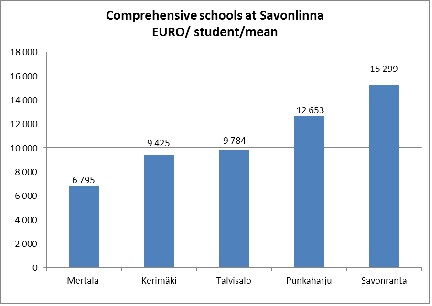
An attempt to develop the equal treatment among the students, cost comparison among the comprehensive schools in Savonlinna and the Russian finance model
In the bigger and economically effective comprehensive schools we have one teacher per 21 students. In the most expensive school units that ratio is one teacher per 10-11 students. Yes, one has to admit that the geography of Savonlinna is very complicated. Savonlinna is 2000 square kilometer in size, which is almost twice as big as Moscow, and we have long school distances in rural areas to get the suburban schools. However, school trips are free for the families. After all, this quality-price ratio is not equal for all students.
Russian schools are financed according to quite a complex scheme depending on the school status, region and a number of students. This model is provided by the Ministry of Education of Russia (2006).
C = C(ss) + C(b) + C(k), where:
C(ss) – state standard costs which depend on regional per capita standard (the density of population in Russia differs greatly from one region to another so each region has its own standard), number of school students; C(ss) = N x U x S, where:
N – per capita regional standard;
U – a school updated coefficient;
S – number of students.
C(b) – specific costs that were not taken into account in F(ss) such as students transportation, school building maintenance etc.;
C(k) – specific costs that were not taken into account nor in F(ss), neither in F(b).
|
Cost comparison among the senior secondary school students
The following Figure 2 shows that there are huge differences on costs between the senior secondary school units in Savonlinna during 2015-2016 school year. The differences in costs correlate with the number of students in a certain school unit. Our town council accepted (still after voting) to quit the suburban school unit number 2 after a strong struggle. As it can be seen, its costs are too high for the richest municipalities in Finland, not to mention our town of Savonlinna which is already taxing the citizens by the highest rate of 22,5% in municipality taxes in Finland. After that the national taxes come, which easily double the income tax for a taxpayer. This situation is unbearable. What is equality in this case in connection with quality-price ratio? I also proposed to shut down the unit number 1 but it still keeps going during the coming year with the estimated 48 students. It means that the cost per student will rise in that unit.
Figure 3 demonstrates the costs after the scores in national abitur tests. They are the facts concerning the quality-price ratio. The average cost for a senior secondary school student in Finland is 7573 euros (Finnish Statistic Center in 2014). It shows that our “bigger” high-schools are well under the Finnish average and the small units are very expensive with all the indicators of costs and effectivity. In the light of the facts we should unite the schooling units but after that comes in the politics to have nothing to do with facts but defending the school network as it has always been in suburban areas. This leads to the situation - both in comprehensive and senior secondary schools - when we have to cut from bigger units in favour of the small ones.
Academic results and quality-price ratio
About 150 years old national Abitur-test (final exam) will finish the senior secondary school studies in Finland. Simply put, it is compulsory for a student to pass at least 4 subjects which the student is attending. Many of the students take more subjects on their test package with the average amount of test subjects between 5 to 6. Usually, this kind of nation-wide testing for all students is very rare in Finland.

|
Из за большого объема этот материал размещен на нескольких страницах:
1 2 3 4 5 6 7 8 9 10 |
