


Партнерка на США и Канаду по недвижимости, выплаты в крипто
- 30% recurring commission
- Выплаты в USDT
- Вывод каждую неделю
- Комиссия до 5 лет за каждого referral
It is seen that despite the heterogeneous nature of the process, the reaction is first order in both hydroxylamine and the nitrile groups on the polymer. The reason for the observed effect will most likely is the high specific surface of the fibers, facilitates the access to the nitrile groups of the polymer as in the case of homogeneous reactions.
Based on the infrared spectroscopic studies, potentiometric titration and the published data, the chemical structure of the resulting anion exchanger (SMA-2) can be represented as follows:
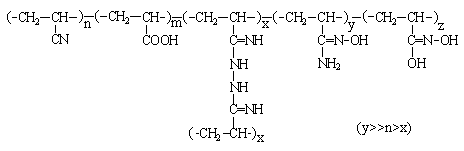
The modified polymer was insoluble in solvents of PAN, which proves the existence of a three-dimensional structure in the polymer.
Estimation of the main functional groups of the anion exchanger SMA-2 treatment was carried out potentiometric titration curves in the coordinates of equation Henderson – Hasselbah. pK of the functional groups was 4.2 and 6.2, indicating that obtained the weak basic of the anion exchanger.
Thus, these studies show that the process of modifying fiber «nitron» nitrogen-containing bases obeys the usual regularities observed in homogeneous reactions.
In order to obtain cross linked anion exchange material modification PAN carried with hexamethylene diamine (HMD). The reaction carried out in of water and butanol that form a homogeneous solution with the diamine in any ratios and temperatures. As can be seen from fig. 2 for the duration of the reaction in aqueous solutions of up to 6 hours at a concentration of HMD 50% and temperatures up to 373K under SEC resine on value HCI not more than 2,0 mg-eq/g, and corresponds to 34 % conversion.
| Fig.2. Dependence of the degree of conversion of the nitrile groups of PAN - fiber in their interaction with the HMD on the duration of the reaction. 1, 2, 3 -, reaction temperature 353, 363, 373 K, respectively. [HMD]=50%, liquor 50. |
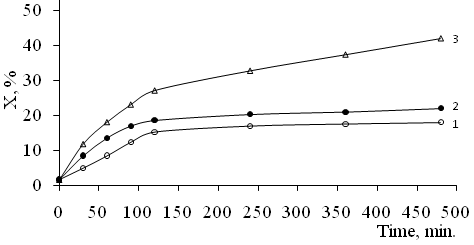
Activation process of adding up to 3% HA to the reaction mixture leads to a sharp increase in the fibers obtained SEC. While SEC modified samples reaches up to 3,5 mg-eq/g.
Based on the obtained data were calculated reaction orders for the HMD and the CN-groups of PAN. Rate equation reaction of fiber «nitron» with the HMD has the following form:

To ascertain the structure of the resulting sorbent was conducted its analysis on the content of functional groups. SEC value corresponding to each functional group shown in Table 1.
Table 1
Determination results of the functional composition of modified HMD polyacrylonitrile fibers in aqueous solution
[HMD] = 50%, [HA] = 3%, T = 373K
SEC, mg-eq/g | ||||||
for 0,1N НСI | for 0,1N NaCI | for 10% NaCI | primary amino | secondary amino | tertiary amino | for 0,1N НСIO4 |
3,7 | 1,6 | 1,6 | 0,4 | 1,6 | 3,4 | 5,4 |
3,9 | 1,8 | 1,8 | 0,5 | 1,5 | 3,9 | 5,9 |
4,4 | 2,0 | 1,9 | 0,5 | 1,7 | 4,6 | 6,8 |
Based on data from IR - spectroscopy and potentiometric titration analysis of functional groups the chemical structure of the product can be represented as follows:
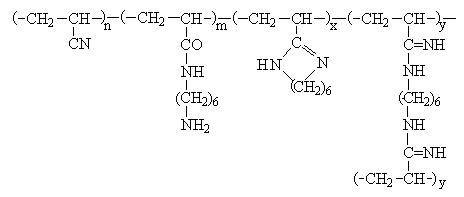
Similar results were obtained by chemical modification of the PAN-hexamethylenediamine fibers in a medium butanol. Having by SEC NaCl indicates that the modification of PAN fiber «nitron» HMD formed anion (SMA-1) not only weak but also strongly basic groups. When carry out fiber modification «nitron» in an organic medium, the number of strongly basic groups more than in the synthesis in aqueous solutions.
When modifying PAN-fiber «nitrone» ethylendiamin (EDA) SEC fiber does not exceed 1,6mg-eq/g SEC sorbents depends on the number of functional groups imparting them ion exchange properties. Increasing the number of functional groups is possible due to the elongation of the modified side chains of the polymer. This elongation has been achieved by modifying the fiber «nitron» EDA in the presence of ethylene dichloride (EDC), which led to an increase in SEC of sorbent (SMA-5) up to 6,0mg-eq/g. Process of the reaction can be illustrated by the following scheme:
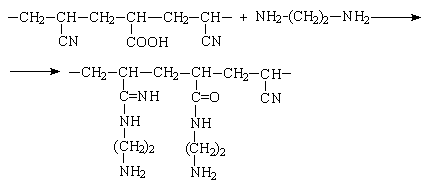
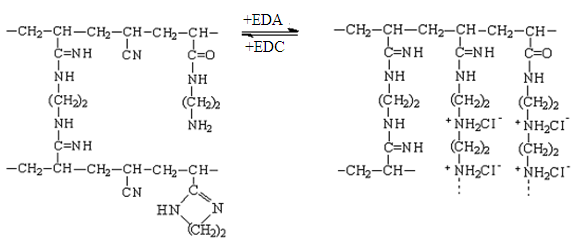
It can be seen that the addition of EDC during fiber «nitron» modification with EDA results in the buildup of oligomer chain by the polycondensation reaction between these components.
The results open up the possibility of synthesis of ion-exchange sorbents with high exchange capacity by polycondensation elongation polymer side chain
As already mentioned above, the reaction ability nitrile groups in the interaction with some nitrogen-containing bases in normal conditions is very low. Therefore, in the modification nitrile groups of polymers with amines their activated by treatment with aqueous hydroxylamine. Previously proposed a mechanism for the observed effect, resulting from the fact that HA interacts with nitrile groups of fibers form amideoximes which is easily replaced with the amine group with a further return HA to the reaction solution. However, in the literature there is no convincing evidence of this mechanism.
About the catalytic effect of HA can be seen from the data given in Table 2. As seen from the table HA added leads to the fact that under identical conditions, the maximum degree of conversion of the product is higher than in the absence of HA. In the process of modifying the HMD in the presence of HA produced sorbents with SEC on HCI about 4,0mg-eq/g, and with HH 3,2 mg-eq/g.
Table 2.
The dependence of the degree of conversion of modified acrylic in different conditions of the concentration of nitrogenous bases in the solution
τ = 2 hours (with HH), τ =6 hours (with HMD) T = 373K
Nitrogen cont. base, % | hexamethylenediamine | Hydrazine | ||||
% solution with a HA | solution without HA | HA solution | solution without HA | |||
water | butanol | water | butanol | |||
The conversion % | ||||||
15 | - | - | 20 | - | - | - |
20 | - | - | - | - | - | - |
25 | - | 17 | - | - | 10 | - |
30 | - | - | 33 | - | 17 | 6 |
40 | - | - | - | - | 22 | 14 |
50 | 70 | 60 | 40 | 10 | 26 | 17 |
70 | - | 62 | 45 | - | - | - |
Convincing evidence for the proposed mechanism of the catalytic action of the HA was to study the interaction of 1,1-DMH with pre-activated PAN. «Nitrone» fiber activation performed with an aqueous solution of HA. When this fiber modified HA had an ion exchange capacity of 1 mg-eq/g The reaction of the activation fiber «nitrone» by 1,1- DMH was carry out for 5 hours at temperature 373K. Under these conditions, SEC of the obtained polymer reached 3,2mg-eq/g (non-activated «nitrone» substantially does not react with 1,1- DMH).Qualitative reaction in the presence of HA obtained polymers and the reaction solution showed that after modification of the polymers of 1,1-DMH no hydroxylamine derivatives, and the reaction solution after completion of the reaction sample provides the HA. Infrared spectroscopic studies of activated polymer and HA further modified 1,1- DMH indicates that in the received sample no absorption band corresponding amidoxime (hydroxamic) groups of the activated HA polymer.
Thus, studies of chemical transformation acrylic fibers with various amines in the presence of HA convincingly demonstrated previously proposed mechanism of the catalytic effect of HA.
In the third chapter, entitled «Kinetics of obtain polikompleksones a modified polyacrylonitrile» are provides the kinetics and mechanism of formation polycomplexons by reacting maleic anhydride (MA) with an anion exchanger SMA-1. In order to obtain chelating polycomplexons carried chemical modification fiber SMA -1 with MA according to the following scheme:
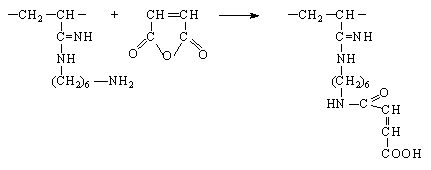
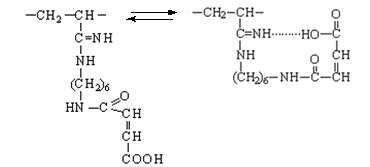
Carboxyl and amine groups in the chelate are spaced apart by six methylene units that impart high fluidity and facilitate the process of chelation
| Fig. 3. Kinetics interaction for SMA-1 sorbent with MA. 1 - SEC by HCI; 2 - SEC by NaOH (2). T = 353K. |
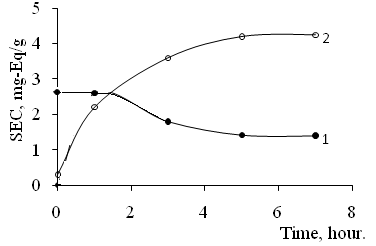
As can be seen from Fig.3 with the increase in reaction time SEC of polycomplexons by NaOH increases and SEC of fiber by HCI decreases. This confirms the proposed scheme, and shows that the interaction of the fiber SMA-1 with MA reaction proceeds to convert the amino groups to amide, and the resulting structure appears polymer carboxyl groups.

|
Из за большого объема этот материал размещен на нескольких страницах:
1 2 3 4 5 6 7 8 9 10 11 12 13 14 15 16 17 18 |
