


Партнерка на США и Канаду по недвижимости, выплаты в крипто
- 30% recurring commission
- Выплаты в USDT
- Вывод каждую неделю
- Комиссия до 5 лет за каждого referral
When comparing the IR - spectra SMA -1 and synthesized polycomplexons seen that in the IR spectra of the product there is a new absorption band at 1711 cm-1 corresponding to stretching vibrations of >C=O of carboxyl groups. The intensity of the bands corresponding to amino groups decreases it broadens due to the formation of molecular hydrogen bonds inside.
Polyampholytic properties polycomplexon SMA-1-MA were shown to study dynamic sorption (DEC) ions Cu(II) and Cr(VI) from the solutions. When this resine DEC of copper ions reached 120mg/g, and of Cr(VI) ions correspond 80mg/g. High sorption capacity for copper ions (II) shows a strong chelating ability of the polymer. Sorption ability by the presence of ions of chromium (VI) indicates maintaining strongly basic groups in the polymer.
Thus, the modification of the anion exchanger SMA-1 maleic anhydride was first time obtained new chelating polymer having a high sorption capacity for cations and anions.
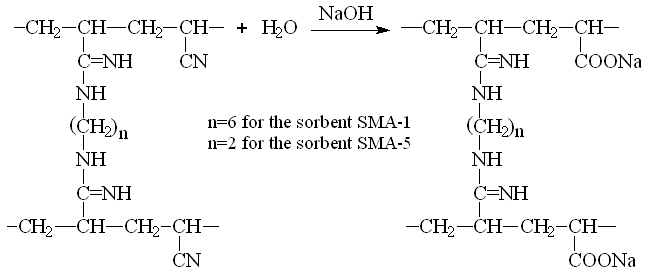
Another method of obtaining polycomplexons was alkaline hydrolysis of the residual nitrile groups of sorbents SMA-1 and SMA-5. The general course of the hydrolysis reaction can be represented as follows:
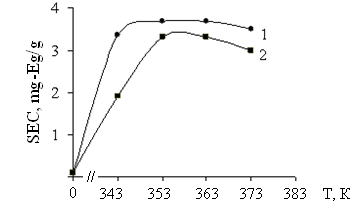
As can be seen from Fig. 4, raising the temperature to 363K SEC by NaOH, produced fibers, increases and then decreases. Reducing the SEC by NaOH with increase in temperature is accompanied by partial destruction of the fibrous structure polycomplexons.
| Fig. 4. Dependence on SEC NaOH polymer obtained сhelating by hydrolyzing SMA-1 (1) and SMA-5 (2) reaction temperature. Reaction duration 30 min [NaOH]=0,2N. Module baths 30. |
The data obtained show that the reaction rate of hydrolysis sorbent SMA-1 is higher than the sorbent SMA-5. Rather, such a difference of reactivity of the nitrile groups in these polymers is due to longer hydrocarbon radical a diamine being crosslinker agents of sorbent SMA-1. This difference in the lengths of the hydrocarbon radicals of modifying amine facilitates access to the hydrolyzed groups of this sorbent.
In all cases, the alkaline hydrolysis of SMA -1 and SMA -5 sorbents with increasing duration of the reaction at the beginning SEC by NaOH initially increases, then decreases. The observed effect is most likely due to the processes autoinhibition and intramolecular cyclization previously observed A. D.Litmanovich in deep alkaline hydrolysis of polyacrylonitrile. Kinetic studies showed that the rate of the hydrolysis of reaction depends on the concentration of NaOH for the first-degree and one SMA-1 half degree for SMA-5. We see that in cases of SMA-5, because of the dense crosslinking sorbent and poor accessibility of the functional groups, of the polymer reaction has a lower order in alkali than in the case of the sorbent SMA-1.
To identify the structure of the obtained polymers were investigated IR - spectrum, and carried out potentiometric titration of their functional groups. These results confirm the polyampholytic nature of synthesized sorbents.
In the fourth chapter, entitled «The physico-chemical characteristics of the obtaining fibrous sorbents» was studied the physico-chemical characteristics of the fibrous sorbents.
To characterize the stability of the investigated sorbents to various agents, including strong oxidizers used to conventional test methods. The greatest resistance to chemicals showed sorbent SMA-1, obtained by modifying the fiber «nitrone» HMD. Under the action of reagents maximum reduction SEC samples does not exceed 20%.
For heat resistance of the polymers obtained we are using thermo gravimetric analysis The curves of the differential thermogravimetric analysis (DTG) of the modified polymer is significantly different from the original fiber curves «nitrone» In the case of modification of HA, heat resistance fiber decreases and it begins with the destruction of 423K. There is a sharp decrease in the mass of sorbent is likely due to the presence amidoxime groups that facilitate the process of destruction due to the elimination of ammonia. Further heating of the product leads to destructive changes deeper than fiber «nitrone». A similar pattern is observed for fibers modified 1,1- DMH.
In the case of modification of the HMD picture changes upward thermal stability of polymers and degradation begins with 498K.
In the case of the product obtained by modifying fiber «nitron» EDA in the presence of EDC, the DTG curve serves as a further evidence of cross-linked and simultaneously branched structure of the ion exchanger. The first increase in the rate of mass loss is observed even at 393K and it lost 9% of the weight of the polymer. Consequently, an increase in the rate of loss for the fiber modified with EDC in the presence of EDA, can be explained by the destruction of the grafted chains of oligomer.
The values of specific surface area and pore size was determined by ion-exchange materials vapor sorption isotherms of benzene and acetonitrile. The specific surface of acrylic fiber source is 2800-3250mg/g. After chemical modification investigated amines specific surface decreases by 2-3 times. And initial pore radius differs slightly modified fibers, however, pore volume in the fiber is reduced by the modification procedure. Although the process of obtaining sorption parameters starting fibers decrease their values remain high compared with granulated sorbents.
Characteristics of the network structure of the modified fibers were carried out on the basis of studying the kinetics of swelling in their DMF. Calculations were performed using Raney equation.
Found that the density of the polymer network nodes or average molecular weight of active chains Mc anion exchangers for all received about the same and varies within 650-720. Frequency grids on one macromolecule is about 100knots, which explains the small swelling of ion exchange fibers obtained in a solvent dissolves the starting fiber «nitron».
In the fifth chapter, entitled «The sorption properties of the synthesized sorbents and polikompleksones» given anion-exchange sorption properties of fibers and polikompleksones derived from acrylic fiber «nitron».
Sorption of ions from aqueous solutions  with sorbent SMA-1 and SMA-5 was studied under static conditions. With increasing temperature of process, a slight decrease in the specific adsorption (Fig.5).
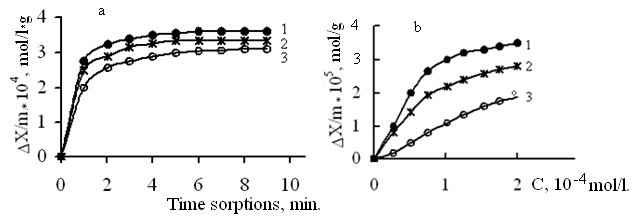
Fig. 5. Kinetics (a) and isotherms (b) of sorption by ion-exchange
SMA-1 fiber of chromate ions at various temperatures.
1, 2, 3 - sorption temperature of 293, 303, 313K, respectively.
Based on dates of the sorption of chromium ions (VI) sorbents SMA-1 and SMA-5 were calculated thermodynamic parameters of the process, the value of which is given in table 3.
As can be seen from table 3 the value of the equilibrium constant for adsorption of SMA-5 is much higher than the SMA-1, indicating more robust binding ions  of SMA-5 sorbent.
Sorption capacity the sorbent SMA-5 in technological solutions, where the ions  are present, is practically identical with the withdrawing ability of the sorbent SMA-1 of artificial solutions where no accompanying the above ions.
Table 3.
Changing the thermodynamic functions for the sorption
of strongly basic sorbents  SMA-1 and SMA-5
Т, К | Г∞, mol/g | К, l/mol | ΔG, J/mol | ΔH, J/mol | ΔS, J/mol·К |
SMA-1 sorbent (artificial solution) | |||||
293 | 0,04 | 509,7 | -15517 | -158,54 | |
303 | 0,03 | 250,0 | -13908 | -55000 | -158,52 |
313 | 0,02 | 97,7 | -11925 | -159,57 | |
Sorbent SMA-5 (technological solution) | |||||
313 | 0,04 | 33457 | -25998 | 17 | |
323 | 0,03 | 29577 | -27158 | -21557 | 17 |
33 | 0,02 | 20578 | -273285 | 17 |
In order to create polymer systems for rapid determination of rare metals immobilization arsenazo (III) in the sorbents SMA-1, SMA-2, SMA-3 was carried. Studies have shown that binding of this reagent is only on the sorbent SMA-1 having strongly basic groups.
In the table 4 presents the thermodynamic parameters calculated on the basis of sorption isotherms arsenazo (III) on the sorbent SMA-1.
Table 4.
The values of the equilibrium constant (K) and changes the
thermodynamic functions of sorption аrsenazo (III) by sorbent SMA-1
Т, К | Г∞·10-4 mol/g | К, l/mol | ΔG, J/mol | ΔH, J/mol | ΔS, J/mol·К |
293 | 5,3 | 3558,7 | -19955 | -37500 | -59,0 |
303 | 8,3 | 2573,8 | -19892 | ||
313 | 13,3 | 1503,8 | -19039 |
As the table shows the value of the equilibrium constant of adsorption is much higher than unity, indicating a strong binding of arsenazo (III) sorbent SMA-1. It should be noted that with increasing temperature increases Г∞ and decreases the value of the equilibrium ch constant values change with temperature indicates that the binding occurs not only through ion exchange but also other weak binding forces which are attenuated with an increase in temperature and lead to a decrease in the value of the equilibrium constant. Is it possible to use this binding polymer reagent for the analytical determination of various metal ions.

|
Из за большого объема этот материал размещен на нескольких страницах:
1 2 3 4 5 6 7 8 9 10 11 12 13 14 15 16 17 18 |
