


Партнерка на США и Канаду по недвижимости, выплаты в крипто
- 30% recurring commission
- Выплаты в USDT
- Вывод каждую неделю
- Комиссия до 5 лет за каждого referral
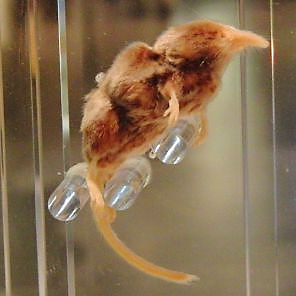
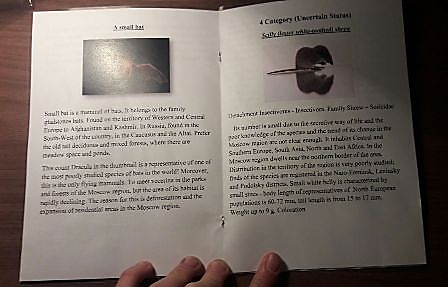
Detachment Insectivorous - Insectivora. Family of Earthmoving – Soricidae
Rare single finds indicate an extremely low number of species in the Moscow region. One of the smallest animals of the fauna of Russia has a body length of 45-55 mm, a mass of 1.7-3.0 g. Almost always, with a low population, inhabits habitats of different types in taiga forests; prefers the outskirts of forest marshes.
The activity is round the clock, eats up to 121 times a day, on average every 10 minutes. For a day eats fodder in 4,2 times more than its weight. It eats small invertebrates. In the fall, seeds are eaten in the diet. Their number is decreasing as a result of summer development. The tiny shrew does not breed in captivity.
The activity is round the clock. Eats up to 121 times a day, on average every 10 minutes. For a day eats fodder in 4,2 times more than its weight. The tiny shrew eats small invertebrates, in the autumn the seeds in the diet observed. Their numbers are dwindling as a result of the villa buildings. The tiny shrew does not breed in captivity.
Natterer’s bat
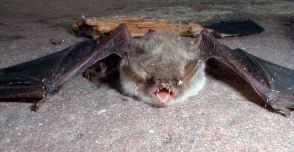
Detachment Bats - Chiroptera. Family - Vespertilionidae
This species is found in North-West Africa, Europe, Asia, Iraq, forests and forest-steppes of the European part of the former USSR, the Crimea, the Caucasus, Transcaucasia, southern Turkmenia. In the Moscow region, the species was first discovered in 1957 in PTR. It is reported about a meeting near Domodedovo. The species in the Moscow Region is few, there is no precise data on the number. The trends in the number change are not completely clear. Maximum life expectancy is 17 years 5 months. Limiting factors: anxiety in wintering, destruction of hollow trees.
Pond bat
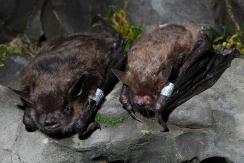
Detachment Bats – Chiroptera. Family – Vespertilionidae
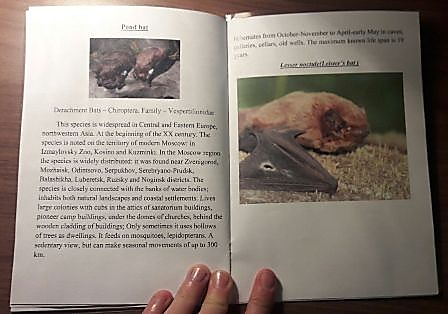
This species is widespread in Central and Eastern Europe, northwestern Asia. At the beginning of the XX century. The species is noted on the territory of modern Moscow: in Izmaylovsky Zoo, Kosino and Kuzminki. In the Moscow region the species is widely distributed: it was found near Zvenigorod, Mozhaisk, Odintsovo, Serpukhov, Serebryano-Prudsk, Balashikha, Luberetsk, Ruzsky and Noginsk districts. The species is closely connected with the banks of water bodies; inhabits both natural landscapes and coastal settlements. Lives large colonies with cubs in the attics of sanatorium buildings, pioneer camp buildings, under the domes of churches, behind the wooden cladding of buildings; Only sometimes it uses hollows of trees as dwellings. It feeds on mosquitoes, lepidopterans. A sedentary view, but can make seasonal movements of up to 300 km. Hibernates from October-November to April-early May in caves, galleries, cellars, old wells. The maximum known life span is 19 years.
Lesser noctule(Leister’s bat )
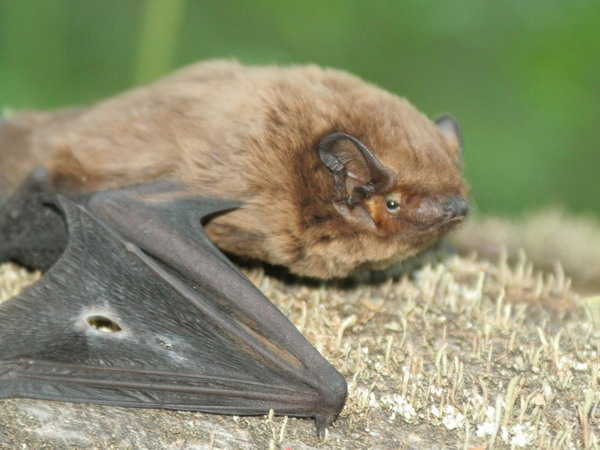
Detachment Bats - Chiroptera Vespertilionidae. Family – Vespertilionidae
This species is widespread in North Africa, the Canary Islands, Madeira, Europe, Turkey, Iran, Afghanistan. At the beginning of the XIX century the species was found in the immediate vicinity of Moscow in its modern borders (Kolomenskoye village, Izmaylovsky menagerie). In the Moscow region is found in Serpukhov district. In the Moscow Region, the population is small, a rare species, found only in the south of the region. To the south, starting from the Voronezh region, the species becomes ordinary. Lesser noctule inhabits forests and forest-steppe. It dwells in forests and parks, the day spends in hollows of trees and bird's houses. On the mornings, Lesser noctules behave quietly, so they cannot be detected by sounds. The maximum known life expectancy is 9 years. It makes long-term seasonal flights, during which it can meet in the steppes. From the summer it habitats disappears in the first and second decades of August, returns in early May. It hibernates mostly singly in buildings and hollows of trees from late September to early April. The main threat to the species in the region is the reduction of forest areas and the destruction of hollow trees.
Nothern bat
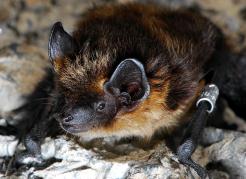
Detachment Bats - Chiroptera. Family – Vespertilionidae
It is a rare little-studied species. This species lives in Europe, Asia up to Kazakhstan, northern Mongolia, north-west and northeast China, Korea and Japan. In the Moscow region, the species was met only once in July 1967 in PTZ.
The northen bat prefers coniferous and mixed forests. It usually lives in human buildings (most often between the roof and the boards of the litter), less often in tree hollows. The maximum known life expectancy is 14 years 6 months.
Common (hazel) dormouse
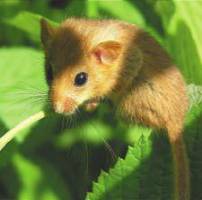
Detachment Rodents - Rodentia. Family – Gliridae
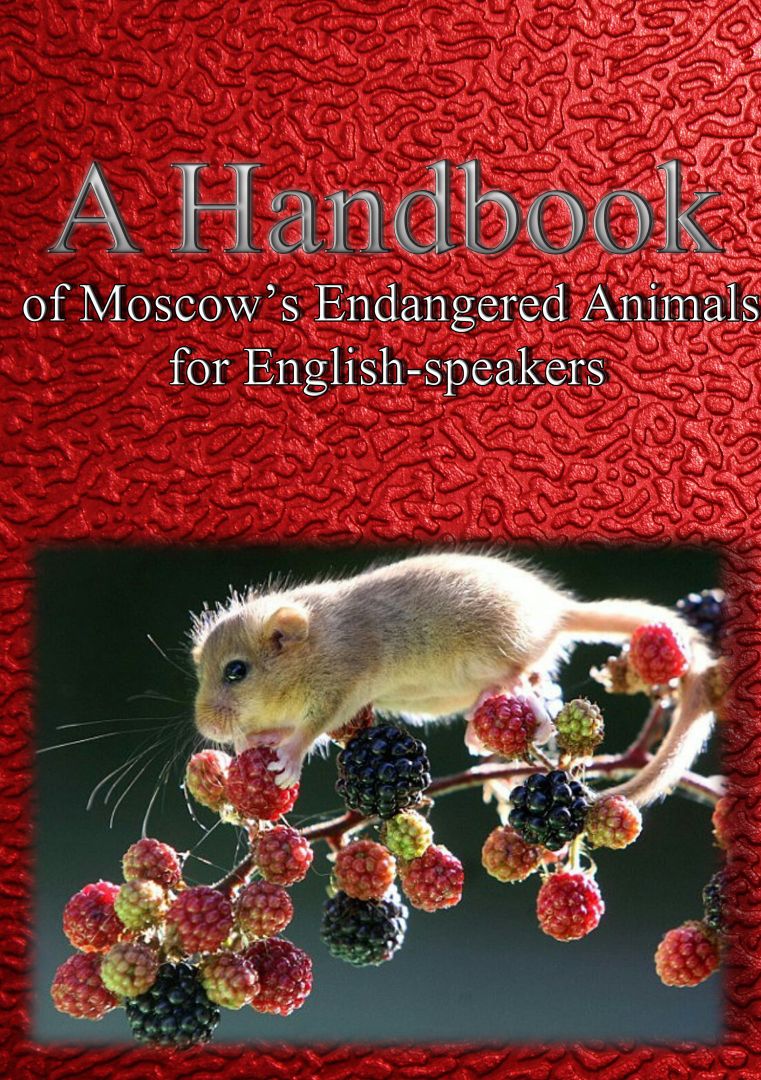
This species is found in broad-leaved plains and mountain forests of Europe and Asia Minor, some islands of the Mediterranean Sea. Information on the current distribution of the species in the Moscow region is scanty and sketchy. The meetings were registered in the Tesovsky Forest (the border of the Mozhaisk and Ruzsky Districts), in Serpukhov, Sergiev Posad, and Leninsky Districts. In the first half of the twentieth century it met in the same Tesovsky forest in the vicinity of Mozhaisk, near Podolsk, in the vicinity of Sergiev Posad, near the railway stations Ashukinskaya and Pravda (Pushkin district), near the village Yazykovo (Dmitrov district), on the border of the Leninsky and Odintsovo districts. The modern population of the species in the area, apparently insignificant, although specific data are not available because of the secretive lifestyle. In general, the hazel dormouse is more common in the suburbs than other types of dormouse. It lives in broad-leaved and mixed forests with a dense undergrowth, in copses, gardens; in high-altitude forests, it settles along the fringes among thickets of bushes. It leads a nocturnal life and lives in artfully constructed nests and hollows. It feeds on nuts, acorns, seeds, berries; eats and insects.
Pine vole (European)
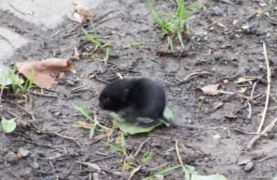
Detachment Rodents - Rodentia. Family Hamsters – Cricetidae
This species lives in broadleaf forests of Western, Central and Eastern Europe. In the Moscow region dwells near the northern border of the area. Only one reliable location of the species is known: in the NP "Losiny Ostrov" near the village of. Abramtsevo, at the junction of Mytishchi, Pushkin and Balashikha rn. The habitat of the underground vole is also located near the south-eastern borders of the Ruza district. The number is low, but there is no specific data for the Moscow Region due to the secretive way of life of the species. It inhabits grassy communities in sparse forests of various types and shrub thickets. Lives colonies, paves a complex network of shallow burrows, relatively rarely comes to the surface; It feeds mainly on underground parts of plants - roots and rhizomes of various herbs, as well as leaves and shoots of grasses, seeds and acorns. For the winter makes large reserves in burrows. The rarity of the species is due to its location on the border of the range. Perhaps a negative impact on the species has an increased recreational load on the forest near Moscow.
Yellow-necked mouse
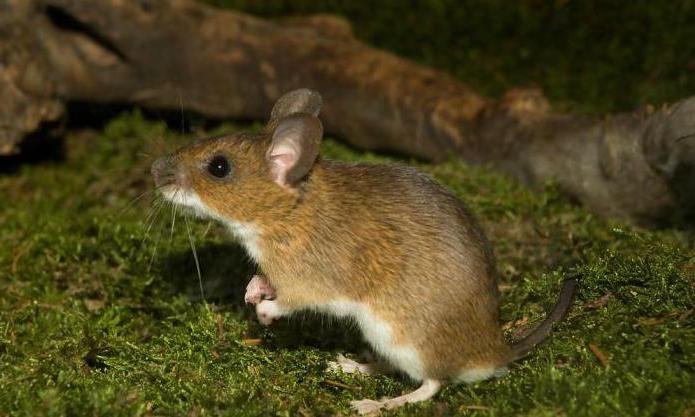
Detachment Rodents - Rodentia. Family Mouse – Muridae
This species is found in broad-leaved forests of Europe from Poland to the Southern Urals. This mouse is marked in Moscow. In the Moscow region, the species was recorded in the Naro-Fominsk region on the border of the Podolsky and Chekhov Districts, in the Serpukhov and Silver-Prudsk Districts. Yellow-necked mouse annually on the border of Naro-Fominsk and Podolsky Districts. The species as a whole is rare, but according to some data, in some forest areas of the Moscow Region the number of yellow-throated mouse can be quite high. The yellow-throated mouse inhabits broad-leaved and coniferous-broad-leaved forests, bushes, and gardens. It often settles in hollows, good climbing trees. It feeds mainly on seeds of trees and grasses, it also eats insects, makes stocks of acorns, linden seeds, etc.
The disappearance of rare species of animals
So, what are the reasons for the disappearance of animals? The influence of a man on wild animals appears in two ways: direct influence and indirect influence through changes of their existence conditions. People build new buildings on an empty land or cut down forests and do not think about animals, make new roads. As a result the whole complexes of animals begin to disappear because they have no place to live. But it is the only one side of the question. Direct influence of the man is a terrible problem for the animals. Careless business managers pollute seas, lakes and rivers by petroleum. Another factor that influences the situation is the consumer attitude to the human environment. Poaching and hunting lead to the fact that many species of animals disappear completely. We have got too many cars, too many factories, too much wastes and carbon dioxide!
A major component of urban terrain is the green massive (parks, urban forests and gardens), birds and animals inhabiting them. The greenery as well as the environmental system, provide comfort of living conditions for people in the city, adjusts to definite limits the gas composition of air and the degree of its pollution, climatic characteristics of urban territories, reduces the influence of noise factors.
The ways to save animals
1. The problem of people cutting down trees could be solved by planting ten new ones for every tree that is cut down. In this way, animals won’t lose their natural habitat. We should also recycle paper products so that there is less need for trees to be cut down.
2. As for factories polluting our rivers, strict fines should be given to the owners of the factories if they dump their dangerous chemicals in the water. As a result, our water will be cleaner and safer to drink and some animals won’t lose their habitat too.
3. To reduce air pollution, the government could ban cars from the city centre. The government should also force factory owners to put filters on their doing this, harmful gases won’t be able to pollute the air and people and animals won’t have difficulty in breathing.
Besides, here is some insight on the endangered species and methods for their salvation.
«The Red Book» lists not only those animals that may disappear from the face of the Earth in the next few years, but those inhabitants, which no longer exist on the planet. Thanks to the documentary sources, people have managed to find information on a few dozen of animals that have disappeared.
Trying to save the next representative of the flora or fauna, scientists are trying not to isolate it from the environment. For this purpose, they use nature reserves, wildlife sanctuaries and national parks.
There are a lot of special organizations which try to find the right ways to save wild animals, land, plants and people. Their basic purpose is to draw attention of the public, authorities, mass media and business to the existed problems of global nature and particular natural areas. The most known are:
- the World Wildlife Fund (WWF)
- Greenpeace (here is "Greenpeace Russia")
- the Royal Society for the prevention of cruelty to animals (the RSPCA)
The RSPCA tries to protect animals from bad use. It operates big nation campaigns aimed at lost pets, circus animals.
The WWF rescues several species of animals, mammals as well as birds. This organization also helps to create more than 250 National parks.
Greenpeace began its work 20 years ago from saving whales. And now Greenpeace is a world-famous organization, which saves plants, animals and people. These organization, want to rescue animals, to help them to survive and to save jungle rain forests, which are in danger of destruction.
They are non-profit and nongovernmental organizations. They unite people of different colors living in different continents and speaking different languages. The common mission of these organizations is preserving life on the earth in its full variety.
And we can say that all the people, not even members of the organizations, must respect the nature, not spoil and not damage it because our environment is our own home and we have to live in it.
Conclusion
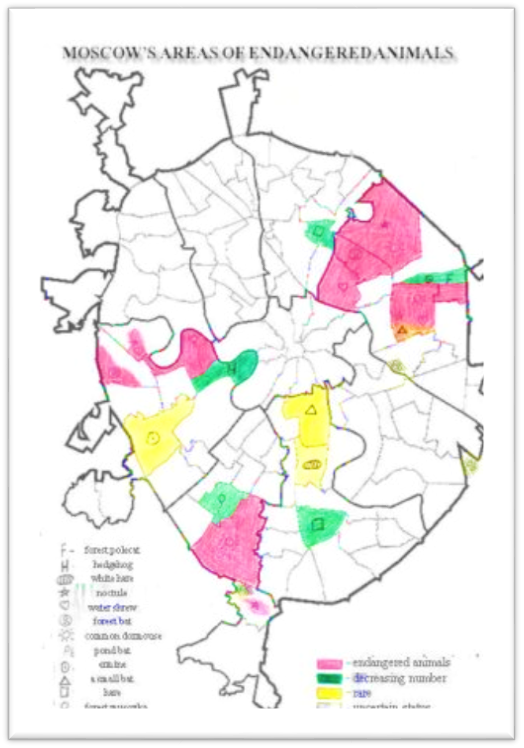
All things considered, there are many solutions to all the problems. The sooner we put them into practice, the better our lives will become. We have created the Red Book of Moscow and the map with their locations. Also, we have created the society “Let’s save species in trouble” in order to preserve endangered animals and we hope it will help people know more about extinct animals, as well as contribute to the preservation of the environment.
Resources
https://en. wikipedia. org/wiki/Red_Data_Book_of_the_Russian_Federation#Red_Data_Book_categories_and_their_explanations https://lektsii. org/3-31520.html https://en. wikipedia. org/wiki/Red_Data_Book_of_the_Russian_FederationApplication

|
Из за большого объема этот материал размещен на нескольких страницах:
1 2 3 4 |
