

Партнерка на США и Канаду по недвижимости, выплаты в крипто
- 30% recurring commission
- Выплаты в USDT
- Вывод каждую неделю
- Комиссия до 5 лет за каждого referral
In the third stage, the recent momentum of solutions are not supported and received, with 14 circulations of production solutions and pH=3, the nickel content is 8 g/dm3 and iron of 0.01 g/dm3.That is almost had been received without iron solutions. It should explain what happened neutralization of solutions with the deposition of iron in the bulk ore in the form of hydroxides, the content of which in the upper layers of the percolator in terms of iron increased to 17 masses. % and over is 14.8 masses. % in the original ore. This means that the hydrolysis of ferric sulfate with the release of H2SO4 in the solution.
The result is not only without iron solutions, which are suitable for separation of nickel from them by any means, but also reduces the consumption of H2SO4 in the leaching ore. In subsequent stages, when the initial acid pH of 1.5 the resulting solutions have pH=3, containing iron not more than 0.01 g/dm3.
The lower Nickel content in the ore by leaching gradually reduced the concentration of nickel in solutions.
In the 9th stage of leaching, an attempt is made to increase the content of nickel in productive solution by increasing the intervals between irrigations to 7 days. The effect is not obtained. The content in solution, g/dm3: 1,66 Ni 0,063 Co, Fe 0,008, of 14.12 Mg, 1,96 Mn And 3.46 Al.
In the 13th stage by increasing the initial concentration of acid, speed and more acidic productive solutions received an increased content of nickel and other elements. However, the iron content was overestimated 0.6 g/dm3.
From the 17th to the 30th stage, despite of the increase of the initial concentration of acid, the pause between irrigations and a large number of revolutions of head solutions to significant intensification of the process of leaching of nickel was observed.
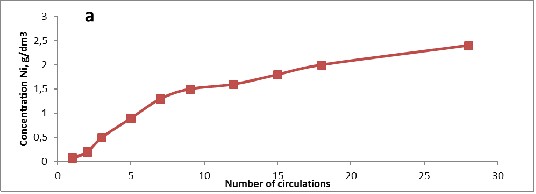
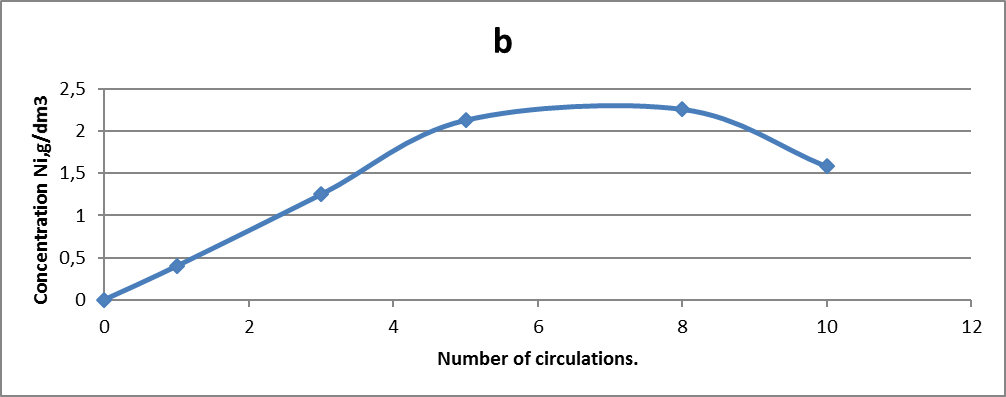
Figures 1(a),(b) and (c) indicate the dependence of the concentration of nickel circulations of the leach solutions. From these figures it follows that a significant increase of nickel concentration from the circulations of production solutions varies depending on the extraction of nickel from ore. So in the range of 10% extraction of nickel from ore effective increase in the concentration of nickel in solution occurs at 7 circulations of production solutions, to 20% at 4-5 and finally to 50% at 2-3.
Figure 1. The dependence of nickel concentration of nickel from the number circulations of production solutions and extracting 10% Ni, b - extract >20% Ni in leaching 50% Ni.

Results and discussions
From the analysis of the obtained data it follows that in the initial stages (up to 10% of the leaching of Ni) is to use the most concentrated solutions of acids (pH≤1) to obtain at pH=3 besiality solutions that are not supporting the working capital solutions of acid before displaying them from leaching. In the future it is necessary to gradually reduce the concentration of acid: at the stage of extraction of nickel up to 20-30% to use solutions with pH~1 and, in the later stages of leaching pH of 1.5.
Production solutions containing nickel less than 2 g/dm3 should be directed to the leaching of fresh portions of the ore to increase the nickel content up to 2-3 g/dm3.
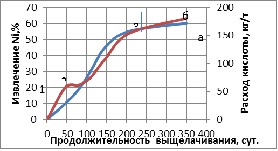
From the above data, exploratory research for 350 days of the extraction of nickel was 62%, and acid consumption 180, 5 kg per 1 tonne of ore (Fig. 2).
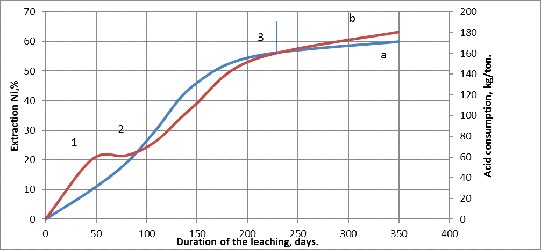
Fig.2. The dependence of extraction of nickel (a) and acid consumption (b) duration of leaching: 1.- pH=0.8, and irrigation density V=133см3/kg. of ore., the average number of revolutions of head solutions of n= 12, pause between irrigations 3 days; 2.- pH=1, the density of irrigation V=67см3/kg. of ore, the average head number of rotations of solutions of n= 10, the pause between irrigations 3 days; 3-. pH=1.5, density of irrigation V=67см3/kg. of ore, the average head number of rotations of solutions of n= 16, the interval between irrigations 1 day;
Taking into account the excess number of revolutions of the parent solutions should be recommended to reduce them to the optimum as described above.
In the result it is assumed that the length of the percolation leaching may be reduced to 225 days.
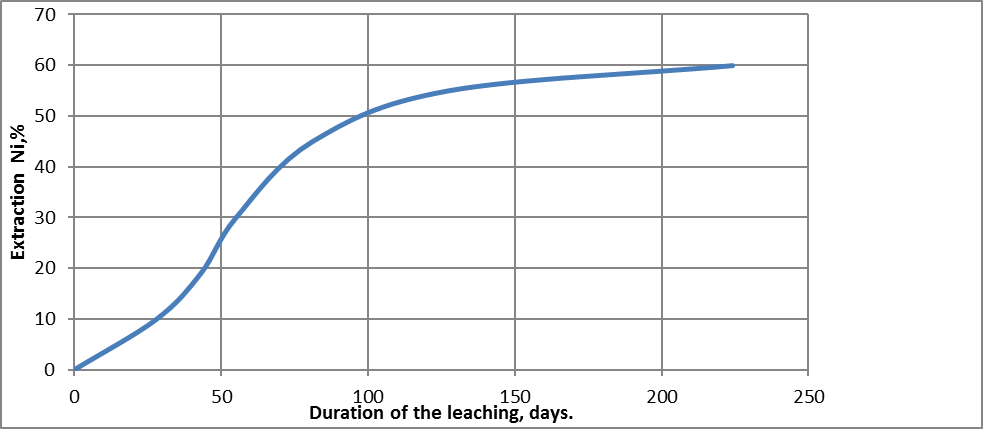
Fig.3 the Dependence of extraction of nickel on the duration of leaching.
After 62% of extraction of nickel was studied by both chemical and phase composition of the leachable ore. From table 6 it follows that remaining in the ore metal contents decrease: nickel, magnesium and manganese correspond to the degree of leaching. The iron content did not change by precipitating it as a hydroxide.
Table 6-the Composition of the leaching of oxidized nickel ore with 55% extraction, mass. %.
Ni | Fe | Mn | Mg |
0,64 | 12,8 | 0,094 | 10,87 |
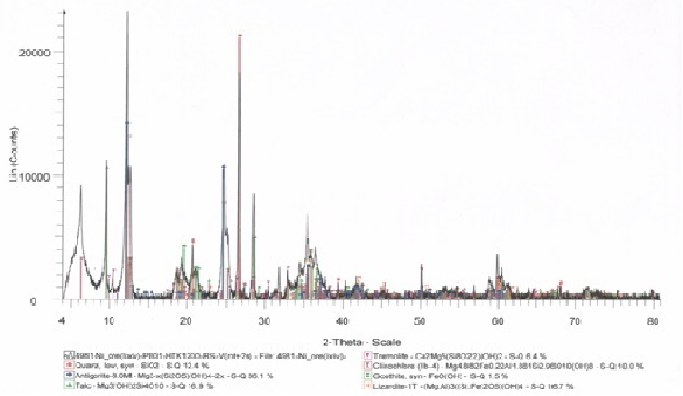
Fig. 4 – Radiograph of the original ore:
Quartz, SiO2-12,4%; Antigorite, Mg3x-1(Si2O5) (OH)4-2x - 36,1%; Talc, Mg3(OH)2Si4O10 – 16,9%; Tremolite, Ca2Mg5(Si8O22) (OH)2 – 6,4 %; Clinochlore, Mg4,882Fe0,22Al1,881Si2,96O10(OH)8-10%; Goethite, FeO(OH) – 1,5%; Lizardite, (Mg, Al)3 ((Si, Fe)2O5)(OH)4-16,7%
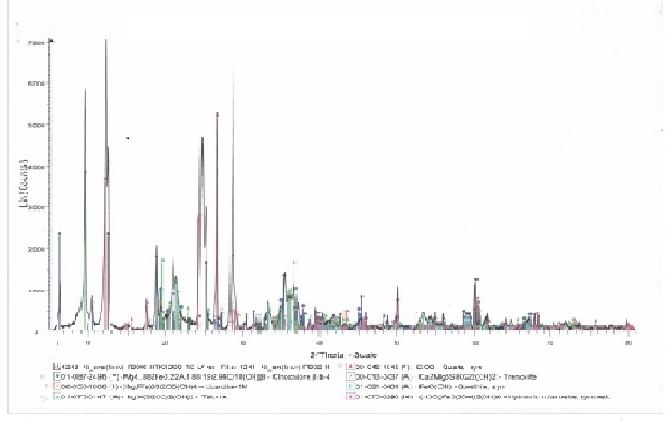
Fig.5 – Radiograph of the leached oxidized Nickel ore the extraction of Nickel 62%:
Clinochlore, Mg4,882Fe0,22Al1,881Si2,96O10(OH)8-10%; Lizardite, (Mg, Al)3 ((Si, Fe)2O5)(OH)4-5%; Talc, Mg3(OH)2Si4O10 – 28%; Quartz, SiO2-10%; Tremolite, Ca2Mg5(Si8O22) (OH)2 – 6,4 %; Goethite, FeO(OH) – 1,5%;Hydronium Jarosite, (H3O)Fe3(SO4)2(OH)6
From figures 4 and 5 we can conclude that there has been a change in the phase (mineralogical) composition of the ore. It should be noted that the initial phases clinochlore, quartz, tremolite, lizardite, goethite and talc. Quartz and talc are known not leached out under these conditions, their presence is clearly indicated on the radiograph.
New mineral formation should include Hydronium Jarosite (H3O)*Fe3(SO4)2*(OH)6) formed from hydronium ions and other ions that make up the leach solutions.
Jarosite sodium and corrositivity was discovered by us earlier in the leaching of copper-zinc ores [10].
And the most interesting is that is completely absent antigorite. This indirectly suggests that the bulk of the Nickel contained in this mineral.
The continued leaching of nickel up to 80% will allow to assess the degree of changes of the chemical composition and the conversion of existing mineral associations.
Conclusions:
1.Existing in the Urals practice sliderule melting of the oxidized nickel ore is environmentally and economically imperfect.
2. An alternative should be considered heap leaching balance (including magnesium) and off-balance sheet of the oxidized nickel ore.
3. Presented research of the oxidized nickel ore collectively allow leaching all the valuable components of Ni, Co, Mn and Mg.
4. At an intermediate stage of leaching reached 62% the extraction of nickel in the acid consumption 180,5 kg/t of ore and received bezglazaya solutions which can be processed by any precipitation, sorption, extraction and other ways to produce marketable products.
The work is done in the framework of implementation of Project # 15-6-3-31 Comprehensive program of UB RAS.
Literature.
[1].Information and analytical center Mineral. A raw complex of Russia for 2012. [Electronic resource]- Mode of access: http://www. mineral. ru/Facts/russia/161/537/3_10_ni. pdf
[2]. Khalezov, B. D., investigation of heap leaching of oxidized Nickel ore Serov deposits./ Khalezov B. D., Chuvashov P. Yu., Vatolin N. A. etc. / / Materials of XVI International scientific-technical conference, Yekaterinburg, 2011,pp. 53-58
[3]. Reznik I. D. Nickel 3T. the Oxidized Nickel ore. Characteristics of the ores. The pyro and hydrometallurgy of laterite Nickel ores./ Reznik I. D., Ermakov G. p. , Schneerson JM– M: OOO "Science and technology", 2004 – 468 p. - 2 t
[4]. Nickel In The Urals. Ways of development: materials of the round table/ under the General editorship of S. S. naboychenko.- Ekaterinburg: Urfu, 2013. Pp. 9-16.
[5].Mineral raw materials: from the bowels to the market: in 3 volumes. //Under the editorship of A. P. Stavsky - M: Scientific world, 2011.-496 S. T. 2
[6]. Kim. E. A. Development of the process of bioleaching of silicate Nickel ores of ferrous-magnesian type: abstract. dis. Cand. tech. Sciences.- Moscow: MISIS, 2010 – 26C.
[7]. A new method for obtaining nickel from the hyperaccumulator plant Alyssum murale. /Barbaroux R., Mercier G., Blais J. F., Morel J. L., M. O. Simonnot Separation & Purification Technology 83. 2011. P. 57-65.
[8].Gavrilov A. S. investigation of the hydrolytic method of extracting metals from Nickel-containing solutions./ Gavrilov A. S., Kolesov B. D., Vatolin N. A. Zelenin E. A. VIII all-Russian youth scientific-practical conference on problems of mining, Ekaterinburg 2014, pp. 170 to 174.
[9].In. I. Beregovskiy. Metallurgy of Nickel. Textbook for schools and courses of the masters./ V. I. Berehovo, N. In. The Gudima. State scientific-technical publishing house of literature on ferrous and nonferrous metallurgy. M: 1956. 355 S.
[10]. Khalezov B. D. Heap leaching copper and copper-Nickel ores.//Ekaterinburg: RIO UB RAS, 2013. – 332с.
Графический абстракт
|

|
Из за большого объема этот материал размещен на нескольких страницах:
1 2 3 4 |
