


Партнерка на США и Канаду по недвижимости, выплаты в крипто
- 30% recurring commission
- Выплаты в USDT
- Вывод каждую неделю
- Комиссия до 5 лет за каждого referral
1. Are vou a student?
2. Are vou a first-vcar student?
3. Is your friend a militiaman?
4. Is your father a militia officer?
5. Is your English lab on the ground floor? (on the first floor?)
6. Are you 20? (17?)
7. Is your friend 18?
8. Are your textbooks on the table?
9. Is your house near a metro station?
10. Is your Institute in the centre of Moscow?
Задание II. Поставьте следующие предложения в отрицательную и вопросительную форму. Дайте краткие ответы на общие вопросы.
The house is new. They are at school. Those men are judges. The students are in that room. My friend's flat is large. My sisters are in Kiev now. My friend is a militiaman.
Задание 12. Прочтите предложения, заполните пропуски соответствующей личной формой глагола to be.
My friend's mother.... a teacher of English. 2. My parents.... not in Moscow, they.... in Pcterburg.not a judge, my mother.... a
doctor. 4....... these texts long? Yes, they............My house.... in a green
street. 6. The students of our group … in the lab now. 7............................ your
friend's wife a student? 8.............. your newspaper on the table? 9. Mi
brother's son.... 5 years old.
Задание 13. Прочитайте и переведите следующие предложения:
My son is only three years old.
Is your friend a judge?
My house is not far from the school.
Mv sister's name is Ann.
Is this work difficult?
My flat is not large, it is small.
Are you busy today?
These stories are very interesting.
Mr. Black is a policeman.
Two students are absent from the lesson.
Our group is in the English lah now.
Задание 14. Переведите на английский язык:
1. Мы студенты МЮИ. 2. Студенты нашей группы сейчас в аудитории. 3. Я не судья, я студент. 4. Дети моего брата сейчас в саду.5. Наша аудитория не большая, но светлая. 6. Мой отец по вечерам дома. 7. Твоя мама врач? Нет, она судья. 8. Твои родители свободны в воскресенье? Да. 9. Твоя сестра дома? Нет, она в школе.
5.Тема: Предлоги: предлоги места и направления, предлоги времени; предлоги, передающие падежные окончания
Теория:
Предлоги места и направления
I.
on
at
in
under
on - на — означает нахождение предмета на поверхности другого предмета: (on the table — на столе).
under - под - обозначает нахождение предмета под другим предметом: (under the table — под столом).
in - в - обозначает нахождение предмета внутри чего-то (in my room - в моей комнате).
at - у, около - обозначает нахождение предмета вблизи другого: (at
 the table — у (около) стола).
II.
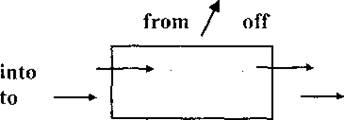
out of from
to - к, в, на — обозначает направление, движение предмета по на правлению к другому предмету; (to the school — к школе, в школу).
into -в - обозначает движение предмета по направлению к другому предмету с проникновением внутрь его: (into that room - в ту комнату).
from - от, из, у - обозначает движение предмета: (from the library - из библиотеки; from your friend- у своего друга).
from, off - с, со - обозначает движение предмета с поверхности другого предмета: (from the table, off the table - со стола).
out of - из - обозначает движение предмета изнутри другого предмета наружу: (out of the room - из комнаты).
Предлоги времени
Предлоги времени вводят обстоятельства времени, которые отвеча-
ют на вопрос: "когда?".
at — указывает на момент совершения действия:
at 8 о 'clock a.m. - в 8 часов утра
in — I) указывает на отрезок времени.
а) с частями суток:
in the morning утром
in the evening вечером
но: at night ночью
б) с названиями времен года:
in spring весной
in summer летом
in autumn осенью
in winter зимой
в) с названием месяцев:
в январе в феврале в марте в апреле в мае в июне в июле в августе |
в) с названием месяцев:
in January
in February
in March
in April
in May
in June
in July
in August
in September
in October
in November
in December
в сентябре в октябре в ноябре в декабре. |
in September
in October
in November
in December
г) при указании года:
in 1918,
in 1945.
2) указывает на промежуток времени, через который начинается действие:
in two days через два дня
in a lesson через урок.
on - употребляется при указании:
а) дней недели:
on Sunday в воскресенье
on Monday в понедельник
on Wednesday в среду
on Thursday в четверг
on Friday в пятницу
on Saturday в субботу.
б) дат:
from... till
during
for
since
on the 1st of May первого мая
on the 10lh of November десятого ноября.
указывает на момент, с которого начинается и до которого совершается действие:
from 9 a.m, till 7 р.m. с 9 утра до 7 вечера
указывает на период, во время которого совершается действие (когда?):
during the holidays - во время каникул.
указывает на период времени, в течение которого совершается действие (как долго?):
for two hours - в течение двух часов
for four years - в течение четырех лет.
указывает на момент, с которого совершается
веришется действие:
s 1980 - с 1980 года
since last Monday - с прошлого
понедельника.
ЗАПОМНИТЕ
II is 6 o'clock now Сейчас 6 часов
5 minutes past two 5 минут третьего
a quarter past six четверть седьмого
half past nine половина десятого
ten minutes to eleven без 10 минут одиннадцать
a quarter to three без четверти три.
— Excuse me, what is the time now? (Excuse me, could you tell me the time now?)
— It's half past two. (it's У o'clock now).
Предлоги, передающие падежные окончания
В английском языке у имен существительных есть только два падежа: притяжательный падеж, в котором существительные принимают окончание ‘s, и общий, представляющий собой основу существительного без каких-либо окончаний. Поскольку имя существительное в английском языке утратило падежные окончания, то падежные отношения выражаются при помощи предлогов.
of— предлог, передающий отношения родительного падежа (кого?, чего?) и обозначает принадлежность или часть целого. Например:
the streets of the city — улицы города;
one of my friends — один из моих друзей.
to — предлог, передающий отношения дательного падежа (кому?, чему?). Например:
Give this book to your friend — Дайте эту книгу своему другу. with, by — предлоги, передающие отношения творительного падежа (кем?, чем?), например:
to write with a pen —писать ручкой; to go home by bus — ездить домой автобусом.
about — предлог, передающий отношения предложного падежа (о ком?, о чем?). Например:
Tell me about your work, please. — Расскажи мне, пожалуйста, о своей работе.
Практика:
Задание 1. Переведите следующие сочетания слов, обращая внимание па предлоги:
to my table, from my tabic, at his table, on her table, off the table, to the bus stop, from the bus stop, in his wife's room, into my room, from my sister's room, at our club, in their flat, from this big house, in Moscow.
Задание 2. Заполните пропуски предлогами и переведите предложения на русский язык.
Take this thick book.... the table, please. Put it.... your bag. Go .... that table, please. Don4 give me your note-book - Please, put it.... flic table. Take the pen.... your e.... the lab, please. Don't write these woeds, do it.... home. Don't go.... school. Take your sister's note-book.... your bag.
Задание 1. Переведите следующие сочетания на русский язык:
a) at S o'clock; at a quarter past nine; at 10 minutes past one; at half past three; at a quarter to ten; at 10 minutes to eight;
b) from nine till eleven о’с1оск; from half past six till a quarter to seven; from 10.30 till 6.15;
c) during the day; during all his fife; during the lesson; during the test; during their visit; during our summer holidays;
d) for an hour; for half an hour; for an hour and a half; for two days; for five weeks.
Задание 2. Переведите на английский язык, используя следующие предлоги времени:
in - утром, зимой, в мае, в 1147 году, в конце сентября, в августе,
днем, через 4 года, через 2 семестра (term), через день;
at - в 9 часов вечера, ночью, почдно ночью, в 11.15, в 7 часов утра;
on - в воскресенье, в четверг, 1 мая, 7 октября, в понедельник;
during - во время каникул, во время игры, во время урока;
for- в течение 3 дней, в течение недели, в течение четверти часа;
from…till - с утра до поздней еючи; с 5.30 до 9 утра; е 10 до 10.45;
since- с прошлой субботы; с вечера; с 1989 года.
Задание 1. Прочитайте и переведите следующие предложения, обращая внимание на предлоги.
1. Will you give this English book to nie, please.
2. Tell me about the history of our militia.
3. Let us speak with your friend about your studies at the Moscow Law University.
4. Don't write with a pen in the book, please,
5. Go to your friend's place by bus.
6. The court is in the centre of the city.
7. 1 have a very interesting detective story with me.
8.We have a library and a reading hall in our Institute.
9. My friend has a lot of free time this week.
10.Will you read and translate this newspaper article for me, please.
11.One of our students has a two-room flat not far from the school.
Задание 2. Замените существительные с предлогом of существительными в притяжательном падеже:
the house of my father; the car of my son; the books of the girl; the case of this judge; the room of my daughter; the nаmе of her friend; the flat of my brother; the family of their sister; the book of these students.
6. Тема: Времена: Present Indefinite, Past Indefinite, Future Indefinite.
Теория:
Времена системы Indefinite
В английском языке имеются три неопределенных (Indefinite) времени: настоящее неопределенное {Present Indefinite), прошедшее неопределенное (Past Indefinite) и будущее неопределенное (Future Indefinite).
Все времена системы употребляются для обозначения обычных, регулярных действий в настоящем, прошедшем или будущем, а также для описания последовательных действий и констатации фактов.
Present Indefinite Tense
Глаголы в Present Indefinite совпадают по форме с инфинитивом
(неопределенной формой), но употребляются без частицы "to'. В 3-м
лице единственного числа глаголы имеют - окончание —s:
I work We work
You work You work
Не They work
She } works It
Вопросительная и отрицательная формы (кроме глагола to be) образуются с помощью вспомогательного глагола "do’’ или ‘’does" (в 3-м лице ед. ч.)
Dо I work? Do we work?
Do you work? Do you work?
he
Does { she work? Do they work?
it
Отрицательная форма
I do not (don't) work. We do not (don't) work.
You do not (don't) work. You do not (don't) work.
He
She } does not (doesn't) work. They do not (don't) work.
It
Краткие ответы строятся следующим образом:
Yes, I (you, we, they) do.
No, I (you, we, they) don’t.
Yes, he (she, it) does.
No, he (she, it) doesn't.
Past Indefinite Tense
Утвердительная форма образуется двумя способами: если гла-
гол правильный, прибавляется суффикс - ed во всех лицах и числах,
например, to work — worked. Если глагол неправильный, он имеет
особую форму. Запомните формы прошедшего времени наиболее
употребительных глаголов:
to be— was, were to get — got
to have — had to see — saw
lo do — did to give — gave
to go — went to write — wrote
to come — came to read — read
to know — knew to tell — told
to take — took to say — said
to understand — understood to speak — spoke
Вопросительная и отрицательная формы образуются с помощью вспомогательного глагола "did".
Краткие ответы строятся так же, как и в Present Indefinite, но с глаголом "did".
Did I work? Did we work?
Did you work? Did you work?
he work?
Did { she work? Did they work?
it work?
Yes, I did.
No, I didn't.
I did not (didn't) work.
You did not (didn't) work.
He
She } did not (didn't) work.
It
We did not (didn't) work. You did not (didn't) work. They did not (didn't) work.
Future Indefinite Tense
Future Indefinite образуется с помощью вспомогательных глаголов shall
(1 л. ед. и мы. числа) и will (для всех остальных лиц).
I shall work We shall work
You will work You will work
He
Sh It
}
will work?
They will work?
Вопросительная форма образуется путем инверсии, т. е. вспомогательный глагол предшествует подлежащему:
Shall we work? Will you work? Will they work? |
Shall I work?
Will you work?
he
Will { she work?
it
Yes, I shall, No, i shall not (shan't). |
Краткий ответ:
Отрицательная форма:
I shall not (shan't) work. You will not (won't) work.
He
She } will not (won't) work
It
We shall not (shan't) work. You wili not (won't) work. They will not (won't) work.
Практика:
Ex. 6. Употребите вспомогательный глагол “do" или "does"
1. ... you live in Moscow?
2. ... Pete work in militia?
3. ... they know about it?
4. ... your sister go to school?
5. ... you read newspapers?
6.... your friend study in your group?
7. ... the students translate texts?
8. ... you do many exercises?
9..... your mother work?
10. ... your group learn English?
11. ... your friend help you?
Ex. 7. Спросите партнера и выслушайте его ответ:
Model: 1 live near Moscow.
— Do you live near Moscow?
— Yes, I do. (No, I don't).
1. My father works as a militiaman. 2. His brother studies at a Medical Institute. 3. 1 read the Komsomolskaya Pravda every day. 4. My friend likes sports. 5. I do my homework at school. 6. He knows German. 7. My sister reads much. 8. I often write to my friend, 9. We study every day. 10. They know English well. 11. My mother works as a teacher. 12. 1 go to the cinema every week.
Ex. 8. Скажите, что это не так:
Model: Не works in militia.
Не doesn't work in militia.
1. My friend studies French. 2. They like sports. 3. He helps me. 4. My sister knows English well. 5. J read the Moscow News. 6. He lives in Kiev. 7. The students know about the meeting. 8. My friends always come late. 9. He sits in front of me. 10. She writes letters to me. 11. I know this man. 12. We do our homework at the lesson.
Ex. 9. Ответьте на вопросы;
1. Do you study well? 2. Do you come to school in time? 3. Do you read newspapers? 4. Do you live in the centre of Moscow? 5. Do you play football? 6. Does your friend work? 7. Does he study? 8. Does he live near you? 9. Does your friend like sports? 10. Do you help your friend?
Ex. 10. Задайте вопросы партнеру и выслушайте его ответы,
(Вам помогут приведенные ниже словосочетания):
Model: Do you know Pete?
Yes, I do. No, 1 don't. to play football, to read English books; to go to the library; to study in the reading room; to help friends; to come to lessons in time; to like music; to ask many questions; to learn English.
Ex. 12. Вспомните, что глагол to be не требует вспомогатель-
ного глагола для образования вопросительной и отри-
цательной формы. Поставьте следующие предложения
в вопросительную и отрицательную формы:
Model: lam a student.
Are you a student?
I am not a student.
1. My friend is a worker. 2. They are militiamen. 3. My father is an engineer. 4. His sister is My parents are pensioners. 6. We are students. 7. It is cold today. 9. I am busy on Friday. 9. He is Mr. Black is a policeman.
Ex. 14. Спросите партнера и выслушайте его ответ:
Model: I read an interesting book yesterday.
Did you read an interesting book yesterday?
Yes, I did. (No, I didn't).
I. I asked him this question. 2. I worked in militia two years ago. 3. I translated a text last night. 4. I helped my friend to do his work. 5. Hived in Arbat Street a year ago. 6. I opened the window in the morning. 7. I liked to play football when I was a boy. 8. I learned English 5 years ago. 9. 1 answered well at the lesson.
Ex. 15. Скажите, что Вы этого не делали;
Model: I read a newspaper in the evening.
I didn't read a newspaper in the evening.
1. I played basketball yesterday. 2. 1 worked as a militiaman last year. 3. 1 studied English at school. 4. I answered all the questions. 5. I helped niy friend to do this work. 6. I translated the text into Russian. 7. J asked him about it.
8. 1 lived near the metro station 3 years ago. 9.1 opened the book 5 minutes ago. 10.1 liked hockey when 1 was a schoolboy.
Ex. 16. Дайте исходную форму глаголов:
took, had, got, saw, came, did, went, knew, read, wrote, gave, understood, told, spoke, was.
Ex. 17. Скажите, что Вы делали это раньше, употребляя соответствующие обстоятельства времени:
... years (months, weeks, days, hours, minutes) ago; last night (Sun
day, vear, month, week); when I was... и г. д.
Model: I read much.
I read much when I was a schoolboy.
I. I see my friend on Sunday. 2. I tell him all news. 3. I take books from the library. 4 1 come home late. 5. 1 know this man. 6. 1 have a dog. 7. I do my homework at home. 8. I go to the cinema every week. 9. I get good marks. 10. I write down all new words into my copybook. 11. I give my pen to Pete.
Ex. 18. Поставьте соответствующую форму глагола "to be'':
1. Не ... at home last night. 2. ... you ready for the lesson? 3. I... not late for the lecture. 4. The students... in the classroom.you at the concert yesterday?last year. 7. My friend... not there. 8. We... militiamen before school. 9. 1 …at a football match last Saturday. 10. The sky... blue. 11. Nick and Pete... friends at school.
Ex. 22. Проспрягайте следующие глаголы в Future Indefinite: to go, to help, to come, to read, to ask, to see, to translate.
Ex. 23. Вставьте вспомогательный глагол shall или will:
I. ... you come to see me on Friday? 2. I... not work tomorrow. 3. The students ... have 3 lessons on Tuesday. 4. We... not study next week. 5.My friend... give me an interesting book.we go to the cinema in the evening? 7. They... do this work in 2 days. 8. The teacher... answer all your questions. 9. I... tell you about it next time. 10. … you give me your pen, please?
Ex. 24. Спросите партнера и выслушайте его ответ:
Model: I shall go to the cinema on Saturday.
Will you go to the cinema on Saturday?
Yes, I shall. (No, I shan't).
1. I shall read the newspaper in the evening. 2. I shall see my friend tomorrow. 3.1 shall do it next time. 4. I shall come late. 5. 1 shall take the book froirfthe library. 6. I shall give you my copy-book in 3 days. 7. I shall ask the teacher about it. 8. 1 shall play tennis on Sunday. 9. 1 shall go to Yaroslavl next month.
Ex. 25. Предложения из упр. 24 сделайте отрицательными.
Ex. 26. Составьте как можно больше предложений, пользуясь таблицей:
1 | read | this work | tomorrow | |
We | shall | go | the exercise | next time |
Не | will | do | the text | in a week |
Yon | write | to the theatre | on Sunday | |
They | help | to the club | ||
my friend |
Ex. 27. Поставьте сказуемое в соответствующую временную форму:
1. We (to study) Criminalistics next year. 2. The students (to have) a meeting yesterday. 3. My friend (to go) lo the Institute every day. 4. I (to work) as a militiaman 2 years ago,you (to see) him next Satur-day? 6. We... (not to know) about it. 7. I (to take) a pencil from my friend 5 minutes ago.you (to study) English or German? 9. We (to translate) this text at the next lesson. 10. My father (to read) newspapers every day. 11. He (to come) home at 6 o’clock last night. 12. I (not to see) this film yesterday.
Ex. 28. Переведите на английский язык:
1. На занятиях мы читаем и переводим тексты. 2. Ты мне расскажешь об этом? 3. Мой друг приходил ко мне вчера. 4. Твоя сестра учится в школе? 5. У нас не будет собрания завтра? 6. Знаешь ли ты об этом? 7. Я выполнил домашнее задание вчера вечером. 8. Мой друг не работает, он учится. 9. Ты был на лекции вчера?
II. Лексика
Словообразование
Теория:
Суффиксация является наиболее распространенным способом словообразования в английском языке.
Суффикс -ег (-or) служит для образования существительных от глаголов и обозначает лицо, производящее соответствующее действие, например,
to work — a worker
работать — рабочий
Практика:
Ех. 1. Образуйте от следующих глаголов существительные с помощью суффикса - er (-or) и переведите их на русский язык:
to teach, to play, to help, to read, to inspect, to write, to report, to speak, to translate, to visit, to investigate.
Суффикс -tion (-ion) также служит для образования существительных от глаголов, но производные существительные обозначают наименование соответствующего действия, обобщенное понятие, напр.,
to graduate — graduation
заканчивать (вуз) — окончание
Ex. 2. Образуйте от следующих глаголов существительные с помощью суффикса - tion (-ion) переведите их:
to investigate, to detect, to inspect, to translate.
Суффикс -ly служит для образования наречий от прилагательных, напр.,
easy —easily
легкий — легко
Ex. 3. Образуйте от следующих прилагательных наречия и переведите их: happy, near, bad, wonderful, real, great, usual, nice, broad, deep.
Ex. 4. Переведите на русский язык следующие интернациональные слова:
police, officer, patrol, uniform, captain, college, economist, militiaman, to visit.
III. Ознакомительное чтение и письменный перевод текстов. Составить свой словарь.
My friend and 1
Look at this man. He is my friend. My friend’s name is Peter. Peter is not old, he is young. He is only 25 (years old). Peter is married. He has a wife. His wife's name is Marry. She is 25, too. Peter and his wife are of the same age. My friend is a judge at a people's court. Marry is a teacher of English at the University. My friend's family is not large. They are three in the family. Peter and Marry have a son, Nick by name. He is only 3.
I am not a judge. 1 am 20. And I'm a student. I study at the Moscow Law Institute. I am not from Moscow, I was born in Kiev.
My friends and J are in Peter’s new flat now. It is not far from the centre of Moscow. It is a two-room flat. My friends are always glad to see me at their place.
Задание 1. Ответьте на вопросы по тексту:
1. Is your friend Nick?
2. What is your friend's name?
3. Is your friend 19? (25?)
4. How old is your friend?
5. Is he married?
6. Who is his wife?
7. Are Peter and Marry of the same age?
8. What is your friend? (your friend's mother?)
9. Is your friend's family large?
10. Do Peter and Marry have any children?
11. How many children have Peter and Marry?
Задание 2. Задайте своему соседу по парте вопросы ко II половине текста.
Задание 3. Ответьте на вопросы, пользуясь образцом. Model: What are you? — 1 am a student.
1. What is your friend? (a judge).
2. What is your friend's wife? (a doctor).
3. What is your sister? (a teacher).
4. Where are your books? (on the table).
5. Where is your English lab? (on the ground floor).
Model: What is your name? My name is Ivanov.
1. What is your name?
2. What is your friend's name?
3. What is your father's name?
4. What is your sister's name?
5. What are these students1 names?
6. What is that man's name?
Model: How old are you? 1 am 22 (years old).
1. How old are you?
2. How old is your friend?
3. How old is your friend's son?
4. How old is this judge?
5. How old arc you and your sister?
Задание 4. Дайте краткие ответы на следующие вопросы,
1. Are you a judge?
2. Have you a sister?
3. Are you 30?
4. Is your family large?
5. Are you and your friend of the same age?
6. Arc you always glad to meet your friends?
7. Is your friend's wife a student?
8. Have you English books at home?
9. Has your brother a family?
10. Have you labs at the Institute?
11.Have you a new flat in Moscow?
Moscow Law University
Moscow Law University is one of the higher educational institutions in the system of law enforcement professional education in Russia. It was founded in 1975 as a higher militia school. The University trains militia officers for Moscow and Moscow region. Our graduates work in all militia services.
Now there are a number of faculties at our University. There are also refreshment courses for working militia officers.
In order to enter Moscow Law University an applicant must pass the entrance examinations successfully.
The students of our University have all conditions for getting a good education. There arc many law enforcement experts of great practical experience. Doctors of Law, professors who give lectures and do their best to give our students professional specialization and provide them with general and cultural education.
There are many specially equipped classrooms, laboratories, lecture-halls, gymnasiums, libraries which are effective for proper training. The term of training at the Moscow Law University is four years. After graduation from our University the students get a diploma of a lawyer and become lieutenants of militia.
The working day of Our students begins at 8.30 a, m3 and ends at 5 p. m. Every day the students have lectures, seminars, tutorials, practical exercises. In order to become a law enforcement expert of high professional standards our students must get knowledge of such sciences as; Operative Detective Activity. Criminalistics. Administrative Law and Administrative Activity, Criminal Law, Criminal Procedure and many others. After classes the students can be engaged in sports, can have scientific societies, various clubs.
Besides very often our students patrol the streets maintaining public order in Moscow.
Ex. 29. Прочтите текст и найдите ответы на вопросы:
1. What specialists does the Moscow Law Institute train?
2. Do the students have all conditions for getting a good education? What are they?
3. What is the term of training at our College?
4. What are the students engaged in during their working day?
5. In what way do our students help maintain public order?
Методические рекомендации для выполнения самостоятельной работы для студентов сокращенной заочной формы обучения /2 семестр/
Для успешной сдачи устного экзамена по дисциплине «Английский язык» необходимо выполнить самостоятельную работу, содержание которой приведено ниже.
Задания выполняются по учебнику:
, Тимофеева язык: учеб. пособие для юридического учебного заведения. – Центр юридической литературы «Щит-М», 20с.
Прежде чем начать выполнение письменных упражнений, рекомендуем:
1. Прочитать теорию по конспекту лекций, учебнику или учебно-методическому пособию, а также на сайте Академии.
2. Только после усвоения теоретического материала по теме выполнить устные и письменные упражнения.
3. Кроме того, должен быть подготовлен словарь юридических терминов и незнакомых слов, выписанных из предложенных текстов для обучения профессионально ориентированному чтению.
Самостоятельную работу необходимо выполнить в отдельной тетради.
Формы контроля самостоятельной работы (КСР)
1. Работа с группой:
1.1. Объяснение преподавателем трудностей, появившихся у студентов при выполнении самостоятельной работы;
1.2. Выборочный контроль заданий самостоятельной работы по усмотрению преподавателя.
2. Индивидуальная работа по самостоятельной работе с каждым студентом.
Контроль самостоятельной работы (КСР) для каждого студента. Индивидуальный контроль, складывается из трех аспектов:
1. Выборочный контроль письменных упражнений с частичным объяснением теоретического материала (почему и как выполнен перевод, заполнены пропуски и т. д.).
2. Студент должен сам составить словарь незнакомых слов к текстам, предложенным для самостоятельной работы.
3. Выборочный устный перевод из предложенных текстов (по усмотрению преподавателя).
Содержание самостоятельной работы для студентов заочной сокращенной формы обучения /2 семестр/
I. Грамматика.
1. Тема: Конструкция there is.
Теория: с.65-66
Практика: упр.7-9, с.66-67
2. Тема: Времена группы Perfect.
Теория: с.68-70
Практика: упр. 12-14, с.71-72
3. Тема: Модальные глаголы и их эквиваленты.
Теория: с.72
Практика: упр. 15-16, с.73-74
4. Тема: Времена группы Continuous.
Теория: с. 87-88
Практика: упр. 9-14, с. 89-90
5. Тема: Неопределенные местоимения.
Теория: с. 91-92
Практика: упр. 18-21; с. 92-93
6. Тема: Типы вопросов (общие, альтернативные, специальные, разделительные).
Теория: с.53-54, с.56
Практика: упр.29,с.53; упр.30, с.54; упр.31-33, с.55-56; упр.34-35, с.56
II. Лексика
1. Словообразование
Теория: с.64, 85
Практика: упр.2-5, с.64; упр.1, с. 86
III. Ознакомительное чтение и письменный перевод текстов «US Constitution» c.159; упр.29, с.161, упр.33, с.163; «Outlines of Constitutional Law» с.168-170, упр.13, с. 170. Составить свой словарь.

|
Из за большого объема этот материал размещен на нескольких страницах:
1 2 3 |
