


Партнерка на США и Канаду по недвижимости, выплаты в крипто
- 30% recurring commission
- Выплаты в USDT
- Вывод каждую неделю
- Комиссия до 5 лет за каждого referral
- At its head is the Sovereign, Queen Elizabeth II.
- The parliament is bicameral. The House of Lords includes the Lords Spiritual and the Lords Temporal
- The Queen is the third component of the legislature.
- Prior to the opening of the Supreme Court in October 2009 the House of Lords also performed a judicial role through the Law Lords.
- Both houses of the British Parliament are presided over by a speaker, the Speaker of the House for the Commons and the Lord Speaker in the House of Lords.
Election
The British government is elected for 5 years.
The prime minister appoints the date of election. The time is chosen to give as much advantage to the leading party as possible. A month before he with close advisers choose the day)
É Date is announced to the Cabinet
É Pr. M. formally asks the Monarch to dissolve Parliament ð M. P. become unemployed, but the government offices continue to function.
É Election campaign lasts for three weeks
É Voting – on Polling Day (Thursday)
É The Leader of the winning party is invited to form the government.
Question 14: Political Parties of the UK
Plan:
Historically there were 2 parties – Tories – Whigs.
They appeared in the XVII century.
The Tories | The Whigs | ||
ò | ò | ò | |
Conservative | Liberal | Labour | |
Ê É | 1906 | ||
Until the end of 19th century they were the only elected to Parliament | Democratic-socialists Trade Union 1945 – First election Motto: British people are community | ||
The Conservative (Tory) Party monopolists and landowners Controls business, industry, commerce. Believes in private enterprise. The word “tory” means an Irish highwayman Principles Individuals have an absolute right to liberty. Foundation of freedom is ownership, independence, opportunity. Every citizen has responsibilities to the neighbors, nation. Government should establish a climate in which enterprise can flourish. | The Liberal (Whig) Party Trading and manufacturing classes. Motto: Civil and religious liberty. For many times won a majority at Parliament. Tories called Whigs preachers, who could go on for 5 hours preaching moralizing sermons. |
Question 15: Capital of the UK
Plan:
London contains four World Heritage Sites: the Tower of London; the historic settlement of Greenwich; the Royal Botanic Gardens, Kew; and the site comprising The etymology of London remains a mystery. | Proper name Lud (furious) Latin – “Lond” – a wild forest Celtic – Llyn (lake) and Dun (fortress) Old european “Plowonida” (an overflown river) NB: The Big Smog (the great smog) |
In July 2007, it had an official population of 7,556,900 within the boundaries of Greater London (1600 km2 )
Roman Londinium Anglo-Saxon settlement called Lundenwic Westminster Tower of London Plague & The Great Fire of London | 1. Local government 2. National government 3. Geography 4. The London Underground 5. The Docklands Light 6. Buses |
The City
Small area east of the center, the site of the original Roman town – the oldest place.
The administration is run Lord Mayor, elected annually
It is one of the biggest banking centers – Threadneedle street.
The central criminal court The Old Bailey.
The West End Between the streets the Mall and Oxford street. Regent Street, Bond Street Entertainment centers – Soho, Picadilly Circus. | The East End industry developed east from the City. A person who is born in the E. E. is called a cockney. The cockney dialect A change of vowels – E. g. Late = Light [lait] Dropping Hs – E. g. He [i:] |
Question 16: Political relations between the UK and the USA
Plan:
Br–Am relations widely encompass and span four centuries, beginning in 1607 with England's first permanent colony in North America called Jamestown.
1. British colonization of the Americas, and Thirteen Colonies (Sir Francis Drake)
Businessmen – The Puritans – The Quakers – Criminals
Thirteen Colonies were involved in the slave trade, slaves in New England Colonies typically worked as house servants, artisans, laborers and craftsmen.
2. The War of Independence
3. American Civil War
At the beginning the UK issued a proclamation of neutrality but the Confederate States of America attempted to provoke British intervention through cotton diplomacy, leading to failed threats of a trade embargo
4. The Great Rapprochement
5. World War I & WWII
6. Cold War
- UK found itself in virtual financial ruin whereas the US was in the midst of an economic boom.
- UK was at the mercy of American economic policy when the US abruptly terminated lend-lease at the end of WWII.
- US & UK became founding members of the United Nations in 1945 Close cooperation between US and UK resulted in the formation of the North Atlantic Treaty Organization with their European allies
- Through the US-UK Mutual Defence Agreement signed in 1958, the United States assisted the United Kingdom in their own development of a nuclear arsenal.
- 2,669 Americans and 67 Britons at the World Trade Center, The Pentagon, and in Shanksville, Pennsylvania were victims of a terrorist plot orchestrated by the Islamic group known as
al-Qaeda on September 11, 2001.
- British forces participated in the United States-led war in Afghanistan and the United States-led invasion of Iraq in 2003.
- The July 7, 2005 London bombings emphasized the difference in the nature of the terrorist threat to both nations.
Question 17: Economy of the UK
Plan:
- Currency –- Pound sterling (GBP)
- Fiscal year – 6th April – 5th April
- Trade organizations – EU, BCN, OECD and WTO
- GDP – $2.674 trillion (2008 est. nom.)
- GDP by sector agriculture (1%), industry (23%), services (76%) (2008 est.)
- Inflation (CPI) – 3,2% (March 2010)
- Labour force by occupation – agriculture: 1,4%; industry: 18,2%; services: 80,4% ; Unemployment – 7,8% (Q4 2009)
- Main industries – machine tools, industrial equipment, scientific equipment, shipbuilding, aircraft, motor vehicles and parts, electronic machinery, computers, processed metals, chemical products, coal mining, oil production, paper, food processing, textiles, clothing and other consumer goods.
- Export goods – manufactured goods, fuels, chemicals; food, beverages, tobacco
- Import goods – manufactured goods, machinery, fuels; foodstuffs
- Gross external debt – $9.088 trillion (30 June 2009)
- Public debt – 68,5% of GDP (2009 est.)
The 1st became highly industrialized (Industrialization of XIX century).
Reason: coal is under the surface ð easy mining ð the most developed industry.
North-West of England – Newcastle
Scotland – Glasgow
Wales – Cardiff, Bristol
Heavy industry
– Birmingham – heavy machinery
Is developed in the London region – Coventry ð produce – railway carriages
– Sheffield – motor cars
Shipbuilding industry is – London, Glasgow, Newcastle, Liverpool, and Belfast)
Woolen industry – Yorkshire (one of the most important items of export).
Originally agricultural zones ð industrial ones. Now the are 2 zones – green (agricultural)
– black (industrial)
The Black Country (the Midlands)
The Smoky Northwest
The Northeast
Question 18: Education in the UK
Plan:
The system of education is determined by the National Education Acts.
The basic features:
- There are wide variations between diff-t parts of the country.
- Education mirrors the country’s social system – it is selective and class-divided.
- In 1988 was adopted the National Curriculum which sets out in detail the subjects children must study and levels of achievement they must reach
Stages of education:
Age | Stage |
Preliminary education | |
3–4 | Nursery school or Kindergarten |
Primary education | |
5–6 | Infant school |
7–8 | Elementary school |
9–11 | Junior school |
Secondary education | |
12–16 | Secondary school |
16–18 | Sixth form college |
Higher education | |
19–21 | College of higher education or Polytechnic |
23 | University & Post-graduate education |
1. System of marking
2. Preliminary and primary education
3. Secondary School
- 11+ Exam
- Grammar Sch
- Technical Sch
- Secondary Modern Sch
- Comprehensive Sch
- GCSE or GCE O-level.
- GCE A-level
4. School life
5. Post-School and Higher Education
6. B. A, M. A., Ph. D.
7. Oxbridge
Question 19: British Culture (Anglo-Saxon – Enlightenment)
Plan:
Anglo-Saxon (5–7th cent.)
As Anglo-Saxons arrived from the Northern Europe _ the West Germanic language.
This period is dominated by the pagan believes (Scandinavian Gods)
Tuesco – the God of Darkness
Woden – the God of War
Thor – the God of Thunder
Freia – the Goddess of Prosperity
Anglo-Saxons didn’t have written language, but they had letters called runes. And songs and stories had to be memorized. “Beowulf”.
In the 7th century the Anglo-Saxons were converted to Christianity _ religious works.
Latin was adopted as the language of the court and science. Chronicles
Medieval (7–13th cent.)
Culture was greatly influenced by Christianity. Venerable Bede
In architecture prevailed cathedral and gothic style
In paintings – icons and faces of canonized people.
In sculpture – scenes from the Holy Bible
In theatre – mysteries, miracles, moralites
The word was perceived as smth material that had great power sermons
The most important science – theology, the aim – to comprehend the God-creator.
Numbers were of great importance
In literature besides clerical genres romances got the popularity.
Sir Malory’s “Book of King Arthur and of his Noble Knights of the Round Table”
Ballads, fables.
William Langland and Geoffrey Chaucer “Canterbury Tales”.
Renaissance (14–16th cent.)
The War of Roses the Tudors became the ruling family. The period of absolute monarchy.
Folk literature flourished
With the Queen Elisabeth coming to the throne England saw great economic and social changes, ðdevelopment of science and art. This period is characterized by development of bourgeois society. The national culture was on the rise.
At the core of the culture was a man
The world was perceived as the sphere for the application of the human abilities.
The essence of the art – the search for truth. Humanism.
Drama was divided in comedies and tragedies. The first playhouse was “The theatre”.
“The Robin Hood”. Sir Thomas More “The Utopia”. William Shakespeare.
Enlightenment (17-18th cent.)
17th cent. was a hard time, political situation was complicated Charles I was beheaded, England ð republicðmonarchy
The period of intensive industrial development _ capitalism
Further development of science and culture.
Painting began to develop.
Country faced the problem of education.
Enlightenment: central subject of research was a man and his nature. Scholars believed in reason and natural goodness of a man They believed in educational power of art – through books, plays, pictures tried to teach ppl.
Daniel Defoe, Samuel Richardson, Jonathan Swift, Henry Fielding, Robert Burns.
Question 20: British Culture (Romanticism – Post-Modernism)
Plan:
Romanticism (beg. of 19th cent.)
Some public ppl disapproved of the Enlightenment trends, some writers in their work paid attention to mystery.
Industrial revolution (Luddite’s crisis) & The French Bourgeois revolution in 1789
Ppl dissatisfied with the current situation called upon ppl to struggle for better future.
George Gordon Byron
I: the world is not solid, but split into two
A character – a person who realizes the imperfection of the real world and his helplessness to improve it, so he leaves this one and becomes a hermit or escapes to some fantastic world.
Romanticists idealized historic past.
Walter Scott, P. B. Shelly. Jane Austin
Realism (19th cent.)
I: criticism of capitalist society and exposure of social contradictions.
True reflection of life. Realists sympathized with working ppl
The leading genre – novel
Charles Dickens, William Thackeray, Charlotte Bronte
Character – a little man in the harsh world
Tomas Hardy, George Eliot paid attention to deep psychological analysis and observation of inner world.
Some realists who couldn’t cope with the reality tried to escape to the world of dreams and beauty. This trend resulted in decadence (decline) trend _ artists forgot about the reality and began to produce are for art’s sake _ pure art _ current of aesthetism.
NB: art shouldn’t reflect the reality but only give pleasure. The beautiful form is far more important than contents. Art can’t teach.
Oscar Wilde, Lewis Carroll
Modernist (20th cent.)
The traditions of realism were continued
Bernard Shaw, John Galsworthy, Herbert Wells
I: to reveal the truth of life. They criticized narrow-mindedness, hypocrisy, stupidity.
The leading genre – novel.
Toward 20-30s ppl began to question basic political and religious beliefs.
The Crisis of bourgeois relations ð great pessimism.
“Stream of consciousness”, they described everything that happened in human’s mind.
James Joyce “Ulysses”
Straggle between realists and decadent writers.
Virginia Woolf, Thomas Eliot, Agatha Christie, J. RR. Tolkien
Post-modernist (21st cent.)
WWII had a great influence on intellectual life.
In the theatre appeared 2 trends: Absurd (shows the meaninglessness of life) & Social drama
Dominating genre is still a novel esp. philosophical, satirical.
George Orwell “The Animal Farm”, William Golding
Question 21: British School of Painting
Plan:
Middle Ages (stained glass, manuscript decoration and manuscript illumination).
The key plot – king, virgin Mary
The characteristic features – attention to the beauty of line, rich colours and fine craftsmanship
XV century pictorial art was dominated by the Continental influences. As all leading artists were foreigners.
The Age of Reason - empirical approach to experience
Portraits Van Dyck,
He was the first to introduce the tradition of representing a sitter against a landscape background. This feature distinguishes the English portrait from the Continental one.
E. g. the portrait of Charles I
The Age of Classicism
the English love of clarity, elegance and restraint.
no psychological depth in the portraits of this period.
Reynolds and Hogarth ð to create a character
The Age of Romanticism
brought the passion for sentiment and Nature.
Landscape and seascape
The attitude toward the nature at once more exact vs an imaginative (Gainsborough)
I: painting should be understood but not only viewed.
But nature is not depicted in all the details, as it was considered to change.
The National Museums in London
Landscapes & Seascapes
Sir Joshua Reynolds
specializing in portraits and promoting the "Grand Style"
He was one of the founders and first President of the Royal Academy.
William Hogarth
was a major English painter, printmaker, pictorial satirist, social critic and editorial cartoonist.
He was a moralizing artist.
His work ranged from excellent realistic portraiture to comic strip-like series of pictures called “modern moral subjects”.
Emblematical Print on the South Sea Scheme.
Thomas Gainsborough
Royal Family's favorite painter.
Painted more from his observations of nature (and human nature) than from any application of formal academic rules.
Portrait of Mrs. Graham; Mary and Margaret: The Painter's Daughters; William Hallett and His Wife Elizabeth, nee Stephen, known as The Morning Walk; and Cottage Girl with Dog and Pitcher, display the unique individuality of his subjects.
Joseph Mallord William Turner
his style is said to have laid the foundation for Impressionism.
he elevated landscape painting to an eminence rivalling history painting.
"The painter of light".
The fighting Temeraire tugged to her last berth to be broken up
Variety of colours, broad touches
He found plots in shipwrecks, fires, sunlight, storm, rain, and fog.
He was fascinated by the violent power of the sea.
He opposed grandeur of nature and weakness of humans
In his later years he used oils ever more transparently, and turned to an evocation of almost pure light by use of shimmering colour
Rain, Steam and Speed - The Great Western Railway
John Constable
Dedham Vale
The Hay Wain
Rebelled against the artistic culture that taught artists to use their imagination to compose their pictures rather than nature itself.
Question 22: Mass Media of the UK
Plan:
The Press
- National Daily and Sunday Papers
- Functions: information, discussion and representation.
- London is the first largest press centre. Almost all daily newspapers are published there. The second – Manchester, Glasgow in Scotland.
Quality papers The Times, The Guardian, The Daily Telegraph, The Financial Times, The Observer, The Sunday Times and The Sunday Telegraph
Popular papers. News of the World, The Sun, the Daily Mirror, the Daily Express.
Tabloids
The Times (1785) is called the paper of the Establishment. – it is independent, but...Conservative Party. – Caution, symbol of solidity in Britain. – reliability and completeness and especially in foreign affairs. – Its reputation for reflecting or even anticipating government policy | The Guardian (until 1959-The Manchester Guardian). – In quality, style and reporting it is nearly equal with The Times. – In politics it is described as “radical”. Liberal Party ð Labour |
The Daily Telegraph (1855) – is the quality paper with the largest | The Daily Mirror – It was also a pioneer with strip cartoons. |
Radio and Television
the British Broadcasting Corporation (BBC)
the Independent Television Commission (ITC)
the Radio Authority
BBC
Ruling board is appointed by the Queen on the advice of the Government.
The BBC has a strong regional structure.
The BBC has five national radio channels for listeners in the United Kingdom.
the World Service of the BBC.
BBC Television
- The BBC has a powerful television service. It owns two channels: BBC1 and BBC2.
- The BBC does not give publicity to any firm or company except when it is necessary to provide effective and informative programmes.
- It must not broadcast any commercial advertisement or any sponsored programme. Advertisements are broadcasted only on independent television
- Advertising is usually limited to seven minutes in any one hour of broadcasting time.
- The Government has no privileged access to radio or television,
- The domestic services of the BBC are financed principally from the sale of television licences.
Question 23: Architecture and Places of Interest in London
Plan:
Cityscape
- No particular architectural style. It is, however, mainly brick built often decorated with carvings and white plaster mouldings.
- Few structures have survived after the Great Fire - Tower of London, Westminster Abbey. A majority of buildings in London date from the Edwardian or Victorian periods
- Wren's late 17th century churches Royal Exchange, Bank of England, Old Bailey
- Lloyd's building, Canary Wharf and the BT Tower in Fitzrovia, London City Hall
Westminster Abbey A gothic building. Crowning place of the British monarchs. Here are tombs and memorials of English monarchs and outstanding people. | St. Paul’s Cathedral The creator – Ch. Wren Built on the place of Old Norma church destroyed by the Great Fire in 1666. A huge dome and “the Whispering Gallery” |
The Tower of London Founded in 11th William the Conqueror It was a fortress, a palace, a prison and a royal treasury. Now – the Museum of arms and armour. Beefeater The Ceremony of key | The Palace of Westminster The old building was destroyed by the fire in 1834, the new one was built in 1840. the Queen Victoria opened the 1st Parliament in 1849. The Houses of Parliament harmonize in style (gothic) with Westminster Abbey. The northern tower is known as Big Ben |
Hyde Park Henry VIII’s place of hunting A place of boating (the Serpentine lake) A place of political meetings and rock concerts | Kensington Park Regent’s Park Richmond Park |
Trafalgar square Nelson’s monument London Eye | Greenwich The observatory The prime meridian The Millennium Dome |
Question 24: The British as They are Seen by Other Nations
Plan:
The British are supposed to be snobbish, unsociable, boring, and hypocritical.
An unusual geographical position (natural isolation) produced the certain spirit.
And the British tend to regard their own community as the center of the world.
The Britons see themselves as tolerant, decent, modest. They are proud of their genius of compromise and fair play.
And the foreign observers also admit British politeness. And also the feature which is indisputable is that the British people are profoundly conservative by temperament. They prefer their glorious past to the uncertainty of the future.
Conservatism Invidualism Privacy | Legalomania Modesty |
The Victorian values (Margaret Thatcher) Work hard Improve yourself Live within your income Give hand to neighbor Respect yourself Be a good member of society Be pride of your country | Other features: Love for gardens, dogs, horses. Love for countryside A nation of flower-growers Do-it-yourselves Sport-lovers Greatest tea-drinkers Sense of humor Practical, own-to-earth ppl. |
Foreign observers admit the British coldness. Do not communicate with strangers, and do not show their emotions openly. But when you get to know them closer they turn out to be rather friendly and warm-hearted ppl.
Arthur Kolstler: “a hybrid between an ostrich and the lion: keeping his head in the sand as long as possible but when force to confront the reality, capable of heroic deeds.
Question 25: Influence of History on the Development of English
Plan:
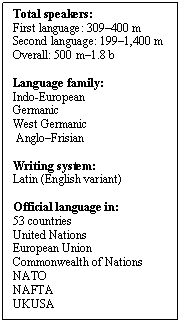 NB: Main category is verb, as a result of turbulent history and insular geographic position
1. Celtic languages are limited to a few areas in Great Britain, the Isle of Man, Ireland, Cape Breton Island, Patagonia, and on the peninsula of Brittany in France. The spread to Cape Breton and Patagonia occurred in modern times. In all areas the Celtic languages are now only spoken by minorities.
2. History Old English ð Old Norse language of Viking invaders ðMiddle English , borrowing heavily from the Norman
Celtic-Latin-Anglo-Saxon-Latin-French-Dutch-English-Modern English
3. Borrowings from Latin
4. Germanic borrowings
5. Standards for learners
6. Vocabulary
7. Written accents
8. Lingwa Franca
Question 26: Early History of the USA
Plan:
1. The earliest settlers – Asian (Siberians, Mongolians) hunters and nomads who followed the game. Beringia
2. The first Europeans were Icelandic Vikings, led by Leif Ericson, in about the year 1000.
Modern Europeans knew nothing about the American continent till the 15th century.
3. Spain
- Need for gold > India > Osmans > New way
- Presupposition the Earth was spherical.
- Spanish throne strengthened its positions, got absolute power and began outer territorial expansion.
- In 1492, the Italian navigator Christopher Columbus landed on one of the Bahama Islands.
- In 1497 Amerigo Vespucci proved that the land discovered by Columbus was not India, but a new land
4. For the next 100 hundred years Spanish, Portuguese, Dutch, English and French explorers sailed from Europe for the New World, looking for gold, riches, honour, and glory. But instead of this they had to face wild severe land.
5. Britain
- The first steps were stimulated by hostility to Spain, Henry VIII’s reforms
- 17th century in - New England near Cape Cod in Virginia. Puritans
- Businessmen. Criminals
6. Colonial America
The 3 main nations – England, Spain and France – the chief nations who established the colonies.
Spain – Florida Texas, Southwest including California.
The French – the St. Lawrence River (Quebec and Montreal), the Great Lakes, the Mississippi, Louisiana
Gradually Britain began to dominate. And the colonies paid duty on different things. Colonization lasted for 300 hundred years. The peoples approached from the east to the west and from the south to the north.

|
Из за большого объема этот материал размещен на нескольких страницах:
1 2 3 4 |
