

Партнерка на США и Канаду по недвижимости, выплаты в крипто
- 30% recurring commission
- Выплаты в USDT
- Вывод каждую неделю
- Комиссия до 5 лет за каждого referral
THE ARTICLES MENTIONED BELOW ARE APPLICABLE ONLY FOR THE UNITED STATES AND CANADA.
1. NOISE EMISSION WARRANTY
SANYANG INDUSTRY CO.,LTD. warrants that this exhaust system, at the time of sale, meets all applicable U. S. EPA Federal noise standards. This warranty extends to the first person who buys this exhaust system for purposes other than resale, and to all subsequent buyers. Warranty claims should be directed to:
3,chung-Hua Road, Hukou, Hsin-Chu Taiwan, R. O.C
Tel:+Fax:+
2. TAMPERING WARNING
Tampering with noise control system prohibited. Federal law prohibits the following acts or causing thereof:
(1) The removal or rendering inoperative by any person other than for purposes of maintenance, repair, or replacement, of any device or element of design incorporated into any new vehicle for the purpose of noise control prior to its sale or delivery to the ultimate purchaser or while it is in use, or
(2) The use of the vehicle after such device or element of design has been removed or rendered inoperative by any person.
Among those acts presumed to constitute tampering are the acts listed below.
(1) Removal of, or puncturing the muffler, baffles, header pipes or any other component which conducts exhaust gases.
(2) Removal or puncturing of any part of the intake system.
(3) Lack of proper maintenance.
Replacing any moving part of the vehicle, or parts of the exhaust or intake system, with parts other than those specified by the manufacturer. t 80
3. SAFETY INFORMATION
Ÿ Always wear your helmet (dot approved) correctly fastened. Do not carry loose items and always wear suitable protective clothes, and protective eyewear.
Ÿ Good psychophysical conditions are very important for safe operation.
Ÿ Do not operate under the influence of drugs and/or alcohol.
Ÿ Do not operate in state of physical fatigue or drowsiness.
Ÿ Slow down on slippery surfaces, unfamiliar terrain and when visibility is reduced.
Ÿ Be alert when operating this vehicle.
Ÿ Do not exceed weight capacity.
Ÿ The safety, stability and handling of this motorcycle may be adversely affected by the addition of accessories or luggage.
Ÿ Do not install accessory or replacement parts not approved by sym.
Ÿ Failure to follow these warnings could lead to an accident, serious injuries or death.
Ÿ Use unleaded fuel octane rating (R+M)/2 method of between 87&92.
Ÿ Read owners manual carefully before operating this scooter.
Ÿ Obey posted speed limit and other traffic signs and signals.
4. SAFETY DEFECT REPORT
SANYANG INDUSTRY CO., Ltd.
NO. 3,chung-Hua Road
Hukou Shiang
Hsin-Chu County, 303
Taiwan, R. O.C
Reporting Safety Defects
If you believe that your vehicle has a defect which could cause a crash or could cause injury or death, you should immediately inform the National Highway Traffic Safety Administration (NHTSA) in addition to notifying Sanyang Industry Co., Ltd.
If NHTSA receives similar complaints, it may open an investigation, and if it finds that a safety defect exists in a group of vehicles, it may order a recall and remedy campaign.
However, NHTSA cannot become involved in and individual problems between you, your dealer, or Sanyang Industry Co., Ltd.
To contact NHTSA you may call the Vehicle Safety Hotline toll-free at 236 (TTY:153);go to http://www. safercar. gov; or write to :
Administrator, NHTSA
400 Seventh Street SW.,
Washington, DC 20590
You can also obtain other information about motor vehicle safety from http://www. safercar. gov.
1... Contents...................................................................................................................................... 1
2... Control Location........................................................................................................................ 3
3... Before Riding............................................................................................................................. 4
4... Safe Riding................................................................................................................................. 4
5... Driving ......................................................................................................................................... 5
6... Use Genuine Spare Parts........................................................................................................ 5
7... Use of Each Component......................................................................................................... 6
Gauges......................................................................................................................................... 6
Operation of Ignition Switch...................................................................................................... 9
Use of Buttons........................................................................................................................... 10
Engine control switch.............................................................................................................. 13
Storage Box................................................................................................................................... 13
Pillion Step.................................................................................................................................... 13
Fuel Tank Cap........................................................................................................................... 14
Brake.......................................................................................................................................... 15
Parking brake............................................................................................................................ 15
8... Important Points and Cautions for Starting Engine.......................................................... 16
9... The Best Way to Drive off...................................................................................................... 17
The Control of Throttle Valve Handle..................................................................................... 17
Parking Method........................................................................................................................ 17
10. Inspection and Maintenance before Riding....................................................................... 18
Routine Inspection................................................................................................................... 18
Engine Oil Inspection and Change........................................................................................ 18
Fuel Inspection......................................................................................................................... 20
Transmission Oil Inspection and Change............................................................................ 20
Inspection and Adjustment of Brake Free Play...................................................................... 21
Brake lever adjustment knob................................................................................................... 21
Disc Brake Inspection.............................................................................................................. 22
Throttle Valve Handle Clearance Adjustment........................................................................ 22
Inspection and Maintenance of Battery.................................................................................. 23
Tire Inspection.......................................................................................................................... 24
Steering Handle Front Shock Absorbers Inspection............................................................ 24
Rear Cushion Hardness Setting............................................................................................. 25
Checking and Changing Fuses.............................................................................................. 25
Checking the Turn Signal Lights and Horn........................................................................... 25
Checking the Front and Rear Lights...................................................................................... 26
Checking the Brake Light........................................................................................................ 26
Checking for Fuel Leakage...................................................................................................... 26
Checking the Lubrication of Body’s Various Mechanisms................................................... 26
Checking the Spark Plug......................................................................................................... 26
Cooling system inspection...................................................................................................... 27
Replenishment of coolant........................................................................................................ 27
A reference table for anti-freeze concentration percentages under different temperatures 28
Crankcase Blow-By Ventilation............................................................................................... 28
Checking the Air Cleaner......................................................................................................... 29
11. When there is an Abnormal Condition or a Trouble........................................................ 30
Diagnosis when Engine does not Start................................................................................. 30
12. Suggestions on Engine Fuel................................................................................................ 31
13. Transmission Oil..................................................................................................................... 31
14. Cautions for Riding Scooter.................................................................................................. 31
15. Periodical Maintenance Schedule...................................................................................... 32
16. Specification ............................................................................................................................ 33
 |
|
|



|
|


|
|

|


|


|

|

|

|
|

|
|

|
|

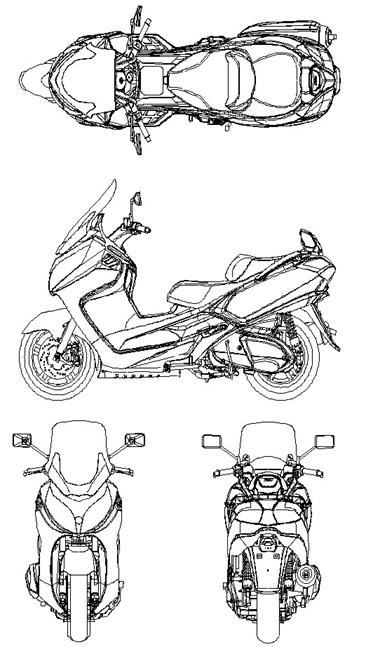
This manual describes the correct usage of this scooter including safety riding, simple inspection methods and so on.
For a more comfortable and safety riding, please read this manual carefully.
For your benefit, please ask your SANYANG dealer the operating manual and carefully read the following: · Correct use of the scooter. · Pre-delivery inspection and maintenance. |
Thank you very much for your patronage In order to maximize your scooter’s performance, a periodical inspection and maintenance should be completely carried out. We recommend that after riding your new scooter for the first 300 kilometers, you should take your scooter to the original dealer for an initial inspection, and to have your scooter inspected periodically every 1000 kilometers thereafter. |
· In case the scooter’s specifications and construction are modified and different from the photos and diagrams on the owner’s manual / catalogues, the specifications and construction of the actual scooter shall prevail.
4. SAFE RIDING
It is very important to be relax and clothe properly when driving, observe traffic regulations, do not rush, always drive carefully and relaxed.
Usually, most people would ride their newly bought scooter very carefully, but after they became familiar with their scooters, they tended to become reckless which may result in an accident.
% To remind you: · Please wear a safety helmet, and properly tighten the chin belt when riding a scooter. · Clothes with open or loose cuffs may be blown by wind and cause the cuffs to get caught on the steering handle and thus affects riding safety. · So, put on clothes with tight sleeves. · Hold the steering handle by both hands when riding. Never ride with only one hand. · Observe the speed limit. · Wear suitable low-heel shoes. · Perform periodical maintenance and inspection in accordance with the schedule. |
· To avoid getting burned by exhaust pipe when taking a passenger. Make sure your passenger has put his/her feet on the pedals. · After running, the exhaust pipe is very hot, be careful not to get burned when conducting an inspection or maintenance. · After running, the exhaust pipe is very hot, select a suitable location to park your scooter to avoid others getting burned by the exhaust pipe. |
 WARNING!!
· Modified scooter will affect its structure or performance, and cause poor engine operation or exhaust noise, which will result in shortening the scooter’s service life. Besides, modification is illegal and does not conform to the original design and specifications. A modified scooter will not be covered by warranty, therefore, do not modify your scooter at will. · Tire and rim modifications will make it unsafe to ride and may cause severe injury or death. |
Keep the related parts of your body such as arms, palms, lumbar, and toes relax and ride with the most comfortable posture in order to be able to react quickly whenever it is necessary.
· Rider’s posture will greatly affect riding safety. Always keep your body’s gravity in the center of the saddle, if your body’s gravity is on the rear part of saddle, the front wheel load will be reduced, and this will cause the steering handle shaking. It is dangerous to ride a scooter with an unstable handle.
· It will be much easier to make a turn if rider inclines his body inward when turning. On the other hand, the rider will feel unstable if his body and the scooter do not incline.
· The scooter is hard to control on a bumpy, unleveled, unpaved road, try to know the road conditions in advance, slow down and use your shoulder’s force to control the handle.
· Suggestion: Do not load objects on the front pedals unnecessarily, to avoid affecting the riding safety and the operation of steering handle.
The rider’s feeling on the handle is slightly different with a load or without a load. Overload may cause the handle to swing and affects the riding safety. Therefore, do not overload your scooter. Ÿ Overloading the scooter will cause the scooter to become unstable and hard to maneuver, it may cause serious damage to the tires and rims, as well as it may change the center of gravity, which could result in an accident that could cause injury or death. Do not exceed the maximum authorized load. |
· Do not place flammable materials such as rags between the body side cover and engine to avoid components damaging by fire. · Do not load objects on areas not specified for loading to avoid damage. |
SUGGESTION To maximize the scooter’s performance and prolong its service life: The first month or first 1000km is the wear - in period for the engine and components. Avoid rapid acceleration, and keep the speed below 60km/hr. |
6. USE GENUINE SPARE PARTS
In order to maintain the scooter’s best performance, each part’s quality, material, and machined precision must conform with the design requirements. “SYM Genuine Spare Parts” were made from the same high quality materials used for the original scooter. No parts would be sold to the market until they could meet the designed specifications through sophisticated engineering and stringent quality control. Therefore, it is necessary to purchase “SYM Genuine Spare Parts” from “SYM Authorized Dealers or Franchised Dealers” when replacing spare parts. If you buy cheap, or fake substitute parts from the market, no guarantee can be provided either for the quality or durability. Also, it may result in unexpected troubles and lower the scooter’s performance.
· Always use SYM Genuine Spare Parts to keep your scooters pure blood and to ensure its long service life.
(The following is SYM 4 stroke liquid cooling scooter’s basic operation, and they could vary from different individual models. Please consult the end of this manual.)
GAUGES
 |
 |

|


|

|

|
 | |
| |
· Not to have trouble on electrical meter working, or damage the electrical meter. · Do not wipe plastic components, e. g. instrument panel, headlight, with organic solvents such. · As gasoline…etc. to avoid damaging these components. |
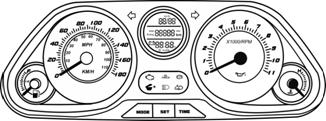
Ÿ Speedometer:
This shows your speed in kilometers per hour (km/h) and in mileage per hour (mph).
Ÿ Odometer:
This odometer shows the total kilometers this motor has been driven.
Ÿ Turn Signal Indicator:
The left or right Indicator will be flashing according to the operated directions of turn signal light switch when it is turned on.
Ÿ Fuel Gauge:
The pointer in this gauge shows how much fuel remains in the tank.
The pointer stays in “E” position when key switch is turned to “OFF.”
When key switch is turned to “ON”, and the “pointer” also in “E” position (red area).
Refuel immediately.
Ÿ Water temperature gauge:
To indicate engine coolant temperature.
When the main switch turns to “ON”, the pointer indicator should be below the (H) position when the scooter is operating.
If the pointer indicator stays above (H) position. Please check the coolant level of spare coolant tank and check cooling fan for proper operation.
Ÿ Engine Oil Pressure Warning Light
If this indicator is activated more than 10 seconds after engine started, stop engine & check engine lubrication.
 |


|

|
|
|
|
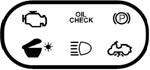
Ÿ EFi Indicator
It displays the condition of the EFi system. If there is any problem in the EFi system, the warning indicator will blink or light up all the time.
· Engine oil indicator
Engine oil indicator is for showing engine oil inspection / replacement time. When the vehicle is ridden for approximately 5,000 kilometer, engine oil indicator illuminates which means engine oil inspection / replacement is needed. Press “MODE” (Oil Reset) button to reset engine oil mileage. Engine oil indicator goes off when the “MODE” button is pressed and the engine oil mileage will be recalculated from the current riding mileage. Engine oil level should be checked every 1,000 kilometer and replaced every 5,000 kilometer.
· Parking brake indicator: This means that the parking brake is pulled up.
· Storage box Indicator:This demonstrated the Storage box lamp opens.
Ÿ High Beam Indicator:
This indicator comes on when the high beam headlight switch is turned on.
· Side Stand warning indicator:
When the side stand pulls down, the warning indicator tights on and the engine cannot be started, when the side stand raises up, the indicator goes out and the engine can be started.
Make sure the side stand is completely retrieved before riding to preventing causing danger. |
|
|
|


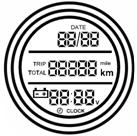
“TIME” Button
a. When the vehicle stands still and the meter shows on ”ODO” mode. Press the “TIME” button more than two seconds to enter the calendar & clock setting mode.
b. When calendar / clock is set up. Press the “SET” button shortly to set up for year, month, date, hour and minute.

 YEAR → MONTH → DATE → HOUR → MINUTE
(FLASHING) (FLASHING) (FLASHING) (FLASHING) (FLASHING)
c. Press the “MODE” button shortly to increase the unit digit. Under the clock setting mode, press the “TIME” button more than two seconds to complete clock setting.
“MODE” Button
a. Press the “MODE” button shortly to switch from odo mode, trip mode and voltage gauge.
 |
b. Engine oil replacement indicator light will illuminate when the vehicle is ridden for approx. 5,000 km, which means the engine oil should be checked or replaced. Key on and press the “MODE” button for at least two seconds after replacing the engine oil, the engine oil replacement indicator light will extinguish.
“SET” Button
a. Press the “SET” button for at least two seconds under tripmeter mode, the trip mileage can be erased.
b. Key on and press the “SET” button shortly to switch from km & mile mode.
Battery Voltage Display
1. Showing the battery voltage.
2. After the main switch is on, the battery voltage will show at least 10 seconds and then clock shows.
Ÿ If the battery voltage is below 10.0V when the main switch is on, the light system is off and the engine is not started, check the battery at SYM dealer. Ÿ If the battery voltage is below 10.0V or over 16.0V when the vehicle is moving, check the battery at SYM dealer. |
 CAUTION:
OPERATION OF IGNITION SWITCH
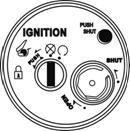

IGNITION SWITCH IGNITION SWITCH KEY
 "Start" position
· Engine can be started in this position.
· Ignition switch key can not be removed.
 "Stop" position
· Engine is shut off and can not be started in this position.
· Ignition switch key can be removed.
 "Steering handle lock" position
· Turn the steering handle to left and press ignition switch key down and then lightly turn it to left to the “LOCK” position.
· The steering handle is locked in this position.

|
Из за большого объема этот материал размещен на нескольких страницах:
1 2 3 4 5 |
