

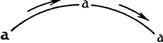
4. The "arc of loudness" or "arc of articulatory tension" theory is based on L. V. Shcherba's statement that the centre of a syllable is the syllable-forming phoneme. Sounds, which precede or follow it, constitute a chain, or an arc, which is weak in the beginning, in the end and strong in the middle.
If a syllable consists of a vowel, its strength increases in the beginning, reaches the maximum of loudness and then, gradually decreases. Graphically an arc of loudness or an arc of articulatory tension can represent it.
|
Consonants within a syllable are characterized by different distribution of muscular tension. Shcherba distinguishes the following types of consonants:
finally strong (initially weak), they occur at the beginning of the syllable;
finally weak (initially strong), they occur at the end of a closed syllable;
double peaked (combination of two similar sounds): in their articulation the beginning and the end are energetic and the middle is weak. Acoustically they produce an impression of two consonants: /'pen 'naIf/, /'gud 'deI/.
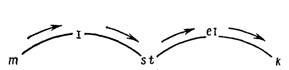
In terms of the "arc of loudness" theory there are as many syllables in a word as there are "arcs of loudness" and the point of syllable division corresponds to the moment, when the arc of loudness begins or ends, that is: initially weak consonants begin a (Finally strong consonants begin a syllable, initially strong end it.) For example, the word mistake consists of two arcs of loudness in which /m/ and /t/ are finally strong consonants and /s/ and /k/ are finally weak. /s/ constitutes the end syllable, finally weak end it of "the arc of loudness", /t/ constitutes the beginning.
|
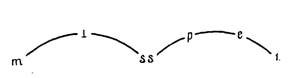
In the word misspell the double peaked /ss/ occurs at the junction of two syllables. The sound /s/ is strong at both ends and weak in the middle, phonologically it consists of two successive allophones of the same phoneme in:
|
A syllable can be defined as a phonetic unit, which is pronounced by one articulatory effort accompanied by one muscular contraction, which results acoustically and auditorily in one uninterrupted arc of loudness.
The experiment carried out by N. Zhinkin showed that it is the pharynx, which is responsible for the variations in the loudness of the syllable. Perceptually the peak, or the crest of the syllable, is louder and higher in pitch than the slopes.
On the acoustic level it is characterized by a higher intensity than the slopes, and in many cases by a higher fundamental frequency.
None of the theories mentioned above are reliable in the definition of the syllabic boundary. To define the syllabic boundary it is necessary to analyse the syllable on two levels: articulatory-auditory (phonetic-phonological), to take into consideration the structural pattern of the syllable.
Different types of the syllabic structure in orthography and speech characterize different languages.
In the Russian language syllables of CГ-CГ type have their boundary after the vowel: мо-ло-ко, о-ко-ло.
There are similar cases in English: wor-ker, ar-my, par-ty but /'w«:k-«/, /'a:m-I/, /'pa:t-I/ (stressed phonetic syllables).
In the Russian words with ГССГ structural type, the place of the syllabic boundary depends on the character of CC cluster. If it occurs initially, it may begin a syllable: мрак — о-мрачать, but Ал-тай, since лт does not occur initially (stressed phonetic syllables).
Similar distributional dependence of the syllabic boundary on the nature of the CC cluster exists in English. E. g.
great /greIt/ — agree /«-'gri:/, break /breIk/ — abrupt /«-brÀрt/
speak /spi:k/ — despite /dI-'spaIt/
sky /skaI/ — escape /I-'skeIp/
but: twice /twaIs/ — saltwort /'s:lt-w«:t/ (бот. солянка, солерóс, потáшник)
It is possible to formulate the following rules of syllable division in English: 1.2 — orthography, 3.4 — phonetics.
1. In affixal words the syllabic boundary coincides with the morphological boundary: dis-place, be-come, un-able, count-less.
2. In words with CVCV structure the syllabic boundary is after the accented vowel: farmer, city, table.
3. In words of CVC structure the syllabic boundary is after the intervocal consonant, which terminates accented syllable: /fa:m-«/, /'sit-i/, /teib-«l/.
4. In words of CVS, VS structure the syllabic boundary is after the intervocalic sonorant: inner /In-«/, cinema /sIn-«m-«, enemy /en-«m-I/.
5. English diphthongs are unisyllabic, they consist of one vowel phoneme, English triphthongs are disyllabic, because they consist of two vowel phonemes: science /'saI-«ns/, flower /'flaU-«/.
FUNCTIONAL CHARACTERISTICS OF THE SYLLABLE
The syllable as a phonological unit performs three functions: constitutive, distinctive, identificatory. They are closely connected.
1. Constitutive Function
Syllables constitute words, phrases and sentences through the combination of their prosodic features: loudness — stress, pitch — tone, duration — length and tempo. Syllables may be stressed, unstressed, high (pitch of the voice), mid, and low, rising, falling, long, short. All these prosodic features constitute the stress pattern of words, tonal and rhythmic structure of an utterance; help to perform distinctive variations on the syllabic level.
2. Distinctive and Differentiatory Function
If we compare the words: lightening ‘освещение’ and lightning ‘молния’, we may observe that their syllabicity is the only minimal, distinctive feature: /'laItņIN/ vs. (versus ‘против’) 'laItnIN/.
It is an example of the word-distinctive function of the syllable.
There are rather many combinations in English distinguished from each other by means of the difference in the place of the syllabic boundary: a name — an aim, ice cream — I scream, we loan — we'll own: /«'neIm/ — /«n 'eIm/, /'aIs'kri:m/ — /aI'skrI:m/, /wI'l«Un/ — /wIl'«Un/.
The distinctive, differentiatory function of the syllabic boundary makes it possible to introduce the term "juncture". Close juncture or conjuncture occurs between sounds within one syllable, e. g. a name, I scream: in the first example the close juncture is between /n/ and /eI/, in the second — between /s/ and /k/. Open juncture, disjuncture or internal open juncture occurs between two syllables. If we mark open juncture with /+/ then in our examples it will occur between a+name, I + scream. American scientists H. A. Gleason, L. S. Harris and K. Pike consider the open juncture a separate segmental phoneme. They include /+/ into the 'inventory of phonemes as a separate differentiatory unit.
3. Identificatory Function
This function is conditioned by the pronunciation of the speaker. The listener can understand the exact meaning of the utterance only if he perceives the correct syllabic boundary — "syllabodisjuncture", e. g. pea stalks ‘стебли гороха’ — peace talks ‘мирные переговоры’; my train ‘мой поезд’ — might rain ‘возможен дождь’.
The existence of such pairs demands special attention to teaching not only the correct pronunciation of sounds but also the observation of the correct place for syllabodisjuncture.
GRAPHIC CHARACTERISTICS OF THE SYLLABLE
The auditory image of a syllable can be shown in transcription: unknown /ÇÀn-'n«Un/, liner /'laIn-«/, maker /'meIk-«/. Parts of orthographic and phonetic syllables do not always coincide. E. g.
Word | Phonetic syllables | Orthographic syllables (Syllabographs) |
table | /'teIb-«l/ | ta-ble |
laden | /'leId-«n/ | la-den |
Spanish | /'spQn-IS/ | Span-ish |
It is very important to observe correct syllable division when necessity arises to divide a word in writing. Division of words into syllables in writing (syllabographs) is based on morphological principles. The morphological principle of word division in orthography demands that the part of a word, which is separated, should be either a prefix, or a suffix, or a root (morphograph): un-divided, utter-ance, pun-ish, be-fore.
However, if there are two or three consonants before -ing, these consonants may be separated in writing, e. g. gras-ping, puz-zling.
Words can be divided in writing according to their syllabic structure, e. g. un-kind-li-ness. They can also be divided according to their meaning, e. g. spot-light.
There are six rules to help with dividing a word in writing:
1) Never divide a word within a syllable.
2) Never divide an ending (a suffix) of two syllables such as - able, - ably, - fully.
3) With the exception of -ly, never divide a word so that an ending of two letters such as - ed, - er, - ic begins the next line.
4) Never divide a word so that one of the parts is a single letter.
5) Never divide a word of one syllable.
6) Never divide a word of less than five letters.
Basic notions: syllable, acoustic, auditory, articulatory, functional, phonological, syllabograph, syllable formation, the expiratory theory, the sonority theory, scale of sonority, arc of loudness, arc of articulatory tension, constitutive, distinctive, identificatory, morphological principles.
Topics for discussion in class: (2 часа)
1. The syllable from the acoustic and auditory, articulatory and functional points of view.
2. Theories of syllable formation and syllable division.
3. Functional characteristics of the syllable.
4. Graphic characteristics of the syllable.
Tasks for independent work: (4 часа)
1. Practice the pronunciation of new phonetic terms before you start working at the lecture. Pronounce them correctly in your speech.
2. Prove that the syllable as a phonological unit performs three functions which are closely connected.
3. Explain the different points of view on syllable formation.
4. Name the rules of syllable division in English.
5. Get ready to give the summary, using new phonetic terms of the lecture.
Answer the following questions:
1. What is a syllable?
2. What are the lines along which a syllable can be analyzed?
3. What is the structure of the syllable?
4. Define the peak and the slopes of the syllable.
5. What is the role of sonorant in syllable formation?
6. Speak on the theories of syllable formation.
7. What do you know about syllable division?
8. How does the syllable perform constitutive and distinctive functions?
9. What is "disjuncture" ("internal open juncture"), "close juncture" ("conjuncture")?
10. What rules of syllable division in writing do you know?
Vocabulary ‘Словарь терминов к теме’
abrupt /«-brÀрt/ ‘внезапный, мгновенный, неровный, обрывистый, крутой’
arc ‘дуга’
accented syllable [«k'sentId 'sIl«bl] ‘акцентируемый слог. Выделяемый различными фонетическими средствами, т. е. ударный слог’
accented vowelz [«k'sentId vaU«lz] ‘акцентированные гласные. Слогообразующие гласные выделяемых слогов, ударные гласные’
affixal ['QfIks«l] ‘аффиксальный’
auditorily ['(:)dIt«rIlI] ‘на слух’
back slope of the 'teeth-ridge ‘задний склон альвеолярного бугра. Узкая полоска внутренней поверхности альвеолярной дуги’
by one muscular con'traction ‘одним мускульным сжатием (стяжением, сокращением)’
coincide [Çk«uIn'saId] ‘совпадать, соответствовать, равняться’
conjuncture [k«n'dZÀNktS«] – ‘a combination of circumstances or affairs; a particular state of affairs ‘стечение обстоятельств (at this conjuncture ‘в сложившихся условиях’)’
constitute a chain ‘составляет цепь’
constitutive [k«n'stItjutIv] ‘определяющий, основополагающий, учредительный, устанавливающий, существенный’
define [dI'faIn] ‘очерчивать, обозначать (границы); определять, давать (точное) определение, давать характеристику’
differentiatory [ÇdIf«'renSIeIt«rI] ‘дифференциальную, различительную’
disjuncture [dis'dZÀNktS«] ‘разделение, разъединение’
distinctive [dI'stINktIv] ‘дифференциальный, дистинктивный, различительный, лингвистически (семиологически) релевантный’
frequency ['fri:kw«nsI] ‘частота. Быстрота колебаний, определяющая восприятие высоты звука. Число колебаний в секунду, обуславливающее физическое свойство высоты тона’
identificatory [aIÇdentIfI'keIt«rI] ‘идентификационная, отождествляющий, устанавливающий совпадения чего-л. с чем-л.’
inventory ['Inv«ntrI] ‘инвентарь’
intervocal [ÇInt«'vo(U)k«l] – ‘интервокальный’
intervocalic [ÇInt«vo(U)'kQlIk] ‘межвокальный, интервокальный. Занимающий положение между двумя гласными звуками’
juncture ['dZÀNktS«] ‘сочленение, соединение. Стык слов или место слияния смежных звуков. Фонетические особенности их соединения и характер промежуточных фаз пристyпа-отступа’
loan [loun] ‘давать взаймы’
observe [«b'z«:v] ‘наблюдать, замечать’
reliable [rI'laI«bl] ‘надежный, заслуживающий доверия, достоверный’
reliable information ‘достоверные сведения’
syllabicity ‘силлабичность, слоговость vs. (versus ‘против’)’
scream ‘кричать, визжать’
slope ‘склон, скат. см. back slope of the 'teeth-ridge’
terminate ['t«:mIneIt] ‘ставить предел, положить конец, завершить’
triphthong ['trIfTN] ‘трифтонг. Сложный гласный звук, содержащий три тембральных оттенка в слитном состоянии. Термин отличается известной условностью, так как, по аналогии с дифтонгом, он как бы подразумевает односложность. В действительности трифтонги обычно состоят из дифтонга плюс гласный и произносятся в медленном стиле как два слога, например: [aU – «], [aI – «]. Лишь при полной редукции второго элемента трифтонги утрачивают двусложность, но при этом образуют новые дифтонги, например: our [aU«, a(U)«, a«]’
unisyllabic [Çju:nIsI'lQbIk] ‘односложный, состоящий из одного слога’
Literature:
1. Jones D. An English Pronouncing Dictionary. London, 1957.
2. Leontyeva S. F. A Theoretical Course of English Phonetics. – М., 2002.
3. O'Connor T. D. Phonetics. Pelican Books, 1977.
4. Длительность английских гласных фонем в зависимости от способа примыкания к последующему согласному. // ИЯШ, 1967, № 3.
5. Р. Общая фонетика. – Л., 1979.
6. , , Теоретическая фонетика английского языка. – М., 2004.
7. Торсуев Г. П. Проблемы теоретической фонетики и фонологии. – М., 1969.
8. Английская фонетическая терминология. – М., 1962.
Part V. stress
Lecture 8. Word Stress (2 часа)
Stress is defined differently by different authors. B. A.Bogoroditsky, for instance, defined stress as an increase of energy, accompanied by an increase of expiratory and articulatory activity. D. Jones defined stress as the degree of force, which is accompanied by a strong force of exhalation and gives an impression of loudness. H. Sweet also stated that stress is connected with the force of breath. Later, however, D. Jones wrote, that "stress or prominence is inherent sonority, vowel and consonant length and by intonation." A. C.Gimson also admits that a more prominent syllable is accompanied by pitch changes in the voice, quality and quantity of the accented sounds.
On the auditory level a stressed syllable is the part of the word which has a special prominence. It is produced by a greater loudness and length, modifications in the pitch and quality. The physical correlates are: intensity, duration, frequency and the formant structure. All these features can be analyzed on the acoustic level.
Word stress can be defined as the singling out of one or more syllables in a word, which is accompanied by the change of the force of utterance, pitch of the voice, qualitative and quantitative characteristics of the sound, which is usually a vowel.
Any word spoken in isolation has at least one prominent syllable. We perceive it as stressed. Stress in the isolated word is termed word stress, stress in connected speech is termed sentence stress. Stress is indicated by placing a stress mark before the stressed syllable: /È/.
In different languages one of the factors constituting word stress is usually more significant than the others. According to the most important feature different types of word stress are distinguished in different languages.
1) If special prominence in a stressed syllable or syllables is achieved mainly through the intensity of articulation, such type of stress is called dynamic, or force stress.
2) If special prominence in a stressed syllable is achieved mainly through the change of pitch, or musical tone, such accent [ÈQks«nt] is called musical, or tonic. It is characteristic of the Japanese, Korean and other oriental languages.
3) If special prominence in a stressed syllable is achieved through the changes in the quantity of the vowels, which are longer in the stressed syllables than in the unstressed ones, such type of stress is called quantitative.
4) Qualitative type of stress is achieved through the changes in the quality of the vowel under stress.
English word stress is traditionally defined as dynamic [daiÈnQmik], but in fact, the special prominence of the stressed syllables is manifested in the English language not only through the increase of intensity, but also through the changes in the vowel quantity, consonant and vowel quality and pitch of the voice (A stressed syllable carries a rhythmic beat. Accent is intonational pitch prominence.).
Stress can be characterized as fixed and free. In languages with fixed type of stress the place of stress is always the same. For example in Czech and Slovak the stress regularly falls on the first syllable. In Italian, Welsh, Polish it is on the penultimate syllable.
In English word-stress is free, that is it may fall on any syllable in a word:
on the first — 'mother
on the second — occasion
on the third — deto'nation
Stress in English is not only free but also shifting, e. g. 'billow is ‘морской вал’, be'low —‘вниз’. In English the place of stress may shift, which helps to differentiate different parts of speech, e. g. 'insult — to in'suit, 'import — to im'port.
When the shifting of word-stress serves to perform distinctive function, V. Vassilyev terms this suprasegmental phonological unit form distinctive accenteme, when it serves to distinguish the meaning of different words, the term is word-distinctive accenteme.
Stress performs not only distinctive function, it helps to constitute and recognize words and their forms (constitutive and recognitive functions).
D. Jones, R. Kingdon, V. A. Vassilyev consider that there are three degrees of word-stress in English: primary — strong, secondary — partial, weak — in unstressed syllables. For example: certification [Çs«:tifi'keiSn].
Most English scientists place the stress marks before the stressed syllables and don't mark monosyllabic words.
In spite of the fact that word accent in the English stress system is free, there are certain factors that determine the place and different degree of word-stress. V. A. Vassilyev describes them as follows: 1) recessive tendency, 2) rhythmic tendency, 3) retentive tendency and 4) semantic factor.
1) Recessive tendency results in placing the word-stress on the initial syllable. It can be of two sub-types: (a) unrestricted recessive accent, which falls on the first syllable: father /'fA:D«/, mother /'mÃD«/ and (b) restricted recessive accent, which is characterized by placing the word accent on the root of the word if this word has a prefix, which has lost its meaning: become /bi'kÃm/, begin /bi'gin/.
2) Rhythmic tendency results in alternating stressed and unstressed syllables, e. g. pronunciation /рr«ÇnÀnsiÈeiS («)n/.
3) Retentive tendency consists in the retention of the primary accent on the parent word, e. g. person — personal /'p«:sn — 'p«:snl/. More commonly it is retained on the parent word as a secondary accent, e. g. similar — similarity /'simil« — simi'lQriti/.
4) Semantic factor.
Basic notions: stress, exhalation, inherent sonority, intensity, duration, frequency, the formant structure, qualitative, quantitative, a prominent syllable, dynamic, accenteme, recessive tendency, rhythmic tendency, retentive tendency.
Topics for discussion in class: (2 часа)
1. The accent terminology suggested by different authors.
2. Types of word-stress.
3. The place and different degree of word stress in English.
Tasks for independent work (4 часов):
1. Concentrate your attention on pronunciation of new phonetic terms used in the pare their explanations and definitions in the English and Russian languages.
2. Characterize all types of word stress.
3. Explain the usage of recessive, rhythmic, retentive tendencies and semantic factor.
4. Get ready to give the summary, using new phonetic terms of the lecture.
Answer the following questions:
1. How is stress defined by different authors?
2. What is stress on the auditory, articulatory and acoustic level?
3. What types of word-stress do you know?
4. To what type of word-stress does the English accentual structure belong?
5. What is the difference between free and fixed word accent?
6. What is the accent terminology suggested by different authors?
7. What are the factors that determine the place and different degree of word stress in English?
Vocabulary:
dynamic accent [daiÈnQmik ÈQks«nt] ‘силовое ударение; динамический акцент’
prominence – выделенность (акустическая). Преимущество в отчётливости звучания. Преимущество в отчётливости звучания, обычно отождествляемое с громкостью. Кратчайшим, способным акустически выделяться слог, неизменно обладающий вершиной громкости в оптимальной фазе слогообразующего звука. Слоговое строение слова, синтагмы, предложения обеспечивает возможность выделения любого лексического отрезка путём усиления акустической активности слоговых вершин.
prominent – выделяющийся (по громкости). Акустически выделяющийся (слог, слово или какой-либо синтаксический отрезок речи).
Èmanifest – ясно показывать, проявлять, обнаруживать, делать очевидным, служит доказательством
increase – n. [Èinkri:s] (an increase in pay ‘прибавка к зарплате’) возрастание, увеличение, прибавление; v. [inÈkri:s] – усиливать(ся)
quantity [Èkwntiti] – количество. Длительность звука речи; его долготная характеристика. В более точном смысле термин обозначает степень изменчивости той или иной нормы длительности, присущей каким-либо фонемам языка.
quality [Èkwliti] – качество или тембр (звука речи). Особый признак, дающий возможность дифференцировать звуки речи, совпадающие по высоте, интенсивности и длительности, но обладающие различными оттенками звучания.
pitch [pitS] (of the voice) – высота основного тона. Главный признак музыкального различения звуков речи, произносимых с участием голоса. Высота основного тона определяется частотой колебаний всей вибрирующей системы и не зависит от оформляющих тембр звука речи гармоники, более высоких по тону, но менее интенсивных по амплитуде. (См. 1. fundamental pitch, 2. frequency: 1.fundamental pitch – основной тон. В большинстве случаев самая низкая и самая интенсивная частота сложного звука. Основной тон вибраций голосовых связок, возникающий как результат колебательных движений всей системы и воспринимаемый на слух в качестве высотной характеристики тонального элемента слога, которая выступает в своей лингвистической функции в акцентном и интонационном строе различных языков; 2. frequency [Èfri:kw«nsi] частота. Быстрота колебаний, определяющая восприятие высоты звука. Число колебаний в секунду, обуславливающее физическое свойство высоты тона.)
beats [bi:ts] – ритмические удары, равномерно чередующиеся звуковые импульсы. В речевой интонации – акцентные вершины ритмически выделяемых слогов.
penultimate [p«ÈnÀlt(im«t)] – грам. предпоследний n. предпоследний слог
shifting ‘изменение, чередование’
to perform ‘исполнять, выполнять’
distinctive – отличительный, характерный
accenteme [ÈQksenti:m] – The distinctive function makes word accent a separate suprasegmental, or prosodic phonological unit, e. g. preimary and weak word accentemes perform word distinctive functions in English: 'billow, be'low.
re'cessive tendency – рессесивная тенденция. Постепенное ослабление и исчезновение разноместности индоевропейского словесного ударения в германских языках вследствие оттягивания его к началу слова, закрепляя на первом, обычно корневом слоге, являющемся смысловой основой.
retentive tendency [ri'tentiv] – удерживание, сохранение
Literature:
1. Jones D. An English Pronouncing Dictionary. London, 1957.
2. Leontyeva S. F. A Theoretical Course of English Phonetics. М., 2002.
3. O'Connor T. D. Phonetics. Pelican Books, 1977.
4. Просодические контрасты в языке. – Симферополь, 1983.
5. К вопросу об обучении фразовому ударению в современном английском языке. // ИЯШ, 1973, № 5.
6. Р. Общая фонетика. – Л., 1979.
7. , , Теоретическая фонетика английского языка. – М., 2004.
8. Торсуев Г. П. Проблемы теоретической фонетики и фонологии. – М.,1969.
9. Английская фонетическая терминология. – М., 1962.
10. Основы фонологии. – М., 2000.
Part VI. Intonation
Lecture 9. Intonation and Its Components (4 часа)
Intonation organizes a sentence, determines communicative types of sentences and clauses, divides sentences into intonation groups, gives prominence to words and phrases, expresses contrasts and attitudes. The two main functions of intonation are: communicative and expressive.
There are two main approaches to the problem of intonation in Great Britain. One is known as a contour analysis and the other may be called grammatical.
The contour analysis is represented by a large group of phoneticians: H. Sweet, D. Jones, G. Palmer, L. Armstrong, I. Ward, R. Kingdon, J. 0' Connor, A. Gimson and others. It is traditional and widely used. According to this approach the smallest unit to which linguistic meaning can be attached is a tone-group (sense-group). Their theory is based on the assumption that intonation consists of basic functional "blocks". They pay much attention to these "blocks" but not to the way they are connected. They treat intonation as a layer that is superimposed on the lexico-grammatical structure. In fact the aim of communication determines the intonation structure, not vice versa.
M. Halliday worked out the grammatical approach to the study of intonation. The main unit of intonation is a clause. Intonation is a complex of three systemic variables: tonality, tonicity and tone, which are connected with grammatical categories. Tonality marks the beginning and the end of a tone-group. Tonicity marks the focal point of each tone-group. Tone is the third unit in Halliday's system. Tones can be primary and secondary. They convey the attitude of the speaker. Halliday's theory is based on the syntactical function of intonation.
The founder of the American school of intonation is K. Pike. In his book "The Intonation of American English" he considers "pitch phonemes" and "contours" to be the main units of intonation. He describes different contours and their meanings, but the word "meaning" stands apart from communicative function of intonation. A. Antipova in her "System of English Intonation" characterizes the approach of the American school to the study of intonation system as "mechanical".
MELODY
Speech melody or pitch of the voice is closely connected with sentence stress. Crystal states that "the only realizations of stress, which are linguistic, which are capable of creating an effect of relative prominence, of accent, are those which are effected with the complex help of pitch, quantity and quality variations. The most important is pitch." [Crystal D. Prosodic Systems and Intonation in English. — Cambridge, 1969 — P. 120.]
Successive contours of intonation singled out of the speech flow may be defined differently: sense-groups (semantic approach), breath-groups (extra-linguistic approach), tone groups (phonological definition) [Crystal's terminology.] intonation groups, tone (tonetic) units, pitch and stress patterns. Each tone unit has one peak of prominence in the form of a nuclear pitch movement and a slight pause after the nucleus that ends the tone unit and is usually shorter than the term "pause" in pausation system.
The tone unit is one of the most important units of intonation theory. It contains one nucleus, which is often referred to as nuclear tone, or peak of prominence. The interval between the highest and the lowest pitched syllable is called the range of a sense-group. The range usually depends on the pitch level: the higher the pitch, the wider the range. High, medium and low pitch of the voice is shown on the staves. The change of pitch within the last stressed syllable of the tone-group is called a nuclear tone. It may occur not only in the nucleus but extend to the tail — terminal tone.
The inventory of tonal types given by different scholars is different.
Sweet distinguishes 8 tones: – level, high rising, low rising, high falling, low falling, compound rising, compound falling, rising-falling-rising.
Palmer has four basic tones: falling, high rising, falling-rising, low rising. He also mentions high-falling and "low level" and describes coordinating tonal sequences (identical tone groups), and subordinating tonal sequences (dissimilar tone groups).
Kingdon distinguishes high and low, normal and emphatic tones and gives rising, falling, falling-rising (divided and undivided), rising-falling, rising-falling-rising and level tone (the latter is not nuclear).
O'Connor and Arnold give low and high falls and rises, rise-fall, fall-rise, and a compound fall + rise (the latter is considered a combination of two simple tunes).
Halliday recognizes seven major types.
Vassilyev gives ten tone units. He states that tones can be moving and level. Moving tones can be: simple, complex and compound. They are: Low Fall; High Wide Fall; High Narrow Fall; Low Rise; High Narrow Rise; High Wide Rise; Rise-Fall; Fall-Rise; Rise-Fall-Rise. The most common compound tones are: High Fall + High Fall; High Fall + Low Rise. Level Tones can be pitched at High, Mid and Low level.

|
Из за большого объема этот материал размещен на нескольких страницах:
1 2 3 4 5 |
