


Партнерка на США и Канаду по недвижимости, выплаты в крипто
- 30% recurring commission
- Выплаты в USDT
- Вывод каждую неделю
- Комиссия до 5 лет за каждого referral
11) to perceive – воспринимать, различать.
Preliminary exercises
Read the following words and translate them without a dictionary:diffract, diffraction; concentrate, concentration, concentrated; identify, identification, identical; compute, computation, computed; correct, correctly; ideal, ideally; spectrum, spectra; material (n., adj.); resultant; phase; discrete; sinus, sinusoidal.
Read and translate the following word-combinations:light – light streaks, a light source, an electric light bulb, monochromatic light, nonmonochromatic light; wave – primary waves, secondary waves, interfering waves, sinusoidal waves; source – an ideal point source, a monochromatic light source; surface – an arbitrary surface, an auxiliary surface, a wave surface.
Translate the word-combinations below (avoid using the preposition ‘of’):явления дифракции, очертание горы, сильный источник света, электрическая лампа, интерференция вторичных волн, синусоидальные волны, источник синусоидальных волн, интерференция синусоидальных волн, теория дифракции, источник монохроматического света, волновая поверхность.
Find equivalent phrases either in Text 2A or in the right-hand column:1) по сравнению с длиной волны | a) to treat monochromatic light as |
2) явлениями дифракции объясняется | b) to take optical disturbance into account |
3) полузакрытыми (прищуренными) глазами | c) beyond the surface |
4) общие положения теории Гюйгенса | d) infinitesimal intensity |
5) учитывать волновое возмущение | e) to compute the resultant disturbance |
6) рассматривать немонохроматический свет как | f) compared with the wave length |
7) за пределами поверхности | g) an infinite number of interfering waves |
8) чтобы вычислить полученное волновое возмущение | h) general concepts embodied in Huygens’ principle |
9) бесконечное число интерферирующих волн | i) with half-shut eyes |
10) бесконечно малая интенсивность | j) diffraction phenomena are responsible for... |
5. Read Text 2 А Diffraction and answer the questions below:
1) Какие примеры явления дифракции приводятся в тексте?
2) Что необходимо подробно рассмотреть, чтобы объяснить явление дифракции?
3) Какой метод можно использовать для вычисления волнового возмущения?
TEXT 2A DIFFRACTION
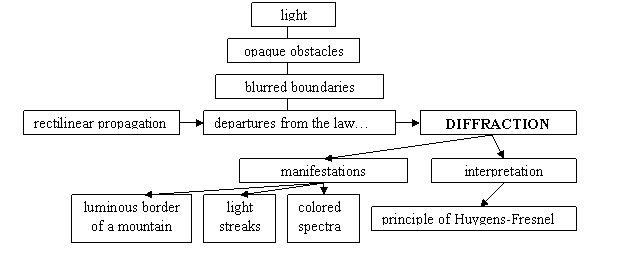

The law of rectilinear propagation of light is not rigorously correct. To some extent, light bends around opaque obstacles, so that shadows always have slightly blurred boundaries, even in the limiting case of an ideal point source. These departures from the law of rectilinear propagation of light are known as diffraction phenomena. They are not very conspicuous because the dimensions of the obstacles that light encounters along its path are usually large compared with the wavelength. However, they are part of our common experience. Diffraction phenomena are responsible for the intensely luminous border that outlines the profile of a mountain a few seconds before the sun rises behind it. The light streaks that we perceive when we look at a strong and concentrated light source with half-shut eyes are due to diffraction. The colored spectra, arranged in the pattern of a cross, that we see when we look at a distant electric light bulb through a piece of thin, closely woven material are again diffraction phenomena.
We can explain diffraction phenomena by making use of the general concepts embodied in Huygens’ Principle. However, it will no longer suffice[6] to work out the consequences of Huygens principle for the limiting case of infinitely short pulses. It will be necessary, instead, to take the actual form of the optical disturbance into account, and consider in detail how the secondary waves interfere with one another at various points of space. The results are simplest in the case of sinusoidal waves. We shall therefore begin by developing the theory of diffraction for monochromatic light and then treat non-monochromatic light as a superposition of sinusoidal waves of different wavelengths.
For the special case of sinusoidal waves, Huygens’ Principle may be stated as follows: Consider an arbitrary surface surrounding a source of monochromatic light. The various points of 3 behave as virtual secondary sources of sinusoidal waves, and the optical disturbance beyond the surface results from the interference of these waves.
This formulation of Huygens principle was first given by Fresnel and is known as the principle of Huygens-Fresnel. The frequency of the secondary sources is, of course, identical with that of the primary wave and their phase relations are determined by the relative phases of the primary wave at the points where the secondary sources are located. If, in particular, the auxiliary surface is a wave surface, then the secondary sources are all in phase with one another.
To compute the resultant disturbance, we can use the methods for the addition of sinusoidal functions In the present application, however, we shall be faced with the problem of dealing with an infinite number of interfering waves, each having an infinitesimal intensity, while in the study of interference phenomena we had to consider only a finite number of interfering waves of finite intensity or, at most[7], a discrete series of such waves.
3000 п. зн.
Words and word-combinations to be learnt:
to some extent – до некоторой степени;
compared with – по сравнению с…;
to be due to – объясняться чем - либо, быть результатом чего-либо;
to result from – быть результатом чего-либо;
to result in – приводить к чему-либо;
to be responsible for – быть причиной чего-либо, вызывать;
as follows – следующим образом;
to take into account – принимать во внимание;
through – посредством, через;
therefore – следовательно;
in particular – в частности.
Exercises
1. Use the structural scheme and word-combinations above to translate the sentences:
1) Эти отступления от закона прямолинейного распространения света известны как
явления дифракции.
2) Явления дифракции можно объяснить, используя принцип Гюйгенса.
3) Явлениями дифракции объясняются полоски света, которые мы видим, когда смотрим на сильный (concentrated) источник света прищуренными глазами.
2. Find a synonym for each verb below:
to encounter, to determine, to take into account, to be located, to perceive, to develop, to result from, to explain, to result in, to consider, to see, to deal with, to work out, to be due to, to compute, to be responsible for, to take into consideration, to be situated, to meet, to interpret.
Grammar Revision
3. For each verb below make five forms of the Participle. What are the functions of the Participle?
to give, to compare, to explain, to consider, to develop, to determine, to compute, to perceive, to arrange, to encounter.
4. Translate the sentences concentrating on the forms and functions of the Participle:
1) Optics is a branch of science studying in particular the processes of light radiation and propagation in different media. 2) While studying optics at the BMSTU the future opticians learn to design various optical instruments. 3) It was only in 1690 that Huygens published his major work on the wave theory of light worked out as early as 16We have just considered an arbitrary surface surrounding a source of monochromatic light. 5) Having made use of Huygens’ Principle and the principle of Huygens - Fresnel, Fresnel developed the light diffraction theory in 18Basing on Maxwell's laws Fresnel developed the equations for reflection and refraction (преломление). 7) If used in an optical instrument, the doubling (удвоение, сдваивание) of the image must not be perceptible to the-eye. 8) When seen through a prism, a small white object appears as a spectrum with the violet end the most deviated. 9) Substances differ widely in their properties varying from almost perfect transparency to almost perfect opacity.
5. Translate the sentences that follow paying attention to the position of the Absolute Participle Construction:
1) The experiment being performed at night, each experimentator was provided with a lantern (фонарь). 2) When looking at a concentrated light source with half-shut eyes we perceive light streaks, the latter being due to diffraction. 3) We dealt with an infinite, number of interfering wave, each having an infinitesimal intensity. 4) After due (соответствующий, надлежащий) consideration a different method was employed the lens being placed between the slit (цель) and the revolving mirror. 5) An optical instrument making use of only a limited portion of a wave front, it is evident that a clear comprehension of the nature of diffraction is essential for a complete understanding of practically all optical phenomena. 6) Problems of diffraction are of great importance in engineering, diffraction imposing limitations (накладывать ограничения) on system performance.
6. Read and translate the following sentences focusing on modal verbs used to show obligation:
1) While studying interference phenomena we had to consider only a finite number of interfering waves of finite intensity. 2) It should be noted that the law of rectilinear propagation of light is not rigorously correct. 3) Light waves are so small, however, that this bending or diffraction takes place to an extent so minute those special precautions (предосторожность, предусмотрительность) have to be taken to observe it. 4) The object whose hologram is to be obtained is illuminated with a laser beam. 5) The wave and particle properties of light are to be regarded as complementary (взаимодополняющий) rather than (а не) antagonistic, each being correct when dealing with the phenomena in its own domain. 6) Before obtaining the algebraic relations we must make certain conventions (договоренность) concerning the sign to be attributed to the quantities considered. 7) If the earth were at rest, the telescope would have to be aimed (to aim - направлять, нацеливать) directly at the star, but since the earth is actually, in motion the telescope must be inclined at an angle Q in order that the star may be seen. 8) In the experiment to measure the velocity of light two experimentators were to take part. One man was first to uncover his lantern, and observing this light from this lantern, the second was to uncover his.
7. Answer the question about Text 2A:
1) What are the most common manifestations of diffraction? 2) What theory could be used to interpret diffraction phenomena? 3) How is non-monochromatic light treated in the text? 4) State the principle of Huygens-Fresnel. 5) What does the optical disturbance beyond the surface σ result from? 6) What method can be used to compute the resultant disturbance?
8. Write an abstract of Text 2A ‘Diffraction’.
9. Use the structural scheme above to speak about diffraction.
10. Read Text 2В (time limit 3-4 min.) and answer the following questions:
1) В каком случае наблюдается дифракция Френеля, и в каких случаях - дифракции
Фраунгофера?
2) Почему желательно различать эти два вида дифракции?
TEXT 2B FRESNEL AND FRAUNHOFER DIFFRACTION
Let us consider the light reaching points on a screen when a diaphragm having a small opening is placed between the screen and a distant point source. According to geometrical theory the edges (edge - край) of the opening cast a shadow (to cast a shadow - отбрасывать тень) on the screen and no light is found within the shadow.
It is customary to distinguish between two cases. When the screen is relatively close to the opening we consider those portions of the secondary waves that travel toward a specified point and speak of Fresnel diffraction if the screen is relatively far from the opening, the lines from various surface elements in the opening on the screen are nearly parallel. We then consider those portions of the secondary waves that leave the opening in a specified direction, and speak of Fraunhofer diffraction. Fraunhofer diffraction occurs also if a lens is placed just beyond the opening, since a lens brings to a focus at a point in its focal plane all light traveling in a specified direction.
There is of course, no difference whatever in the nature of the diffraction process in the two cases, and Fresnel diffraction merges (to merge-переходить) gradually into Fraunhofer diffraction as the screen is moved away from the opening. But the character of the diffracted beam is considerably different in the two cases, and so it is useful, although not necessary, to distinguish between them.
1200 п. зн.
11. Translate Text 2C in writing using a dictionary (time limit 15 min.):
TEXT 2C THE CONCAVE GRATING
The plane grating requires the use of two lenses, the first to render parallel the light incident on the grating, and the second to bring the diffracted rays to a focus. These lenses add to the, complexity of a spectrograph, and furthermore, if investigations are to be made in the ultraviolet, the lenses may have to be made of some material other than glass since ordinary optical glass is not transparent much outside the visible spectrum. Both lenses may be dispensed with in the concave reflection grating. A concave grating is ruled on a polished concave spherical surface, the rulings being the intersections with the surface of equidistant planes parallel to the principal axis of the surface. The surface acts at the same time both as a grating and as a concave mirror.
700 п. зн.
SUPPLEMENTARY READING TASKS
Task 1 Match these word and expressions (underlined in the text below) with their definitions (given in the right-hand column):
1) deal with | a) whatever happens or happened |
2) to contradict | b) a mistake or problem in an argument, plan, set of ideas etc |
3) (to cast) a shadow | c) based on what is reasonable or sensible |
4) in any case | d) to disagree with something, especially by saying that the opposite is true |
5) valid | e) close to the exact number, amount etc, but could be a little bit more or less than it [= rough; ≠ exact] |
6) a flaw | f) not clear in shape or sound [=blurred] |
7) approximate | g) to take the necessary action, especially in order to solve a problem [= handle] |
8) (to be) specific | h) the dark shape that someone or something makes on a surface when they are between that surface and the light: |
9) fuzzy | i) detailed and exact |
The Correspondence Principle
The only reason we don't usually notice diffraction of light in everyday life is that we don't normally deal with objects that are comparable in size to a wavelength of visible light, which is about a millionth of a meter. Does this mean that wave optics contradicts ray optics, or that wave optics sometimes gives wrong results? No. If you hold three fingers out in the sunlight and cast a shadow with them, either wave optics or ray optics can be used to predict the straightforward result: a shadow pattern with two bright lines where the light has gone through the gaps between your fingers. Wave optics is a more general theory than ray optics, so in any case where ray optics is valid, the two theories will agree. This is an example of a general idea enunciated by the physicist Niels Bohr, called the correspondence principle: when flaws in a physical theory lead to the creation of a new and more general theory, the new theory must still agree with the old theory within its more restricted area of applicability. After all, a theory is only created as a way of describing experimental observations. If the original theory had not worked in any cases at all, it would never have become accepted.
In the case of optics, the correspondence principle tells us that when λ /d is small, both the ray and the wave model of light must give approximately the same result. Suppose you spread your fingers and cast a shadow with them using a coherent light source. The quantity λ /d is about, so the two models will agree very closely. (To be specific, the shadows of your fingers will be outlined by a series of light and dark fringes, but the angle subtended by a fringe will be on the order of 10-4 radians, so they will be invisible and washed out by the natural fuzziness of the edges of sun-shadows caused by the finite size of the sun.)
Task2 Rearrange the paragraphs below in a logical way:
Huygens’ Principle
1) Thomas Young () was the person who finally, a hundred years later, did a careful search for wave interference effects with light and analyzed the results correctly. He observed double-slit diffraction of light as well as a variety of other diffraction effects, all of which showed that light exhibited wave interference effects, and that the wavelengths of visible light waves were extremely short. The crowning achievement was the demonstration by the experimentalist Heinrich Hertz and the theorist James Clerk Maxwell that light was an electromagnetic wave. Maxwell is said to have related his discovery to his wife one starry evening and told her that she was the only person in the world who knew what starlight was. | 2) The history is interesting. Isaac Newton loved the atomic theory of matter so much that he searched enthusiastically for evidence that light was also made of tiny particles. The paths of his light particles would correspond to rays in our description; the only significant difference between a ray model and a particle model of light would occur if one could isolate individual particles and show that light had “graininess” to it. Newton never did this, so although he thought of his model as a particle model, it is more accurate to say he was one of the builders of the ray model. |
3) Almost all that was known about reflection and refraction of light could be interpreted equally well in terms of a particle model or a wave model, but Newton had one reason for strongly opposing Huygens' wave theory. Newton knew that waves exhibited diffraction, but diffraction of light is difficult to observe, so Newton believed that light did not exhibit diffraction, and therefore must not be a wave. Although Newton's criticisms were fair enough, the debate also took on the overtones of a nationalistic dispute between England and continental Europe, fueled by English resentment over Leibniz's supposed plagiarism of Newton's calculus. Newton wrote a book on optics, and his prestige and political prominence tended to discourage questioning of his model. | 4) Returning to the example of double-slit diffraction, f, note the strong visual impression of two overlapping sets of concentric semicircles. This is an example of Huygens' principle, named after a Dutch physicist and astronomer. (The first syllable rhymes with “boy.”) Huygens' principle states that any wavefront can be broken down into many small side-by-side wave peaks, g, which then spread out as circular ripples, h, and by the principle of superposition, the result of adding up these sets of ripples must give the same result as allowing the wave to propagate forward, i. In the case of sound or light waves, which propagate in three dimensions, the “ripples" are actually spherical rather than circular, but we can often imagine things in two dimensions for simplicity. |
5) Since Huygens' principle is equivalent to the principle of superposition, and superposition is a property of waves, what Huygens had created was essentially the first wave theory of light. However, he imagined light as a series of pulses, like hand claps, rather than as a sinusoidal wave. | 6) In double-slit diffraction the application of Huygens' principle is visually convincing: it is as though all the sets of ripples have been blocked except for two. It is a rather surprising mathematical fact, however, that Huygens' principle gives the right result in the case of an unobstructed linear wave, h and i. A theoretically infinite number of circular wave patterns somehow conspire to add together and produce the simple linear wave motion with which we are familiar. |
(from Optics by Benjamin Crowell, Fullerton, California, ed. 2.2, 2007, ISBN -2)
Task 3 Match the words and expressions (underlined in the text) with their definitions:
1) a theorist | a) the material that everything in the universe is made of, including solids, liquids, and gases |
2) to relate to | b) the part of mathematics that deals with changing quantities, such as the speed of a falling stone or the slope of a curved line |
3) made of | c) a shape or pattern that looks like a wave |
4) (the atomic theory of) matter | d) if two or more things do this, part of one thing covers part of another thing: |
5) tiny | e) produced, for example by putting the different parts together |
6) in terms of | f) half a circle |
7) to exhibit (diffraction) | g) to secretly plan with someone else to do something illegal |
8) calculus | h) to show how two different things are connected |
9) to question smth | i) to separate something into smaller parts so that it is easier to do or understand |
10) to overlap | j) used to say that lots of small amounts gradually make a large total |
11) a (concentric) semicircle | k) to have or express doubts about whether something is true, good, necessary etc |
12) to break smth down into | l) a quality or power that a substance, plant etc has [= quality, characteristic] |
13) ripples | m) someone who develops ideas within a particular subject that explain why particular things happen or are true |
14) (the principle of) superposition | n) used to show that you are describing or considering a subject in a particular way or from a particular point of view |
15) to add up | o) to spread |
16) to propagate (forward) | p) to clearly show a particular quality, emotion, or ability |
17) a property (of waves) | q) putting one picture, image, or photograph on top of another so that both can be partly seen |
18) to conspire | r) extremely small |
Task 4 Compare what you have learn about diffraction and Huygens’ Principle from the above text with what you found out from Text 2A.

|
Из за большого объема этот материал размещен на нескольких страницах:
1 2 3 |
