


Партнерка на США и Канаду по недвижимости, выплаты в крипто
- 30% recurring commission
- Выплаты в USDT
- Вывод каждую неделю
- Комиссия до 5 лет за каждого referral
MODULE 3 POLARIZATION Texts: A. Polarization of Light Waves B. A Polarizing Microscope C. Wiener’s Method Grammar revision: the Infinitive, complexes with the Infinitive |
Terminology
1) polarization – поляризация, linear polarization – линейная поляризация;
2) polarizing filter – поляризационный фильтр (поляризатор); sheet polarizer – пленочный (листовой) поляризатор;
3) analyzer – анализатор, дисперсионная призма;
4) to oscillate - колебаться, вибрировать, oscillation - колебание, качание, oscillating function – функция колебаний;
5) transparency – прозрачность, transparent – прозрачный, просвечивающий;
6) incandescent lamp – лампа накаливания;
7) transverse – поперечный;
8) to absorb – поглощать, впитывать; absorption –поглощение;
9) axis (pl. axes) – ось; transmission axis – ось пропускания;
10) incident light – падающий свет;
11) optical vector – электрический вектор;
12) to emerge from – появляться, выходить из....
Preliminary exercises
1. Read and translate the following words without a dictionary:
function, position, vector, component, plastic, detail, vibration; scalar, parallel, physical, equivalent, microscopic, ordinary, isotropic, approximate.
2. Read and translate the adjectives below, pay attention to their affixes:
a) finite – infinite; regular – irregular;
b) coherent – incoherent; polarized – unpolarized;
c) distinguishable, appreciable, incandescent, resultant, angular, perpendicular.
3. Read and translate the word-combinations below:
direction – preferred direction, intermediate direction, direction of propagation; quantity – vector quantity, scalar quantity; plane – vibration plane, plane polarization, plane-polarized light, plane light wave.
4. Find equivalent phrases either in Text 3A or in the right-hand column:
1) в определённых случаях | a) in more detail |
2) исследовать природу... | b) to keep in a fixed position |
3) с другой стороны | c) some distinctive property |
4) некоторые отличительные особенности | d) from the above considerations |
5) изготовление солнцезащитных очков | e) to inquire into the character of... |
6) держать неподвижно | f) closely obeys a law |
7) строго подчиняется закону | g) the manufacture of sunglasses |
8) направление которого не совпадает с... | h) on the other hand |
9) более подробно | i) in certain cases |
10) из вышесказанного | j) whose direction does not coincide with… |
5. Read Text 3A ‘Polarization of Light Waves’ and answer the following questions:
1) На каком примере объясняется явление поляризации света? 2) В чём сущность закона Малюса? 3) Какой свет называется линейно-поляризованным?
TEXT 3A POLARIZATION OF LIGHT WAVES
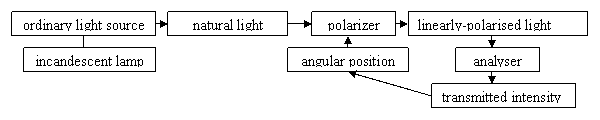

By the study of interference and diffraction we have learned that the optical disturbance is a rapidly oscillating function of time whose form, in certain cases, approximates that of a sinusoidal function. However, we have not yet inquired into the character of the optical disturbance.
It is clear that, if optical disturbance is a scalar quantity, or if it is a vector parallel to the direction of propagation, all planes through the same light ray are physically equivalent. If, on the other hand, the disturbance is a vector pointing in a direction different from the direction of propagation, the plane combining this vector might be expected to possess some distinctive property.
The question thus arises whether the infinite numbers of planes passing through the same light ray are physically distinguishable. This question can be answered by a simple experiment with a sheet polarizer, which is a sheet of transparent plastic widely used, e. g., in the manufacture of sunglasses. Let us hold a sheet polarizer before our eyes and look through it at a light source such as an incandescent lamp. If we rotate the sheet in its own plane we notice no change in the light intensity. We now place a second sheet polarizer between the light source and the eye. If we rotate the second sheet in its own plane, keeping the first in a fixed position, we find the light intensity to change periodically. The intensity is practically zero at two angular positions[8] of the second sheet 180° apart, and it is a maximum at angular positions half-way between[9]. If we actually measure the intensity I of the light that emerges from the second sheet polarizer, we find that it closely obeys, a law of the following type:
I (¯) =I0 cos2 (¯) (3-1)
where I0 is the maximum intensity and ¯ is the angle of rotation of the second sheet, measured from the position at which the intensity is a maximum. The law expressed by (3-1) is called the Law of Malus.
The very fact that the transmitted intensity depends on the angular position of the second sheet proves that the optical disturbance is a vector quantity, whose direction does not coincide with the direction of propagation. We shall call this vector the optical vector. To explain in a natural way the details of the above experiment, as well as many other observations, it is necessary to assume that the optical vector of a plane light wave propagating in an isotropic medium is perpendicular to the direction of propagation.
From the above considerations, there develops the following picture. Light waves are transverse waves. In the light coming from an ordinary light source, the optical vector changes direction rapidly and irregularly with time, while it always remains perpendicular to the direction of propagation. As we shall discus later in more detail, this behavior is due to the incoherent superposition of the optical disturbances coming from the many microscopic sources that form any ordinary light source. The light under such conditions is called natural or unpolarized light.
Consider a light wave incident perpendicularly upon a sheet polarizer. The sheet transmits the light wave without appreciably absorption if the optical vector is parallel to a certain preferred direction (the "transmission axis"), while (it absorbs completely) if the optical vector is perpendicular to this preferred direction. If the optical vector has an intermediate direction, it may be regarded as the resultant of two vectors, one being parallel and he other perpendicular to the transmission axis of the sheet polarizer. The sheet transmits the first component and absorbs the second so that, in all cases, the optical vector of the light wave emerging from the filter is parallel to the transmission axis. We shall call this wave linearly polarized or plane polarized. We shall call the plane containing the direction of propagation and the optical vector the plane of vibration. Any optical device capable of transmitting only linearly polarized light will be called a polarization filter.
2500 п. зн.
Words and word-combinations to be learnt:
actually - действительно, в самом деле
to obey a law - подчиняться закону
to coincide with - совпадать с чем-либо
to assume - предполагать
as well as - a так же
so that - так, что
by means of - посредством, с помощью
Exercises
1. Learn the following definitions:
Polarizer is an instrumental means to produce polarized light.
Analyzer is an instrumental means which detects light polarization and dejection of vibrations.
Optical vector is an oscillation vector whose direction does not coincide with the option of propagation.
2. Translate the following sentences:
1) То, что интенсивность света зависит от углового положения второго листа, доказывает, что распределение поля есть векторная величина. 2) При двух угловых положениях поляризатора повернутого на 90° "интенсивность практически равна нулю. 3) Из опыта с пленочным поляризатором следует, что световые волны являются поперечными волнами. 4) Свет, исходящий из естественного источника света называется неполяризованным (естественным). 5) Любое оптическое устройство, посредством которого передается только линейно-поляризованный свет, называется поляризационным фильтром (поляризатором).
Grammar Revision
3. Read and translate the following sentences focusing on the forms and functions of the Infinitive:
1) Screens made of transparent substances are frequently used to diffuse the light from a source. 2) To prevent aberrations the mirror must be of large aperture. 3) To obtain the algebraic relations we must make certain conventions (договоренность) concerning the sign to be attributed to the quantities considered. 4) The first attempts to measure the velocity, of light were made in 16To obtain a 100% monochromatic light is impossible. 6) Probably one of the first optical phenomena to be noted was that the shadow of an object illuminated by a source of small dimensions had the same shape as the object. 7) Yu. Denisyuk was the first to propose three-dimensional media to be used for recording holograms. 8) One of the earliest optical instruments ever to be made was the humble (скромный) pair of spectacles. 9) A pair of spectacles has served to extend our useful life by at least 20 years.
4. Read and translate the following sentences paying attention to complexes with the Infinitive:
1) Most optical media have the same properties and are considered to be isotropic. 2) The great progress in all branches of optics may be said to have resulted indirectly from the invention of the electric lamp. 3) While the experiment was entirely correct in principle, we know the velocity of light to be too great for the time interval to be measured in this way with any degree of placation. 4) A pocket microscope developed in 1702 is known to have produced magnifications up to The laser beam is a highly collimated bundle of rays and as such has proved to be of great help in many applications in industry, medicine, etc. 6) The matrix has turned out to be of great advantage in many scientific considerations. 7) Light is believed to be an electro-magnetic radiation at very high frequencies (10 cps). 8) We know a light beam to consist of thousands and millions of rays in a wide frequency range and at various states of polarization. 9) The incident wave was assumed to be monochromatic. 10) We believe the degree of polarization to be a maximum, when the angle of incidence equals the polarization angle.
5. Answer the questions about Text 3A:
1) What instrument was used in the experiment described to obtain polarized light? Describe the experiment. 2) What does the experiment with a sheet polarizer prove? 3) What does the transmitted intensity depend on? 4) What does the Malus law state? 5) Is optical disturbance scalar or a vector quantity? 6) What light is considered to be linearly polarized? 7) What is a polarizing filter?
6. Write an abstract of Text 3A.
7. Use the diagram above to speak about polarization.
8. Read Text 3B (time limit 5 min.) and speak about the principle behind a polarizing microscope operation.
TEXT 3 В A POLARIZING MICROSCOPE
When ordinary light is directed from the mirror to the polarizer, it emerges from the polarizer as polarized light. It passes on through the optical system to the analyzer. Since the vibration direction of the analyzer is set at 90 degrees to that of the polarizer, none pf the light which reaches the analyzer is allowed to pass to the eye the extraordinary ray coming from the polarizer has become the ordinary ray of the analyzer and it is therefore reflected out of the field of the microscope. The field appears black unless an object which rotates the plane of polarization interferes with the natural path of the light. This peculiarity (особенность) of the polarizing microscope is what makes it so valuable for analysis of many materials.
700 п. зн.
1. Translate Text 3C in writing using a dictionary (time limit 60 min.):
TEXT 3C WIENER’S METHOD
То observe the interference between incident and reflected waves is not an easy matter, mainly because the distance between the planes of maximum and minimum intensity is less than one wavelength. The problem, however, can be solved with a technique devised by Wiener. A very thin film of photographic emulsion is placed at a small angle to the reflecting surface, if the incident light is in the appropriate state of polarization, the film developed will show a series of light
and dark bands, the maximum darkening occurring along the lines where the plane of the film intersected the planes of maximum intensity.
This technique was a very important one historically because it provided the first experimental determination of the plane of light waves. Most other polarization experiments, in fact, - while proving the existence of linearly polarized light, do not furnish information about the actual direction of the vector representing the optical disturbance. For example, the experiment described in Section 3 - I shows a sheet polarizer to transmit only light waves whose optical vector is parallel to a certain preferred direction. It does not enable us to mark this preferred direction. It does not enable us to mark this preferred direction on the sheet. We can now do so by performing Wiener's experiment with light that has gone through the sheet polarizer. We repeat the experiment a number of times, rotating the«sheet in its own plane between exposures of the photographic films, until the interference bands become sharpest or until they disappear completely. In the first instance the transmission axis of the polarizer will be the direction parallel to the reflecting surface. In the second instance, it will lie along the intersection of the plane of the sheet with the plane of incidence.
1800 п. зн.
SUPPLEMENTARY READING TASKS
A Fundamental Property of Anisotropic Media
Until now we have confined our attention to the propagation of light in isotropic media, i. e., substances whose optical properties are the same in all directions. Liquids, as well as amorphous solid substances such as glass and plastics, are usually isotropic because of the random distribution of the molecules. In many crystals, the optical as well as the other physical properties are different in different directions. This optical anisotropy, often referred to as double refraction, or birefringence, is due to the particular arrangement of the atoms in the crystalline lattice and, is found to produce many curious and interesting phenomena, which we propose now to investigate.
We start with a simple experiment. A parallel beam of monochromatic light passes through a polariscope formed, for example, by two sheet polarizers, and then falls upon a screen. We rotate the analyzer until the light spot on the screen disappears. The transmission axis of the analyzer is then perpendicular to that of the polarizer i. e., the polarizer and the analyzer are crossed). Between the analyzer and the polarizer we now insert a thin, plane-parallel plate cut from a birefringent crystal obtained by cleavage. The light on the screen will, in general, reappear. The analyzer being rotated, the light intensity will change periodically between a maximum and a minimum, but will not become zero for any position of the analyzer. We thus conclude that the light emerging from the plate is no longer linearly polarized.
After removing the plate, we again place the analyzer and the polarizer in the crossed position, reinsert the birefringent plate, and rotate it in its own plane. For each complete turn, we find four positions, at 90° to one another, for which the light spot on the screen disappears. We conclude that the light now emerging from the plate has the same linear polarization as the light incident upon the plate. We can check this conclusion by rotating the analyzer and noting that the corresponding variation of the transmitted light intensity follows the law of Malus. It is thus possible to trace on the plate two mutually perpendicular lines such that a linearly polarized light wave vibrating in a direction parallel to either line traverses the plate without changing its state of polarization. We сall these lines the axes of the plate.
By generalizing this result, we can describe the fundamental property of optically anisotropic medium as follows: for every direction of propagation there are only two waves vibrating in one or the other of two mutually perpendicular planes that preserve their state of polarization while traveling through the medium.
Consider now a wave which, upon entering the plate, is linearly polarized, but does not vibrate in either of the two preferred directions. We may regard the incident wave as the superposition of two linearly polarized waves vibrating in the two preferred directions. If the velocities of propagation of these two waves were the same, the two component waves after traversing the plate would recombine into a linearly polarized wave with the same plane of vibration as the incident wave. Since we know from experiment that this is not the case, i. e. since we know the state of polarization of the wave to change on traversing the plate, we conclude that the velocities of propagation in an anisotropic medium of the waves vibrating in the two preferred directions are different. We can, of course, check this conclusion directly by measuring (e. g. with an interferometer) the velocities of propagation through a birefringent plate of the two waves whose planes of vibration contain one or the other of the two axes of the plate.
(unknown source)
Rainbows
Rainbows are the most famous of many extraordinary displays that can be seen in the sky. Everybody seems to love them, from children to old men, and few wouldn't stop at least a few seconds to admire a fully developed rainbow. It has to do, undoubtedly, with its beautiful sequence of colors; but also with its perfect geometrical shape against the random background of clouds. If one could see the polarization of the rainbow, a new order would become apparent: the rainbow is strongly polarized. Indeed, with a polarizer its contrast significantly improves and you can find otherwise undetectable rainbows!
Rainbows form the arc of a perfect circle centered on the shadow of your head. Yes, that's right. Everybody sees a slightly different rainbow even if standing side by side: each one has his own personal rainbow! If you are not sure where a rainbow should appear during rainy weather do the following. Look for the shadow of your head on the ground; that's the center of the circle (antisolar point). Next, find the radius by stretching in a line your two hands (thumb to thumb) at arm length. Of course, if the tip of your finger doesn't reach above the horizon, then the sun is too high for a rainbow.
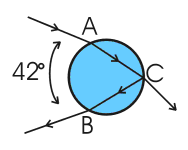 The drops of water refract and reflect the rays from the sun backwards, at 42 degrees to the incoming rays. Thus, the rainbow is seen in a direction opposite to the sun as a circle of that radius, an angular size of which is independent of your distance to the raindrops. This is also true for the rainbow produced by a watering hose: no matter how much you step back, you won't be able to include its full diameter in your photograph (you need a very-wide-angle lens for that). Of course, when you step back, the individual drops forming the arch will change. The largest rainbow (half a circle) appears when the sun is close to the horizon. However, from airplanes, mountains or tall towers, where one can see raindrops below the horizon, the rainbow can be as large as a full circle.
Two refractions (A, B) and one internal reflection (C) inside the spherical water drops form the primary rainbow. A secondary rainbow, which sometimes appears outside the primary one (at 51 degrees) is caused by two internal reflections instead of just one. An interesting side note: small raindrops remain almost perfectly spherical falling through the air; very large raindrops are deformed but, contrary to popular belief, they are flattened vertically instead of becoming elongated and pear-shaped as the archetypal cartoonish drop.
The color sequence of the rainbow is caused by the two refractions (A, B) as red is refracted slightly less than blue. On the other hand, the polarization of the rainbow is caused by the internal reflection (C). The rays strike the back surface of the drop close to the Brewster angle, so almost all the light reflected is polarized perpendicular to the incidence plane (perpendicular to the monitor screen). This is similar to the way the glare of the sun on the sea is polarized, except that now the reflecting surface is not horizontal. As the incidence plane is determined for each drop by the plane containing the sun, the drop, and the observer, the rainbow is polarized tangential to the arch. Thus, a vertical polarizing filter will produce a gap at the top of the rainbow while enhancing the contrast of the sides.
The primary rainbow is 96% polarized while the secondary is 90% polarized. The extra brightness of the sky inside the primary rainbow (and outside the secondary rainbow) is also polarized tangentially (but to a lesser degree) as it has the same origin as the bows. With a filter pointing radially it disappears together with the rainbows and becomes undistinguishable from the dark Alexander's band between the bows (named after Alexander of Aphrodisius, AD 200).
(http:///index-net/index. html)
[1] would be produced by... – обычно создается...
[2] continue unperturbed – остаются без изменений
[3] a master – эталон
[4] b. – the written abbreviation of born;
[5] ca. – a written abbreviation of circa (=about).
[6] it will no longer suffice – теперь будет недостаточно
[7] at most - самое большее
[8] at two angular positions of the second sheet 180 apart - в двух угловых положениях через 180°
[9] at angular positions halfway between - в угловых положениях на половинном угле поворота, т. е. 90°

|
Из за большого объема этот материал размещен на нескольких страницах:
1 2 3 |
