


Партнерка на США и Канаду по недвижимости, выплаты в крипто
- 30% recurring commission
- Выплаты в USDT
- Вывод каждую неделю
- Комиссия до 5 лет за каждого referral
Министерство высшего и среднего специального образования СССР
Московское ордена Ленина, ордена Октябрьской Революции
и ордена Трудового Красного Знамени
высшее техническое училище им.
Г. В. КИРСАНОВА, Т. И. КУЗНЕЦОВА
Утверждены редсоветом МВТУ
МЕТОДИЧЕСКИЕ УКАЗАНИЯ
ПО ОБУЧЕНИЮ ЧТЕНИЮ ТЕХНИЧЕСКОЙ ЛИТЕРАТУРЫ
НА АНГЛИЙСКОМ ЯЗЫКЕ ПО ОПТИКЕ
Часть 1
(редакция 2008 года,
только для web-сайта факультета «Лингвистика»)
Москва 1987
Данные методические указания издаются в соответствии с учебным планом.
Рассмотрены и одобрены кафедрой иностранных языков 14.10.86 г., методической комиссией факультета ОТ 22.12.86 г. и учебно-методическим управлением 29.01.87 г.
Рецензент к. т. н. доц.
Методические указания предназначены для обучения чтению и переводу научно-технической литературы. Приведены оригинальные тексты из английской и американской научно-технической литературы по оптике для развития навыков перевода, аннотирования и реферирования. Разработан терминологический словарь. Тематика методических указаний согласуется с курсом лекций, читаемым на факультете. Рекомендуется использовать для обучения студентов IV—V семестров дневного отделения. Способствует интенсификации учебного процесса.
© Московское высшее техническое училище им.
MODULE I INTERFERENCE Texts: A. Interference B. 0ptical Interferometers C. Elements of the Theory of Interference Grammar revision: 1. Functions of ‘that’ 2. The Gerund |
Terminology:
1) interference – интерференция, взаимодействие; an interfering beam – интерферирующий пучок;
2) common – 1.общий; 2.обычный; a common source – общий источник;
3) disturbance – распределение поля возмущения; violent disturbance – сильное возмущение; instantaneous disturbance – мгновенное возмущение; optical disturbance – распределение оптического поля;
4) crest – гребень волны;
5) trough – подошва волны;
6) film – плёнка;
7) propagation – распространение;
8) to superimpose – накладывать (одну волну на другую); superposition – наложение,
суперпозиция;
9) succession – последовательность;
10) validity – действительность, обоснованность, точность; rigorous validity –абсолютная точность.
Preliminary exercises
Read the following international words and translate them without a dictionary:manifestation, region, corpuscular, model, analogous, associate, individual, coherent, monochromatic, intensity, situation, combine, adequate, geometry, form, analyses, electromagnetic, theory, character, linear.
Read the following words and say which part of speech they belong to:a) observation, reflection, propagation, assumption, interpretation, superposition, succession;
disturbance, interference; statement; validity, linearity, intensity; observer;
b) soapy, linear, careful, analogous, instantaneous, optical, natural, geometrical;
c) simultaneously, particularly, precisely, experimentally, practically, similarly, adequately.
Compare the singular and plural forms of the nouns:phenomenon – phenomena, medium – media, analysis – analyses, datum – data, maximum – maxima, minimum – minima, axis – axes.
soap bubble, soapy water, wave motion, wave superposition, wave model, light effects, color effects, light intensity, light propagation, light wave, superposition principle, interference phenomena, common manifestations.
Read Text 1А ‘Interference’ and answer the following questions:1) Какие условия обязательны для проявления интерференции?
2) С помощью какой теории происхождения света объясняется это явление?
3) Приведите из текста примеры интерференции света?
TEXT 1A INTERFERENCE

For many years optics has been divided into three branches: physical, physiological and geometrical. The expansion of knowledge has led to modernization of these classical subdivisions, which are now generally referred to as Optical Physics, Vision and Optical Engineering. Optical Physics is a very active subject, indeed pursued in most universities and other research centers.
It has enjoyed rebirth, since the invention of the laser in I960, which is undoubtedly the most important optical discovery of recent times. Optical physics includes the study of quantum electronics, partial coherence, holography, interference, polarization, diffraction, image enhancement, non‑linear optics and similar subjects.
Interference. General Considerations.
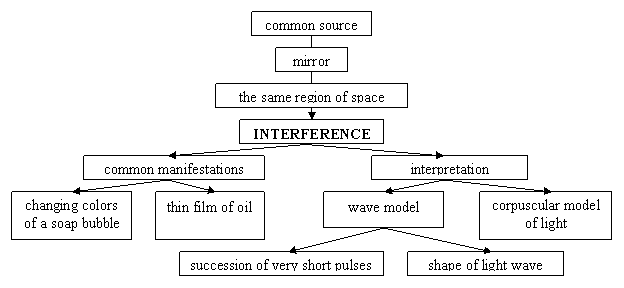
Everyone has noticed the changing colors of a soap bubble, or a thin film of oil floating on water. These are perhaps the most common manifestations of interference, a phenomenon that is observed when two or more beams of light from a common source arrive, along different paths, at the same region of space. In each of these two cases, the interfering beams are those reflected at the two surfaces of a thin film – a film of soapy water in air, or a film of oil between air and water.
The corpuscular model of light does not afford any simple interpretation of interference phenomena. The wave model, however, suggests a most natural interpretation. Indeed, the phenomena observed when two light beams are superimposed are closely analogous to those associated with the superposition of two surface waves, such as are produced by two pebbles falling into a pool of water.
A careful observer will notice that in certain regions, where the crest of one wave arrives simultaneously with the trough of the other, the effects of the two waves almost cancel, while in other regions, where a crest meets a crest or a trough meets a trough, the superposition of the two waves produces a more violent disturbance than do the individual waves. Similarly, in the region where two coherent monochromatic light beams overlap, there are places where the light intensity is practically zero and others where it is particularly strong. The situation is more complicated if white light is used. As we have already mentioned, white light is a superposition of light of different colors, each color gives a separate set of maxima and minima, and these combine to give the color effects mentioned above.
In order to interpret interference phenomena it is necessary to specify the wave model of light more precisely than we have done so far. We found that we could account for the phenomena of geometrical optics by assuming that light waves consist of a succession of very short pulses, without making any assumptions as to the exact shape of these pulses. However, knowledge of the shape of light waves, which geometrical optics ignores, is essential for the interpretation of interference phenomena.
Our analysis of interference phenomena is based upon the superposition principle, which can be stated as follows: the instantaneous optical disturbance at a point where two or more light waves cross is the sum of the optical disturbances that would be produced by[1] each of the waves separately. This statement implies that the propagation of a light wave is not affected by the presence of other light waves in the same medium, the observation that two light beams whose paths cross in a region of space continue unperturbed[2] beyond this region is an experimental test of the superposition principle. In the electromagnetic theory of light the rigorous validity of the super position principle for light waves is guaranteed by the linear character of Maxwell’s equations.
3800 п. зн.
Words to be learnt:
to account – считать, рассматривать; счет; to account for объяснять
to afford – быть в состоянии что-то сделать
to cancel – уничтожать
exact – точный
to overlap – частично совпадать
Служебные слова: in order to... – чтобы; so far... – до сих пор; beyond – за пределами, вне.
Exercises
Look through the text above and find equivalents of the following Russian phrases:тонкая пленка нефти, наиболее часто встречающиеся проявления, изменяющиеся цвета, внимательный наблюдатель, наложение света, последовательность импульсов, делать предположение, точная форма, создавать более сильное возмущение, пучки монохроматического света, частично совпадают, чтобы объяснить явление интерференции, определить более точно, последовательность коротких импульсов, утверждение (положение) означает, уравнение Максвелла.
Complete the sentences below with the appropriate word or word-combination:1) The natural interpretation of interference phenomena can be given by...
a. a corpuscular theory of light
b. wave model
2) In regions where a crest meets a crest or a trough meets a trough, the superposition of the two
waves produces a violent…
a. interference
b. disturbance
3) White light is a superposition of light of…
a. different colors
b. similar colors
4) According to the superposition principle the instantaneous optical disturbance is a sum of
optical disturbances produced by
a. all the waves together
b. each of the waves separately
Translate and memorize the definitions below:Interference is a phenomenon when two or more beams of light from а common source arrive, along different paths, at the same region of space.
White light is a superposition of light of different colors. Coherent waves are waves whose phase difference remains constant in time.
Grammar Revision
Translate the sentences focusing on the functions of ‘that’:that | conjunction | Object Clause | что |
Subject Clause | то, что | ||
Relative Clause | который | ||
Indicative Pronoun | тот, та, то, те | ||
used to substitute for a singular or plural (those) noun |
1) That light has many different effects is known to everybody. 2) If sources have a phase difference that varies rapidly and irregularly with time, they are said to be incoherent. 3) We found that light waves consist of a succession of very short pulses. 4) The fact is that optical disturbance is directly related with the light intensity. 5) The interfering beams are those reflected at the two surfaces of a beam film. 6) Interference phenomena are similar to those produced by Fresnel mirrors. 7) This phenomenon is identical with that mentioned above. 8) The effects of light are closely analogous to those associated with waves.
Translate the sentences focusing on the functions of the Gerund:by, in | measuring | измеряя, путем измерения, при измерении |
on (upon), after | измерив, после измерения | |
without | не измеряя, без измерения | |
before | до измерения, прежде чем измерить |
1) The image formed by the returning light can then be observed directly without being weakened by reflection. 2) The ray in passing from air to water is refracted towards the normal. 3) Before discussing the results of experiments, we must state that it is impossible to observe interference between light waves emitted by independent sources. 4) By measuring the angle between two mirrors we can determine the distance between two sources. 5) A phenomenon that is observed in superimposing - two or more beams of light is known as interference. 6) It is impossible to speak of the optical disturbance without mentioning the light intensity. 7) On passing a narrow beam of sunlight through a glass prism Lomonosov found that the patch of light on a screen was broadened out into a band of colors: red, orange, yellow, green, blue, indigo and violet.
Answer the questions about Text 1A:2) What is interference? 2) What are the most common manifestations of interference? 3) What happens when the crest of one wave arrives simultaneously with the trough of the other? 4) In what case can a violent disturbance be produced? 5) What does the superposition principle state? 6) Does the presence of other light wave effect the propagation of a light wave? 7) What confirms the validity of superposition principle experimentally?
Чтобы наблюдать явления интерференции, необходимо использовать когерентные источники света, т. е. источники, разность фаз которых постоянна во времени. Такие источники можно создать путем использования одного источника и его изображения или используя два различных изображения одного и того же источника.
Write an abstract of Text 1A:v выделите наиболее значимую информацию из каждого абзаца;
v обобщите полученные сведения;
v используйте, слова – клише: сообщается о..., излагается..., приводится…; -
v избегайте сложных предложений.
Use the structural scheme above to speak about interference. Read Text 1В (time limit 3-4 min.) and answer the following questions:1) Какая единица измерения взята за основу измерения в интерферометрии?
2) Какое изобретение способствовало расширению возможностей проведения измерений
в интерферометрии?
3) Какова цель применения голографической интерферометрии?
TEXT 1B OPTICAL INTERFEROMETERS
Optical interferometers are very important scientific tools. The standard unit of length is based on interferometric measurement using the wavelength of krypton 86 and our view of the whole world of Physics is greatly dependent on the unit of length. Einstein's relativity theories were constructed to explain the results of some very important interferometric experiments made bу Michelson and Moorly. The invention of holographic interferometry has in the last years to a great extent widened the possibilities of interferometric measurements.
Hologram interferometry can be used for measurement of dimension deformation, vibration and changes in refractive index. It is a general agreement that hologram interferometry has the following advantages over ordinary interferometry: I) Displacement of non-optical rough surfaces that scatter light in a diffuse way can be measured with interferometric ace accuracy because each small surface defect is compared with its own image. 2) An object can be compared with itself as it was during earlier exposure. Thus the dimensions of the object during two or more conditions can be compared. 3) When the measuring object is to be compared with a master[3] (эталон) the latter can be substituted by its holographic image which might rake possible a saving of time and space.
1400 п. зн.
Translate Text 1C in writing using a dictionary (time limit 25 min.):TEXT 1C ELEMENTS OF THE THEORY OF INTERFERENCE
There are two general methods of obtaining beams from a single beam of light, and these provide a basis for classifying the arrangements used to produce interference. In one the beam is divided by passing light through apertures placed side by side. This method, which is called division of wave - front, is useful only with sufficiently small sources. Alternatively the beam is divided at one or more partially reflecting surfaces at each of which part of the light being reflected and part transmitted. This method called division of amplitude can be used with extended sources and so effectс mау be of greater intensity than with division of wave front. In either case, it is convenient to consider separately the effects which result from the superposition of two beams (two-beam interference), and those resulting from the superposition of more than two beams (multiple-beam-interference). Historically, interference phenomena have been the means of establishing the wave, nature of light and today they have important practical uses, for example in spectroscopy and metrology.
1100 п. зн.
SUPPLEMENTARY READING TASKS
The Nature of Light
Task 1 Reorder the passages below to obtain two logical texts. Match each text with the appropriate title (A or B):
A. The Cause and Effect Relationship in Vision B. Light is a Thing and it Travels from One Point to Another. | 1) How do we see luminous objects? The Greek philosophers Pythagoras (b.[4] ca.[5] 560 BC) and Empedocles of Acragas (b. ca. 492 BC), who unfortunately were very influential, claimed that when you looked at a candle flame, the flame and your eye were both sending out some kind of mysterious stuff, and when your eye's stuff collided with the candle's stuff, the candle would become evident to your sense of sight. |
2) A more convincing way to decide in which category light belongs is to find out if it takes time to get from the candle to your eye; in Newtonian physics, action at a distance is supposed to be instantaneous. The fact that we speak casually today of “the speed of light” implies that at some point in history, somebody succeeded in showing that light did not travel infinitely fast. Galileo tried, and failed, to detect a finite speed for light, by arranging with a person in a distant tower to signal back and forth with lanterns. Galileo uncovered his lantern, and when the other person saw the light, he uncovered his lantern. Galileo was unable to measure any time lag that was significant compared to the limitations of human reflexes. | 3) Another issue that few people have considered is whether a candle's flame simply affects your eye directly, or whether it sends out light which then gets into your eye. Again, the rapidity of the effect makes it difficult to tell what's happening. If someone throws a rock at you, you can see the rock on its way to your body, and you can tell that the person affected you by sending a material substance your way, rather than just harming you directly with an arm motion, which would be known as “action at a distance.” It is not easy to do a similar observation to see whether there is some “stuff” that travels from the candle to your eye, or whether it is a case of action at a distance. |
4) Today, photography provides the simplest experimental evidence that nothing has to be emitted from your eye and hit the leaf in order to make it “greenify.” A camera can take a picture of a leaf even if there are no eyes anywhere nearby. Since the leaf appears green regardless of whether it is being sensed by a camera, your eye, or an insect's eye, it seems to make more sense to say that the leaf's greenness is the cause, and something happening in the camera or eye is the effect. | 5) The earth does not, however, stay at a constant distance from Jupiter and its moons. Since the distance is changing gradually due to the two planets' orbital motions, a finite speed of light would make the “Io clock” appear to run faster as the planets drew near each other, and more slowly as their separation increased. Roemer did find a variation in the apparent speed of Io's orbits, which caused Io's eclipses by Jupiter (the moments when Io passed in front of or behind Jupiter) to occur about 7 minutes early when the earth was closest to Jupiter, and 7 minutes late when it was farthest. |
6) The first person to prove that light's speed was finite, and to determine it numerically, was Ole Roemer, in a series of measurements around the year 1675. Roemer observed Io, one of Jupiter's moons, over a period of several years. Since Io presumably took the same amount of time to complete each orbit of Jupiter, it could be thought of as a very distant, very accurate clock. A practical and accurate pendulum clock had recently been invented, so Roemer could check whether the ratio of the two clocks' cycles, about 42.5 hours to 1 orbit, stayed exactly constant or changed a little. If the process of seeing the distant moon was instantaneous, there would be no reason for the two to get out of step. Even if the speed of light was finite, you might expect that the result would be only to offset one cycle relative to the other. | 7) Modern people might feel uneasy about this theory, since it suggests that greenness exists only for our seeing convenience, implying precedence over natural phenomena. Nowadays, people would expect the cause and effect relationship in vision to be the other way around, with the leaf doing something to our eye rather than our eye doing something to the leaf. But how can you tell? The most common way of distinguishing cause from effect is to determine which happened first, but the process of seeing seems to occur too quickly to determine the order in which things happened. Certainly there is no obvious time lag between the moment when you move your head and the moment when your reflection in the mirror moves. |
8) Based on these measurements, Roemer estimated the speed of light to be approximately 2 x 10⁸ m/s, which is in the right ballpark compared to modern measurements of 3 x 10⁸ m/s. (I'm not sure whether the fairly large experimental error was mainly due to imprecise knowledge of the radius of the earth's orbit or limitations in the reliability of pendulum clocks.) | 9) Newtonian physics includes both action at a distance (e. g. the earth's gravitational force on a falling object) and contact forces such as the normal force, which only allow distant objects to exert forces on each other by shooting some substance across the space between them (e. g., a garden hose spraying out water that exerts a force on a bush). |
10) Despite its title, this chapter is far from your first look at light. That familiarity might seem like an advantage, but most people have never thought carefully about light and vision. Even smart people who have thought hard about vision have come up with incorrect ideas. The ancient Greeks, Arabs and Chinese had theories of light and vision, all of which were mostly wrong, and all of which were accepted for thousands of years. | 11) One piece of evidence that the candle sends out stuff that travels to your eye is that intervening transparent substances can make the candle appear to be in the wrong location, suggesting that light is a thing that can be bumped off course. Many people would dismiss this kind of observation as an optical illusion, however. (Some optical illusions are purely neurological or psychological effects, although some others, including this one, turn out to be caused by the behavior of light itself.) |
12) One thing the ancients did get right is that there is a distinction between objects that emit light and objects that don't. When you see a leaf in the forest, it's because three different objects are doing their jobs: the leaf, the eye, and the sun. But luminous objects like the sun, a flame, or the filament of a light bulb can be seen by the eye without the presence of a third object. Emission of light is often, but not always, associated with heat. In modern times, we are familiar with a variety of objects that glow without being heated, including fluorescent lights and glow-in-the-dark toys. | 13) Bizarre as the Greek “collision of stuff theory” might seem, it had a couple of good features. It explained why both the candle and your eye had to be present for your sense of sight to function. The theory could also easily be expanded to explain how we see nonluminous objects. If a leaf, for instance, happened to be present at the site of the collision between your eye's stuff and the candle's stuff, then the leaf would be stimulated to express its green nature, allowing you to perceive it as green. |
(from Optics by Benjamin Crowell, Fullerton, California, ed. 2.2, 2007, ISBN -2)
Task 2 Choose the correct definition for these words and expressions (underlined in the texts):
Para10: to come up with means (a) to reach a particular standard, (b) to think of an idea, (c) to have to deal with problems or difficulties;
Para 12: to get right means (a) to put exactly in a particular position or place, (b) to begin doing something immediately, (c) to understand correctly:
to be familiar with means (a) to be able to recognize, (b) to speak in an informal or friendly way, (c) to have a good knowledge or understanding of something;
a variety of means (a) a lot of things of the same type that are different from each other in some way; (b) a particular type of person or thing; (c) consisting of or including many different kinds of things or people;
Para 1: luminous means (a) large, heavy, and lumpy, (b) very famous or highly respected, (c) shining in the dark;
stuff means (a) things informal used when you are talking about things such as substances, materials, or groups of objects when you do not know what they are called, or it is not important to say exactly what they are; (b) the people who work for an organization, (c) the qualities of someone's character;
Para 13: bizarre means (a) too full of small details, (b) an occasion when a lot of people sell different things to collect money for a good purpose, (c) very unusual or strange;
Para 7: feel uneasy means (a) not to feel worried or anxious, (b) to be worried or slightly afraid (c) to feel comfortable or relaxed;
to imply means (a) to suggest that something is true or that you feel or think something, without saying so directly, (b) to fix an idea, attitude, etc. firmly in somebody’s mind, (c) to ask somebody to do something in an anxious way because you want or need it very much;
precedence over means (a) an official action or decision that has happened in the past and that is seen as an example or a rule to be followed, (b) the job of being president of a country or an organization, (c) the condition of being more important than somebody or something else;
rather than means (a) instead of something, (b) fairly or to some degree,(c) more than a little, but not very;
time lag means (a) the period of time between two connected events, (b) the tired and confused feeling that you can get after flying a very long distance, (c) a delay or period of waiting between one event and a second event
Para 4: regardless of means (a) paying no attention to somebody or something; treating somebody or something as not being important: (b) concerning somebody or something, (c) without being affected or influenced by something;
Task 3 Try to give your own definitions of the words and word-combinations below (underlined in the text):
Para 3: affect
send out
Para 9: to exert forces on
spray out
Para 11: a piece of evidence
to bump off course
to dismiss
to turn out
Para 2: a more convincing way
to find out
to succeed in
to fail
back and forth
Para 6: pendulum clock
to get out of step
Para 5: to draw near
Para 8: a ballpark
MODULE 2 DIFFRACTION Texts: A. Diffraction B. Fresnel and Fraunhofer Diffraction C. The Concave Grating Grammar revision: 1. the Participle, the Absolute Participle Constriction 2. Modal Verbs |
Terminology:
1) rectilinear propagation of light – прямолинейное распространение света; the law of
2) rectilinear propagation of light – закон прямoлинейного распространения света;
3) to depart – отступать; departures from the law... – отступления от закона...
4) an obstacle – препятствие, предмет; opaque obstacles – непрозрачные предметы;
5) to encounter obstacles – наталкиваться на (встречать) препятствия; to bend (bent – bent)
6) around obstacles – огибать препятствия;
7) blurred boundaries – расплывчатые (неясные) границы (очертания);
8) luminous – светящийся;
9) a light bulb – электрическая лампа; a distant light bulb – далеко находящаяся
10) электрическая лампа;

|
Из за большого объема этот материал размещен на нескольких страницах:
1 2 3 |
