


Партнерка на США и Канаду по недвижимости, выплаты в крипто
- 30% recurring commission
- Выплаты в USDT
- Вывод каждую неделю
- Комиссия до 5 лет за каждого referral
Тема
Известные писатели и поэты.
№ | Прогнозируемые результаты урока | Срезовые работы |
1 2 3. | знают лексику по теме “The Printed Page ”. умеют использовать данные лексические единицы в контексте. умеют читать тексты заданной тематики и понимают общее, полное содержание, извлекают нужную информацию. | Guess the word from the definition. (PT8) |
Reading |
Lewis Carroll and His Literary Success.[8] a) Lewis Carroll was an unusual man who led three lives. One was the life of a mathematics don at Oxford university. He loved the subject he taught . In his second life he was a child photographer. But he is the best remembered as the author of the wonderful book . The title of the book is “Alice’s Adventures in the Wonderland”. b) It happened in July 1862. A 30-year-old Oxford don, the Reverend Charles Lutwidge Dodgson (that is Lewis Carroll’s real name) took out a boat and together with his friend Robinson Duckworth and his three daughters had a river trip. They took tea on the riverbank before returning. It was not an unusual event in itself. was most unusual. Because during this journey Dodgson told the story , Alice by name, that she asked Dodgson to write it down for her. Thus Dodgson created one of the best loved and most interesting children’s books under the pen-name Lewis Carroll. This pen-name came from his first two names and Latinizing them, “Lutwidge… Ludwidge… Ludovic – Louis and Charles…” c) The book had a great success. , it became very popular. Together 180,000 copies were sold during Dodgson’s lifetime. Nowadays it is difficult to find a child . d) As a famous writer Lewis Carroll had a lot of friends. Whenever he was invited to their parties, he entertained children with stories, games and puzzles. But though he had friends he was rather lonely. e) Lewis Carroll died on 14 January 1898. It was an attack of bronchitis that turned out to be fatal. Level I. Chose the appropriate title to the paragraphs. 1. The Origin of the Writer’s Pen-name. 2. A Very Popular Book. 3. Fatal Disease 4. Different Lives of One Person. 5. Fame doesn’t mean hapiness 6. The Trip that Changed the Life. Level II. Fill in the gaps in the text using the parts of the sentences below. 1. who doesn’t know the book and its characters 2. but his student found him humorousless and dry 3. that so interested one of the little girls 4. that is read and enjoyed by children and grown-ups all over the world 5. but the result of that journey 6. as soon as it was published Level III. Choose the correct variant. 1. Lewis Carrol was an unusual man because he a) wrote an unusual book b) was a university teacher c) had quite different occupations 2. The most successful of Carol’s life was the life of a) teacher b) writer c) photographer 3. The story about Alice was written because a) a little girl asked Carroll to do it b) he wanted to become a successful writer c) he wanted to remember his river trip 4. The book became popular a) after 180000 copies were sold b) during Carroll’s life time c) only after Carroll’s death 5. Carroll as a famous writer was often invited to the parties a) to entertain children b) to read his famous book 6. Carroll died because of a) fatal wound b) fatal accident c) fatal illness |
Домашнее задание: Make a computer presentation about your favourite writer. Speak on the following points: biography, genre in literature, famous books, problems reflected in his/her works, awards. |
Урок № 10
Тема
Любимые книги.
№ | Прогнозируемые результаты урока | Срезовые работы |
1 2 | знают лексику по теме “The Printed Page ”. умеют использовать данную лексику в диалогическом высказывании. | Correct the mistakes in the text. (PT 9) |
Oral Speech |
Present your reports about famous writers. |
Dialogue |
Make up and present the dialogue with your partner. Discuss: - what books are popular today - what books you prefer to read and why - where you take books (libraries/home/friend) - how much time you spend on reading - who your favourite writer is - what your favourite book is - why it is your favourite |
Домашнее задание: Write about your favourite book. |
Урок №11
Тема
Повторение изученного.
№ | Прогнозируемые результаты урока | Срезовые работы |
1 2 | знают лексику по теме “The Printed Page ”, умеют переводить предложения с русского на английский язык умеют образовывать слова нужной части речи | Change the words according to their meaning in the sentences. (PT 10) |
Lexics |
Express the same in English Жизнь писателей совсем нескучна, так как они очень наблюдательные и творческие люди. Им необходима тишина, чтобы сосредоточиться. Часто автор проводит долгие годы за написанием одной книги. Но это того стоит. Благодарные читатели вознаграждают писателей своим вниманием и любовью. Моя мама обожает читать книги. Ей нравятся разные жанры литературы. Она увлекается и приключенческими романами, и детективами, и научной фантастикой, и поэзией. Наша квартира – это настоящая сокровищница книг. Они везде: на полках, в книжных шкафах, столе. Мои друзья говорят, что чувствуют себя, как в библиотеке. |
Word formation |
Change the words in brackets according to their meaning in the sentence. 1. It’s not always easy to make the … between facts and opinions. (differ) 2. In my view … of the Press must be maintained. (free) 3. They gave the … of the robber in crime Time. (describe) 4. J. K. Rowlings has had an enormous influence on children’s …. (literate) 5. Why do press … think they can turn up at a celebrity’s house? (photograph) 6. You have to be a … person to work on children’s TV. (humour) 7. There is a … rule on tabloid newspapers that the truth always takes second place to a good story. (written) 8. When Jill was at … school she used to dream of being a journalist. (second) 9. are you thinking of a career in …? (journal) 10. You don’t actually get a lot of … from a news report on radio or TV. (inform). |
Дом. работа Get ready to the final test on topic “The Printed Page”. |
Урок №12
Final Test.
LEVEL I.
I. Draw the intellectual map of the lesson.
II. Choose the correct variant.
1. Love to the Motherland is the … of every citizen.
a) event b) duty c) evidence
2. Sometimes popular newspapers contain … .
a) courage b) wisdom c)lies
3. You can’t feel … being surrounded by your parents and relatives.
a) alone b) lone c)lonely
4. You can find a lot of … about music in this periodical.
a) articles b) events c) stories
5. A. Solzhenitsyn … the noble prize in literature spent many years in immigration.
a) rewarding b) rewarded c) rewards
6. The work of a … is writing plays for the theatrical performances.
a) writer b) dramatist c) poet
7. The … of writing was a great step to progress in ancient times.
a) invent b) invention c) inventor
8. The life of the journalist … this case was put at risk.
a) investigate b) investigated c) investigating
9. All the people try to be … in the libraries not to disturb the others.
a) quiet b) quietly c) quietness
10. He was shocked … the hall.
a) enter b) entered c) entering
11. The last edition of this book was … in no time.
a) selled b) selling c) sold
12. It’s rather difficult to be … writing articles made to order.
a) fair b) strange c) peaceful
13. All the books must be … after agreement with the authors.
a) supposed b) published c) hold
14. … money in his childhood helped him to become a successful businessman.
a) Earning b) Printing c) Reaching
15. Don’t be so noisy! He can’t … on his report.
a) concentrate b) hold c) type
III. Guess the word from the definition.
1. a long written story in prose dealing with people and events
2. stories about things which never exist but come from the imagination of the writer
3. a novel in which the main character goes through all sorts of trials often in search of hidden wealth
4. a story about a murder or theft
5. a story about romantic relations between a man and a woman
6. a story about a beautiful princess living in a wonderful palace and waiting for her prince
7. a story about dead people coming back to life
8. a story about heroic people defending their country from the enemies
9. a poem with the speaking animals and a moral at the end
10. a story which orally comes from the generation to the generation
11. a story which is performed in the theatre
12. a paper which presents the news in a sensational way using the facts from the private life of the people
13. a paper which presents the news of a particular region
14. a magazine published weekly, monthly or quarterly
15. a magazine with the articles on one professional theme
IV. Fill in the gaps in the text using the words on topic “Press”
There are no official government 1… in Great Britain. They are very different and have their individual styles. But in spite of the definite profile they can be classified into 2 main groups 2… which are serious and 3… (or 4…) which are smaller in size and contain many photographs. Depending on the area over which newspapers are 5… they can be further divided into 6… and 7… . Most of the papers are 8… but some of them come out only on Sundays and they are considered 9… papers. In addition to the news they provide 10 … on arts, new-11… books, sport … or gardening.
V. Change the words on the right according to their meaning in the text.
Charles Dickens books are read by all – learnt and
simple, rich and poor. The main cause of his … is 1 popular
the great … of Dickens. He loved his fellow-man. 2 kind
His … , understanding eye looked with 3 humour
… on good and bad alike. His characters are real 4 tolerant
and true to life. He became … after “Pickwick 5 fame
Papers” publication. The story was strange.
A firm of … had a number of funny pictures. 6 publish
They wanted to get some articles … them. 7 illustrate
Someone suggested that the young newspaper
… Charles Dickens could do this job. It was 8 report
a … job for Dickens and he agreed but asked 9 fascinate
for more … in writing. So “Pickwick Papers” 10 free
came into being and had a great success. At one
stride Dickens became the most popular novelist.
VI. Read the sentences and define if the Gerund or Participle I was used there.
1. Feeling homesick he decided to return home.
2. He paid particular attention to the investigation speaking at the conference.
3. I like reading adventure stories.
4. While discussing the problem they had to look through a lot of papers.
5. John enjoyed seeing his old friend.
6. Having breakfast he listens to the latest news.
7. When did she start writing poetry?
8. The old friends liked talking about their childhood.
9. Few minutes later he left the shop without buying anything.
10. Harry Potter slept on the doorstep not knowing he would soon become the most famous boy in the world.
LEVEL II.
Correct the mistakes (15) in the text.
Literary Britain.
British literature is very richly. You can always find a town, a city or a village connected with a famous writer, a poet or a drama writer.
All of us enjoy read Shakespeare, Hardy, Burns and Sir W. Scott. England is a birthplace of Jerome K. Jerome, the outhor of humour stories and the Bronte sisters who are famous for their fascinated novels.
The best place to start a literary explore of London is Westminster Abbey. Here you can see the Poets’ Corner with the monuments and tombs of outstanding writers. The houses of Ch. Dickens, O. Wilde, G. Eliot and others were turning into museums. Only in London you can see the chance to visit the fictitious address of Sherlock Holmes and get the evident of his investigetions.
Modern children’s writer R. Dahl was born in Wales. Here you can also see the White Rabbit Memorial shown that Wales inspired L. Carol to create his literary tresure “Alice in Wonderland”. You can also visit Whitby, the town where the classical horor-story about vampires was writen.
Oxford University’s list of former students sounds like a writer’s one. Here you’ll see R. D. Blackmore, C. S. Lewis, J. R.R. Tolkien.
In Scotland you can follow the story of R. Burns, the great Scottish poetry. Scots the world over celebrate his birthday every year.
LEVEL III.
I. Translate from Russian into English.
I. Книги – это настоящее сокровище в нашей жизни, это мудрость, накопленная веками. На земле нет людей, которые не любят книги. С раннего детства мы очарованы сказками и стихотворениями. В школьные годы у каждого появляется любимый приключенческий роман, полный тайн и храбрых героев. На уроках литературы мы изучаем басни, легенды, пьесы, исторические и военные произведения. Подростки обожают научную фантастику и расследование преступлений в детективах. Некоторые не боятся странных существ в рассказах-ужасах или сопереживают вместе с героями любовных романов. Образованные и интеллигентные люди предпочитают читать классиков. Многие думают, что эти романы скучны, зато они не содержат лжи. Такие произведения учат нас быть добрыми справедливыми и выполнять свой долг.
Урок №13
Reading Test.
Stepmother.
(After J. Creenwood)
I was born at number Nineteen, Turnmill Street, London. My mother died when I was five years old. She died fifteen minutes after my sister Polly was born. As my father worked from morning till night, he had no time to look after me and Polly, so he married again soon. He married Mrs. Burke who was much younger and more good-looking than my mother. But I did not like my stepmother and she didn’t like me. So we began to hate each other; but she didn’t show her hatred when my father was at home. She beat me very often and she made me work very hard. From morning till night she found work for me to do. I looked after the baby. When she was awake, I took her for a walk, carrying her in my arms, and she was very heavy. I cleaned the rooms, went shopping, etc. There was always work for me to do.
One day a woman come to see my stepmother and they drank a lot of gin. All the money that my father had left for our dinner was spent. When the woman went home my stepmother said to me in tears, “Oh, what shall I do, Jimmy, dear, what shall I do? Your father will come home soon, and there is no dinner for him. He will beat me cruelly. What shall I do, what shall I do?” I was sorry for her, she had tears in her eyes, and she called me “Jimmy dear” for the first time. I asked her if I could help her and she said at once “Oh, yes you can help me! When your father comes home in the evening, Jimmy, dear, tell him that you lost the money he left for our dinner.” “How could I lose it?” I asked in surprise. “You can tell him that I sent you to buy some food. Suddenly a big boy ran against you and the money felt out of your hand and you couldn’t find it. That will be very easy to say, Jimmy, dear, please say it to your father!” “But he will give me a good beating for it!” “Oh, no, he won’t! I shall not let him beat you, you may be sure! Here is a penny for you, go and by some sweets with it!”
So I went off and spent my penny on sweets. When I came back and opened the door, my father was at home waiting for me with his waist-belt in his hand. I wanted to run out of the room but he caught me by the ear. “Stop a minute, young man!” he said. “What have you done with the money?” “I lost it, father,” said I in fear and looked at my stepmother. “Oh, you lost it! Where did you lose it?” “In the street, Father. Ask Mrs. Burke, she knows!” I told him what my stepmother had asked me to tell him. I was not much surprised that he didn’t believe my story. But my stepmother’s words surprised me very much. “Yes, he told me the same thing,” she said, “but he is a liar! He has spent your money on sweets. I can’t beat him, he is your child, but you can give him a good beating!” And she stood by while my father beat me with his belt till the blood showed. I hated my stepmother so much now that I wanted to see her dead.
Level I.
Put the facts into a correct order.
1. the death of the mother
2. the waste of money
3. the cruel beating of the boy
4. the boy’s birth
5. the father’s new marriage
6. hatred between the stepmother and the stepson
7. the deception of the father.
8. the birth of the boy’s sister
Level II.
True or False?
1. The boy was born in England.
2. His mother died because she had been ill for a long time.
3. The stepmother always showed her hatred to the boy.
4. The boy spent all the money on sweets.
5. The boy was afraid that his father would beat him.
6. The father thought that his son was a liar.
Level III.
I. Choose the correct variant.
1. The boy’s mother died after…
a) the father’s death
b) his birth
c) his sister’s birth
2. His father married again because…
a) Mrs. Burke was much younger and more good looking than his first wife
b) he couldn’t look after the children
c) he had a lot of work
3. The stepmother made her stepson working all day long because…
a) there was a lot of work to do
b) she didn’t like him very much
c) she worked hard herself
4. She spent all the money on … one day.
a) drink
b) clothes
c) entertainment
5. The stepmother was “kind” to her stepson because…
a) she began to love him
b) she repented of her hatred to the stepson
c) she wanted him to take the blame upon himself
6. The father beat the boy cruelly because…
a) his son wanted to see his stepmother dead
b) his son cheated the stepmother
c) the stepmother cheated everybody
Урок №14
Listening Test.
Poet and Traveller[9].
Nicolai Gumiliov was born in 1886. When a child he was a great reader and he began writing poems very early. Most of all the boy liked reading about far away countries and travelling. At the age of 12 he made his first journey when his family moved to Tiflis (now Tbilisi). Nicolai loved living in the South when the sun was so bright and the sky was so blue. In Tiflis he published his first poem in a real grown-up newspaper.
The family returned to St. Petersburg where Nicolai went to grammar school. The boy wasn’t among best students but the head of the school Innokenty Annensky a poet himself understood very early how talented the boy was.
After finishing school Nikolai left home for Paris where he became the student of Sorbonne university. He continued to think about travelling. Most of all he wanted to see Africa. His father didn’t like the idea and the young man secretly put some money his parents send him and in 1907 he went to Africa first to Egypt and then to Sudan. Before going away he wrote a lot of letters to his parents and asked his friends to send them to St. Petersburg to his parents as he didn’t want them to worry about him.
Africa caught his imagination. He fell in love with it as soon as he saw it. He travelled about the continent more than once and helped to study the life and the culture of its peoples. The most important things, the new impressions made him write more wonderful poems.
Level I.
Write which of the statements are True and which are False.
1. In the poets early years his greatest pleasure was books.
2. The poet began to think about travelling after he visit Tiflis.
3. Tiflis was the place where Nikolai’s poem first came out in print.
4. Nikolai was not an excellent pupil.
5. Annensky was an author.
6. Nikolai’s father wanted his son to see the world, and gave him money to travel to Africa.
7. The poet didn’t write to his parents from Africa.
8. The poet did some scientific work in Africa.
Level II.
Complete the sentences.
1. N. Gumiliov was born in …
2. In the childhood he liked reading books about…
3. He made his first journey at the age of…
4. He went to school in…
5. The head master of the school knew …
6. He left home to…
7. Beeing a student he secretly put some money for …
8. He travelled about continent and …
Level III.
Answer the questions.
1.What were Gumiliov’s favourite activities in the childhood?
2.What books did he like to read?
3. When did he make his first journey?
4.Why did they come to St. Petersburg?
5What university did he study at?
6. What was Nikolai’s dream?
7. Did his parents help him to visit Africa?
8. How did the travelling about Africa influence Gumilyov’s works?
Урок №15
Oral Test.
Level I.
Be able to speak on the following topics using the plan.
1. The book is written by…
2. The title of the book…
3. It’s … (the type of the story)
4. The scene is laid in …
5. The plot of the book …
6. The characters …
7. The book tells about …
8. There are some … episodes
9. I couldn’t help …
10. On the whole …
11. It is worth reading …
12. It teaches us …
13. I advise you to read this book because …
Level II.
Be able to speak on one of the following topics.
1. My favourite book.
2. My favourite writer.
Level III.
Be able to speak on one of the following topics.
1. Press in Britain and in Russia.
2. The role of books in our life.
3. My favourite book.
4. My favourite writer.
PRELIMINARY TEST1.
Draw the part of the intellectual map.
PRELIMINARY TEST2.
Draw the part of the intellectual map.
PRELIMINARY TEST 3.
Change the words in brackets according to their meaning in the sentence.
1. It’s real … when you have a lot of friends. (happy)
2. … makes people reserved and unhappy. (lonely)
3. Tim saw my brother going along the road with a … . (strange)
4. I began to appreciate the … of my grandfather many years later. (wise)
5. I have a very strong … that something terrible will happen. (feel)
6. … is the age when a lot of actions are forgiven to you. (child)
7. I can see no … in watching this boring documentary. (enjoy)
8. The … in the hall was so narrow that such huge man could hardly get it through. (enter)
9. Her smile was very … and we couldn’t but agreed to do it. (fascinate)
10. Everything was silent. This … helped me relax. (quite)
PRELIMINARY TEST 4
Choose the correct variant.
1. Adventure books were … enough.
a) fascinate b) fascinating c) fascinated
2. Novels … without interest are not useful.
a) reading b) are read c) read
3. Books … in this shop are not expensive.
a) sold b) selling c) sell
4. A child … by the fairy-tale couldn’t say a word.
a) impresses b) impressed c) impressing
5. My sister is the girl … the picture on the blackboard.
a) drawn b) drawing c) draws
6. This boy revises the poem … it to himself.
a) whispers b) whispered c) whispering
7. I was sitting straight … the beating of my heart.
a) felt b) feeling c) feel
8. The man … the room was very frighten.
a) enters b) entering c) entered
9. Books … many years ago are still popular today.
a) written b) writing c) write
10. The film … his youth had a great success.
a) showed b) showing c) shown
PRELIMINARY TEST5.
Fill in the gaps in the sentences using the words on topic “Press”
1. It was very difficult to … his living at the age of 14.
2. Her … knowledge of English helped her to get this job.
3. There was an interesting … in the magazine describing the bad habits of young generation.
4. The text was … on both sides of the paper.
5. His … collection of books contained both classical and modern authors.
6. The crowd was so huge that I was … away on the other side of the road.
7. He got money … newspapers and magazines.
8. She … so quickly that my eyes couldn’t follow her fingers.
9. I can’t believe that this sensational book is so … .
10. The book … in 1916 is a real rarity.
11. Are you … with your geographical report?
PRELIMINARY TEST 6.
Translate the phrases and sentences from Russian into English.
A: моё любимое занятие, печать (на компьютере), статья о редких видах птиц, заработать хорошие деньги, издавать ежемесячный журнал, дешёвая газета, печатать при помощи печатного станка, частная школа.
В: У Джона есть свой личный самолёт. Ты закончил работать со статьями? Я никогда не писал статьи в газеты и журналы. Нижняя строчка на этой странице плохо пропечатана. Он опубликовал результаты своего исследования? Я не думаю, что частные университеты – лучшие в стране. Он сам зарабатывает себе на жизнь.
PRELIMINARY TEST7.
Read the sentences and define if the Gerund or Participle I was used there.
1. Famous writers don’t need introducing themselves.
2. The girl sitting next to the window is our best pupil.
3. Everybody liked the idea of publishing his first novel.
4. Instead of telling the truth he boy went on lying.
5. Knowing Chinese he interpreted the speech perfectly.
6. They had a wonderful time visiting this exhibition.
7. Typing letters demands concentration.
8. Sue spends all the time enjoying herself at different parties.
9. Speaking the phone he failed to see the guests off.
10. We don’t mind his living alone.
PRELIMINARY TEST 8.
Guess the words through their definitions or synonyms.
1. obligation, something what is necessary to do
2. boldness, bravery
3. to keep something
4. to study the facts carefully in order to find the criminal
5. thankful, grateful
6. something that happened in a period of time
7. to cheat, tell false information
8. to get to some place
9. honest and just
10. not to know exactly, not to be sure
11. to make something that hadn’t been known before
12. a thing that helps to prove something
PRELIMINARY TEST9.
Read the text and correct the mistakes (24) in it.
William Shakespeare is a famous drama writer. His works are often publishing in one single book and it is not a large one. Perhaps some may wonder why Shakespeare has become fame as one of the great poets. It would be very difficult to give a brief explain. But you’ll immediate see why he has earned this praise. Read his books you understand that nobody could say a word in a better way.
Shakespeare’s plays are fascinated and wonderfully interested. His history works tell the stories of the early English kings: of poor, weak Richard II, clever Henry IV and bravely Henry V. Others telling the stories of the ancient world: the murder of Julius Caesar; Mark Anthony, the Roman General, who lost an empire through his own weak and foolishness. Other plays recount the tales of imagine characters: of the nobleman Othello who murdered his innocent wife after listen to lies of an evil man, of Romeo and Juliet whose love was an example to follow.
Shakespeare seemed to know human nature through. The characters in his plays seem like live people. There are so many heroes among them: fine soldiers, not too clever countrymen, tender ladies and tigers in women clothing. Shakespeare show us every kind of man and woman, good and bad touches all our feelings from sorrow sad to joyous. We can not help feel sorry when we see poor King Lear making mad by the cruelty of his two daughters and we laugh at the misadventures of the fat and funny Falstaff.
Last of all though Shakespeare wrote his plays only for amuse of those who went to see them they contain many good morals and ethic lessons. They can help those who read them to be better, wiser and happy.
PRELIMINARY TEST10.
REVISION.
WORD FORMATION.
Change the words according to their meaning in the sentences.
The History of Writing.
The … of writing gave a huge advantage to the world and 1.develop
we might see it as the … of the media. 2. begin
Pieces of pottery with marks on have been … in China. 3. covered
Hieroglyphics and other forms of picture … developed in the 4. write
area around Mesopotamia where the ancient Sumerian … 5. civilize
was based. However the Phoenicians had the first true alphabet.
It had 22 letters and was in …for 1000years. The first 2 signs 6. use
were called “aleph” and “beth” which in Greek became “alpha”
and “beta”. The modern … alphabet is based on the Greek 7. Europe
and spread to other countries under the Romans. A number of
changes took place as the time passed. The Romans added the
letter G, and the letters J and V were … to people in 8. known
Shakespeare’s time.
If we look into the history of punctuation we also find some … 9. interest
facts. The Romans used to write quaesto at the end of the
sentence to show that it was a question. They started to write Qo
in place of the whole word and then put the Q above the o. In
the end that became the question mark “?”
Результативность изучения темы
№ | Класс число учащихся | Результаты процесса изучения темы и итоговые результаты | |||
Средние баллы по срезовым работам | Итоговая работа (теория) | Итоговая работа (практика) | |||
7 | 1. 4,8 | Число уч-ся. Усвоение на уровне: | Число уч-ся. Усвоение на уровне: |
| |
2. 4,8 | 0 (2) m= | 0 (2) m |
| ||
3. 4,6 |
| ||||
4. 4,2 | I (3) n= | I (3) n |
| ||
5. 3,8 |
| ||||
6. 4,2 | II(4) k= | II(4) k |
| ||
7. 4 |
| ||||
8. 3,8 | III(5) l= | III(5) l |
| ||
9. 3,8 |
| ||||
10.4 |
| ||||
| |||||
Общий средний балл | Общий средний балл | Общий средний балл |
| ||
4,2 | 4,4 |
| |||
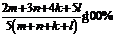
Качество усвоения по формуле
| Качество усвоения по формуле
| Качество усвоения по формуле ср. балл/5*100% |
| ||
4,4/5*100=88% |
|
Анализ и выводы
Данная работа рассматривает изучение темы “Family Issues” по УМК New Millennium English 10 на основе образовательной технологии «Достижение прогнозируемых результатов»
Весь учебный материал представлен в виде карты темы “Family Relations”
Для отработки данного учебного материала был разработан комплекс упражнений. Дифференцированная система заданий способствует учету индивидуальных способностей и возможностей каждого ребенка и позволяет ему самостоятельно работать над развитием собственного интеллекта и культурного уровня. Таким образом, создаются условия для вовлечения каждого учащегося в активный познавательный процесс.
Усвоение учащимися учебного материала отслеживается на каждом из уроков с помощью соответствующих срезовых работ, что дает возможность учителю своевременно скорректировать недочеты и пробелы в знаниях учащихся.
Прогнозируемые результаты изучения учебной темы представлены в виде итоговой работы, задания которой дифференцированы по уровню сложности.
Работа была апробирована с учащимися 10а класса школы № 000 со следующими результатами: Процент усвоения - 100%, процент качества -86%, средний балл -4,3, что выше в сравнении с традиционным подходом, примененном соответственно в 10б классе, где успеваемость составила 100%, качество - 50%, средний бал - 3.7.
Таким образом, можно сделать вывод, что применение образовательной технологии «Достижение прогнозируемых результатов» является эффективным, способствует улучшению качества знаний учащихся и осознанному их применению на практике.
[1] O. В. Афанасьева, Английский язык 5-й год обучения, - Учебник для общеобразовательных учреждений, - М.: Дрофа, – 2007г. –с.69
[2] O. В. Афанасьева, Английский язык 5-й год обучения, - Учебник для общеобразовательных учреждений, - М.: Дрофа, – 2007г. –с.73
[3] O. В. Афанасьева, Английский язык 5-й год обучения, - Аудиокурс, №25
[4] O. В. Афанасьева, Английский язык 5-й год обучения, М. – Дрофа. – 2007г.- с.79.
[5] O. В. Афанасьева, Английский язык 5-й год обучения, М. – Дрофа. – 2007г.- с.84
[6] O. В. Афанасьева, Английский язык 5-й год обучения, - Аудиокурс, №31
[7] O. В. Афанасьева, Английский язык 5-й год обучения, М. – Дрофа. – 2007г.- с.104
[8] O. В. Афанасьева, Английский язык 5-й год обучения, М. – Дрофа. – 2007г.- с.109
[9] [9] O. В. Афанасьева, Английский язык 5-й год обучения, - Аудиокурс, №34

|
Из за большого объема этот материал размещен на нескольких страницах:
1 2 3 |
