


Партнерка на США и Канаду по недвижимости, выплаты в крипто
- 30% recurring commission
- Выплаты в USDT
- Вывод каждую неделю
- Комиссия до 5 лет за каждого referral
I decided to check home tasks every lesson using different interesting activities. In ten lessons I analyzed the results of the work done.
Name | bring me (clothes cards) | game (match, describe pictures) | who is the first (crossword) | listening game (number cards) | team work (sums) | match (colour cards) | who is the first (puzzle) | team work (picture description) | project work (colourful pictures) | dress up the toy (clothes design) |
Tanya | + | + | - | + | + | + | + | + | + | + |
Max | + | + | + | + | - | - | - | - | - | - |
Angelina | + | + | + | + | + | + | - | + | + | + |
Alex | + | - | + | - | - | + | + | + | + | - |
Nastya | + | + | - | + | + | + | - | - | + | + |
Egor | - | + | + | - | + | - | + | - | + | + |
David | + | + | + | + | + | + | + | + | + | - |
Kostya | + | + | + | + | + | + | + | + | + | + |
Eugen | + | - | - | + | + | - | + | + | - | - |
Danil | + | - | + | - | + | + | + | - | + | + |
As we can see from the table, in this case 70% of pupils do their home tasks regularly.
The results of the work done are successful. Checking home works regularly in a competitive way leads to the systematic doing of the home tasks by pupils. Moreover, homework is not associated with boring and difficult process; pupils have no “homework syndrome”. My future plans are to continue the work and to form positive attitude towards the home tasks.
Petukhova Tatyana, gymnasia №1, Krasnoyarsk
In my experience young learners can’t assess their knowledge themselves. Can we teach them to assess their knowledge objectively? One way would be to work out the criteria of assessment for young learners and implement the procedure of self-assessment into their learning practice.
I’ve chosen observation and comparison as methods in my exploration case.
Selecting the instrument I decided that the diary of assessment according to the scales would be very proper. The diary of assessment consists of 5 parts: Reading, Speaking, Writing, My problems and My achievements. For example the part “Writing” has 5 criteria: content, volume, selecting of the words, building of the English sentence, tidiness. The teacher and the pupil assess the knowledge using the same scale. The children can compare their own results with the teacher’s. Thus they can see if they access themselves objectively or not.
12 children of the fourth form took part in this exploration.
· The results of the first data collection in reading, writing, speaking: 56% of the pupils assess their knowledge not objectively. The assessment of the pupils and the teacher has coincided in 44%.
· The results of the second data collection: 61 % of the pupils can assess their knowledge objectively.
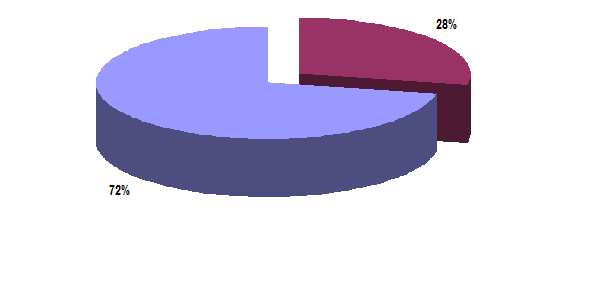
· The results of the third data collection: objective assessment - 72%, not objective assessment - 28%
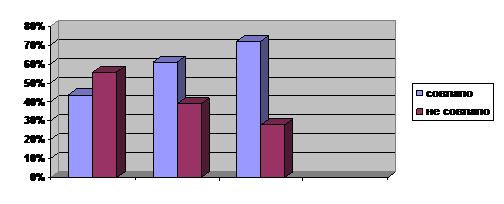
According to the graphs the number of the pupils with the high and low assessment falls. And the number of the pupils with the objective assessment starts to increase.
1) As a result we can see that children can be taught to assess their knowledge objectively with the help of the diary.
2) The child working with different criteria of assessment begins to understand the role of different skills and aspects in learning of the foreign language.
3) At the end of the exploration we discovered that the children began to pay attention to the language phenomena. As a result the quality of the learning increases and the children can find and overcome their difficulties in foreign language learning.
4) The child was given a chance to see how far he progressed in learning English and watch the dynamics of his success.
Larissa Deyeva, gymnasia № 13, Krasnoyarsk
Irina Naumova, Solontsovskaya secondary school
Emma Koshkina, Mingul School
Olga Orlova, School № 32
Marina Serdyukova, School № 42
All of us work in secondary schools. Everybody has different teaching learning situation referring to the number of English lessons per week; pupils’ level of knowledge; their age; personal teacher’s experience; course books, etc. But all of us have the same problem. Our pupils don’t use classroom English at the lessons.
YL predominantly use mother tongue at the lesson. So, during our short experiment we wanted to motivate YL use classroom lexis during English lesson. But we were in doubt whether we supply our learners with necessary resource of classroom English. Our action plan included three main points:
Find and choose appropriate words and phrases. Supply YL and classroom environment with them. Encourage YL to use classroom English implementing a set of appropriate activities.We chose checklist as an instrument because it is not time-consuming, simple in design, it shows valid data, and is objective and precise.
With the help of the checklist we collected data how often YL use classroom lexis in English and in Russian. We did it three times during lessons (it depended on the schedule of each teacher).
First, we gave each pupil the list of classroom expressins in English. We made this input through story telling relevant to the age. Then we have been activating this lexis through different types of exercises: mime games, action games, gap-filling, guessing games, true-false statements and creative activities.
We obtained the number of phrases used in English and in Russian by YL. When we shared our results, we discovered a common tendency:
- In the course of implementation the use of Russian language was reduced.
- By the second data collection the use of English was greatly increased and by the third data collection it was slightly reduced, but in comparison with the first data collection it was still rather *****ssian was used quite little by the end of our experiment.
Having analyzed our data we came to the conclusion that the aim of our exploration was achieved. YL started using classroom lexis in target language after we had implemented all the actions.
But we came across two problems:
1. Not all phrases are used in English in P-P interaction.
2. There are a couple of pupils who don’t use classroom English at all.
It could be the statement for our future exploration and we can initiate the second action cycle.
As the result of our research now we have the resource-pack where there are all the activities which encourage YL to use classroom English. We would like to publish this resource-pack for other teachers to use in practice.
Olga Tarabrina, Brazhenskaya school
Yulya Frezzen, school 161, Zelenogorsk
We start our exploration from the common statement that our pupils can’t remember new words quickly. How effectively can different techniques influence on better memorizing of the words? What if we try out specially selected techniques for better words memorizing?
Our classroom exploration was held in the 2nd grade, where pupils’ level is the “Beginners”, because of the first year of their studying of the foreign language. The majority of our pupils memorized new words very slowly and we spent a lot of time practicing new vocabulary. We used different techniques given in their course-books, games, visual support for better words memorizing, but it wasn’t enough, and moreover, they didn’t work well. This very problem urged us on implementing different techniques for better words memorizing taking into account different types of children’s perception.
First of all, there was a psychological test, which was given to the pupils in order to see the level of their memory. After this test we could pick out the children to participate in classroom exploration and we defined the number of pupils in the experimental group (3).
Our next step was to choose methods and instruments of data gathering. We have chosen an oral test as an instrument of data collecting.
Then, the first test was given to the pupils and we saw the number of words they used. It was done in order to compare it with the further final test after implementing special techniques.
After that, we defined techniques that could optimize the learning process and help children to memorize new words more effectively. But the teachers prioritized different techniques: Olga chose rhymes (such as «Мясо жарится, шкварчит, мясо по-английски meat»). Yulya chose games and Kira focused on miming and gestures, which activated the development of different perception types with children.
· Then, these techniques were implemented in the class. Classroom exploration covered the study of four topics, and each topic included 10 words which had to be studied during 4 lessons. The test was held after each topic and all the results were put down into the table.
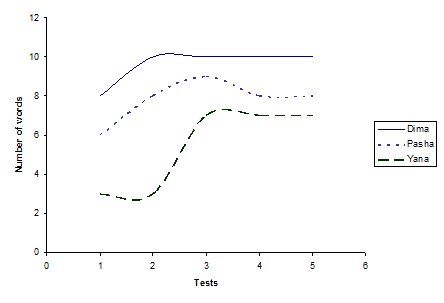
· Finally, all the gathered information was analyzed and presented in the diagram, where you can see the growth of the memorized words.
Rhymes
Number of words Names | 1st test | 2nd test | 3rd test | 4th test | 5th test |
Dima | 8 | 10 | 10 | 10 | 10 |
Pasha Vasiliev | 6 | 8 | 9 | 8 | 8 |
Yana Kolesova | 3 | 3 | 7 | 7 | 7 |

|
Из за большого объема этот материал размещен на нескольких страницах:
1 2 3 |
