


Партнерка на США и Канаду по недвижимости, выплаты в крипто
- 30% recurring commission
- Выплаты в USDT
- Вывод каждую неделю
- Комиссия до 5 лет за каждого referral
Games
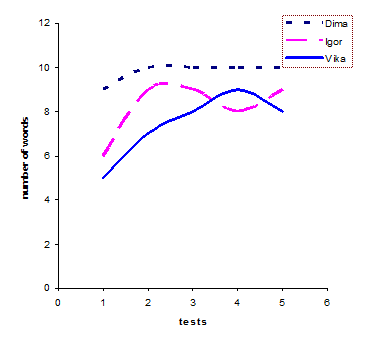
Number of words Names | 1st test | 2nd test | 3rd test | 4th test | 5th test |
Dima | 9 | 10 | 10 | 10 | 10 |
Igor | 6 | 9 | 9 | 8 | 9 |
Vika | 5 | 7 | 8 | 9 | 8 |
Mimes and gestures
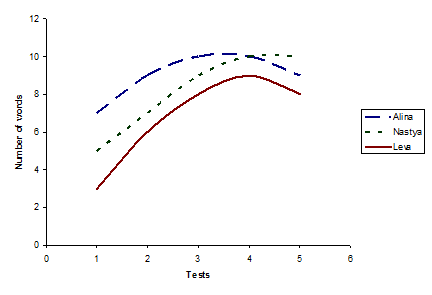
Number of words Names | 1st test | 2nd test | 3rd test | 4th test | 5th test |
Alina | 7 | 9 | 10 | 10 | 9 |
Nastya | 5 | 7 | 9 | 10 | 10 |
Leva | 3 | 6 | 8 | 9 | 8 |
We find these techniques very useful, because:
· They highly motivate pupils to study English. Pupils were interested in acquiring new strategies in their learning.
· By the end of our classroom exploration children remembered more words in comparison with their previous practice.
It is seen from the diagram, the usage of the techniques, such as rhymes and games was effective, because the quantity of memorized words increased gradually.
So, we can come to the conclusion, that usage of these techniques speeds up the process of memorizing words.
But then a new problem appeared: children memorized new words quickly and forgot them some time later. Therefore, our future actions will be:
· to organize the training of the new lexis for a long - term memory;
· to find more techniques that will allow our children to enrich their active vocabulary and use the new words fluently.
Helen Prokopenko, school 16, Krasnoyarsk
Natalia Shuvaeva, gymnasia 2, Krasnoyarsk
Lidia Slepkova, Talovskaya school
English teachers are often faced with the problem when young learners cannot point out the main idea in the text. We discussed this problem and decided to test the learners and measure the level of the knowledge of the children. We were interested in the developing of YL reading strategies and helping them to learn how to extract the main idea from the text.
For this reason we designed some special techniques, implemented them in the class and analyzed the results of the experiment.
The procedure of the exploration was the following:
· Preliminary investigation.
· Designing the instrument (test).
· Choosing 3 experimental learners (middle level).
· First data collection
· Increasing the amount of the used techniques:
choose the appropriate title,
put the sentences in a logical order,
finish up the sentence,
fill in the gaps with the given words,
match the pictures and the extracts,
put the pictures in the right order,
predict what the text will be about according to the title,
make up your own story.
· Second data collection (
· Keeping implementing the techniques.
· Final data collection
The data for the research was collected by three teachers and it was discovered that the children mostly failed to extract the main idea of the text.
The results of the tests were thoroughly analyzed with the help of the graph given below. As it is shown in the graph displaying the first data collection, our thoughts about low abilities of the learners to find out the main idea of the text were proved.
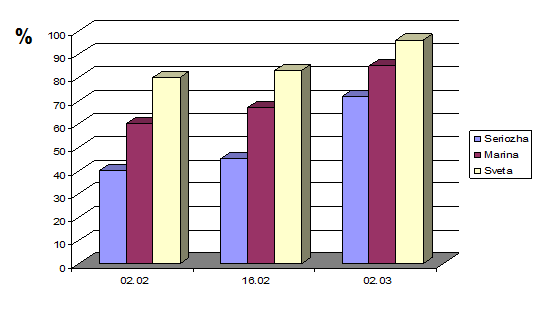
As you see the above diagram pictures that the usage of different techniques and activities lead to development of reading comprehension. It motivates the learners to experiment with the end of the research children were eager to use more English. When we discussed the results of the experiment with the literature teacher she noticed that these pupils made success in analyzing texts and extracting the main idea from the text at the literature lessons easily.
So our future plans are to visit other teachers’ lessons and look whether our techniques are helpful in other subjects.
Spirina Marina, lyceum №7, Krasnoyarsk
Anisimova Yulia, gymnasia №1, Krasnoyarsk
Reflecting upon our teaching – learning situation we can hardly ignore the fact that young learners don’t use classroom English. We discussed the problem and made a conclusion that we should motivate them to do it. Practicing a competition to motivate learners to use classroom English could improve the situation.
That’s why we developed an action plan:
· to introduce a limited number of classroom English phrases;
· to discuss the rules and start a competition among the learners in order to motivate them to use classroom English at the first stage;
· to design the instrument for observation;
· to conduct lesson observation and collect data at the beginning, in the middle and at the end of the experiment;
· to sort out and interpret collected data;
· to make conclusions and plan futher actions.
The experiment was conducted in two groups of young learners in different schools.
In the group of 2nd year learners, according to the rules of competition, which had been discussed with the learners, they got a coloured counter for each phrase used appropriately; during the experimental period three winners were awarded. Since assessment hasn’t been introduced yet, this form of evaluation was a success. In the group of 3d year learners the most active students got «Expert» badges at every lesson and at the end the winners got excellent marks and the certificates.
Classroom English | Olya | Sasha | Max | Lena | Tim | Alex | Paul | Mike |
Can I go out? | ||||||||
Repeat, please. | ||||||||
Can you check it, please? | ||||||||
Can you help me? | ||||||||
Give me a pen, please. | ||||||||
Wait a bit. | ||||||||
What’s the English for...? | ||||||||
Can I come in? | ||||||||
Sorry, I’m late. |
In both groups data were collected with the help of an observation sheet three times during the experiment and once some time later, and we can observe a similar tendency, except the beginning of the experiment.
Number of learners using classroom English, % | ||
2nd year learners | 3rd year learners | |
First data collection | 27% | 30% |
Second data collection | 36% | 53% |
Final data collection | 55% | 80% |
Conclusion.
So, as you can see from the table above students in both groups kept using classroom English phrases during the experiment, and go on using them in appropriate situations. So we can say that competition motivates learners to use classroom English and therefore helps to reduce usage of their mother tongue at the lessons. Even the weaker students get involved and start producing more English.
We understood, however, that the phrases they have learnt cannot be widely used in peer communication. That is why we are planning to add to the list more phrases that will be useful for pair and group work, and involve students in peer observation.
Natalia Pizhik, Talskaya school
Larissa Tarasevich, Abanskaya school № 1
Rakiya Usenko, school № 4, Divnogorsk
In our classes there are some students who are not satisfied with the marks they have got, they look upset, even cry. We tried to find out the reasons of such behaviour. We supposed that it might happen because our students don’t know the criteria of evaluation and they couldn’t apply them.
So, having analyzed the situation we’ve come up to the conclusion that YL can’t evaluate themselves adequately. And our research question is if it is possible to teach young learners to evaluate themselves according to the criteria given to them. The aim of our exploration is to observe whether children’s behaviour will change or not if we input some certain criteria for evaluation.
First, it was a preliminary survey with 2 questions:
· Do you feel offended with teacher’s marks? | Yes: 9 students No: nobody |
· Why? | - The teacher is not fair. - My mum will be angry with me. - My mark is worse than others’ marks. - I’ve got better marks in other subjects. - I don’t know. |
Then, we worked out the criteria for self-evaluation and discussed them with our students.

FIRST DATA COLLECTION inputting criteria for evaluation FINAL DATA COLLECTION
These are the data from their final self –evaluation sheets:
· Do you feel offended with teacher’s marks? | Yes: 1 student No: 8 students |
· Why? | - I don’t know. |
Having analyzed the data we’ve come to the conclusion:
We could obviously see that after introducing certain criteria students were able to evaluate themselves adequately. Besides we noticed that children became more confident and they started listening to each other’s answers. They also started trying to give a short feedback to each other.
We found out that two of our students had low self-esteem and one of them couldn’t evaluate himself according to the criteria. Our task was to find out the reasons for this.
Our plans for future are to continue developing their self-evaluation skills and teach our pupils how to evaluate their peer - and group work.
We think that it is very important to do this work in primary school because we develop the basis for reflection and the foundations for life-long learning.
Anna Makarova, school № 94, Krasnoyarsk
Tatiana Maltseva, Lyceum № 3, Krasnoyarsk
In our class the children of the 2nd form have been studying English for two years. In the 1st form they were taught in a traditional way. They knew the alphabet, they could read, but they didn’t speak much. They mostly communicated by saying “Yes” and “No”. So we could make a conclusion that in our class Young Learners were reluctant to speak English.
With the help of our exploration we decided to answer the question: would the quantity and quality of speaking change if we introduce communicative tasks at the lessons?
We discussed a whole range of possible actions and prioritized the only one. We decided to try out using a range of communicative activities which would stimulate young learners speaking English.
The plan of our exploration was developed. We chose two third formers who were reluctant to speak and worked out a range of communicative tasks for their programme (implementing 1 communicative task every week).
For more objective result we have chosen two pupils in every group. As the result of both pupils was almost the same we presented one variant of the data we collected.
The chosen activities were given to the pupils. While pupils were completing the task, the teacher was listening and taking notes of what the pupils produced in English. The first data collection demonstrated small quality and quantity of speaking production.
First data collection
Activity: (table filling) the learner asked and answered questions of different people.
(Can you jump/ swim…?
Yes, I can./ No, I can’t)
Quantity | Plan 20 | Fact 12 | 60% |
Quality | Yes/No | 7 | 35% |
Short | 5 | 25% | |
Full answer | 0 | 0% | |
Not done | 40% |
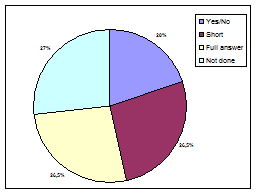
Second data collection
Activity: (matching) the learners described his/her relatives on the picture/photo, others guessed asking special questions
(He/she has got…
Has he/she got …?
Yes, he/she has. / No, he/she hasn’t.)
Quantity | Plan 15 | Fact 11 | 73% |
Quality | Yes/No | 3 | 20% |
Short | 4 | 26,5% | |
Full answer | 4 | 26,5% | |
Not done | 27% |
Third data collection
Activity: (role play ‘Getting a Job”) the learners were given the cards with their roles. The interviewer asked questions and the learner answered questions according to the information on his card.
(What’s your name?
How old are you?
Where do you live?
Can you…?
Have you got…?)
Quantity | Plan 20 | Fact 18 | 90% |
Quality | Yes/No | 3 | 15% |
Short | 4 | 25% | |
Full answer | 4 | 50% | |
Not done | 10% |
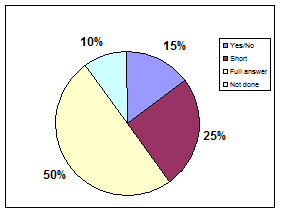
Taking everything into consideration, we proved our hypothesis that communicative tasks provide real necessity to speak English. Children in our group produced more phrases and they were more complicated.
While observing the learner’s speaking, we focused both on quantity and quality of produced phrases. The diagrams show the increase and improvement of quantity and quality.
Besides, communicative tasks helped children to overcome fear to make mistakes as the focus was not on accuracy but on fluency. Moreover, such activities stimulated pupils not only for speaking, but improved the whole learning process. But that doesn’t mean that we should avoid the development of accuracy. And this will be our next issue for the research.

|
Из за большого объема этот материал размещен на нескольких страницах:
1 2 3 |
