


Партнерка на США и Канаду по недвижимости, выплаты в крипто
- 30% recurring commission
- Выплаты в USDT
- Вывод каждую неделю
- Комиссия до 5 лет за каждого referral

КРАСНОЯРСКИЙ КРАЕВОЙ ИНСТИТУТ ПОВЫШЕНИЯ КВАЛИФИКАЦИИ
РАБОТНИКОВ ОБРАЗОВАНИЯ
Сборник методических статей учителей английского языка
ИССЛЕДОВАНИЯ В КЛАССЕ
педагогов в предметной области «английский язык»
КРАСНОЯРСК
Ответственные редакторы: ,
Сборник методических статей «Исследования в классе педагогов предметной области
“английский язык”./ Красноярский государственный университет.- Красноярск, 2006.
Сборник составлен из статей учителей английского языка, которые работают в средних общеобразовательных школах, гимназиях и лицеях г. Красноярска и Красноярского края
ISBN | © КРАСНОЯРСКИЙ КРАЕВОЙ ИНСТИТУТ ПОВЫШЕНИЯ КВАЛИФИКАЦИИ РАБОТНИКОВ ОБРАЗОВАНИЯ |
ИССЛЕДОВАНИЕ В КЛАССЕ
педагогов предметной области «английский язык»
I ЧАСТЬ
ИССЛЕДОВАНИЯ УЧИТЕЛЕЙ
В российском образовании под термином микроисследование в классе понимается краткий по времени эксперимент, имеющий целью позитивное изменение в обучении, преподавании или социальной ситуации в учебной группе.
Оно имеет четкий фокус и проводится самим учителем с использованием простых методов и тщательно подобранных инструментов. Такое микроисследование предполагает обязательное изучение ситуации и выделение проблемы, выдвижение гипотезы о способе ее преодоления, составление плана проведения эксперимента, анализ полученных данных, а также формулировку выводов и заключений.
По сути, микроисследование в классе представляет собой грамотный подход со стороны учителя к контролю качества обучения. При этом анализируется сугубо индивидуальная ситуация в классе и предлагаются решения, эффективные для устранения конкретной частной проблемы. В некоторых случаях результаты работы могут представлять интерес для всего педагогического сообщества в целом, но, в первую очередь, они работают на улучшение ситуации в исследуемом классе.
Микроисследование, проводимое учителем в классе, не следует приравнивать к классическому научному исследованию. Оно имеет свои отличительные особенности. Самые существенные из них это краткий период времени, занимаемого исследованием и узкий фокус наблюдения. Такое микроисследование не требует специальных лабораторий, экспериментальных площадок, сложных наукоемких методов, таких как математического анализа.
Основными задачами учителя - исследователя становятся наблюдение, сбор и правильная интерпретация данных, свидетельствующих об изменениях, происходящих в классе. При этом учитель принимает на се6я новую роль – исследователя, стороннего наблюдателя – и присутствует в классе в новом качестве, рассматривая происходящие события в аналитическом ракурсе.
Иногда идея участия учителей в исследовательской работе вызывает тревожные предупреждения со стороны критически настроенных коллег. Недостаток времени и особых исследовательских умений, отсутствие понимания в школьном окружении или со стороны администрации, страх публично заявить о наличии серьезных проблем – эти аргументы звучат чаще всего. Весомые контраргументы выдвигают сами учителя, проводившие микроисследования в своих учебных группах:
· Самое главное заключается в том, что учитель – исследователь реализовывает на практике рефлексивный подход, позволяющий ему определить, углубить и развить позитивные стороны собственной деятельности.
· Участие в совместных групповых исследованиях приводит к расширению профессиональных сообществ и изменению стиля общения в них: приобретается умение быть корректными и конструктивными при публичных обсуждениях и толерантными к другому мнению.
· Выступления с устными презентациями дают хороший опыт участия в критических обсуждениях и уверенность при защите собственных проектных идей.
· Письменные отчеты об эксперименте дают представление о содержании, формате, стиле и способе организации письменных работ и публикаций.
В представленном издании помещены письменные отчеты учителей, проходивших курсы переподготовки учителей английского языка для работы в начальной школе при Центре англоязычного образования в Красноярске. Здесь представлены письменные отчеты в оригинальной версии, на английском языке, так как курсы переподготовки и защита финальных работ проходят на английском языке. Несмотря на то, что отчеты предлагают очень краткую и формализованную информацию о проведенных исследованиях, они дают представление о проблемном характере и практической направленности экспериментов.
Turusheva Ann, lyceum № 3, Krasnoyarsk
Kiselyova Jane, lyceum № 3, Krasnoyarsk
Kazachonok Ann, school № 88, Krasnoyarsk
We started our work after making an agreement that in our classes young learners don’t speak much English at the lesson. In the process of discussion the following question was raised: Do we use collaborative types of work to give our learners more chance to speak English?
So, we decided to prove the suggestion that we could increase learners’ talking time in English by using pair tasks at every lesson.
The procedure of the exploration included several steps:
· Selecting an instrument (Audio-taping)
· Choosing 3 experimental pairs of learners (middle level)
· First data collection (02.04)
· Increasing the amount of speaking pair activities (every lesson)
· Second data collection (07.04)
· Keeping implementing pair tasks
· Final data collection
All 3 teachers in different groups and classes collected the data for the exploration. But the results appeared to be very similar and the evident tendency for progression was noticed. Therefore, we present one version of the data gathered.
The talk of the chosen pairs was recorded on the audiotape during 3 minutes. After that all the details were thoroughly listened and summarized with the help of the tables and graphs given below. And as shown in the graph displaying first data collection our suppositions about a small quantity of English spoken by children were proved.
First data collection
Activity: (table filling) learners ask each other about the colour of his/her classroom objects and fill in the table.
( · What colour’s your pen/pencil/rubber…?
· Red/green/blue… )
Pair | Names | Number of phrases |
Kate | √ √ | |
Vlad | √ √ √ √ | |
Sasha | √ √ √ | |
Masha | √ √ √ | |
Nastya | √ √ √ | |
Sophia | √ √ |
Second data collection:
Activity: (Name Game) Learner1 points to the pictures of main characters given in the course book asking a question, learner 2 answers not giving the name but the relationship to another character. Then they change roles
( · Who’s this?
· Kev’s sister/Bill’s brother…)
Pair | Names | Number of phrases |
Kate | √ √ √ √ √ | |
Vlad | √ √ √ √ √ √ √ | |
Sasha | √ √ √ √ √ √ | |
Masha | √ √ √ √ √ √ √ √ | |
Nastya | √ √ √ √ √ √ √ | |
Sophia | √ √ √ √ √ √ √ |
Third data collection
Activity: Learners ask and answer questions about the names and the age of the characters referring to the pictures of the course book
( · Who’s this?
· Suzy/Gary/Bill…
· How old is Suzy/Gary/Bill...?
· Seven/five/eight…)
Pair | Names | Number of phrases |
Kate | √ √ √ √ √ √ √ √ | |
Vlad | √ √ √ √ √ √ √ √ | |
Sasha | √ √ √ √ √ √ √ √ √ | |
Masha | √ √ √ √ √ √ √ √ √ | |
Nastya | √ √ √ √ √ √ √ √ √ | |
Sophia | √ √ √ √ √ √ √ √ √ √ |
So, as you see the above diagrams pictures gradual increasing of English phrases spoken by learners at the lesson. According to this fact we may conclude that frequent use of the pair tasks leads to the enlargement of learners’ talking time.
Moreover, it motivates children to further studying and experimenting with the language. As our observations have proved, the learners were eager to produce more English. But a new problematic area was noticed: trying to produce more phrases there were more slips of the tongue in learners’ speech. Therefore, our plans for the future are to think over the possible actions for the improvement of learners’ pronunciation skills.
Chumakova Ekaterina, Gymnasia № 7, Krasnoyarsk
Young learners don’t get into the habit of using the context to infer the meaning of unknown words.
Are there any ways I can promote effective learning strategies to develop children’s ability to use linguistics and visual clues and other background information to understand the meaning of unknown words?
I’ve decided that in this sort of situation I could use special exercise to give them more chance to practice in guessing the meaning of a word, relying solely on the text. The exercise is called “My computer’s gone crazy” and includes 4 steps:
1) The teacher explains that her computer has a problem and that every now and then it changes a word she tapes. In the worksheet she forgot what word she taped. The children have to read each sentence and guess the meaning of the strange word. There may be more than one possible answer. If children’s answer makes sense, the teacher accepts it.
2) The whole class discusses the answers. The teacher asks them to explain why they chose that particular word and why they excluded other possible words.
3) The children try to create similar exercises, with perhaps one or more sentences each. The teacher makes other training worksheets using children’s sentences.
4) The children identify the strange words getting points to win this sort of competition among their classmates.
To explore the problem I worked out the action plan:
1. Selecting an instrument (analysis of children’s written works)
2. Choosing an experimental class of learners.
3. Trying out the exercise (steps 1, 2)
4. First data collection (31.01)
5. Implementing the exercise (steps 2, 3, 4 repeated 2 times as a circle)
6. Final data collection (21.02)
Children’s written works were collected for analysis. There were works of 2 types: filled in test worksheets (texts with unknown words) and sheets with “crazy” sentences (as the children called them). The second ones were collected every other lesson (children created “crazy” sentences at home). As for the test worksheets, they included an element of self-observation (children were asked to mark the unknown word with a ”v” if they used a vocabulary to understand the meaning of the word).
There were also training worksheets (10 sentences with ‘strange’ words), but they were used not to measure children’s progress, but to practice them in guessing and to organize a sort of guessing competition among the learners.
The data for the exploration was collected from all of the forth classes (4”A”,”B”,”V”,”G”) to have the complete picture of the problem.
Form | Amount of guessed words, % | Amount of created “crazy” sentences, sentences per a learner | |
First data collection. | Second (final) data collection. | ||
4”A” | 35 | 52 | 18 |
4”B” | 49 | 69 | 17 |
4”V” | 33 | 56 | 19 |
4”G” | 59 | 72 | 20 |
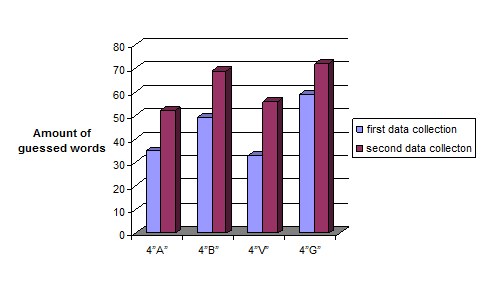
So, as you can see, the above graph picture demonstrates the increase of words guessed from context. It’s about 18% (within 3 week period). Large amount of created “crazy” sentences proves our observation that children were eager to work with context, they were motivated for further studying and improvisation with the language. According to this fact we may conclude that the exercise we’ve chosen helps to enhance children’s receptive skills. It develops their ability to comprehend the meaning of words relying solely on text.
But the exploration covers only the reading area of the problem. Being completed with one more step this exercise, we think, may help learners to become better listeners. This step includes the following actions:
· The teacher divides the class into two groups.
· The children take turns to read their exercises. They pretend to be broken tape recorders and go bzzzz when the ‘strange’ word comes along.
· Members of the opposite group try to find out the word.
· The group gets a point for each correct answer.
Thus, our plans for the future are to try this exercise to develop learners’ listening skills. As for further developing of reading skills we are going to teach the learners to ignore unknown words while reading to understand the main idea of the text.
Katrukhina Alexandra, school № 000, Krasnoyarsk
The real problem in my class is that most of my learners do not do their home tasks. What I’m worried about is whether I check their home tasks in proper way. That’s the reason why I have decided to try checking their home tasks every lesson in an unusual and interesting way.
Analyzing the situation in the class with the help of the register I understood that most of the young learners do not do their home tasks regularly.
Name | 4.02 | 7.02 | 11.02 | 14.02 | 18.02 | 21.02 | 25.02 | 28.02 | 4.03 | 7.03 |
Tanya | - | + | - | - | + | - | + | + | - | - |
Max | - | - | - | + | - | - | - | - | - | - |
Angelina | + | - | + | - | + | + | - | - | + | - |
Alex | - | - | - | - | - | - | - | + | - | - |
Nastya | - | + | - | - | + | - | - | - | + | - |
Egor | - | - | + | - | - | - | - | - | - | + |
David | + | - | + | + | - | + | + | - | - | - |
| + | + | - | + | + | + | + | - | + | + |
Eugen | - | - | - | - | - | - | - | + | - | - |
Danil | - | - | + | - | - | - | - | - | - | + |
 Kostya
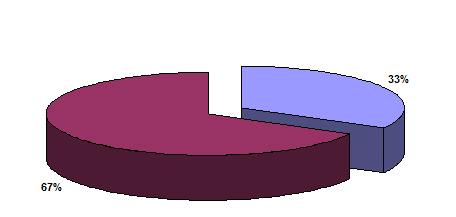
The information from the register showed that only 30% of pupils do their home tasks regularly.

|
Из за большого объема этот материал размещен на нескольких страницах:
1 2 3 |
