

Партнерка на США и Канаду по недвижимости, выплаты в крипто
- 30% recurring commission
- Выплаты в USDT
- Вывод каждую неделю
- Комиссия до 5 лет за каждого referral
In case conditional average size of a family in all settlements is accepted by a minimum size (one laboring person, one pensioner and one child), the total income of each second (!) family in Chereshnya and Galitsyno (and each third - in Esto-Sadok) will be lower than minimum of subsistence average for Russia, that according to the latest data of Rosstat for such composition of a family makes up 18 458 rubles.
The results of the sociological survey on the income of citizens in connection with satisfying their needs (Table 6) testifies to the low potential of economic development. In fact, each third respondent in Chereshnya and Galitsyno possess money sufficient only for primary survival (provision of food and clothes).
Table 7
Assessment of material welfare | Chereshnya % of the number of questioned | Estosadok % of the number of questioned | Galitsyno % of the number of questioned |
We hardly make ends meet, we do not have money even for food | 13,0 | 3,8 | 10,2 |
We have enough money for food, but purchasing of clothes creates difficulties | 28,0 | 11,5 | 32,2 |
Our income is enough for food and clothes, purchase of durable things (TV set, refrigerator, furniture, etc.) is hardly feasible for us | 41,0 | 34,6 | 23,7 |
Purchase of durable things is not a problem for us, but really expensive goods – a car, a country house are hardly affordable | 16,3 | 36,5 | 30,5 |
At present, we can afford all goods we need | 1,7 | 13,6 | 3,4 |
Thus, it is possible to make a general conclusion that income of families in two settlements – Chereshnya and Galitsyno – make it possible for them to live on the edge of survival: people have money only for food and clothes. Even in case concealment of part of income from sales of vegetables and fruit (that could not make a significant value due to a limited volumes of growing and high competition) by some respondents is possible, comparison with the situation in Estosadok demonstrates that income and well-being of population connected with employment on the Olympic objects and servicing tourists by the inhabitants of Estosadok are higher than in other pilot settlements. In this context, economic prospects of inhabitants of Estosadok, located 4 kilometers from Krasnaya Polyana, look more preferable than in other settlements.
All the more surprising and paradoxical is the situation with the assessment of prospects for the development of settlements by their inhabitants themselves. In terms of overall pessimistic vision Estosadok – the most prosperous settlement - is the absolute leader (see Diagram 5).
Diagram 5 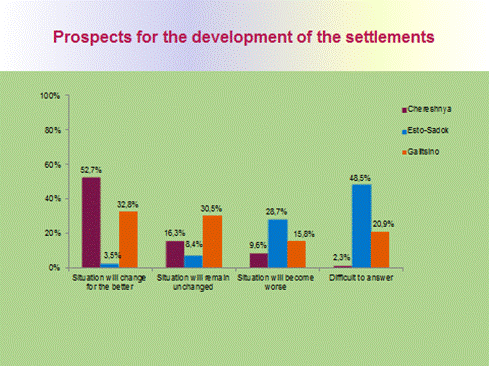
Explanation to this fact will be given below in the course of the analysis of ratio between current and future problems (risks).
As the overwhelming majority of population in all three settlements does not have higher education, and rather small part of population have secondary special education, this puts several constrains on possibilities of getting jobs. Insufficient level of education is a very important factor that prevents from increasing well being and transition to sustainable development, first of all, due to impossibility of diversifying available jobs and services on the constantly changing labor market. Therefore, in their proposals on raising the level of education of teenagers and youth, respondents stressed the need of introduction of evening courses (centres) of professional education.
It is necessary to mention that the absolute majority of inhabitants of all settlements understands the importance of education and wants their children to get a better chance for the future. In the responses of inhabitants of all settlements and age groups the proposal on “establishing a child cetnre of education and development” occupies the first – second place in terms of importance. Numerous remarks refer to the quality of teaching in schools. A popular proposal is connected with creation of creative groups and sport sections. It is also aimed at improving quality of education and work with children and youth. All those proposals express the essence of the idea of sustainable development. Therefore, changes in the field of education and organization of leisure for children and youth should be sequentially carries out.
3.4. Current and past problems as risks for sustainable development
The theory of sustainable development teaches to make out the shape of the future against the background of current situation, develops the skill to see “the heart of the matter”.
Therefore, analysis of prospects for sustainable development starts first of all with studying the content and possible evolution of current problems, representing priorities for citizens, but, at the same time, also envisages study of the past (accumulated) problems that local population does not consider the most important (the effect of habit), but that might hide potential risk in future. Implemented sociological study may serve as a basis for analysis of that type and development of practical recommendations that will facilitate solution of current and past problems in a unified format of sustainable development.
According to the answers of respondents, the main institutional problem – fixation of property rights, was (is being) successfully solved in pilot settlements. In the answers to open questions and in their explanations to the answers none of the respondents identified absence of property rights for land plots as a priority problem. In all three settlements per cent of inhabitants that registered property rights for their land plots is rather high. This is a positive fact, as in the absence of a possibility of confirming property rights it is not possible to talk about sustainable development. Therefore, the risk of appearance of a problem related to property rights is not expected in future.
3.5 Environmental risks as a main limiting factor for developing agriculture in its market and natural forms
In general, as the analysis of item 3 shows, natural economy forms a basis for the life support of inhabitants of pilot settlements. It is mainly based on agriculture (in less extent in Estosadok). It is evident that sustainability of agriculture is primarily determined by environmental factors. The results of sociological study testify to the fact that several environmental factors raise the biggest concern of local population.
In Chereshnya settlement (see Diagram 6) the biggest concern is connected with negative impact of constant (24 hour a day) use of heavy load trucks (noise, dust, car emissions) in the course of implementation of construction of Olympic objects. Breakage of environmental equilibrium brings the risks of landslides that are considered as serious by inhabitants. Formation of disposal tips in places not intended for this also cause concerns of population.
Diagram 6
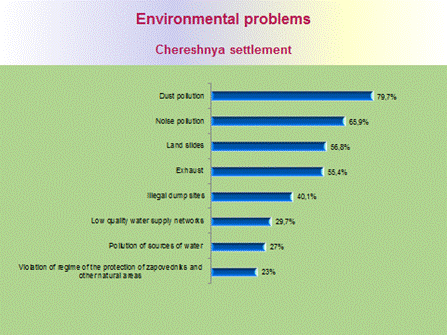
The sociological survey shows that problems of water supply and water quality do not cause anxiety of local population now.
In general, it might be considered that impact of transport undoubtedly has negative impact on growing of fruits and vegetables, creates difficulties for safe pasturing and limits possibilities for poultry breeding. Air pollution and soil contamination significantly deteriorates quality of products and may lead to creation of problems related to sales of products to consumers.
Though the problem of extreme transport intensity is definitely temporal, nevertheless it is necessary to think about implementation of technical measures on partial limitation of noise and pollution (noise cancelling shields, temporary high blind fences, bypasses, where possible, etc.).
It is necessary to mention that the issue of landslides was identified by 62 per cent of respondents. It testifies to the attention of local citizens to a potential risk for their life. In the past landslides destroyed the building of a kinder garden in Chereshnya. Currently 8 places of high risks of this natural disaster are identified that are located near roads and houses.
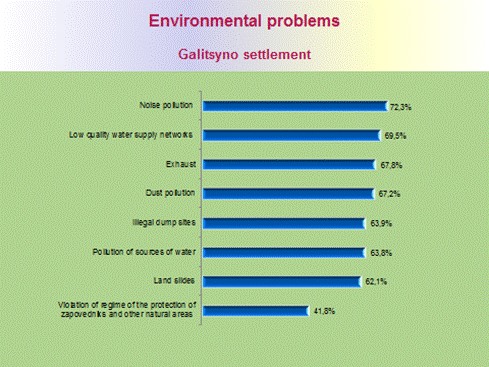
Sociological study for the settlement of Galitsyno (Diagram 7) identified similar environmental issues but with higher accent on low quality of water supply.
Diagram 7
In Estosadok settlement impact of cargo motor transport servicing construction objects raises the biggest concerns of local citizens. This was also reflected in their answers (see Diagram 8).
Diagram 8
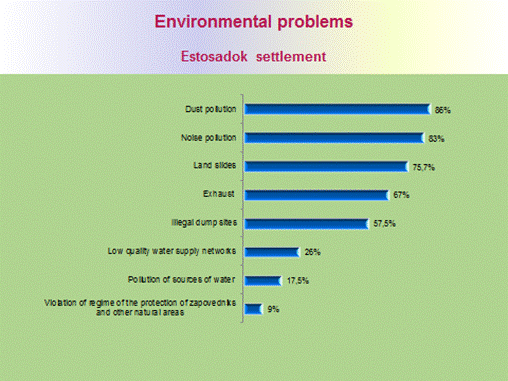
Inhabitants of pilot settlements note as the most acute environmental problems that presently directly interfere with their interests. The problem of violation of protective regime of the strictly protected natural area and other protected areas is the less priority[4] as the use of the environment in the protected areas does not bring direct harm to the economy of settlements at present. At the same time, from the point of view of sustainable development, violation of the regime of strictly protected natural area with corresponding consequences for biodiversity might be considered as a serious priority issue and should be touched by public organizations, experts, politicians, including at the local level.
Inhabitants of the pilot settlements could not and should not assess interconnection between the cause and the consequence and identify how serious is the pollution of Mzytma river influence human being. These interconnections should be identified by experts and specialists, attracted already at the stage of examination of projects. Negative environmental “external effects” that appear in the form of degradation of ecosystems might easily cause very concrete and economically measurable losses for settlements within the zone of their spreading.
According to our belief the acuteness of environmental problems in Estosadok settlement both in absolute (drastic deterioration of environmental quality) and in relative (in comparison with two other pilot settlements) terms was the reason for very pessimistic assessment of the future by the inhabitants of this settlement.
Inadequate water supply (water quality that does not correspond to sanitary-hygienic norms) was mentioned by 88.5 % of respondents. This problem was mentioned as the most acute (after absence of gasification) in the general list of 22 socio-economic and environmental problems. From our point of view, this environmental problem is the main negative phenomenon in the life of the settlement[5].
Elimination of this problem from the point of view of long term sustainable high quality water use solution is the option that is most favorable for the inhabitants of Estosadok. It might cardinally change both general view on the prospects of development and the assessment of work of local authorities.[6]
It should also be mentioned that such important economic factor for widening the scope of the marketable agriculture as the capacity of local market (Adler, Sochi) from the point of view of local citizens does not represent a serious limitation. From the 22 listed problems “the issue of sales of local products” in terms of priority for the most agriculturally developed settlement of Chereshnya occupies the last place. It should also be noted that the per cent of population that noted that such problem did not exist exceeded the number of respondents who ranged it. Similar situation is observed in Estosadok and Galitsyno settlements where this problem was also placed in the end of the list of priorities.
It might be assumed that bad conditions of roads in the vicinity of pilot settlements and inside them, considered as a high priority for all pilot settlements (1 place in terms of importance in Chereshnya, 4th place in Estosadok, 8th – in Galitsyno, where the 5th place is occupied by the quality of functioning of public transport) testifies to the existence of the problem of delivery of products to the local market. However, while selecting such an interpretation one should keep in mind that bad quality of roads in all pilot settlements also are the sources of dust and factors of pollution with gasses.
In any case, the results of sociological study definitely testify to the fact that in terms of importance “economic factor” could not compete with the value of clean air, clean water and clean soil, attained by the citizens.
3.6 The risks of tourism development
As the development of tourism, along with agriculture, is one of the main directions of future activities in the pilot settlements, it is necessary to take into account risk assessment of tourism development identified by local citizens themselves. As stated below, main risks (concerns) of tourism activities as a type of business for local citizens are identified as external ones that do not depend on them. Consecutive government policy on removing (minimizing) of identified risks, adequate accounting of internal potential and assistance to local citizens in disclosing their potential and abilities might contribute to the confidence in prospects for tourism and let citizens to make a conscious and professional choice in favor of tourism.
Thus, citizens of Chereshnya are not sure in the favorable territorial location of their settlement (relatively close to Adler) and complain for the absence of relevant infrastructure. About 60% of inhabitants are ready to render accommodation to tourists for rent, and about 40 % are ready to help in organization of excursion programmes, while part of them propose pedestrian touristic walks and horse riding. About 22 % of youth form the respondents are interested in organizing trips on quadracycles. There are people eager to be involved in kayaking. Certain concerns are connected with low level of interest in teaching the outsiders in specific kinds of sports (the lowest rating of all options) in the settlement that positions itself as a sport centre.
From the point of view of the respondents, low level of tourist services and weak medical service are limiting factors for the development of tourism in Galitsyno settlement. In this settlement about 36 % of respondents are ready to teach newcomers in certain kinds of sport. In comparison with Chereshnya settlement, bigger activity is observed in the field of organization of amateur hunting, horse riding and accompanying newcomers for amateur fishing.
In spite of a clear preference, given by the citizens of Estosadok settlement to tourism as a perspective branch, the number of questioned that expressed readiness to provide touristic services, inhabitants that are not ready for that type of activity and respondents that found it difficult to answer this question, were practically equal (with a slight preference in favor of “for” in the youth sample). People eager to be involved in touristic activity are ready to use in future Olympic objects and to hold trainings in mountain skiing, snowboard and ski jumping. Some respondents are ready to provide transfer services. In this regard, people who are ready to specialize in touristic services count on all-year-round tourism. They also stressed their readiness to render services on collection of medical herbs, mushrooms and berries.
In their comments citizens of Estosadok expressed their regrets connected with closure of specialized classes on hotel services in the secondary school, located Krasnaya Polyana. No doubt, that possible development of technical kinds of tourism will also require additional education and certification.
In the list of priority problems inhabitants of Estosadok mentioned the issue of establishing a steady mobile connection. It is clear that fulfillment of this wish is a necessary condition for the development of tourism. Among other factors limiting tourism development inhabitants of the settlement mentioned passive position of the authorities, absence of relevant infrastructure and inadequate environmental condition. The youth is concerned with high prices on touristic services that might discourage outsiders.
In general, in order to improve their well-being all participants of the study in all settlements are ready to work more and to seek additional earnings. There was a case when a pensioner from Galitsyno settlement expressed his readiness to return to his previous place of work and to work as a road master (naturally, highly demanded profession) in case material condition of the family becomes worse.
All representatives of the youth in all three settlements are eager and ready to work. None of them count on the lifelong rent. They believe in successful overcoming of difficulties similar to the majority of young people of their age. In any case, in their answers on identification of priority problems they often think that many problems do not exist.
In all settlements the main part of population consists of people who spent the bigger part of their lives in their small motherland, while some of them – the whole life. It explains their readiness to improve life conditions on their territory. Both old and young people are ready to improve their territory, participate in addressing the issues of their settlement (construction of water supply and sanitation, road repairing, etc.).
Modern market economy disperses people in search of work. The task of sustainable development is to create the forms of employment that allow to preserve a community of people in their settlement.
3.7. Increasing activity and involvement of inhabitants in the process of decision making
Even the most qualified experts are not able to assess everything and the state bodies – to ensure all necessary conditions. Therefore, citizens should themselves actively participate in preparation of decisions and decision-making connected with their settlements. General universal mechanism of participation – is creation of public organizations and delegating them some of representation functions. It is expedient to assess attitude of inhabitants of different settlements towards public organizations.
Table 8
The necessity of establishing public unions
(in brackets – answers within youth sample, 18-30 years of age)
Chereshnya (% of inquired) | Estosadok (% of inquired) | Galitsyno (% of inquired) | |
Yes | 59,0 (59,1) | 33,2 (28,9) | 64,4 (51,9) |
No | 9,6 (15,9) | 11,4 (17,3) | 19,2 (33,3) |
Difficult to answer | 31,4 (25,0) | 55,4 (53,8) | 16,4 (14,8) |
Estonian community functions in Estosadok and general meetings of inhabitants occur when necessary. Relatively big sample of Estosadok inhabitants did not produce an opinion on the necessity of additional public union. This can be interpreted in various ways and we cannot provide the final view.
Of the three pilot settlements the highest polarization of the opinion on this issue was observed among the youth of Galitsyno settlement. In the course of the sociological questioning an impression was formed that public life of the settlement was organized around the two public personal leaders that might prevent from organizing structuring. Appearance of nihilism towards any public institutions among the youth is also possible. In Chereshnya settlement general opinion of population was more common. However, in general both in Chereshnya and in Galitsyno the share of population that mentioned the deliberate need for more structural organization of the public life.
Agricultural production is considered by local citizens from the point of view of sales of surpluses of produced natural products in markets of Adler and Sochi. It seems that due to relatively small tradable amounts goods concerns of market sales are not among priority problems of pilot settlements. However, the situation might change in future. A certain problem for the citizens in this case is connected with the quality of roads and functioning of public transport.
In the course of the sociological study not a single opinion of local citizens was expressed (in contrast to external experts) on the development of new types of economic activity apart from those that already exist. At the same time, some interesting proposals were connected with further development of already existing types of economic activity. Among these proposals is the wish of inhabitants of Chereshnya settlement on the construction inside the settlement (in the vicinity of it) of a mini plant for processing fruits and vegetables. In their turn, inhabitants of Estosadok proposed some options for the development of touristic activities, in particular, technical kinds of tourism. This testifies to the fact that the most active part of inhabitants understands that sustainability might be attained by diversification of activities.
The problem of national conflicts among local citizens is not a priority. Only small per cent of local population mentioned it as an issue (about 4%). The more important issue if connected with workers from the outside. Local population is concerned by growing criminalization and absence of common cultural space.
Citizens of all three pilot settlements are primarily concerned by the state of infrastructure, including roads. Basic common priorities for them are connected with gasification, heating and medical services. Their public activity is concentrated around addressing these issues by the state.
Chapter 4. Cluster model of sustainable development of pilot settlements
Collected and analyzed information, obtained through sociological study, allow to make general conclusion on the unsustainable nature of economic development of the settlements.
This conclusion is based on the following factors:
1) Low per capita income of inhabitants of pilot settlements;
2) High share of natural economy that depends on changing environmental conditions;
3) High level of dependence of each separate settlement on variable external factors: demand for working force, social conditions, development of infrastructure, etc.
4) Pilot settlements do not yet have opportunities for promoting their original products. It testifies to the need for “adjusting” to a driver in the form of an external investor and/or other territorial structure.
One of the basic principles of sustainable development is creation of jobs in the vicinity of accommodation. At the same time organization of a certain type of economic activity should not be artificial (as was the case with soviet collective farms and state farms). Type of activity that might attract working force from settlements should be profitable and citizens should match it by their professional skills.
The slogan “We work for you during the whole year” might become a general slogan for the settlements. It can also be other interpretation of an idea of the all year round economic activity of the inhabitants of pilot settlements, connected with provision of touristic services and/or agricultural production. This also envisages all year round demand for services and products of local citizens by consumers. At the same time, it envisages formation of a favorable infrastructure for timely supply of necessary products and/or rendering required services.
Territorial cluster approach[7] that unifies six settlements is proposed as a basic principle for the development of settlements of Chereshnya, Estosadok and Galitsyno. It unifies nine settlements and is based on the following principles:
· Geographical proximity of settlements that form the territorial cluster;
· Single product in the production of which all pilot settlementsб included in the cluster, are involved at different stages of production;
· Mutual complementarity of functions of all settlements that form the territorial cluster;
In a more formal sense territorial cluster is understood as a totality of enterprises and organizations that:
· are located closely to each other;
· forms a chain for production of added value in one or several sectors (key types of activity);
· ensures increasing of efficiency of each enterprise/organization and their integration in national global system of the division of labor;
· possesses a mechanism for self-organization and self-governance;
· provides for effective mobilization of resources of a territory, growth of competiveness and integrated development.
General direction of the development of Sochi as a mountain climatic and balneological resort is quite logical and determines a nature of the cluster under formation as recreational-touristic.
In principle, all settlements located near the highway – Adler - Krasnaya Polyana and/or related to Mzytma river basin, form common mountain cluster. Therefore, common policy of sustainable development needs to be formulated for the whole bulk of settlements. Options of target resettlement of population from settlements that are in critical conditions (for example, Akhshtyr) to settlements with better conditions. In our case, identification of a cluster consisting of only nine settlements is rather conditional. It is connected with demonstration character of the Project and its objectives.
It is envisaged that territorial (mountain) cluster will include the following settlements: Krasnaya Polyana, Esto-Sadok, Lesnoe, Kazachyu Brod, Monastyr, Galitsyno, Chereshnya, Nizhnyaya Shilovka, Verkhneveseloe.
It is necessary to mention that cluster approach widens the boundaries of economic activity by moving it outside the limits of territorial structures. It is difficult to determine in advance how strong financial ties inside the cluster might be. It is quite possible that in due time development fund will appear inside the cluster. In any case, at the first stage of self-organization the settlements should understand interdependence and mutual responsibility of their actions. First of all, it relates to quality of products and services proposed by them.
In Russia there is a serious problem of “the lack of attention to small forms of development”. A cluster that develops horizontal ties at the local level might evolve into an institute of local development.
The Scheme 1 presents a general model of functioning of the mountain cluster. Success of the development of the mountain cluster depends on external factors aggregated as a group of institutional conditions and the level of development of market economy, as well as a “platform” on which the cluster is based. It relates to supply of gas, water, availability of roads, additional energy capacities, etc. (infrastructure of sustainable development).
On the most important things
In the course of the meeting with inhabitants of Chereshnya settlement the following phrase was repeated many times: “Build us good roads and give us gas, all the rest we will do ourselves”. Though it seemed to be a clear overstatement, as local citizens are unable, for example, to protect themselves from landslides, nevertheless, gas and good roads that were mentioned as priority infrastructure factors that prevent them from the transition to self-sustaining development.
The quality of the Agenda 21 depends on the degree to which priority problems, connected with availability of internal and external factors are identified; ways for addressing those issues are determined and addressed. It is also necessary to take into account that problems, that might be “automatically” solved within the framework of political and economic progress, should not be addressed in the context of the Agenda 21. The complexity (though decidable) is in their identification.
In the course of the brain-storming organized during the workshop “Characteristic and assessment of the initial socio-economic situation in the pilot settlements and analysis of possibilities for their development” held on 21 December 2011 in Moscow, the participants identified (minimized) the main external factors that had influence sustainable development of pilot settlements.

|
Из за большого объема этот материал размещен на нескольких страницах:
1 2 3 4 5 |
