

Партнерка на США и Канаду по недвижимости, выплаты в крипто
- 30% recurring commission
- Выплаты в USDT
- Вывод каждую неделю
- Комиссия до 5 лет за каждого referral
For the thriving component No 1 (Estosadok – Krasnaya Polyana) the most important external barrier is connected with the absence of free land sites necessary for sustainable development of the area. Measures related to a programme of restoration of the state of Mzymta River were not identified (target quality indicators). Several organizations took responsibility on this programme, including JSC “Russian Railroads”. Serious damage was brought to beekeeping – traditional occupation of inhabitants of Esto-Sadok. It was caused not only by withdrawal of lands for construction purposes, but by general trend of decreasing the number of fruit trees and flowers.
At the same time, some positive “external factors” might be mentioned related to Component No 1, connected with the development of new touristic routes, “closed up” on Esto-Sadok and Krasnaya Polyana and related possibility of involvement of national and international tour operators. Possibilities for eco-tourism in the Sochi National Park will be widened.
It is planned that in future construction of new hotel complexes and an Aqua park will be performed (the construction of Aqua park “Belarus” had already started but was stopped due to the lack of funds).
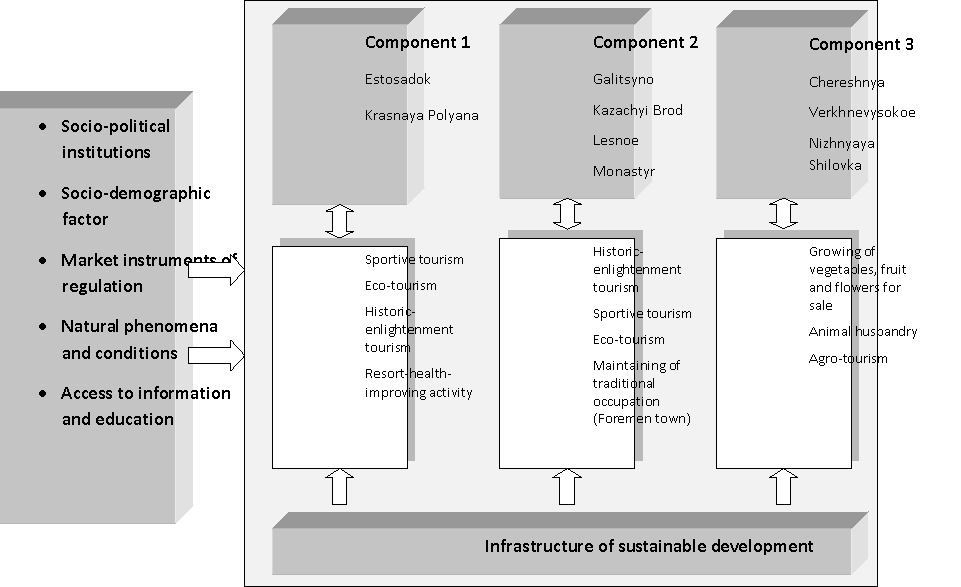 External conditions Mountain cluster
Among the external limiting factors related to Component No 2 – Galitsyno, Kazachyi brod, Monastyr, Lesnoe – absence of free areas for social construction (club, new school) was mentioned for the pilot settlement of Galitsyno.
There are no cafes or restaurants in the pilot settlement. The problem of water supply also exists. At the same time, the settlement of Galitsyno is favorably located in the centre of popular touristic routes and objects. Significant number of touristic objects exists in other settlements, including cultural ones, highly demanded by tourists and pilgrims.
The settlement of Lesnoe, located 4 kilometers from Galitsyno (along a single-row road with asphalt surface) possesses objects that represent cultural and historical value. This include the Greek Orthodox church of St George, Trinity-Georgian nunnery, ruins of the medieval Christian temple. Settlement of Lesnoe is located on the banks of middle course of the fast mountain river Psakho. During floods it is possible to go down the river Psakho on kayaks. Rich natural environment, diversity of landscapes provides various opportunities for organization of tourism of different types.
In the vicinity of pilot settlement of Galitsyno there is a natural monument of paleolithic age – Akhshtyr cave. It is very popular among travelers. A trout farm and an ostrich farm – objects of study, entertainment and gastronomic tourism are located near Kazachyi Brod settlement. The settlement of Kazachyi Brod is famous for its souvenirs produced from glass.
A strong impulse in the direction of provision of services for sportive tourism for the settlement of Galitsyno will be connected with planned bringing into operation of the four-star “Marriott” hotel complex in the end of 2013, located between the settlements of Krasnaya Volya and Galitsyno. This object is a part of an ambitious project that envisages construction of an 18-hole golf field, a club house, golf academy, tennis courts, three swimming pools, a spa centre and a residential settlement with cottages with a total area of 110 000 square meters. Horse riding sport centre will side with Galitsyno mercial bank “Natsbusinessbank” will act as the investor of the project and Joint Stock Company “NBB-Development” will act as its developer.
According to the project the golf complex will have common water intake with the settlement of Galitsyno and contemporary treatment facilities of the complex, presently being designed, will also be used by the settlement of Galitsyno.
According to international and Russian practices teaching of children in the Golf academy will be free of charge. Similar principles in relation to children from Galitsyno settlement will be applied also for studies in the horse-riding sport club. According to its standards and traditions “Marriott” hotel organizes its own training courses for training qualified personnel and stimulates employment of local population.
For the Component No 3 – Chereshnya, Verkhnevysokoe, Nizhnyaya Shilovka – the main external barriers for the pilot settlement, similar to the above two cases, are the lack of lands (in that case – for the development of agricultural production and animal husbandry) related to the transition of the part of agricultural lands to the specially protected lands. Space for pasture was not formed.
Regular landslides (2-3 times a year) represent a special risk for Chereshnya settlement, especially for communications and residential houses.
In connection with rather long terms of recoupment of fruit gardening (very popular among inhabitants of Chereshnya) problems with getting small interest-bearing credits for organizing commercial activity exist. Citizens of the pilot settlement of Chereshnya, similar to citizens of other settlements of the given component, might be employed in case the lands of the former soviet farm “Voskhod”, located nearby, are transformed into lands of hotbed farm.
Territorial vicinity of Adler (in case the issue of road quality is addressed) might provide a preference in the course of transportation of agricultural products and flowers.
During the meeting of the Executor and the Customer with activists of Chereshnya inhabitants raised the issue of the development of a project on agro-tourism, when the guests might get acquainted with the whole “production – consumption” process – from growing of fruit and vegetables and flowers (man-height long lilies) – to processing of products and cooking of food related to different national cuisines (population of Chereshnya consists of Russians and Armenians).
4.1. Overcoming external barriers
Deficit of free lands for the development of pilot settlements represents a common barrier for the whole mountain cluster. Sochi National Park possesses reserves of land necessary for sustainable development of the components 1, 2 and 3 of the mountain cluster.
The Sochi National Park is a part in the specially protected area, that also includes zakaznik and biosphere reserve, the boundary of which is rather conditional. At present, the bigger part of mountain climatic and balneological resort under formation (about 84 %) is included in the specially protected areas and objects, where access is limited and access regime is overregulated.
Two options exist for the solution of the problem of overcoming the external barrier related to absence of mutual understanding and coordinated work of the citizens and the Sochi National Park. These two solutions might be considered as mutually complementary.
The first one – transfer of property rights
Transfer of a part of lands of the National park to the municipality of Sochi for creation of objects and development of infrastructure for organizing all-year round tourism, resort recreation, balneological health restoring, preserving traditional occupation of local population bee keeping, gardening, etc.), based on the potential of the mountain cluster.
In particular, the development of the following types of tourism and active recreation is possible:
· Touristic pedestrian hikes, climbing on near-by mountains;
· Horse-riding;
· Pedestrian excursions for gathering berries and medical herbs and mushroom picking;
· Zones for cycling
The second option is based on the creation of an open and transparent model of cooperation of the national park with local citizens.
Development of various official kinds of tourism on the territory of the National Park itself with attraction of local citizens as escorts (according to the results of the sociological study and meeting with Galitsyno settlement activists local citizens are ready to work both as escorts and as guides, as well as to help huntsmen). At present, organization of excursions is given to people that work in this sphere unofficially (so-called «black guides»). Local population is interested in organizing the following types of tourism:
- pedestrian recreational tourism
- environmental paths
- study tourism - visits to dolmens – ancient graves, dating back to 3 - 5 millennium B. C., medieval fortresses. These historical monuments are located on the territory of the National Park.
It is proposed to create a public union of interested touristic organizations in order to reach an agreement on excursion routes and to develop conditions for excursions on the official basis. Tour operators are ready to be included in this area of work, as internal touristic market is not developed in the mountain cluster and Russian tourist groups at present are oriented at visits to the regions of Abkhazia.
Strengthening of cooperation between the National park and local citizens should be aimed at resolving conflicts and finding compromise solutions related to:
- Illegal pasture of kettle on the lands of specially protected areas;
- Illegal logging for heating of houses.
The experience of UNDP/GEF project “Organization of sustainable life support of population in specially protected natural areas: conceptual basis and practical guidelines”, described in the introductory part, testifies to the good prospects of cooperation of the National park with local citizens on the basis of organizing simple micro-crediting schemes. In our case this topical for the settlement of Chereshnya where there is an urgent need for significant speeding up of agricultural development.
The most important external problem for the pilot settlements of Estosadok and Galitsyno is predictable growth of population in both settlements up to several thousand people in each of them. Estosadok might turn from a rural settlement into a town. Intensive development of country houses economy on the adjacent territories might create additional load on the infrastructure of Galitsyno. This substantiates the expediency of the development of documents on the spatial planning and zoning of territories of the components 1 and 2 of the mountain cluster. Existing General Plan of the development of Sochi is too large-scale for such objects.
Lessons learnt in the course of implementation of the international project “Sustainable development of mountain regions of the Caucasus – Local Agenda 21” testify to the importance of establishing communication ties. Of special importance is establishing an interaction among the people and give them access to information on the future. Thus, in the course of the meeting with population of Estosadok it became evident that inhabitants are practically unaware of the plans of Sochi administration.
In the three pilot settlements Internet is commonly accessible only at schools. In Estosadok it is not accessible due to the absence of a school. A school equipped with computers and having access to Internet might be considered as a temporary solution and a very inconvenient place for meetings and communication of inhabitants in the evenings and on week-ends. Separate clubs, having computers and Internet access, should be constructed in each settlement. In Estosadok the club should be renovated, equipped with computers and connected to Internet.
Availability of Internet is a necessary condition for remote education that widens its potential in Sochi.
The network of educational institutions widened in connection with holding of 2014 Olympic Games in Sochi. At the same time, there is a serious information gap between the wishes of inhabitants of the pilot settlements and the offer of educational institutions. In the course of the meetings with local population and representatives of educational institutions the Executor and the Customer acted as providers of information between the two parties. It is evident that the issues of modernization of the School of arts in Krasnaya Polyana and dance classes at the school of Chershnya should be addressed through self-governance bodies and by means of direct contact of parents with management of corresponding school.
There are real possibilities for studying English (English First) in Sochi at preferential prices. It might be requested by citizens that wish to actively work with foreign tourists during and after the Olympic Games. A Consortium of higher education institutions was established in Sochi in view of the forthcoming Olympic Games. However, its work in Sochi itself is not yet very active.
As it was shown above in the course of generalization of the sociological survey percentage of inhabitants that have secondary special education is rather low. The Centre of employment in Sochi provides an opportunity for professional retraining, including such specialties as fitter, concrete worker, erector. In case a person has the status of “unemployed” training is provided free of charge. The cost of paid courses varies from 850 to 4950 rubles.
The University of Sochi also provides educational programmes demanded in connection with preparation for and holding of the Olympic Games. Field trainings are organized. If necessary, inhabitants of the pilot settlements might self-organize and present an application for this.
4.2 Developing Infrastructure for Sustainable Development
As it was stressed before, solving “past” (inherited from the past) problems in a sustainable way has a special meaning for the mountain cluster, that could be expressed by the following set of activities:
1) Gas supply to pilot settlements (in the 1980-ies the issue of gas supply for Krasnodar region was put on the agenda but was not solved). Improving heating using gas is the common demand of local residents of the three pilot settlements. Gas supply of the pilot settlements (and the whole Adler – Krasnaya Polyana region as well) stems from the official governmental resolution.
2) Improving road safety by constructing the bus stop towards “Alpica Service” and the pedestrian crossing (Estosadok is covered by the Zone of International Hospitality and we suppose this issue to be set up in the framework of this programme). On the contrary, Galitsyno is beyond this programme and the road safety becomes a real headache. The school building in Galitsion is located too close to the narrow road with intensive traffic of heavy trucks.
3) Rehabilitation of the River Mzymta is a common problem of all settlements included in the mountain cluster. We consider worth studying an issue of construction of passages for fish (trout, sturgeon) in the dam, built in Krasnaya Polyana in 1960-ies. Such an activity might have become a bright example of the modern type of thinking, placing conservation and protection of bio-resources in the list of priorities of the 21-st Century.
4) Road repair and reconstruction is the highest priority for Chereshnya settlement comparing with the two others. This is explained, by the very bad state of pavement and secondly by the perspectives of Chereshnya to become the supplier of flowers, fruits and vegetables for the whole mountain cluster.
5) The inhabitants of Chereshnya – a large settlement dispersed over a big mountainous territory - need good outdoor and indoor lighting. However, electricity cuts happen very often. This is due to the shortage of energy inherited by the Soviet past. In view of the Olympic Games this problem has to be solved.
One of the main achievements of modern civilization is simplification of the process of communication through mobile connection. Of all the three settlements only Estosadok has connection problems, including lack of a stable signal and connection in some parts of its territory.
4.3 Development Directions of the Pilot Settlements
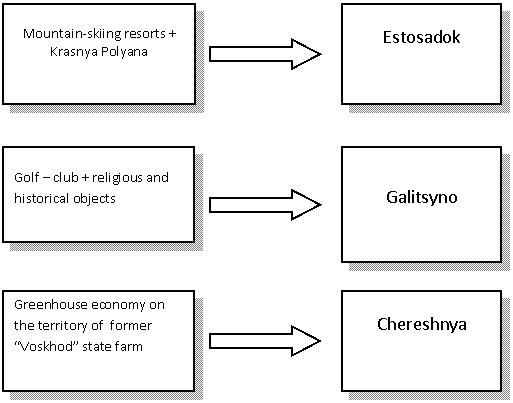
The scheme № 1 provideы the basic directions of development for all three components of the cluster. They were selected as the result of the sociological study accompanied by “deep interviews” with the local residents, heads of self-governance bodies and heads of local administration. Beside this, the analysis demonstrated the presence of one common factor for all three pilot settlements – the external driver that forms the vector of the development to the big extent.
Scheme № 2 Drivers for the Pilot Settlements
Component 1 of the mountain cluster (Estosadok – Krasnaya Polyana)
Modern sport infrastructure is a driving force for the component 1 in the part of sport tourism. Ski jumps, a modern and well equipped hospital recently constructed in Krasnaya Polyana, new hotels standing along the road from Krasnaya Polyana to Estosadok create favorable conditions for going in for sports in general and ski – jumping in particular. These are solid arguments for sport tourism and recreation activities. Of course, this type of tourism presumes high - price level.
Taking into account the final purpose of developing all year round model of tourism the Component 1 should provide various types of touristic services meeting the needs of young people and people with medium and high income. Conditionally the following types of touristic services could be proposed:
· Shooting sports (pneumatic weapon, bow, arbalest)
· Technical types of sports (mountain bicycles, jeep riding …)
· Foot and horse tourism
· Ecological tourism
It should be stressed that Krasnaya Polyana is an environmentally sensible territory. Thus, a careful study of this territory and its zones should be undertaken before making a decision the development of technical types of sport. It might happen that the roads under construction for the Olympic Games might be the most suitable place for this activity.
In our opinion, these are pedestrian and horse tourism to be stimulated in Krasnaya Polyana. Development of all year round tourism, that means providing supply constantly in a way that secures the demand, presumes origination of a well recognized brand. The cultural activities organized regularly under this brand attract attention of tourists.
Below few complementary ideas from different cultural areas are given that might be successfully implemented in Estosadok and Krasnay Polyana.
Idea 1. Fairy Tale
The Summer Residence of the Russian Ded Moroz (the Russian equivalent of Santa Claus) with celebration of his visits by organizing folklore carnivals.
Idea 2. Enlightenment and Gastronomic Types of Tourism
Cuisine of different nations presented in the restaurants of Estosadok and Krasnaya Polyana. Ecologically pure products, including mountain honey – the proud of this region. Looking forward, we recommend to protect and keep running the research in beekeeping and do not destroy the demonstration apiary that occupies 1.5 hectares on the reserved territory.
Idea 3. Historical and Enlightenment Types of Tourism
Visiting historical and cultural monuments, such as the hunting – box of the last Russian Emperor Nicholas the Second, Museum of Tamsaare – the famous Estonian writer, the houses visited by the famous Russian singers Shaliapin and Sobinov.
Idea 4. Strengthening International Friendship:
The results of the sociological study demonstrate that life of people of different nationalities within one settlement does not cause ethnic conflicts. Citizens did not mention the growth of criminalization connected with the inflow of seasonal migrating workers. However, they mentioned cultural differences and differences in models of communication. We suppose that until this problem has not turned from cultural to ethnic, it might be addressed through communication on the principle of tolerance and respect. For this purpose we propose to consider the issue of organizing in the region of Krasnaya Polyana of a House of Friendship of Nations with holding of national concerts and festivals. From our point of view, this approach is also topical in connection with a jubilee that coincides with holding of the Olympic Games – 200 years anniversary of unification of the Caucasus and Russia.
As it is seen from the above considerations, accent on the sportive tourism envisages integrated development of the area of the cluster “Estosadok - Krasnaya Polyana”, when the issues of catering and organization of creative leisure are addressed in a modern way.
Component No2 of the mountain cluster (Galitsyno, Kazachyi Brod, Lesnoe, Monastyr).
Pilot settlement of Galitsyno that primarily specializes in rendering touristic services, falls under the following types of tourism: cultural – ethnic, study - entertaining and sportive.
We suppose that being a focal point (“hub”) of various touristic demands and tours Galitsyno may play the role of a service centre on providing logistic and technical services.
It includes:
· Increasing the number of shops providing various sets of goods;
· Development of repair shops (repair of metal products, repair of clothes), laundry, etc.;
· Meeting the demand of tourists for tasty and cheap local food, as well as canned products (tangerine jam, feijoa jam, etc.)
The idea of creating the Town of Craftsmen for keeping handicraft perfectly suits Galitsyno.
The poor state of the primary school, absence of a culture house (a medical care centre is located on the place where it was in the past) contradict to the important role that this settlement should play in future.
We are looking forward to construction of a modern school, a club and a tourist information centre.
The territory of Galitsyno should be well-organized in order to fulfill the functions of the “tourist hub”. Land use planning and zoning should be developed beforehand.
The big threat for sustainable development might be connected with constuction of waste dump site for storing wastes in Kamenka place (near Galitsyno) above the place where the Golf Club intends to construct a water scoop (part of the water intake aimed to satisfy the needs of Galitsyno).
The idea was discussed at the end of 2011 at the top level meeting in the Ministry for Natural Resources and Environment. Implementation of this idea might destroy the golf project and large scale tourism.
Component No 3 of the Mountain cluster (Chereshnya)
Specialization of the settlement of Chereshnya is connected with provision of guests of the mountain cluster with quality agricultural products. In order to diversify these products local citizens propose to develop a project and to construct a mini-factory for processing fruits and vegetables (canned stewed fruit, juices, baby food, dried fruit …) near the settlement.
Special attention should be paid to the issue of organizing a hothouse farm. Such farms exist in some private houses but the scale of this activity should be increased. The option of allocating around 10 – 30 hectares of land possessed by the former state agricultural farm for a hothouse enterprise looks very attractive and sensible taking into account the all year round principle of operation. At present, the lack of agricultural products in winter season is covered by imported products from Turkey. It does not seem very reasonable from economic point of view.
For the agricultural settlement of Cherehnya, similar to many other settlements of that type, of special importance is the issue of development institutions – organizations interested in accompanying of small businesses. First of all, it relates to micro-crediting, forecasting and marketing of products. One of the advantages of the pilot settlement of Chereshna is its vicinity to Adler. However, bad roads make this advantage useless. It refers not only to transportation of products to the town, but also to rendering medical services.
Well-organized sport work with the youth and teen-agers is a special feature of Chereshnya settlement. The youth from Chereshnya are champions in free-style wrestling. Therefore, one of the recommended measures that might be supported by donors within the framework of the Local Agenda 21 is the “investment in future generations” by creating conditions for further improvement of sport skills. It might be done by increasing the number of gyms and stadiums in Chereshnya. The vicinity of an Ice-palace (Adler) provides a possibility for children for going in for sports.
4.4 Developing the Basics for Implementation of the Local Agenda 21
All observations and recommendations provided in the text of this document have common value and could not be charged one against the other. However, the Local Agenda 21 is not able to take all problems in consideration and solve all of them. Below the basic tables are given presenting a set of recommended activities developed in a full accordance with our previous conclusions and recommendations. They are formalized to start negotiations on practical realization of the Local Agenda 21 proposals with all parties concerned, including representatives of business community, partners of Olympic Games and investors.
Problem | Activities of Sochi 2014 in the field of SD | Objectives | Tasks | Measures | Stakeholders | Possible cooperation with business | Tentativetime-frame | Expected results |
Estosadok | ||||||||
Inadequate conditions for the organized sport activities of local population | Healthy living World without barriers | Facilitation of the development of mass and professional sport | Popularization of healthy lifestyle, physical activities and mass sport | Construction and arrangement of the sport child-youth school No 4 for 70 persons in the settlement | Administration of Krasnodar krai, Administration of the town of Sochi | Coca Cola DOW | 2012 – 2013 | Widening possibilities for mass sport and physical culture activities, especially for children and youth |
Insufficient tangible assets of local population for mountain skiing activities | Healthy living World without barriers | Facilitation of the development of mass and professional sport | Use of post-Olympic heritage by local citizens | Development of a programme of preferential activities on mountain skiing for local population | Operators of mountain skiing complexes with the support from Administration of Krasnodar krai and Administration of the town of Sochi | 2015 | Use of the Olympic sport objects by local population, growth of the number of the youth active in mountain skiing | |
Inadequate informing of local population on the performance of preparatory works for holding the Games | Modern technologies | Provision of free information-communication space for effective informing and interaction | Development of opportunities for the access to and exchange of information | Connection to Internet in libraries and in the club and provision of computers | Mega-phone, Roste-lecom, Microsoft | 2012 | Widening possibilities for local population for using the services of modern information technologies (including access to social networks) | |
Inadequate conditions for cultural-social interaction inside the settlement | World without barriers Culture and national values | Provision of free information-communication space for communication and development, including for children | Development of possibilities for socialization and development of children | Reconstruction, modernization of the club and library building, establishment of the child development centre | Administration of Krasnodar krai, Administration of the town of Sochi | DOW Mega-phone | 2013 | Improvement of communication potential and conditions for upbringing and development of children for local citizens |
Weak popularization of historical and cultural monuments, limited access to natural, cultural and historical monuments | Culture and national values World without barriers | Increasing the level of patriotism, culture and knowledge of native culture, nature and history | Ensuring unimpeded access to ethno-cultural, natural and historical monuments for local citizens | Compilation of a register and ensuring informing and access of local inhabitants to natural and historical monuments: sites of ancient people, dolmen complexes, medieval fortresses | Administration of the town of Sochi Russian Geographical Society, Interested agencies | 2012 | Systematization of historical knowledge | |
Shortage of equipped sources of mineral water | Healthy living | Increasing health-improving effect of recreation | Realization of balneological function in the recreational-touristic cluster | Equipment of a drinking pump-room in the vicinity of the construction of Gorki-town object | Administration of the town of Sochi, Hotel administration | P&G Sberbank of the Russian Federation | 2013 | Inclusion of a drinking pump-room in the list of touristic objects |
Popularization of the recreational object “Medvezhyi Ugol” with mineral water springs in the district of Chwizhepse settlement | Healthy living Harmony with nature Culture and national values | Health improvement for inhabitants of the settlement, town, etc. Raising the level of knowledge of the native nature | Realization of balneological function in the recreational-touristic cluster | Informing inhabitants of settlements, the town of Sochi, guests of the availability of a significant number of springs of mineral water on the territory of Krasnpolyansky rural district | Administration of Krasnodar krai, Administration of the town of Sochi | 2013 | Inclusion of a recreational object in the list of touristic routes | |
Problem | Activities of Sochi 2014 in the field of SD | Objectives | Tasks | Measures | Stakeholders | Possible cooperation with business | Tentativetime-frame | Expected results | ||||
Galitsyno | ||||||||||||
Absence of a conceptual base for the development of a touristic and recreational centre (hub) on the basis of the settlement | Economic prosperity Harmony with nature | Increasing of touristic attractiveness of objects of natural and historical heritage and observation of environmental requirements | Implementation of analytical works on comprehension and systematization of fields of tourism development | Development of a concept of sustainable tourism development, including a register and popularization of places of attractiveness, development of small businesses, zoning of the territory of the component No 2 of the mountain cluster, etc. | Ministry of sport and tourism of the RF, Administration of Krasnodar krai, Administration of the town of Sochi | Ensuring inflow of tourists, increasing employment of local inhabitants | ||||||
Inadequate development of facilitation of touristic routes | Economic prosperity Harmony with nature | Creation of a hospitable atmosphere and improvement of quality of services | Organization of new routes and attraction of local citizens for rendering touristic services | Development of new routes, reconstruction of historical monuments | Administration of Krasnodar krai, Administration of the town of Sochi, Town planning council of Sochi, Administration of the National Park of Sochi | Ensuring inflow of tourists, increasing employment of local inhabitants | ||||||
Problem | Activities of Sochi 2014 in the field of SD | Objectives | Tasks | Measures | Stakeholders | Possible cooperation with business | Tentativetime-frame | Expected results |
Development of modern methods of remote education | Basic values | Creation of necessary conditions for education of children | Ensuring possibility for getting full secondary education for children of the settlements, including at the high educational level | Organization of remote education for schoolchildren of the settlement | Administration of the town of Sochi | 2012 | Improvement of the quality of education of schoolchildren of the settlement | |
Problem | Activities of Sochi 2014 in the field of SD | Objectives | Tasks | Measures | Stakeholders | Possible coopera-tion with business | Tentativetime-frame | Expected results | |
Chereshnya | |||||||||
The risk of land slides | Modern technologies | Ensuring environmental safety, protection from unfavorable natural phenomena | Implementation of measures preventing from land slides | Development of project documents on the protection of the settlement from land slides | Administration of Krasnodar krai, Administration of the town of Sochi, National Park of Sochi | 2013 | Prevention of serious damage for the settlement and human health | ||
Inadequate possibilities for the employment and provision of relevant level of income for local citizens in the agricultural sector | Economic prosperity Healthy living Modern technologies | Ensuring processing of agricultural products | Production of ecologically pure juices and other drinks, products of processing vegetables and fruit (mixtures, cereals…) | Assessment of economic efficiency of establishing a mini-plant on the processing of fruits, vegetables and berries in the settlement or close to it | Ministry of agriculture of the RF, Administration of the town of Sochi | 2012 | Supply of population and guests with ecologically pure products within the framework of the development of a recreational-touristic cluster | ||
Shortage of products of vegetable growing by local producers | Economic prosperity Healthy living | All-year-round supply of consumers with agricultural products | Regular production of agricultural products and products of their processing | Consideration of the issue of organization of a large-scale hothouse farm | Administration of Krasnodar krai, Administration of the town of Sochi, Local profile institutes | 2012 | Diversity of nutrition for the guests and citizens of Sochi | ||
Inadequate possibilities for the development of children and organization of their leisure | Healthy living World without barriers | Creation of favorable possibilities for the development of children and organization of their leisure | Creation of new conditions for leisure of children | Establishment of a kindergarten Creation of additional hobby groups on the basis of the School No 67 Completion of the second stage of the construction of the school(including a gym) | Administration of Krasnodar krai, Administration of the town of Sochi | Favorable social condition | |||
Conclusion
The work on the Agenda 21 consisted of three stages. They might be identified as standard, bearing in mind the necessity of correspondence of the procedure of the development of a model Local Agenda 21 to the substance of the document.
“Bottom – up” planning assumes and envisages implementation of a significant amount of work, namely at the local level, in contact with local population, their self-governance bodies and state authorities.
As the main focus of the project is joint work population on the formation of a positive future connected with sustainable development in the context of holding of the 2014 Olympic Games in Sochi, the main criteria of selection of pilot municipalities was availability of active people that consider alternatives to the present state of things and welcome changes.
At the first stage pilot settlements were selected: Estosadok, Galitsyno and Chereshnya. Description of general situation in the context of social, economic and environmental aspects of sustainable development was made for these settlements.
The decision on selection of pilot settlements was made according to the results of field survey, performed by the Executor, consultation with vice-mayor of Sochi, specialists of the Department of economics and prognosis of the Sochi Administration, thorough discussions with experts of Sochi 2014 Organizing Committee participating in the project.
Within the framework of the first stage a sociological questionnaire was developed.
At the second stage a sociological study was performed and its results were summarized with the help of a standard computer model.
Deep study of the way of life of the pilot communities demonstrated exceptional importance of environmental aspect of sustainable development that forms the basis of agriculture, animal husbandry and tourism.
Assignment of quotas of sampling was performed by national composition, but in each pilot settlement a youth group was selected separately. As it was described above, preferences and views of the youth on some issues differed from the opinion of the older generation. In any case, the Executor paid special attention to the opinion of the young generation and integrated its position in the Agenda 21.
After careful consideration of possible models of transition to sustainable development the Executor chose a cluster model. One of the considerations in favor of formation of a mountain cluster was connected with wide spread opinion of the citizens of pilot communities shared by local authorities on the expediency of implementation of joint core activity of pilot settlements with other settlements located nearby. In other words, the idea of isolated development of pilot settlements has not been raised.
At the third, final stage of work several components that have their specialization were identified inside the cluster. Moreover, conditions of the transition to sustainable development were differentiated in the final report along with supporting measures of infrastructure character. The role of culture and maintaining of cultural traditions was also identified along with adequate attention to ensuring access to education and information.
In order to prepare a final document communication measures for validation of major conclusions of sociological survey and discussions of the proposals of the Local Agenda 21 on specific fields of activity were held within the framework of the final stage of work.
In December 2011 the workshop “Characteristic and assessment of initial socio-economic situation in the pilot settlements and analysis of possibilities for their development” was held on the basis of the National Research University “Higher School of Economics” in Moscow. This event of information-analytical and consultative character collected about 25 participants. It was very useful as the organizers succeeded in collecting a very impressive composition of participants, including the First Deputy Head of Administration of the Adler district, Acting Director of the Department of Economics and Prognosis of the Administration of Sochi, heads of the departments of recreation and tourism of Sochi administration and the Department of Support and Development of Small Business. Representative of the Ministry of Regional Development of the Russian Federation. Leading experts from various institutes of the Higher School of Economics and the Russian Academy of Sciences, members of public organizations, specialists of the non-commercial organization “Organizing Committee of Sochi 2014” and experts of the Russian Regional Environmental Centre took part in the workshop.
The workshop was successful in terms of addressing of the following issues:
1) Validation of the sociological study;
2) Provision of additional information on the pilot settlements;
3) Discussion of a wide range of issues and reaching consensus on the main characteristics of pilot settlements;
4) Exchange of opinions on the development vectors, external and internal limitations, limits of applicability of a cluster model.
Development of the Agenda 21 inevitably envisages establishment of a feedback with local population after the initial draft plan of recommended actions is ready. This task was completed within the framework of the third stage of work. Meetings of the Executor and the Customer with activists of all three pilot settlements were held.
These meetings proved the right orientation of the Agenda 21 on the development of tourism and agriculture in the pilot settlements. They also added many specific proposals and accurate definitions. Some acute problems, such as improvement of interaction of local population with Sochi National Park relate to the federal level of issues. Therefore, they were reflected in the document accordingly.
Prior to the meeting with activists of the three pilot communities the Executor and the Customer had a meeting with specialists of profile departments of Sochi administration, including such departments as: department of agriculture, department of food and industry, department of health care, education and science, department of support of small business, recreation and tourism.
Information meetings with representatives of the administration on the one hand, and representatives of local population of pilot communities on the other, allowed to look at problems and priorities identified in the Agenda 21 from different sides and at different angles. It added objectivity and real facts to the available picture.
Final presentation meeting in the headquarters of Administration of the Adler district of Sochi, held in the extended format with attraction of all stakeholders, allowed to reach a consensus on the issue of filling of the Agenda 21 with specific measures. They were presented if the form of tables and discussed by each pilot settlement.
In general, participants of the final meeting on the project “Development of the Agenda 21 for sustainable development of pilot mountain settlements related to holding of the XXII Olympic and XI Paralimpic Winter Games in Sochi in 2014”, held on February 9, 2012 expressed general support of activity of the Executor – Autonomous Non-Commercial Organization “the Russian Regional Environmental Centre” (RREC) and gratitude to the Autonomous Non-Commercial Organization “the Organizing Committee of Sochi 2014”.
In their final resolution the participants made a conclusion that the project resulted in raising the activity of local population in terms of strengthening of self-governance and identification of priority problems, as well as ways for solving them. At present, possibilities for sustainable development of pilot settlements are considered and formed in the context of preparation for and holding of the Olympic Games and post-Olympic period.
The participants of the meeting adopted the following resolutions:
1. To approve the results of the work within the framework of the project;
2. To facilitate dissemination of the results of the project among local citizens, to raise their awareness and knowledge in the field of sustainable development;
3. To approve main provisions of the project “Development of the Agenda 21 for sustainable development of pilot mountain settlements related to holding of the XXII Olympic and XI Paralimpic Winter Games in Sochi in 2014”, contained in the presentation of the Executive Director of RREC, Mr. Michael Kozeltsev.
4. To take the measures proposed in the text of the Agenda 21 as a basis and to facilitate their practical implementation.
Thorough compliance with the procedure of the Agenda 21 and provision of participation of a wide spectrum of stakeholders made it possible to develop a balanced document. Its final version was presented at the final workshop in Moscow. This workshop actually summarized the results of the project that was implemented within the limited time-frame. The participants broadly endorsed the list of measures contained in the Agenda 21.
Many useful comments and recommendations were made in the course of the workshop. They related to environmental innovations, application of foreign practices of “green certification” and the experience of implementation of the Alpine Convention of 1991. Of special interest is the experience of European inter-regional organization Euromontana that works on the projects on sustainable development of mountain regions. The idea of this organization on the spatial superposition of production and life activity, creation of low-waste production cycles are very close to and shared by the Executors of the project and will be definitely applied during realization of the Agenda.
Within the framework of the proposals on the inclusion of innovation technologies in the Local Agenda 21 it is necessary to mention prospects of cooperation with the technological platform “Technologies of ecological development” representing a ground for formation of perspective technologies and their future introduction through mechanisms of public-private partnerships.
The idea of a demonstration project in pilot settlements related to the installation of a source of solar energy might have a “show” effect. However, it should be carefully developed in the context of the ongoing increasing of energy capacities of the Big Sochi that might result in providing a surplus of energy for pilot municipalities that are not presently covered by corresponding economic growth.
The participants of the final workshop in Moscow came to the general agreement on the necessity of formation of an interagency group on monitoring implementation of the Local Agenda 21. Negotiations with partners on the implementation of measures of the Local Agenda 21 should be intensified along with arranging constructive work with relevant government agencies. The Local Agenda 21 needs creation of an adequate infrastructure built on the use of the potential of the state target programmes, development funds, mechanisms of attraction of funds, accumulated by the Russian Union of Manufacturers and Entrepreneurs and the Chamber of Industry and Commerce.
Holding of the XXII Olympic and XI Paralimpic Winter Games in Sochi in 2014 gives a potential opportunity for significant changes in the life of local settlements. Transition to sustainable development might be realistic in case all the stakeholders are unified by one common goal, when each momentary action is imbued with care of the future.
To see a World in a Grain of Sand
And a Heaven in a Wild Flower,
Hold Infinity in the Palm of Your Hand
And Eternity in an Hour.
William Blake, from the “Auguries of innocence”
References
1. Федеральный закон «Об общих принципах организации местного самоуправления в Российской Федерации» (Закон о МСУ) от 01.01.2001 N 131-ФЗ (принят ГД ФС РФ 16.09.2003)
2. Agenda 21, United Nations Conference on Environment and Development (UNCED), UN, 1992,
3. Local Agenda 21, Chapter 28 of the Agenda 21, United Nations Conference on Environment and Development (UNCED), UN, 1992,
4. UNEP Sport and the Environment Initiative
5. Olympic Movement’s Agenda 2, Sport for Sustainable Development, IOC.
6. Генеральный план городского округа «город Сочи», принят решением Городского собрания г. Сочи 14.07.2009 г. No 89
7. , «Организация устойчивого жизнеобеспечения населения на особо охраняемых природных территориях: Концептуальные основы и практическое руководство», Благотворительный фонд «Центр охраны дикой природы», Красноярск, 2009 г.
8. Planning for Sustainability, the Starter guide, The Natural Step, 2009, Canada,
9. «Местное природоохранное планирование в России», Российский региональный экологический центр, Центр поддержки местных инициатив по устойчивому развитию и экологической безопасности, Ярославль, 2003 г.
10. «Устойчивое развитие российских регионов: мнения факты, перспективы», Москва, 2008 г.
11. «Повестка дня для горных селений Кавказа», Российский региональный экологический центр, Москва, 2009 г.
12. Integrated Community Sustainability Planning, A Guide, The Natural Step, Canada, 2009,
13. Conservation and Sustainable Development in Mountain Areas, Mountain initiative Task Force, IUCN, 2004,
14. The International Partnership for Sustainable Development in Mountain Regions, FAO, 2011
15. План действий по охране окружающей среды и устойчивому развитию Кораблинского муниципального района Рязанской области, Российский региональный экологический центр, НИПИ «Кадастр», 2006 г.
16. Living the Dream, 2010 Winter Games Post-Games Report, The Resort Municipality of Whistler, Canada, 2010,
17. Delivering the Dream, 2010 Winter Games Strategic Framework Summary, The Resort Municipality of Whistler, Canada, 2010,
18. Independent Environmental Assessment, Beijing 2008 Olympic Games, UNEP, 2009,
19. Sochi 2014, Report of the UNEP 2nd Expert mission, 28-30 January 2010,
20. Sustainable Sport Management, UNEP, 2001,
21. The Sport and Environment Commission, IOC,
22. Green Goal in South Africa, UNEP, FIFA, 2010,
23. Reducing the Carbon Footprint of Major Sporting Events, The UNEP/GEF Project, 2010,
24. Sustainable development in mountain regions: the path ahead, FAO,
25. From Rio 1992 to 2012 and beyond: 20 years of sustainable mountain development in Eastern and South-Eastern Europe, Eastern Europe, Draft Regional Report, Lucerne World Mountain Conference, 11-12 October, 2011, UNEP-Vienna Office, 2011,
26. Sustainable Agriculture and Rural Development in the Mountains Initiative, International Partnership for Sustainable Development in Mountain Regions, 2005,
27. Sustainable Livelihood Initiative, International Partnership for Sustainable Development in Mountain Regions, 2004,
28. Green Economy and Sustainable Mountain Development: Kathmandu Declaration, ICIMOD, 2011,
29. Manual on Sport and the Environment, IOC, Lausanne, Switzerland, 2005,
30. Possibilities for the Development of Small Businesses in Rural Areas, Swiss Agency of the Development and Cooperation (Swisscontact), 2010.
[1] Improving quality of drinking water in Estosadok might serve as an example. In October 2011 during the sociological opinion poll the residents of Estosadok named bad water quality as one of the major problems. At the next meeting at the beginning of 2012 they did not touch this issue.
[2] Of course division between “past” and “current” (new) problems is rather conditional, however, it is useful for a discrete type of event which is the Olympic Games. This approach helps in formulating constructive evaluation model for local residents.
[3] See official statistics of settlements – note by the author.
[4] For Akhshtyr settlement, that was not included in the list of pilot ones, the issue of protection of nature protected areas is more acute. It might be connected with the fact that transportation of solid rocks extracted in the quarry, located on the territory of the national park, takes place trough the area of the settlement.
[5] Absence of gasification and corresponding connection to gas network might be considered in the context of the most priority wishes of population (citizens were not deprived of gas but were deprived of quality water supply). Inhabitants of the pilot settlements did not live in the conditions of central gas supply, but until recently used water of higher quality. Deprivation of welfare of common use caused a very negative reaction of citizens.
[6] As we mentioned earlier the sociological survey was provided in October, while the second visit in January demonstrated that water problem does not exist anymore.
[7] Sustainable development on the basis of a model of territorial cluster does not contradict to other possible and discussed development options: free economic zone, zone of anticipatory development.

|
Из за большого объема этот материал размещен на нескольких страницах:
1 2 3 4 5 |
