


– Mom, let’s try to make a paste. You know we have a whole bag of Anton’s apples! – Oh, this girl, she is fond of cooking something special.
I understand how much it will cost to me, but I agree.
– Well, we’ll necessarily try to. Just let’s buy a paste box, for knowing to what to aspire.
The Mighty Men
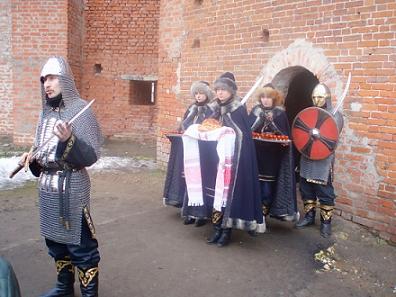
There is a huge ancient soldier before the entrance to a small door with the shod handle. He is not dressed modern: the chain armor, linen trousers are filled in boots and a cap with fur is on his head. We hurry up to him from another end of Kolomna’s Kremlin – it seems to us that this heavy door will close up, and we’ll be left high and dry.
– Hold your horses! – He is big, strong and magnanimous as a real soldier. Though we are trying to run quicker under the low arch – and we are in a gloomy premise – in a vallum.
– Mom, it seems like a simple wall outside, and it looks as if it’s possible even to live inside, – the children are surprised. A lot of amazing things are in the vallum – we are getting upstairs to the very top. I’m getting afraid of high steps and stairs. But the children have instantly come to be in front of a daring fellow, who has just started telling the story in the armory room.
Unexpectedly and pleasantly in the end of the story we heard the word “you are welcome” which meant that it’s possible to take all objects of the reconstructed ancient armament in our hands, to consider and to try them on. We have started doing it immediately with pleasure. One of my daughters has sunk in a helmet. Another one has tried to lift the mace. The serious weapon is not for children’s hands.
All these were made by hands of our contemporaries, but it was the same at the time of our ancestors.
It’s so heavy, - is heard from the helmet that drops almost to the chin of the little girl.
The sight at the town from the vellum height pleases an eye. We are looking around, and children are trying to be put out from a loophole to make out a wall foot better. My breath is grasping, I’m squeezing small palms of my daughters, and meantime our kind good fellow is telling us about the history of Kremlin and about features of defense of the fortress.
Now I’m holding my children’s hands, I’m very scared to be at such height. But they are fine: the palms are slipping out of my hands – the children are getting upstairs much better than I am.
And the kind good fellow, meanwhile, is narrating not only about military life of the fortress, but also about peaceful everyday life, about terrible torture chambers and mythical secret passages for the river proceeding at the foot.
In such places it always seems that a secret is about to reveal. It doesn’t matter that people searched these subways or reached treasures many centuries before us.
We are listening to legends and believe in a miracle because stories of this town are rich with mysticism.
We come out from another door - and, being carried away by the discussion, plod slowly somewhere and forget that our car is absolutely in the other direction.
ЗАДАНИЕ ДЛЯ САМОКОНТРОЛЯ
Read the beginning of the text and say if these sentences are true or false.
· Kolomna used to be the capital of Moscow Princedom, with Kremlin and monasteries.
· The way to Kolomna is a straight line.
· Kolomna is the lovely low town, for a wonder remained color and originality in our changeable world aspiring to updating.
· Kolomna Kremlin is very similar to Tsaritsyno.
Keys
· false
· false
· true
· true
Continue the sentence:
·Of course, the first that you feel, having entered on the museum court yard is a smell of.....
·There are frills and ruches on them – certainly, the people making a paste should look.....
·It is absolutely impossible to imagine that a paste has thought up just for.....
·The Kolomna paste-maker, as it happens, used to be...
Keys:
·Of course, the first that you feel, having entered on the museum court yard is a smell of hay and apples.
·There are frills and ruches on them – certainly, the people making a paste should look exactly like they do.
·It is absolutely impossible to imagine that a paste has thought up just for keeping apples fresh for winter.
·The Kolomna paste-maker, as it happens, used to be a city symbol.
Find in the texts English equivalent for the following words and expressions:
кольчуга, доспехи, полотняные штаны заправлены в сапоги; остаться с носом; не спешите; крепостная стена; крутизна ступенек; старинное вооружение; современники; военная жизнь крепости; мирные будни.
A Travel to Borovsk
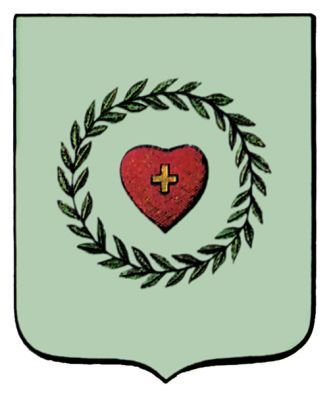
Several times Borovsk was in the thick of the historical dramas, but step-by-step passions cooled and the town was found away from the events and the roads, having turned into a quiet, green town with its inimitable color. Recently, it again was found on a crossroad of the countries and the worlds, having sheltered an ethno park with its yurtas (['jʊətə] nomad's tent), huts, wigwams and ancient structure, in its environs.
The Kaluga highway dodges and turns to us by its different sides. We like its playful rebelliousness to our plans - sometimes it seems that it turns back at all. It`s good, that the guideboards give us a hint about the right way, and every time we make sure that we are going to the necessary place.
The town Borovsk is the aim and the first stop of our travel. The name of the town itself takes place from the word <pine forest> and till now corresponds to the facts - on the entrance to the town oak-groves and pine forests surround the highway. The town lurked among these forests, hid, like still is standing (stands) guard over Ancient Rus.
The history of the town.
For the first time Borovsk is mentioned in the chronicle, in the spiritual letter of the prince (duke) of Moscow Ivan II in 1358.
At different times the town had been passing from one price to another, before it finally joined Moscow. Laying on its southern approaches, Borovsk was playing the role of a defensive post; it has been surrounded by shafts and oaky stockade town with two passable and four remote towers.
In 1444 two kilometers away the town Pafnutiyev Monastery was found (until 90th years of XVI century was enclosed by powerful, stone, fortified walls).
The story of this little town is wonderfully filled with events. In Pafnutiyev Monastery there was False Dmitriy, archpriest Awakum, who did not accept reforms of Orthodoxy. His companions – boyarynya Morozova, known for a famous picture, and Urusova, were incarcerated right here. So Borovsk became the center of old belief.
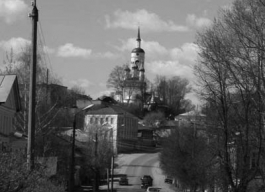
Twice during Napoleonic battle the town was ravaged by the Frenchmen. Leaving ruined Moscow, the French emperor wanted to go to Europe by the Kaluga highway. But the main aim of Kutuzov was to turn a Frenchman on the Smolensk road. And after the only lost battle near Maloyaroslavets, Napoleon again returned on the way, that he had destroyed, having spent two nights in Borovsk, in the house of merchant Bolchakov.
The town was occupied during the Second World War. In the beginning of 20 century it was almost missed out of economic life of the country because of the building of the railway, that passed by. In 1917 the fortress of the town was taken into pieces for building new streets. So the center of a fighting life, the town, that used to be in the thick of the historical events, became a usual local town.
The morals of the district town.
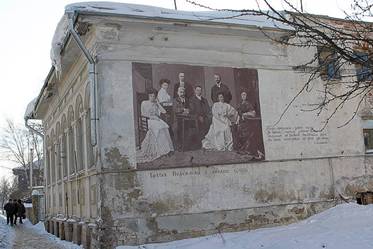
We are driving along the road and we are surprised by plenty of pieces of graffiti – these are such pictures on the walls of houses. But there are not painted geometrical figures, madness of colors does not strike your eye – there are quite tones, people, who look like ghosts, live in drown windows. On the walls photos of family albums are returning to life, the knights, who are ready for defense of the ancient town, are saluting us, scientists are working and even fluffy cats, having shared drown windowsill with grandmother’s ficus, are basking in the sun. It appears that amateur artist – Vladimir Ovshinikov paints the town. In these paintings the ancient town is returning to life, its history, buildings that have not been kept.
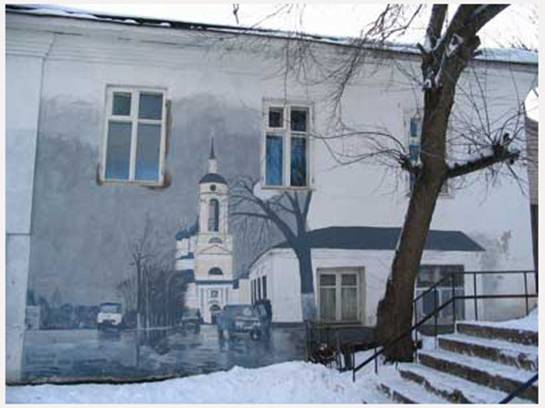
Leaving the car, we are continuing our trip on foot to take a better look around us, read carefully lines of verses and take a good look at faces of ex-citizens. Wall paintings are naives and very graphics, but in the town it makes its special atmosphere of a comfortable house, designing by a taste of the owner. Genka is bending his head on one side. I guess that right now she is fitting a painting like that on our small holiday house (country house). Well, for the beginning I will offer her to paint an adornment on a sheet of a whatman paper.
In the center of the town, near to The Eternal Flame and the avenue of memory, a piece of local history hid behind the trees. Small and comfortable, it tells us that life used to boil in Borovsk. We are examining ancient things that used to belong to the citizens: clothes, furniture, things of peasant and merchant life. We can’t help but admire how much work was put into these things.
-Wow! Mom, how did they do that? Why are there holes in the coat? What does it mean <summer coat>? – hailstorm of questions are raining down on me. We are staring at wickerwork of a chair and embroidery of an ancient coat.
We are passing slowly and sedately the hall, devoted to the history of The Great Patriotic War, giving credit for memories of many heroes, soldiers and civil. Because you know, that Borovsk was occupied, it means, that partisan warfare has been waging fully by local population. Heroes – both adults and children. It is sad to examine theirs photos and read scraps of theirs letters. We are very much alike, they just had to live (and survive) in other conditions. Girls are surprised: on the windows there are photos of theirs peers. Almost having moved apart atmosphere of the wartime by hands, we went walking around the town.
Where? Historical museum of Borovsk, Kaluga Oblast’, Borovsk, Lenin Square, 7.
How? Is opened: 10:00-17:00, days of work – Monday and the last Friday of month. The cost of visit – 40 rubles.
P. S. You can order guided tour of the town on your transport by phone (4
The house-museum of Tsiolkovsky.
– Who is Tsiolkovsky? – asked girls, having seen a pointer. – Well…it`s a famous scientist, a man, who dreamed about space – my information about Konstantin Eduardovich was found scrappy. Daughter is looking at me waiting the detailed story, but I properly know nothing. – May be his house-museum will tell us more?
We found a small house on the outskirts of Borovsk. A usual house, there are lots of them. It seems that almost nothing has changed. Here the scientist spent just one year of his life. But imagination will help us to imagine his life and life of his family in ancient times, by the way we won`t have to think much over. So, we are again plunging into ancient times, opening the doors into the near past.
Here is a woman dress, a chest of drawers, a writing table – simple things of the family of the great scientist. His working corner attracts our attention – there is a workbench, axes, saws, planes and even ancient welder. It`s strange to imagine that the scientist, who became famous for his reflections about space, loved working by his hands so much.
Tsiolkovsky, dreaming about space and flights, made a number of discoveries, that though did not give him an opportunity to get into space, but allowed his followers to fly in space.
On the second floor (actually there was the Tsiolkovskys apartment) a gymnasium was reconstructed: here are school desks, completely different from modern, a uniform, and some things. Mentally we try on school apron and throw away the cover of a school desk, filtering on a learning place. We dipped a feather into inkpot and stood still waiting: today a teacher is going to tell us new fascinating story about the sky.
– What is this tube on the stand for? –my daughter asks.
– You know, Tsiolkovsky became deaf in his childhood, and it was very hard for him to study. He had to leave school desk and to stay at home, studying by himself. There was not deaf aid that time and he was always wearing this tube. And by the way apparently he succeeded in being adored teacher for pupils.
–I wish we could hear the stores that carried away pupils!
Where? The house-museum of Tsiolkovsky, Kaluga Oblast’, Borovsk, Tsiolkovskaya Street, 49
How? It is opened: 09:30-17:30, days of work - Monday and the last Friday of month. In announced working time, the museum could be closed, it`s better to call beforehand by the phone: (4The cost of visit – 30 rubles.
P. S. Some part of the exhibits of the museum was reconstructed with the help of memories of scientist’s daughter.
A crossroad for different nations (people).
Having left hospitable and original town, we decided, that we had traveled to plenty places, and now, it would be great to learn equally to get over space. There, near to Borovsk, is such a magical place, where in some minutes one can cross half of the planet and get from nearby Moscow remote place to the steppes of Mongolia or even find himself on the Extreme (Far) North. Some turns on the pointers-and there is the place, where different cultures and traditions meet.
We had a keen guide, and though the day was declining waning, she went with us in a long tour of different countries to share with us her knowledge about culture of different nationalities.
We began with Russian stove. It is huge, it is more than common stove fourfold, and Russian stove became the center of composition of Russian izbas. It should be: it was feeding and heating our ancestors. And here is if we are climbing in this huge stove after Baba-Yaga. Oh, I wish they would not bake us, like they did with ill children many years ago. But no, this stove is not really stoked. But now girls really know where a brownie inhabits with its kikimoras, and where pots with porridge were put on. It`s easy to imagine, how the old hag is pushing Vanusha into a fire chamber on a huge spade. Here we got round to the top: everything’s seen around from the plank bed of this magical stove. Not only the Russ-mother, but lively Ukraine, hospitable Belarus, the suns of steppes Mongols scattered their camp, and somewhere behind the forest, we can`t see it at all, old Buyan with its court got stuck in 9th century.
Russian izba is usual for us, and Byelorussian and Ukrainian courts are almost equally the same but jurt is not. It appears that it could be different: Mongolian, Kirghiz. We found to be casual witnesses of a placing of a mobile home. It’s quickly and simply. There are thoughts that it could be built in 40 minutes. And then take pleasure from warmth of the native home, like a snail that carries her house with itself.
A guest comes to us on a gathering in Mongolia jurt. He takes his kumus (it`s very old instrument, relatives of Russian vargan) and begins playing. Girls are looking at him with curiosity, trying to guess melodies: <The forest raised a Christmas tree >, <In a garden whether in a vegetable garden>. Genka is hogging, scratching the forehead, trying to remember the name of new songs. Probably, it`s easier to remember like that. And still, how close we are: where else will Kirghiz play to you usual, children`s melody on a small folk instrument?
Having left the guide, we went by ourselves to Buyan`s court – it`s a historical place where you are given views about the way of life of ancient Slavs. A long logroad on a bog, like a road in time. Of course, my daughter jumped back from a log and had her feet wet. Turn-by-turn we reached low izbas with a grassy roof.
We knock and come in. It smells like smoke, there are skins on the plank beds, walls are blacken with smoke – our relatives were heating with a chimneyless stove. It appears that a lath fence worked not only for barrier of courts but for building of to-falls: there some cattle live. May be this goat that is tied in front of the gate? Children were trying to milk her, having heart by edge of ear, that today the visitors were taught to this work. But their milking finished very quickly, as goat turned to them its horns: – Mom, let’s go and see something else. – hurried me up the girls. I still can`t get rid of the feeling, that while we are walking from one izba to another, the owners, having hidden, are examining attentively uninvited guests, and that brings me some discomfort. But the owner we found on the way back nearby shooting range, where people shoot from a bow. We entered into a conversation, discussed complications of ancient way of life. It appears that they are friendly guys. Just theirs caftans are antique, and sometimes they say some strange words, but they smile in tune with the times.
The evening was going down on a mixed world of the park, and we went home, having dropped in tender husky on the way. Blue-eye dogs were jumping joyfully and holding up theirs sides for stocking. Though we wish to stay much it`s time to leave this world, where ancient homes and Chukchi tents are so close.
Where? Ethno world, 90th km from Moscow by Kiev highway or Minsk highway, Kaluga Oblast, Borovsk region, Petrovo village.
How? In the weekends there is every hour a sightseeing tour, the cost is 300 rubles.
P. S. In the park there are master-classes, ethnic festivals. The timetable of events you could know by the phone: (484),
The map of a long trip in Borovsk
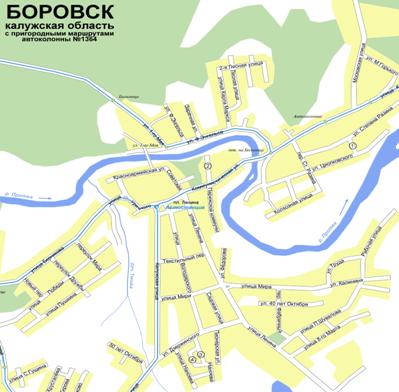
Moscow-Borovsk, Historico-local history museum
The way by Kaluga Highway will take about 1 hour 40 minutes (90 km)
Historicolocal history museum - The house - museum of Tsiolkovsky.
The time of the way by car is 5-7 minutes
The house-museum of Tsiolkovsky - Ethno world
The time of the way by car is 20-30 minutes.
ЗАДАНИЕ ДЛЯ САМОКОНТРОЛЯ
Continue the sentence:
1. The story of this little town is ……………………..
2. The town was occupied during……………………...
3. We are driving along the road and we are surprised by …………… on the walls of houses.
4. Tsiolkovsky, dreaming about space and flights, …………….., that though did not give him an opportunity to get in space, but allowed his followers to fly in space.
Keys:
1. The story of this little town is wonderfully filled with events.
2. The town was occupied during the Second World War.
3. We are driving along the road and we are surprised by plenty of graffiti - these are such pictures on the walls of houses.
4. Tsiolkovsky, dreaming about space and flights, has made a number of discoveries, that though did not give him an opportunity to get in space, but allowed his followers to fly in space.
Find in the texts English equivalent for the following words and expressions:
- впервые упоминается
- город был оккупирован
- только здесь нарисованы
- видимо-невидимо
- несмотря на то, что
- русская изба
A TRAVEL TO PERESLAV-ZALESSKY
A small town with a big history, studded with ancient monasteries, the funny museums of iron and kettle, the miniature railway, and grandfather of Russian Navy – the first small boat of Peter the First. It’s time to start the most fascinating journey to the shores of Pleshcheeva Lake.
“Chaise under a tarpaulin”. It is from childhood. We get into the car early in the morning, to go away and spend all day long outside home; we are worried not to forget anything as we are going into the wild lands. When everybody takes their seats, we start our journey. The feeling of going by the house on the wheels doesn’t leave us, as of the muff from the merry children’s book. It is also a dream from my childhood – a journey in the mobile house. Even Emelya drove on the stove. But we are more like the Bremen Town musicians. And we sing that ‘there is nothing better in the world, than to wander with friends in the wide world’.
After MKAD you drive through a city for some time, and then it gradually gets into forests. Firstly, the road climbs up steeply, and then it falls down. And for the sake of these endlessly, going far hills, I am ready to pass on it again.
The turning to Sergiev Posad is long ago behind. Behind there is the mansion Abramtsevo with its amazing history – we are going into the town, which is ready to open its secrets to us, to show us much new and interesting. From this the right foot itches and there is lightly sucking in the stomach with joyful impatience. And I want to jump out quickly and to absorb everythingthat it can offer us.
Monasteries in Pereslavl – Zalessky.
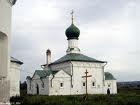
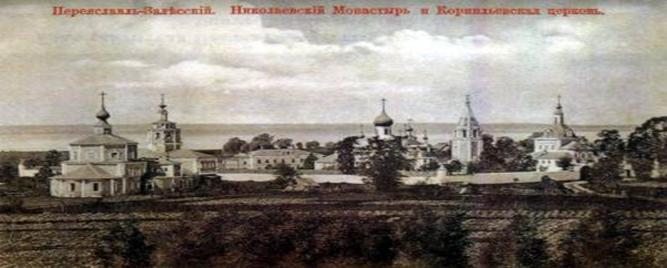
Pereslavl-Zalessky is famous for its monasteries. There are five monasteries in this small town. You go around the town – and only read the signs – to the right there is the Fedorovsky monastery, by the left there is theTroitskiy Danilov Monastery… It is amazing, how do such deep traditions of orthodoxy get on with the heathen relicts in this town?
I cannot pass indifferently by the monastery. That is the history; it is ahard work of many people. Well, frankly speaking, I was very interested in how people can lay down such fortress walls or take and build a town inside the city.
We went to the Fedorov monastery as soon as we arrived in the town. We went there by chance, but did not regret about it. Because in this monastery the ancient relic – the miraculous icon of the God mother is preserved. And in St. Nickolas monastery the shrine relics of St. Daniel is kept, and in the Nikitsky – there are the relicts of Nikita Stolpik. The Uspensky Goretsky monastery meets visitors also as the local history museum.
Alexandrov Mountain, the Blue Stone and Red Square.
Pereslavl – is the town with low houses on the Shore of Pleshcheev Lake. The Fedorov monastery and arboretum are behind us. The street gets down from the mountain and here we are already inside the gross ring. Ancient Pereslavl–Zalessky was surrounded by the high earthen bank from the military considerations.
At once, on the left, there is the charming wooden house; it is a building of a female gymnasium built the century before. A little bit further, on the opposite side – there is the museum of iron, here we’ll return later. Still further, there is the strict and laconic house of the manufacturer Pavlov, the honorable citizen of Pereslavl – Zalessky, who is famous for his charity and participation in affairs of the town. Across the street, there are churches, churches… and Red Square. On the other side, there is the building from red brick with white decorations elements – this is the man’s gymnasium. The sights “the man’s gymnasium” (in the center), “middle age” and “younger age” (on the right and on the left) were made on the façade from white brick. After the revolution these sights were brought down for some reason, and the facade with chippings stands in beauty till now. There is the fire-station of the last century and the same earth bank – the old town is behind us.
Passing the Nikitsky monastery along the twisting road we leave to Pleshcheevo Lake and Alexandrov Mountain, it was named so in honor of Alexander Nevsky. They say, it was called Jarlina Bald patch before. But that’s true it is the bald patch. There is no forest and it has never had forests there. From the name it’s clear, that before there was the temple some time ago. Our suppositions were confirmed immediately. Yes, the town view is simply wonderful from this mountain. All the town is plainly visible!
Under the mountain, there is the blue stone on the lake shore. I wonder, why it was called blue, it is grey. There are a lot of footsteps here. People come to the stone – a bunch of handkerchiefs and ropes are imposed on the surrounding bushes, and some food lay out around. I know that if I stand on the stone with my bare feet and to think about the important, as if illness and troubles leave/ But it is too cold, and we are not walruses, so we’ll refrain.
The museum of irons.
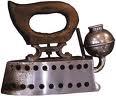
That it is the unusual museum, I understood it even at the entrance to it. Well, in the first, you should look at the signboard. Hardly, you’ll find somebody who has left without a photo of this signboard. The design of the house and the surrounding area adjusts to the merry harmony. And it is immediately clear, that no one will hiss at us. It is possible even to touch something. And no grandmother will faint away!
So we plunged into the magical world of humor, folklore and fairy tales. It would seem strange the presence of irons here? But we thought about the witch Baba Yaga and about Fedora with her dirty dishes. And we had the idea, that here some of her irons were quieted after long wanderings on the marches.
In general the iron is not only an object of everyday life, it is a philosophy. Unhappy Cinderella, worked out by the stepmother and her sisters, ironed their holiday dresses in the dreams about her own ball. It seems one of the irons, which she used, is standing on a shelf. When you iron with such iron, you have time to think over all life in details till pension, not only about the dances with the Prince.
And here is the small iron, as I had in my childhood; it used to be not a toy – people ironed laces and folds with its help. Yes, the clothes were, probably, terribly impractical. We wear other clothes – jeans, T-shirts. Immediately, we discussed the Finnish ironing – it is when you spank yourself and the husband with wet hands before going to a respectable place. From school, we tried to optimize this process and exchange recipes, how to iron tapes and sleeves with the collars (more exactly not to iron): you wash a bow and put it to the grass. It flattens itself; it dries, falls off – it is necessary to fasten it in to hair. That mums were surprised to see at stains on the glass. It is not a tiny iron, heated on the stove, to iron out atlas and silk.
I looked around, listened to the guide and thought about how I am lucky, that I live at present time. My life is easy and pleasant. And it is not necessary to me, after rinsing linen in the icy water, to reel it up on the roller and to roll it on a corrugated board.
It isn’t required to me to catch coal with tongs, and then inflate it, swinging in other sides with the heaviest cast-iron, in order to iron shirts to my beloved husband. And I do not put the heaviest cast-iron on the stove, which doesn’t have a cable, while the first cosmonaut says his amazing: “Let’s go“,- and flies round the globe in a spaceship.
The museums of teapots.

At once from the Museum of irons we go to the Museum of teapots. But it is on the other end of the town, but it is the brotherfor the previous place. Few minutes of healthy laughter before the entrance – and the humorist is not necessary. And the whole secret is in the folk saying and fantasy – the facade is used up by wisdoms and stick on all sorts of illustrating rubbish. Especially we liked the saying about the shovel, with which it is not cold anywhere.
In the museum of teapots, I’d like some tea. There are a lot of merry notes on the shelves. The girl – guide tells us not only about teapots, but also about any different nice small things, which are so glittering on the shelves. I am like magpie –my hands want to take bright little things. We sharpen a razor with the special machine. Are there a lot of places, where it will be possible to try? This activity occupies our men for a long time, and we make a photo on the background of teapot like a bucket in size and then on the background of the teapot-hootch the way, here they look well after the dishes – it will hardly run away, as from Fedora. Travelling pots, ancient kettles, antiques kettles – all live here the way, it is always pleasant, to meet things in the museums, which you have or have ever had. Here we noticed a couple of our old friends. I use them very seldom, only in emergency situations and here they are so popular.
Our guide shows any objects, that are used in having hot drinks, fancy teapots, coffee pots, and we are staring at the sides and clap lashes in wonder. It seems, rather easy to boil tea, doesn’t it? No, mankind has invented so much stuff: the kettle for a soldier’s march, the kettle for a lot of people, the modern electric kettle and even the antediluvian historical. I wasn’t going to write poems. The place stroke me so much that I could only feel merry.
The boat of Peter the First.

I was surprised to know that the boat was not below, at lake (it seemed to me logical) but it is on the mountain, at the top. It turned out to be that if you want to touch with the history, you have to make some effort. We went with a cap in hand to grandfather of Russian Navy, remembering everything we know about Russian shipbuilding. On the way we met also Peter, dressed as Peter the First, and he told us nothing about his fleet.
The historical value of this place is in that, it is one of the oldest museums in Russia and one of the earliest attempts to preserve everything we have got from the forefathers. Peter I made his decree, according to which the Pereslavl general had to preserve all the comic fleet for progeny edification.
In a small house a small, but famous in legends, boat is kept for many years. Looking at it, you surprisingly realize the fact, that from this little boat a whole fleet grew for a short time, and the Russian state became a great sea power. The sacred awe consumed me, when Iimagined a young Peter, the ruler of the history, in frankly speaking, small boat rocking on the waves on the Lake Pleshcheevo.
The Museum of Locomotives.
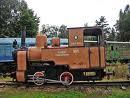
And then we went to the museum of locomotives. It is pleasant to ride about the forest, imagining that, the machines cannot wait for you, carefully assembled by someone on the local narrow gauge railway sidings. It is pleasant to ride on a car through the forest, especially, in winter when the entrance is made well and you can drive without the difficulties. We parked next to a small enclosure for ancient cars – a rudiment of a museum of automobile technics –and the engines of our cars hadn’t stopped yet and our men had already run to look at Dodge three quarters and lorry. And now they are squatting treated rubber, as they are Pinkerton, and argue that the machines are in good condition – and they see the traces of mud are on the wheels.
After examining all cars, almost snuffing their tailpipes, we went to stare at the locomotives.
With what pleasure you can walk on the rails, looking at the old iron horses, carriages, trolleys. It is amazing, how everything is small, close, in comparison with modern transport. Someone’s child playing Heracles rode the locomotive back and forth. Well, not a locomotive, but a trolley. But where else can you play in such railway?
And why are we worse? We started to push locomotives too. And the girls helped too. Locomotives are untouched, this is understandable, but you can try, it is also very important.
Separately in enclosure behind grating other miracles are languishing. Strange things can be found there. For example, the car on a railway – based. I thought earlier, that Kusturitsa made it. It is a pity, of course, that you cannot touch it.
Naturally, we did not pass by the arrows and semaphores. We felt them as the family. They are neat, pretty, like souvenirs from the shop. However, everything remained toys. Because it is small. The whole railway as if made for Prince Aleksey is a small copy of real railway. These are real railway carriages, locomotives, blowers. They also bought a real benefit. There were industrial developments of peat, which was used as fuel, so on this narrow – gauge road trolleys valuable raw material was exported to a large railway.
And by the way, there is an armored train. You’ll laugh, but it stands on the siding track. Excited by patriotic feelings, our friends went to ride on the trolley. And we didn’t go, we stayed to study locomotive engines and enjoy the nature.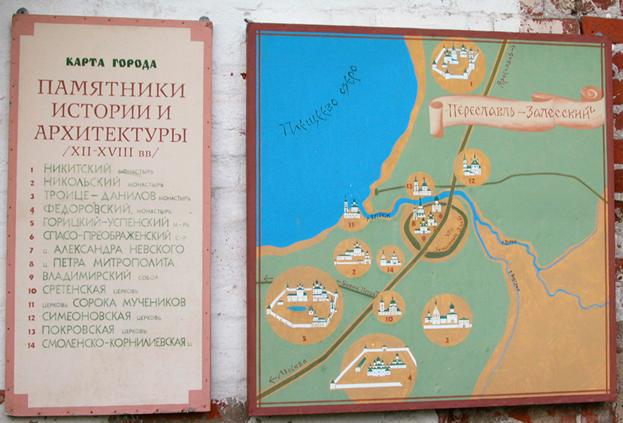
ЗАДАНИЯ ДЛЯ САМОКОНТРОЛЯ
1. Put the correct preposition into the right sentence.
Around, by, in, after, on
1) ….. the shore of the river there are picturesque valleys and hills.
2) You shouldn’t pass ……. our famous museums and enjoy the beauty of the ancient buildings
3) A lot of people come to our city to walk ……. it and get unforgettable impressions.
4) ……. the revolution a lot of ancient churches were destroyed.
5) This museum was called …… honor of the famous people.
Keys:
1. On. . 3. Around. 4. After. 5. In.
2. Make the combinations of words.
Fire ground
Foot mother
Middle water
History pots
Lake station
Grand age
Step ship
Icy situations
Space museum
Tea step
Back mother
Emergency shore
Keys:
Fire station, foot step, middle age, history museum, lake shore, grand mother, stepmother, icy water, spaceship, tea pots, background, emergency situations.
3. Find in the text the English for:
миниатюрная, «шарабан под брезентом», кибитка, равнодушно, чудотворнаяикона, пожарнаячасть, гимназия, плешь, как на ладони, глажка по-фински, рифленая доска, морская держава, дрезина, бронепоезд, запасной путь, монастырь.
СПИСОК ЛИТЕРАТУРЫ
1. Ананьев структура личности и ее становление в процессе индивидуального развития [Текст] / // Психология личности. Хрестоматия. В 2-х т. Т. 2. – Хрестоматия. – Самара: Издательский дом «Бахрах-М», 2002. – С. 7-8
2. Асмолов, личности: принципы общепсихологаческого анализа [Текст] /. – М.: «Смысл», ИЦ «Академия», 20с.
3. Бондаревская : личность в гуманистических теориях и системах воспитания [Текст] / , , - Ростов н/Д: Творческий центр «Учитель», 19с.
4. Выготский сочинений в 6 т. [Текст] / . – М.: Педагогика, 1984
5. Выготский личности и мровоззрения ребенка [Текст] / // Психология личности. Хрестоматия, В 2-х т. Т. 2. – Самара: Издательский дом «Бахрах-М», 2002,.- С. 160-164
6. Горлова личности. Концепция личностного подхода в дошкольном и начальном школьном образовании [Текст] / . – М.: МГПУ, 20с.
7. Зимняя психология [Текст] / . – Ростов-на-Дону: Феникс, 19с.
8. Куканова ориентированное обучение учащихся 5 -11 классов в общеобразовательной школе: Система и технология [Текст]: дис. ... д-ра пед. наук / . – Москва, 19с.
9. Леонтьев и речевая деятельность в общей и педагогической психологии [Текст] / . – М.: Издательство Московского психолого-социального института; Воронеж; Издательство НПО «МОДЭК», 2003. – 536 с.
10. Ротанова -деятельностный подход как основа методики обучения иностранным языкам: автореф. дис. на соиск. учен. степ. к. п.н. / - М., 2004. – 16 с.
11. Сериков ориентированное образование: к разработке дидактической концепции [Текст] / // Педагогика. – 1994. – № 6. – С. 16-21.
12. Ротанова -деятельностный подход как основа методики обучения иностранным языкам: автореф. дис. на соиск. учен. степ. к. п.н. / – М., 2004. – 16 с.
13. Шароватов подход к воспитанию патриотических качеств личности в учреждениях культурно-досугового типа [Текст]: дис. … канд. пед. наук /. – Москва, 2005. – 196с.
14. Шевлюкова ориентированный подход как условие оптимизации межличностного взаимодействия субъектов образовательного процесса в средней школе: автореф. дис. … канд. пед. наук / . – Екатеринбург, 2006. – 24 с.
15. Якиманская построения образовательных программ и личностное развитие учащихся [Текст] / // Вопросы психологии. – 1999. – № 3. – С 39-47.
Справочные и информационные издания
16. Болъшой психологический словарь [Текст] / под ред. , . - 3-е изд., доп. и перераб. — СПб.: прайм-ЕВРОЗНАК, 2006.-672 с.
17. Большой толковый словарь рус. яз. [Текст] / сост. и гл. ред. . – СПб.: Норинт, 2000. – 1536 с.
18. Закон РФ «Об образовании» [Текст] // Вестник образования. – 2012. - № 11. – С. 2-60.
19. Педагогический энциклопедический словарь [Текст] / Гл. ред. -Бад. – М: Большая Российская энциклопедия, 2003. –– 528 с.

|
Из за большого объема этот материал размещен на нескольких страницах:
1 2 3 |
