


Партнерка на США и Канаду по недвижимости, выплаты в крипто
- 30% recurring commission
- Выплаты в USDT
- Вывод каждую неделю
- Комиссия до 5 лет за каждого referral
In order to internalize conflicting objectives of the public partner (local authorities) and the service provider (RZD) PPP was proposed to structure the relationship between the parties. Some of them managed to turn to profitability within two or three years after establishment, all of them improved quality of services but in terms of financial sustainability most of them are far beyond standard criteria.
By design PPP has important features that may make the structure of property rights in the project relevant to the problem of low incentives to innovate. PPP aims at internalizing the conflict between local authorities (acting as a principal with the power to set tariffs) and RZD (acting as a regulated service provider). Elimination of the informational asymmetry between the parties may result in a sort of substitution of a counter-productive bargaining between the regulator and operator by more formal corporate procedures where relative ‘voting power’ is determined by the structure of share capital.
2. Literature review
Constructing the model, we have been inspired by three seemingly unrelated streams of literature. We have borrowed regulatory framework from Armstrong et al (1994). Idea of politician as an informed supervisor has originated from the work of Laffont (2000). Finally, we have followed Bennett and Iossa (2006b) in introducing delegated contracting as opposed to centralized contracting. We depart from this literature by making the very process of delegation endogenous and develop specific analytical framework for the analysis of PPP creation in the sector of suburban passenger transportation in Russia. This approach can be generalized to the case of organizational choice in public sector.
Dealing with RZD we essentially deal with a regulated monopoly so that literature on it must be investigated first. In their work, Armstrong, Cowan, and Vickers (1994) are concerned with such market failure as the problem of monopoly power, which becomes especially important to target in case of a natural monopoly – one that arises as a result of increasing returns to scale in the industry – as under such condition marginal cost goes below average cost making firms operating under perfect competition unprofitable and consequently implying that introducing more competition to the market is not the way to overcome the inefficiency associated with monopoly power.
There are consequently two agents in the literature under consideration – the regulator and the service provider. It must be noted that in a regulated private firm managers act as agents to two principals, the regulator and the body of shareholders, and these principals have quite different objectives that they wish management to pursue. In this work, in line with the broad literature within this framework, we will ignore the fact that there are monitoring problems for shareholders as well as the regulator, and assume management of service providing firm to simply maximize its profit:

The regulator is assumed to be a benevolent agent the objective of which is thus to maximize social welfare as given by expression:

where  stands for price charged by the firm,
  and
and  representing consumer and producer surpluses measured by profit respectively, the former being weighted with
  . A reason to place less weight on profit than on consumer surplus is that “shareholders tend to be wealthier than general consumers, so that a welfare criterion with some distributional concern should value a pound in the hand of a typical consumer more than a pound in the hand of a typical shareholder” (Ibid, p. 16).
An alternative way of modeling the benchmark case was provided by Laffont (2000)[1]. The Constitution – analogue to the regulator introduced before – is also assumed to be a benevolent agent, whose objective is thus social welfare maximization.
Consumers’ utility is measured by consumer’s surplus, while the firm’s utility is measured as:

where  stands for the transfer from the government to the firm,
  stands for unit product cost and
  stands for the number of service users.
What differentiates the work of Laffont crucially is the assumption that to obtain the participation of the firm an individual rationality constraint must be satisfied for all values of the informational parameter :

However, in the real-life case under consideration the firm continues operating under transfer being insufficient to cover its losses, in other words, under participation constraint not being fulfilled. Consequently, such a framework is inappropriate for the purpose of this work.
Yet, what we have borrowed from Laffont is the idea of the need for informed supervisor. Laffont investigates regulated monopoly within asymmetric information framework, and in such a framework, acquiring information becomes a specialized task for which society needs particular agent – the Politician. His utility can be written as:

where  stands for the reward from the Constitution.
The funding of public goods production together with the reward to the Politician require indirect taxation with a cost of public funds  , so that social welfare can be rewritten as:

where  stands for the consumer surplus.
Fig 1.: Politician as informed supervisor
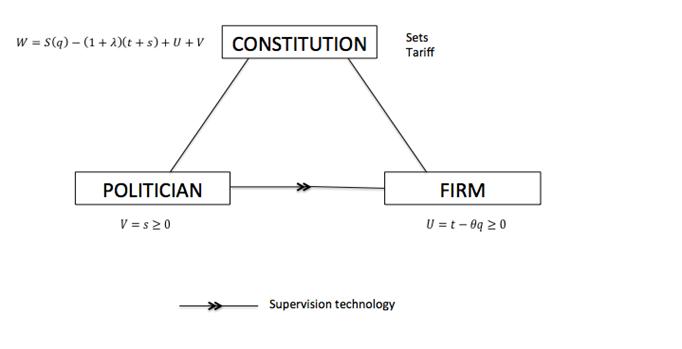 Source: Laffont (2000)
Laffont assumes that the Politician observes a verifiable signal with some nonzero probability, which he can however decide not to transmit truthfully to the Constitution in case of collusion with the Firm. The Constitution thus needs to provide incentives to the Politician in order to induce its non-cooperative behavior.
We modify this approach by assuming it is PPP that is an informed supervisor. It obtains the true knowledge about the firm for sure, that is, with probability equal to 1. Its establishment thus eliminates informational asymmetry. Intuitively, the reason behind is that PPP represents the joint venture between the firm and the regulator. Consequently, within PPP all the information about the firm becomes revealed to the regulator. This also implies there is no scope for the information to be transmitted untruthfully as this was the case with the Politician.
All in all, it is thus essential to work within the asymmetric information framework, and the work of Armstrong et al (1994) satisfies this condition, what represents one of the reasons why it has been chosen.
The reference to informational asymmetry as an argument for PPP establishment we use in our work is thus not innovative[2]. However, there exists the other approach to modeling how PPP establishment contributes to social welfare improvement. It asserts that it is bundling, that is, internalization of synergy effects emerging when investment and operational stages are undertaken by one contractor.
Martimort and Pouyet (2008) put an emphasis on complex combination of tasks provision of most public services involves. “Those activities necessitate indeed, first, to build infrastructures and, second, to operate these assets as efficiently as possible. Delegation to the private sector thus takes place de facto in a multi-task environment” (Ibid, p.394).
The traditional form of public procurement is associated with unbundling of these tasks. “First, a government designs the characteristics and quality attributes of the project. Second, the government chooses a private builder to build assets but retains ownership. Finally, the government chooses an operator, who may be either public or private, to manage these assets and provide the service” (Ibid, p.394).
Under PPP, however, the government only chooses a service provider which then designs the quality attributes of the infrastructure, builds these assets and, finally, manages them as efficiently as possible. In other words, tasks under consideration are now bundled. Tasks being performed by the same firm allow internalizing the impact that a better infrastructure design has on operating costs as generally a positive externality is presented.
Such an approach has also been undertaken by Bennett and Iossa (2006a), Fang et al (2009a), Fang et al (2009b), Carmona (2010), Iossa and Martimort (2009), Iossa and Martimort (2012) etc. However, in the particular case under consideration, informational asymmetry approach rather than bundling should be implemented since investment and operational stages are undertaken by one contractor in the benchmark case of PSO, so that synergetic effect resulting from their bundling is already realized thus not representing the potential reason for PPP establishment.
Although various informational problems could be defined on which the model will further be based, including the inability of both the firm and the regulator to differentiate between consumers according to their preference for the product, Armstrong et al (1994) states explicitly that “The informational problem of most importance in the modern economies of regulation, however, concerns the asymmetry of information between the regulator and the firm. The firm typically is better informed that the regulator about (1) the cost and demand conditions in the industry and (2) its actions, for example, its level of cost-reducing effort” (Ibid, p.27). The former is the case of hidden information, and the latter – of hidden action.
Within informational asymmetry approach, hidden characteristics rather than hidden actions problem should lie in the basis of the model as long as investment stage of the project in question has been overcome prior to entering the bargaining process and thus the level of investment activity no matter of what type could not be the choice variable.
We have further modified the work of Laffont by stating it is not the Constitution who undertakes the decision once obtaining the information from the informational supervisor. Instead, once PPP is formed it is in its power to set the tariff. That is, we deal with the delegation of decision-making, the idea of which has been borrowed from Benett and Iossa (2006b).
Fig. 2. PPP as informed supervisor
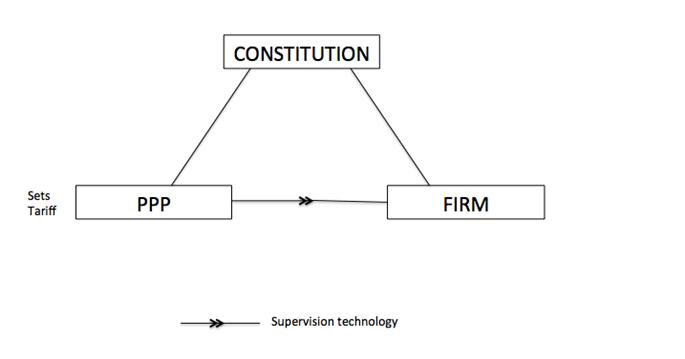
Benett and Iossa (2006b) use the incomplete-contract approach to compare the outcomes of two scenarios – “centralized contracting” and “delegated contracting” (Ibid, p.77). In the former, public sector agency contracts directly with the service provider. In the latter, public sector delegates to a PPP the task of contracting with the service provider. The difference in outcomes stems from different objective functions that public sector and the PPP have. While the public sector is assumed to be benevolent central government which is thus social a welfare maximizing agent, the PPP representing a local government is assumed to maximize a combination of its own profit and the social benefit which it is concerned with due to representatives of the service users having seats on the board of PPP. The service provider is assumed to be profit maximizing.
Thus, in considering the PPP case, this paper examines the effects of delegation of contracting to an agent that does not maximize social welfare, though has some concern for social benefit. Indeed, delegation by the principal of bargaining responsibility to an agent whose incentives differ from those of the principal will affect the outcome of bargaining with third party. The choice variable which defines the outcome is innovation or level of investment in innovative methods made by the service provider. They are of two types – one that raises the quality of service at the expense of higher cost, the other reduces cost, but the side-effect is that there is some sacrifice in the quality of a service. Such innovations could not be foreseen when the initial contract is drawn up and thus represent aspect of service provision that cannot be determined ex ante, so that bargaining may take place over the splitting of the surplus from implementation of the innovations. The service provider anticipation of the outcome of such bargaining affects the incentive to research possible innovations. Note that it is assumed the bargaining powers are distributed ex ante in such a way that under centralized contracting, central government extracts the whole surplus from the service provider, and under delegation, agent extracts the whole surplus from the third party, while principal in turn keeps agent on its budget constraint.
Service provider’s objective function:

where  is the side-payment made by the party who negotiates with the service provider
PPP objective function:
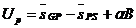
 is the side payment PPP receives from public sector;
  is the side payment made by PPP to the service provider; and
  (0, 1) is the weight that PPP places on the social benefit from the project.
Public sector objective function is the sum of consumer surplus and the profit of the service provider:

where is set equal to zero if there is centralized contracting, and  is set equal to zero if there is delegation. Taxation is assumed distortive and we denote the shadow cost of public funds by
  (0, 1).
A conclusion can be made using the language of Armstrong et al (1994) that this paper is concerned with hidden action type of asymmetric information. Yet, in relation to the real life case that has motivated this paper hidden action consideration seems less appropriate. Indeed, in case of bargaining game between local authorities and RZD the level of investment is predetermined and has no effect on the very choice of contractual arrangements with the regulated monopoly. Consequently, hidden characteristics type of asymmetric information should be applied instead. Following Armstrong et al (1994), the service provider could be assumed to be better informed about its cost of providing the service.
Above the main literature that shapes the area of study has been provided. It must be emphasized however that all the papers discussed above take the possibility of PPP creation as given, simply investigating how desirable such an outcome would be. None is concerned with the way organizational choice is made.
Although some works can be found in which game theoretic approach is used when studying PPP, the aim of these papers is different from one our work poses. For example, the work of Medda (2007) examines allocation of risks as a bargaining process between the two agents - the public sector and the private sector in transport PPP agreements – confronted with the decision about risk allocation offers, this process being modeled with a final offer arbitration game. That is, the general idea of this work is to analyze through a game framework the behavior of the players when confronted with opposing objectives in the allocation of risks.[3] According to the author, “The two different behaviors of the agents will generate the most ‘fair’ offer, that is, the offer that reduces the probability of a bad outcome” (Ibid, p.214). The general idea of our work is to analyze through a game-theoretic framework the behavior of the players when confronted with opposing objectives as well, however we are interested not in their ex post behavior but in their behavior prior to PPP establishment. Hence, not only the aim of this work but the approach implemented to its fulfillment is innovative.
Thus, the main idea and contribution of the paper is to model the process of organizational choice as endogenous one.[4] The specific purpose of the work is to develop a conceptual framework that would allow explaining the existing heterogeneity of organizational forms in public sector. The bargaining game with delegation under asymmetric information is then solved and analyzed with several important extensions.
3. Model
3.1 Centralized contracting
3.1.1 Agents, their objectives and choice variables
Following the notations of Armstrong et al (1994), in case of centralized contracting we deal with two agents – the Regulator and the Service Provider.
In line with the literature discussed above, the regulator would be perceived as benevolent agent whose objective is thus to maximize social welfare. It must be noted that this assumption is not a conventional – for example, in their work Maskin and Tirole (2008) explain the widely observed phenomenon of PPPs not aligning with the public's best interest by modeling government officials having preferences that differ from those of a social welfare maximizer. They motivate the approach by claiming that “there is substantial evidence that politicians' project choices are influenced significantly by the desire to please constituencies and by budgetary constraints” (Ibid, p.413). More general way in which recent studies have departed from the benevolence assumption is by supposing that the private partner or other parties may capture the procurement process by colluding with the government.[5] Nevertheless, our work is not concerned with regulatory capture. We believe that assumption governmental benevolence is a step in the analysis of PPPs that is reasonable to undertake even though it definitely over-simplifies reality.
As it has already been stated, RZD operates under cost-based approach to regulation when its private information on costs is taken into account when tariff is set and subsidy is determined. Hence, hidden characteristic introduced to our model would be the cost the service provider incurs and then reports to regulator. Following Armstrong et al (1994) we assume that the firm has constant unit cost of production . The parameter is unobserved by the regulator, although the regulator has a view on the likelihood of the various outcomes of , which is summarized by the density function  . The unit product cost has continuous distribution on range
  . is assumed to be exogenous, so that there is no scope for any cost reduction on the part of the firm.
The assumption of no fixed cost is common in the literature on optimal regulation. Admitting the importance of fixed cost consideration for the determination of payoffs in the game that is outlined below we will not relax this simplifying assumption throughout the paper. This allows us to compare our results with those in the literature. Moreover, existing regulatory stimulus in the passenger railway transport in Russia allows Suburban Passenger Companies to pay symbolic 1% of the infrastructure access charge and save up to 50% of their total cost. Thus the assumption of fixed costs to be virtually zero is also relevant for the case studied.
Consequently, assuming that the objective of the service provider is profit maximization, optimization problem it faces could be written as:

where  represents demand for the service; stands for unit product cost which is an exogenous variable,
  represents lump-sum transfer from the regulator to the service provider.
As a result of a hidden characteristics problem, regulator’s objective function is essentially the function of expectations regarding the variables of which it is uncertain – unit product cost of providing the service. Social welfare which this benevolent agent attempts to maximize would be modeled as weighed average of consumer and producer surpluses, lower weight being placed on the service provider’s profit following the argument provided by Armstrong et al (1994):

Following the lines of Armstrong and Sappington (2006), a transfer payment  from consumers to the firm is modeled to entail a reduction of
  in the surplus enjoyed by consumers. The parameter λ ≥ 0 represents the social cost of public funds. This cost arises from the distortions created by the taxes imposed on consumers/taxpayers to raise the funds.
3.1.2 Outcome
It must be noted that in the particular case under consideration we deal with the regulator explicitly announcing it realizes that together with compensation the service provider still bears losses. That is, under tariff imposed by the regulator the monopoly is not expected to break even after subsidy is provided. This implies that informational asymmetry is not the key reason for the state of affairs under consideration. What factors we believe to fully explain the status quo is low relative weight placed on the monopoly’s profit in social welfare function together with budget that could be devoted on transfer being limited. Indeed, the former factor makes the regulator impose tariff such low that it cannot cover the unit cost of production, while the latter one makes funds available for transfer are not enough to cover losses the service provider incurs. Thus, we could start with complete information framework.
Complete information framework
As it has been determined in Section 3, the regulator being benevolent agent sets tariff in accordance with the social welfare maximization problem:

The set-up of the real-life case under consideration makes us believe budget is insufficient to cover losses the service provider is expected to incur from its operations implying regulator’s budget constraint is binding.  stands for the regulator’s budget, and we assume this parameter do be exogenous.
In order for closed form expression of tariff to be found demand function has to be specified. For simplicity, assume it to be linear:

So that regulator’s optimization problem can be rewritten as:

FOC: 
In the specified framework, optimal tariff is 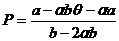
SOC: 
For the tariff found to represent solution to the optimization problem in question it must be that second order derivative is negative, that is, the condition  must hold, that implies
  [6]. Indeed, if the reverse is true tariff expressed above represents the solution to social welfare minimization problem. It is achieved at negative level of tariff, what under quadratic objective function implies it would be optimal to charge no tariff given the constraint naturally imposed on this variable. Intuitively, in case of too low weight being imposed on producer surplus in social welfare function maximization of consumer surplus which is achieved at zero tariff becomes effectively the objective of the regulator. As free public service does not correspond to the real-life case we attempt to model, let’s assume interior solution is obtained.
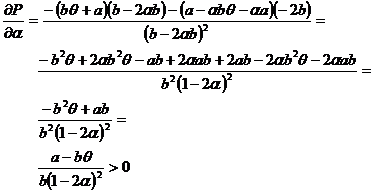
It would be reasonable to assume that charging the price equal to its unit product cost the monopoly could have obtained nonnegative demand, that is, that break even point exists. Hence,  what implies the derivative of optimal price with respect to the relative weight the regulator places on the service provider’s profit is positive. Obviously, this allows us to expect tariff to be low exactly as a result of relative weight being placed on the monopoly’s profit being low.
Proposition 1: in complete information framework, optimal tariff is increasing function of relative weight imposed on producer surplus in social welfare function
Now, let’s consider the condition in which charging the tariff imposed by the regulator results in negative operating profits:
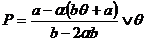
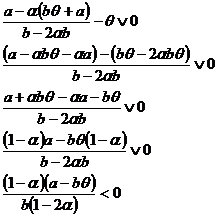
Using the previously justified condition as well as derived restriction , we could determine that  , that is,
  is additional restriction that is needed to be placed on the parameter to model the real-life case under consideration.
Proposition 2:  represents the range of possible values of the relative weight placed on producer surplus in social welfare function for the optimal tariff to be positive yet insufficient to cover unit cost of providing the service.
represents the range of values of the relative weight placed on producer surplus in social welfare function which correspond to the real-life case under consideration. represents the condition required for internal solution to be obtained, as otherwise socially optimal tariff would be equal to 0. Yet, zero tariff is definitely less than unit product cost. As is the restriction naturally incorporated in our model, a general conclusion could be made that within the framework we have constructed socially optimal tariff, that is, one that maximizes social welfare, turns out to be lower than economically optimal tariff, that is, tariff set at the level of marginal cost.
Lemma 1: If  , then socially optimal tariff is less than economically optimal tariff
  [7]
[7]
It remains to determine what the restriction on regulator’s budget and consequently transfer to the monopoly makes the service provider end up with its losses not being fully covered:
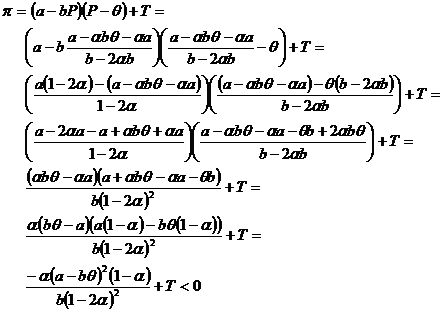
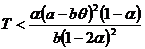
Note that upper bound is positive under the restrictions imposed before, that is, there is non-empty set of values of region’s budget that makes transfer to regulated monopoly insufficient to cover its operational losses.
In this part, we have modeled the real-life case under consideration within complete information framework, proving that the combination of low relative weight places on producer’s surplus in social welfare function and insufficient transfer as a result of a limited budget is sufficient to make a regulated monopoly operating under cost-based approach to incur losses.
For the purpose of future comparison, let’s derive the resulting social welfare:
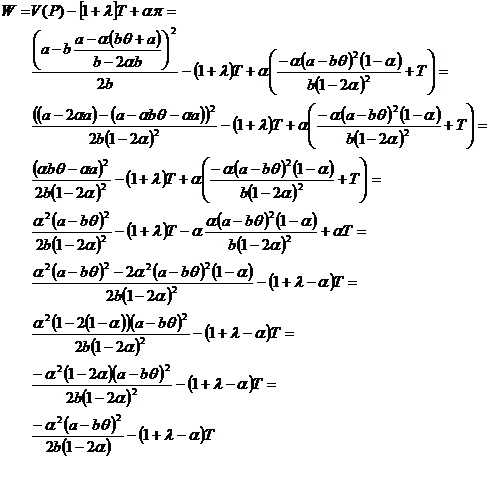
Although the above model allows to fully explain the real-life case under consideration, within this framework it is impossible to justify the creation of PPP on behalf of the regulator – first-best is already obtained, so that no change to the current state of affairs could be beneficial from the society’s point of view. Hence, no change would be agreed upon by the regulator which is assumed to be a benevolent agent.
Overall, there is no space for PPP in the given framework. Introduction of informational asymmetry of the type discussed above thus becomes essential, if not for modeling conventional compensatory agreement scheme than in order to justify the tendency for PPP creation observed in reality.
Together with specifying asymmetric information framework which would become our benchmark case, the comparison of outcomes of the asymmetric information modeling with those of complete information modeling would be made.
Asymmetric information framework[8]
The optimization problem the regulator solves is same to the one defined within symmetric information framework except for the fact that expected unit product cost serves as an input rather than its actual level due to asymmetry of information problem. Consequently, the tariff charged would be:
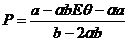
Let’s provide the comparison of this figure the with actual unit product cost:
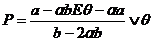
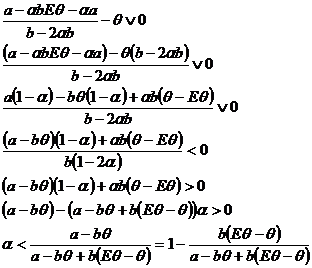
Note that the expression for the upper bound of the relative weight placed on producer surplus in the social welfare function has changed. It has decreased for the case  , that is,
  . Put it another way, the range of possible values of the parameter has narrowed in case . Intuitively, this implies that asymmetric information framework makes it less likely for the monopoly to incur operational losses in case this monopoly is efficient, where under efficiency unit product cost being lower than its expected level is understood. Indeed, tariff in this case is determined on the basis of unit product cost higher than that the service provider actually incurs and is thus higher than within complete information framework, and increase in tariff has positive effect on the monopoly’s operating profit given it is below the unit product cost and thus definitely below its monopolistic level.
For the opposite case of  , that is,
  the effect of asymmetry of information is harder to be defined analytically as in the case of extreme inefficiency the inequality could even reverse. Yet, intuitively, the effect of switching to asymmetric information framework is definitely negative for inefficient firms. Indeed, as tariff is then determined on the basis of unit product cost lower than that the service provider actually incurs it is lower than one within complete information framework, and reduction in tariff has negative effect on the monopoly’s operating profit given it is below the unit product cost and thus definitely below its monopolistic level.
Obviously, in case of  there is no difference from the complete information framework outcome.
As the efficient firm obtains higher tariff in asymmetric information framework this could the case that the tariff exceeds the unit cost of providing the service, so that the firm actually earns positive operating profit:

|
Из за большого объема этот материал размещен на нескольких страницах:
1 2 3 4 |
