


Партнерка на США и Канаду по недвижимости, выплаты в крипто
- 30% recurring commission
- Выплаты в USDT
- Вывод каждую неделю
- Комиссия до 5 лет за каждого referral
4.2 Fare-dodgers
Additional factor that provides a space for PPP creation even in the absence of the asymmetry of information is considered in this work. It is volume of fare evasion – the factor which has not been sighted in any relevant papers yet.
Within this framework we deal with two types of demand for the service:
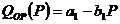

where  stands for the demand of obedient passengers and
  stands for the demand of free-riders.
Note that while demand of obedient passengers is downward sloping as usual, demand of fare-dodgers is upward-sloping reflecting the positive relationship between the tariff charged for the service and the number of free-riders. What is crucial is that  . This inequality allows modeling the relationship between the two categories of passengers under consideration correctly. Indeed, reduction in the number of obedient passengers following the increase in tariff is only partly explained by some obedient passengers having decided to become free-riders as some of them simply switch to using other means of transport. Increase in number of obedient passengers following the reduction in tariff is only partly explained by some free-riders having decided to become obedient passengers as some new passengers who have not previously used the service would decide to enter. Consequently, the overall demand for the service is downward-sloping yet steeper than the demand of obedient passengers:

4.2.1 Centralized contracting
There are two sources of the influence of the existence of free-riders on social welfare. First, fare-evasion affects social welfare negatively via producer surplus as it results in the service provider undertaking the costs of providing the service yet not obtaining revenues and thus adds to negative operational profits of the monopoly. Second, fare-dodgers are essentially users of the service whose corresponding benefit thus has to be accounted for in consumer surplus calculation affecting social welfare positively.



Fare-dodgers problem is of particular importance in Russia, making up around 10-30% of users of the service under consideration.
Table 10: The scope of fare-evasion in suburban railway transport sector in Russia
PPP | Number of fare-dodgers (%) | Average monthly wage in Russian regions in the year 2010 |
Sverdlovskaya | 3 ( | 19674,7 |
Yuzhno-Uralskaya | 7 – | 17388,4 |
Moskovsko-Tverskaya | 22 ( | 25502,1 |
Central | 10 – | 40479,2 |
Nord-West | 15 – | 27618,1 |
Saratovskaya | 15 – | 14592,3 |
North | 5 – 7 ( | 21263,3 |
Source: the Federal State Statistics Service
The Dementiev, Zaitseva (2013) study on social capital in the sector of suburban railway transport in Russia has revealed that fare-evasion does not depend on the size of fines and on-route ticket inspection intensity. In fact, the only effective measure that triggers passengers behavior and forces them to pay for the journey proves to be access prevention via tourniquets. Thus the reason for such a figure is that the installment of tourniquets by RZD is somewhat problematic when railway stations belong to local authorities.
That is, in Russia volume of fare-evasion depends on the level of control discretely rather than continuously: the two possible realizations occur, fare-evasion taking place in accordance with the demand function written above and no fare-evasion. Thus, instead of introducing control variable we would assume that for certain fixed amount  access of free-riders to the service could be completely technically blocked by tourniquets. It must be emphasized that under no fare-evasion we understand previous free-riders entering the pool of obedient passengers rather than leaving, that is, overall demand for the service becomes comprised of obedient passengers only.




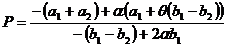
As nominator is increased by  while denominator is reduced by
  , both nominator and denominator remaining positive, tariff is increased as a result of access to the service by free-riders being blocked. This result is an intuitive one. Before the tariff representing the solution to social welfare maximization problem was set at such a level that marginal loss to consumer surplus from tariff increase was equal to marginal gain to producer surplus from tariff increase multiplied by
  . With free-riders having turned into obedient passengers, marginal gain to producer surplus from higher tariff weighted by increases exceeding the corresponding marginal cost to consumer surplus which is unaffected by the change. Consequently, higher tariff becomes socially optimal.
At the absence of fixed cost blocking the access of free-riders to the service will be purely beneficial to the society. Indeed, it is in power of the regulator to leave the tariff unchanged, and under the unchanged tariff the only change to the social welfare would be increase in revenue of the service provider as those who had previously used the service for free would start to pay for it. The decision of the regulator to change the tariff could only be motivated by further improvement in social welfare it would introduce.
However, the regulator may decide not to block the access of free-riders to the service in case the social cost of the funds required for this purpose is higher than the increase in social welfare the change under consideration would introduce:

4.2.2 Delegated contracting
As it has been stated above, there exists an option for the regulator to block the access of free-riders to the service at some fixed cost which it however does not exercise. It seems that the gain to social welfare that arises from free-riders turning into obedient passengers is lower than the social cost of that fixed amount required to block the access of free-riders to the service.
However, the change under consideration could become socially optimal in case of the fixed amount in question being borne not by the regulator but by the service provider. Indeed, blocking the access of free-riders to the service is less costly in social welfare terms when being incurred by the service provider than by the regulator -  . Yet, the tariff charged would be the same as in case of the change under consideration being undertaken by the regulator as FOC of tariff setting is independent of who incurs the fixed cost of blocking the access of free-riders to the service.
  .
.
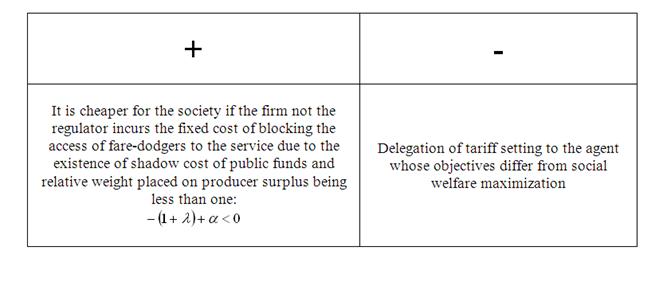
Yet, in order to allow for the fixed cost in question being borne by the service provider it is necessary to establish PPP, implying the change under consideration could only come at cost of suboptimal level of tariff as a result of delegating the process of decision making to the agent whose objective function represent the weighed average of social welfare and producer surplus, that is, whose objectives differ from social welfare maximization. Indeed, under information being symmetric the tariff set by the regulator is socially optimal one.
The higher is the share of the service provider in PPP, the greater is the negative effect of PPP establishment on social welfare that arises from the delegation of decision-making to the agent whose objectives differ from the social welfare maximization. Yet, the ownership structure of PPP does not affect the positive effect of PPP establishment on social welfare that arises from turning fare-dodgers into obedient passengers. As in case of the firm’s share in PPP being equal to zero the negative effect under consideration will not be presented so that PPP establishment is social welfare improving, there must exist non-empty set of possible values of  ,
,  where
where  , under which the negative effect of PPP establishment on social welfare is no greater than the corresponding positive effect. That is, there must exist non-empty set of possible values of , , where, under which PPP establishment is perceived by the regulator as social welfare improving.
All in all, within the given framework there is a space for PPP establishment (see Table 11).
Table 11. Regulator’s trade-off from PPP establishment
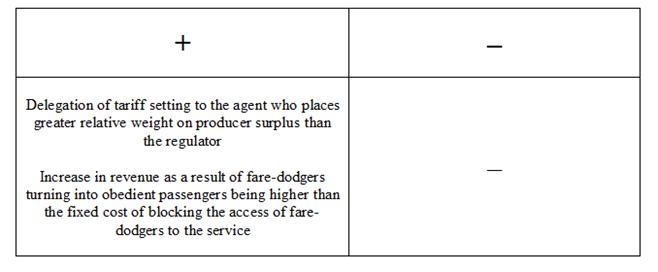
Even in the absence of PPP, it may be beneficial for the service provider to incur the fixed cost of blocking the access of free-riders to the service. There are two reasons for this. First, it is cheaper for service provider than for the regulator to incur the fixed cost in question -  . That is, the loss to the monopoly incurred in order for the access of free-riders to the service being blocked is lower than that to the regulator. Secondly, the gain to the monopoly from the access of free-riders to the service being blocked is higher than that to the regulator. In order to demonstrate this, skip the fixed cost of undertaking the change in question. As increase in social welfare as a result of the access of free-riders to the service being blocked is accompanied by reduction in consumer surplus due to the increase in tariff, producer surplus when being weighed by is increased by more than social welfare when the change under consideration takes place. Consequently, producer surplus is increased by more than social welfare when the change under consideration takes place:
  .
.
Combining the two effects: 
In fact, as soon as the regulator finds it socially optimal for the access of free-riders to the service to be blocked by the service provider, it is beneficial for the service provider to incur the fixed cost of blocking the access of free-riders to the service even at the absence of PPP:  . Consequently, as soon as there is a space for PPP establishment, the service provider benefits no matter of its share in PPP, in other words, any share in PPP is profit-increasing for the firm. Hence, there is no scope for the offer not to be made (see Table 12).
Table 12: The firm’s trade-off from PPP establishment
Note that the absence of private information on behalf of the regulator makes the service provider perfectly aware of the regulator’s reaction on any offer it makes. Consequently, given framework provides no space for such offers from the service provider that would be rejected by the regulator.
5. Conclusions
This paper develops a conceptual framework for the analysis of the establishment of trusting partnerships in the form of PPP in public sector. We contribute to the existing literature on PPP by making an organizational choice endogenous in a sense that local authorities are free to accept or reject the offer to partner with the regulated firm. This modeling approach differs from the story of regulatory capture because tariff setting is delegated to a third agent (PPP) that has no private interest. In essence, PPP is viewed as a specific institutional arrangement that aims at maximizing the composite objective function to determine tariff. Under trusting relationships within PPP the firm’s hidden characteristics are also revealed. Thus this strategic interaction between the agents creates the room for social welfare improvement through PPP. The standard regulatory problem of optimal tariff setting under hidden information about the firm’s cost becomes a subgame of the ‘regulatory bargaining game with delegation’.
The very presence of loss-making firms in the sector of public service provision (so called status quo) when socially desirable tariff is set at the level below economically optimal one and subsidies from the budget are insufficient to cover all the losses resulting from such a regulation, is captured in the model in the following way. First, we take a standard regulator’s objective function which is commonly used in the literature with lower weight on the firm’s profit reflecting certain redistributional concerns of the state. Second, we impose budget constraint and assume it to be binding reflecting the case when the lack of public funds affects organizational choice in the introducing further the asymmetry of information regarding firm’s costs we create a certain room for bargaining between the firm and regulator. Then we define conditions for PPP arrangements to become an equilibrium outcome in the above mentioned bargaining game.
For the sake of tractability of the model we use a number of simplifying assumptions about linear demand function and constant unit cost of services. Nevertheless, the descriptive power of the model goes beyond the case of establishment of PPPs in suburban railway passenger sector in Russia. Being able to account for the diversity of different organizational choices in this sector the model has broader applications and implications.
In the Basic model service provider was assumed to have private information about its cost. In Extension 1, we assume that regulator is uncertain about demand and consider an isolated effect of this assumption by making the firm’s cost known to regulator. To illustrate this assumption we introduce concessionary passengers that are deemed to be compensated from the budget. The corresponding budget constraint may or may not be binding. In the latter case the firm is unaware about the sufficiency of public funds that becomes a hidden characteristic of the regulator. Thus, two-sided asymmetry of information is captured by these modeling assumptions.
In Extension 2, we return to initial assumptions with no asymmetry of information but introduce a specific class of consumers that illegally escapes from paying for the service and thus is not eligible for any compensation from the budget. It is socially optimal to enforce obedient behavior of such passengers. It is cheaper for the firm than for the regulator to block the access of fare-dodgers to transportation service due to the social cost of public funds. However, the legislative status of passenger transportation as a public service that is ought to be provided on a non-excludable basis prevents the firm from just blocking the access without partnering with local authorities. Consequently, even complete information case allows for the bargaining process over PPP.
Information structure of the basic model and its two extensions is summarized in the table below.
The need to reveal its private information under PPP arrangement may make it reasonable for the firm not to enter the bargaining game. This is the case of the Basic model and Extension 1 only. Furthermore, Extension 1 introduces hidden information on regulator’s side, thus making potentially optimal for him to reject the firm’s offer. Specifically, the regulator may not wish to reveal its budget constraint in order to escape from mandatory compensation of concessionary passengers.
Table 13. Properties of the basic model and its two extensions
Basic Model | Concessionary passengers | Fare-dodgers | |
The firm has hidden information | + | + | - |
The firm can escape the game | + | + | - |
The regulator has hidden information | - | + | - |
The regulator can reject the offer | - | + | - |
Under all three specifications, the service provider was shown to unconditionally benefit from PPP’s establishment, what explains the motive for RZD to strive for entering partnership relationships with the local authorities. It is somewhat counterintuitive that the effect of PPP establishment on consumer surplus is generally negative as regulator favors consumers relatively more than the firm in his welfare maximization problem. The actual effect on social welfare is ambiguous apart from the case with complete information (Extension 2).
Table parative statics when PPP is established
Basic Model | Concessionary passengers | Fare-dodgers | |
CS | ¯ in most cases in case of very cost efficient firm | ¯ | ¯ |
PS | | | |
W | ¯ | ¯ | |
P | in most cases ¯ in case of very cost efficient firm | | |
The developed theoretical model and its extensions shed some light on the process of PPP establishment. It rationalizes two important reasons for the delay in the implementation of railway reform in the sector of suburban passenger transportation in Russia at the regional level. We claim that in the regions where status quo is retained the offer to establish PPP was either not made by RZD or rejected by local authorities. The model also explains how different ownership structures in the established PPPs may be formed. The analytical framework we elaborated allows us to account for the diversity of organizational choices in public sector.
Bibliography
Armstrong, M., Cowan, S., & Vickers, J. (1994). Regulatory reform: economic analysis and British experience, The MIT Press, London.
Alexandersson, G., Nash, C., & Preston, J. (2008). Risk and reward in rail contracting. Research in Transportation Economics, 22(1), 31-35.
Armstrong, M., & Sappington, D. E. M. (2006). Regulation, competition, and liberalization. Journal of Economic Literature, 44(2), 325-366.
Bennett, J., & Iossa, E. (2006a) Building and managing facilities for public services, Journal of Public Economics,
Bennett, J., & Iossa, E. (2006b). Delegation of contracting in the private provision of public services. Review of Industrial Organization, 29(1-2), 75-92.
Bernardino, J., Hrãebícãek, Z., & Marques, C. (2010). Applying social marginal cost pricing in rail PPPs: Present state, drawbacks and ways forward. Research in Transportation Economics, 30(1), 59-73.
Boardman, A. E., & Vining, A. R. (2012). The political economy of public-private partnerships and analysis of their social value. Annals of Public and Cooperative Economics, 83(2), 117-141.
Church, A., Frost, M., & Sullivan, K. (2000). Transport and social exclusion in London. Transport Policy, 7(3), 195-205.
Chong, E., Huet, F., Saussier, S., & Steiner, F. (2006). Public-private partnerships and prices: Evidence from water distribution in France. Review of Industrial Organization, 29(1-2), 149-169.
Carmona, M. (2010). The regulatory function in public-private partnerships for the provision of transport infrastructure. Research in Transportation Economics, 30(1), 110-125.
Dementiev, A. V., & Zaitseva I. A. (2013). Public transport and social capital: the case of economy in transition, mimeo
Eriksen, K. S., & Jensen, S. (2010). The cost of second best pricing and the value of risk premium. Research in Transportation Economics, 30(1), 29-37.
Fang, S., Liu, L., Bao, J., & Fang, W. (2009). The research on multi-task bundling of public-private partnerships based on principal-agent model. Paper presented at the 2009 International Conference on Information Management, Innovation Management and Industrial Engineering, ICIII 2009, 1 384-388.
Fang, S., Zhang, J., & Bao, J. (2009). The research on bundling in public-private partnership. Paper presented at the 2009 International Conference on Management Science and Engineering - 16th Annual Conference Proceedings, ICMSE 2009, .
Hooper, L. (2008). Paying for performance: Uncertainty, asymmetric information and the payment model. Research in Transportation Economics, 22(1), 157-163.
Iossa, E., & Martimort, D. (2009). The theory of incentives applied to the transport sector, CEDI Discussion Paper Series number 09-04, Working Paper No. 09/210
Iossa, E., & Martimort, D. (2012). Risk allocation and the costs and benefits of public--private partnerships. RAND Journal of Economics, 43(3), 442-474.
Laffont, J. J. (2000). Incentives and Political Economy. Oxford University Press, New York.
Laffont, J. J., & Tirole, J. (1993). The Theory of Incentives in Procurement and Regulation. MIT press, London.
Laffont, J. J., & Martimort, D. (1999). Separation of regulators against collusive behavior. RAND Journal of Economics, 30(2), 232-262.
Laffont, J. J., & Tirole, J. (1991). The politics of government decision making: a theory of regulatory capture. Quarterly Journal of Economics 106, 1089–1127
Martimort, D. (1999). The life cycle of regulatory agencies: Dynamic capture and transaction costs. Review of Economic Studies, 66(4), 929-947.
Medda, F. (2007). A game theory approach for the allocation of risks in transport public private partnerships. International Journal of Project Management, 25(3), 213-218.
Martimort, D., & Pouyet, J. (2008). To build or not to build: Normative and positive theories of public-private partnerships. International Journal of Industrial Organization, 26(2), 393-411.
Maskin, E., & Tirole, J. (2008). Public-private partnerships and government spending limits. International Journal of Industrial Organization, 26(2), 412-420.
Maffii, S., & Parolin, R. (2010). Applying social marginal costs pricing to the road sector. Research in Transportation Economics, 30(1), 38-42.
Meersman, H., Pauwels, T., Van de Voorde, E., & Vanelslander, T. (2010). Applying SMC pricing in PPPs for the maritime sector. Research in Transportation Economics, 30(1), 87-101.
Nash, C. (2008) Passenger railway reform in the last 20 years - European experience reconsidered. Research in Transportation Economics, 22
Phang, S. (2007). Urban rail transit PPPs: Survey and risk assessment of recent strategies. Transport Policy, 14(3), 214-231.
Vining, A. R., & Boardman, A. E. (2008). Public-private partnerships in Canada: Theory and evidence. Canadian Public Administration, 51(1), 9-44.
[1] See Vining ans Boardman (2008), Boardman and Vining (2012) for intuitive rather than theoretical alternatives
[2] See also Iossa and Martimort (2012), Hooper (2008).
[3] Although our work is not concerned with optimal risk allocation, Phang (2007), Eriksen and Jensen (2010), Alexandersson, Nash, and Preston (2008) represent appropriate sources of the literature on this topic
[4] Chong et al (2006) focus on organizational choice as well, yet describing rather than modeling it
[5] see Laffont and Tirole (1991), Laffont and Martimort(1999), Martimort (1999)
[6] Note that implicit assumption employed is thus that nominator of optimal tariff expression is less than 0
[7] see Bernardino, Hrãebícãek and Marques (2010), Maffii and Parolin (2010), Meersman, Pauwels, Van de Voorde, and Vanelslander (2010) for further considerations regarding marginal cost pricing
[8] Note that the condition  holds for this framework as well
[9] This result is less obvious as the profit of the efficient firm represents concave function of deviation of actual unit cost of providing the service from its expected level. The reason behind is that in case of the efficient firm the tariff increases when switching to asymmetric information framework. As soon as the tariff reaches its monopolistic level, further increase in the tariff would negatively affect the profit, however, the profit could not fall below zero what takes place when the tariff is so high there would be no users of the service. Yet, zero profit is still higher than negative one the firm would obtain if operating under symmetric information. Thus, the efficient firm benefits from operating in asymmetric information framework.
[10] We avoid the problem of regulator defining optimal tariff within incomplete information framework as the utility of concessionary passengers does not enter FOC

|
Из за большого объема этот материал размещен на нескольких страницах:
1 2 3 4 |
