


Партнерка на США и Канаду по недвижимости, выплаты в крипто
- 30% recurring commission
- Выплаты в USDT
- Вывод каждую неделю
- Комиссия до 5 лет за каждого referral
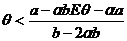
This could even be the case that the firm is so efficient that the tariff imposed by regulator within asymmetric information framework is above its monopolistic level so that service provider would find it optimal to opt for the tariff reduction.
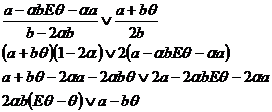
Note that inefficient firm ( ) would never opt for tariff reduction, as expected. Yet, tariff reduction could be optimal for efficient firm if:
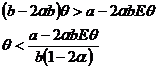
Hence, if ex post PPP establishment the firm opts for the tariff reduction two conclusions could be made simultaneously. First, it is an extremely efficient firm. Secondly, it has been earning positive operating profit under compensatory agreement.
Proposition 3: The firm may opt for the tariff reduction after PPP establishment if and only if it is extremely efficient in terms of cost.
Actual profit level will further be used in determining actual social welfare:
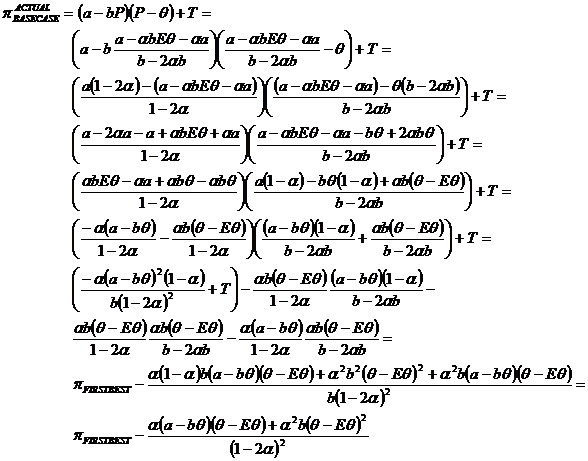
What we see is that indeed inefficient firm characterized by a condition could never benefit from operating in asymmetric information framework, the reverse being true for the efficient firm[9]. The profit is unaffected in case  .
.
The purpose of determining actual profit figure is to derive actual social welfare that would further be used to determine whether decision regarding PPP establishment made by the regulator is indeed welfare improving:
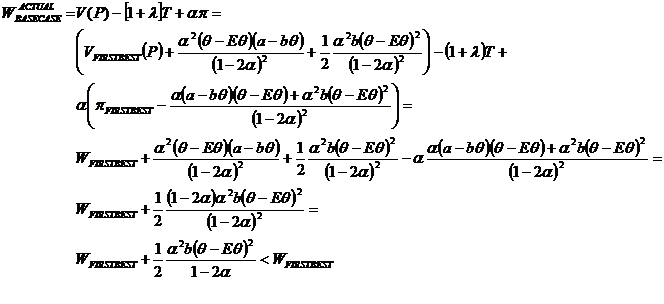
As it has been expected, the asymmetric information framework creates the scope for social welfare improvement.
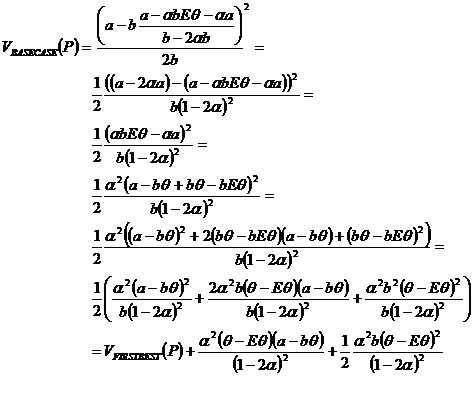
The profit figure on which the regulator would base its comparative analysis via inserting it in the social welfare expression would however be different as long as the regulator is unaware of actual unit product cost the service provider incurs due to asymmetric information problem. The result will actually coincide with that obtained in symmetric information framework except for the actual unit product cost being replaced by its expectation:
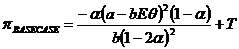
This figure in turn is needed in order to answer the question of whether PPP would be preferred over compensatory agreement by the regulator who is in power of undertaking such a decision. Note that again the result will coincide with that obtained in symmetric information framework except for the actual unit product cost being replaced by its expectation:

3.2 Delegated contracting
3.2.1 Agents, their objectives and choice variables
It is conventional to deal with three parties when considering PPP framework –the regulator, PPP and the service provider.
Under delegated contracting, the regulator who is still assumed to be a benevolent agent delegates the decision-making process to PPP which could effectively be represented as local authority. The objective function of this party is the weighed average of social welfare, that is, regulator’s objective function, and monopoly’s profit, that is, service provider’s objective function. Weights are equal to the corresponding shares of the two parties to the contract in the joint venture. Yet, the decision of whether to establish PPP is nevertheless undertaken by the regulator.

where  represents the share of the regulator in PPP.
Note that following Bennett and Iossa (2006b), two transfers are now presented: one from the regulator to the PPP, and the other from the PPP to the firm. However, following Bennett and Iossa (2006b) we would consider these transfers to be equal, in other words, we would assume nothing is settled in hands of PPP. Consequently, the two transfers effectively represent single transfer from the regulator to the service provider, now transmitted through PPP. For simplicity, we would skip this mechanism from further consideration and leave the notation relating to the transfer as they are in the benchmark case.
The firm’s objective function remains unaffected since ownership structure of PPP defines the relative weights of consumer and producer surpluses in the composite objective function. It has nothing to do with distribution of profit (or dividend sharing rule) since the only function that is delegated to PPP as a trusting partnership is to set tariff according to its optimization problem.
3.2.2 Outcome
We model the negotiation process as a ‘regulatory bargaining game with delegation’. Timing is provided in Fig. 3.
Fig 3: Timing of a ‘regulatory bargaining game with delegation’
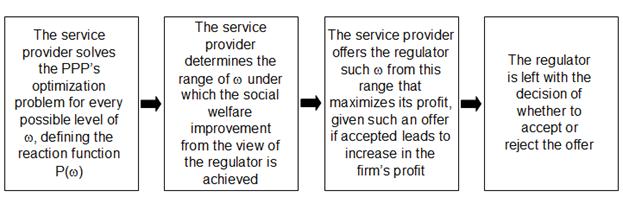
Now, let’s consider the channels through which PPP establishment affects social welfare from the regulator’s perspective. In other words, let’s investigate what trade-off the regulator considers when deciding on whether to accept or reject the offer (see Table 3).
Table 3: Regulator’s trade-off from PPP establishment
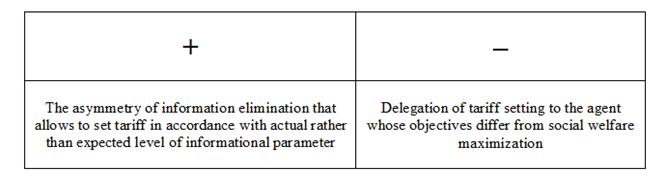
On the one hand, once PPP is established the asymmetry of information elimination results in the tariff being determined not on the basis of expectations regarding the monopoly’s unit product cost but on the basis of its actual level, what is social welfare improving. Yet, the asymmetry of information elimination takes place ex post the decision under consideration is made. Consequently, when deciding on whether to accept or reject the offer the regulator compares expected social welfare with the function of the tariff set on the basis of expectations of the unit product cost. Other things being equal, the latter figure which corresponds to the status quo is lower:

However, the asymmetry of information elimination comes at cost of delegation of decision-making to the agent whose objectives differ from social welfare maximization, that is, to PPP.
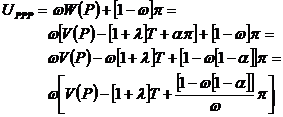
Let’s introduce a new variable that would represent a relative weight placed on producer surplus in PPP’s objective function –analogue to  in regulator’s objective function:

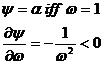
Hence, the greater is the share of the service provider in PPP, the greater is the departure of the decision maker’s objective function from that of the regulator. In other words, the higher is the share of the service provider in PPP, the greater is the negative effect of PPP establishment on social welfare that arises from the delegation of decision-making to the agent whose objectives differ from the social welfare maximization. Yet, the ownership structure of PPP does not affect the positive effect of PPP establishment on social welfare that arises from the asymmetry of information elimination. As in case of the firm’s share in PPP being equal to zero the negative effect under consideration will not be presented so that PPP establishment is social welfare improving, there must exist non-empty set of possible values of ,  where
where  , under which the negative effect of PPP establishment on social welfare is no greater than the corresponding positive effect. That is, there must exist non-empty set of possible values of , , where, under which PPP establishment is perceived by the regulator as social welfare improving.
Note that PPP could be concluded to represent an agent who places a greater relative weight on producer surplus than it would be socially optimal. This represents the stimulus for the service provider to enter PPP independently of whether it is efficient or not. Consequently, the effects on the firm from PPP establishment could be summarized (see Table 4 and Table 5).
Table 4: The efficient firm’s trade-off from PPP establishment
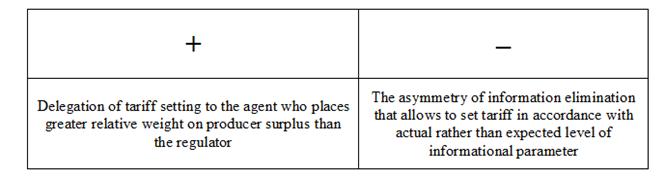
The efficient firm is negatively affected by the asymmetry of information elimination as a result of PPP establishment. Consequently, nonzero share in PPP is required by the efficient firm for the positive effect of the greater relative weight being placed on producer surplus in decision-maker’s objective function to just outweigh the negative effect of the asymmetry of information elimination. There is thus a range of possible levels of ,  where
where  , which could even be empty, under which increase in the firm’s profit over the status quo level is achieved. Consequently, there is a scope for no offer to be made by the service provider in case the range of those values of that correspond to the firm being not worse off from PPP establishment being empty or not overlapping with the range of those values of that correspond to social welfare improvement from the regulator’s perspective.
Table 5: The inefficient firm’s trade-off from PPP establishment
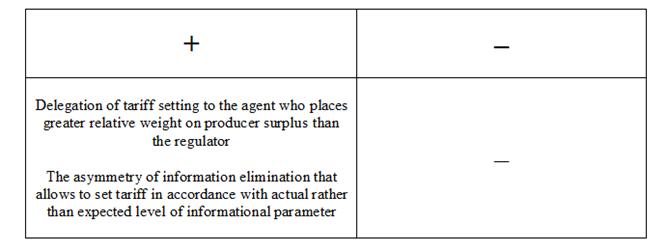
As opposed to the efficient firm, the inefficient firm benefits from the asymmetry of information elimination. Consequently, even zero share in PPP makes the firm better off from PPP establishment. Thus, any share in PPP is profit-increasing for the firm. Hence, in case of inefficient firm there is no scope for the offer not to be made.
Note that the absence of private information on behalf of the regulator makes the service provider perfectly aware of the regulator’s reaction on any offer it makes. Consequently, given framework provides no space for such offers from the service provider that would be rejected by the regulator.
Once we have defined the effect of PPP establishment on the regulator and the service provider, we could turn to analytical derivation.
The objective function thus represents the monotonic transformation of the regulator’s objective function except for the variable being replaced by the variable  . Consequently, the solution to the maximization problem would be the same except for the variable being replaced by the variable :
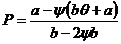
Profit of the service provider again is expressed in the same way as within complete information framework except for the variable being replaced by the variable :
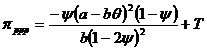
As it has been expected,
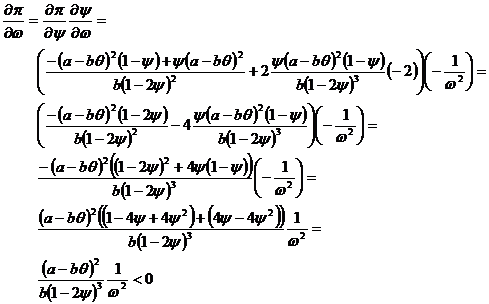
what implies the lowest from the range of the variable under which social welfare improvement from the regulator’s perspective is achieved is chosen, if results in increase in profit over its status quo level.
Deriving social welfare the fact will be used that its expression represents monotonic transformation of social welfare expression within complete information framework where variable is replaced by the variable :
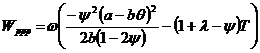
Yet, as the regulator has to undertake decision ex ante, it would be based on expected welfare figure:
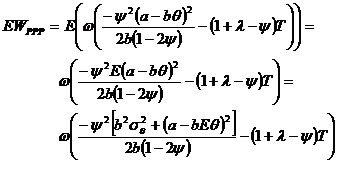
3.3 The regulator’s choice
When deciding whether to accept or reject the offer, the level of social welfare under compensatory agreement as perceived by the regulator who is unaware of the actual unit product cost of providing the service is compared with social welfare expected once the decision making is delegated to informational supervisor who yet has objectives different from social welfare maximization, that is, to PPP:

3.4 Actual effect on social welfare
Yet, once the offer is accepted by the regulator so that PPP is established social welfare should not necessary improve. First, the social welfare under compensatory agreement was not known to the regulator due to the asymmetry of information problem. Second, the decision of whether or not to accept the offer is undertaken ex ante the asymmetry of information is eliminated and thus is based on expected rather than actual social welfare ex post PPP establishment. Consequently, in order to determine whether PPP establishment is indeed social welfare improving it is necessary to compare the actual social welfare before and after PPP establishment.

4. Extensions
4.1 Concessionary passengers
Concessionary passengers are those who have socially based ticket privileges. In this work we assume they do not pay for their trip. Consequently, providing the service to this group the monopoly bears cost of transportation but receives no revenue. The regulator is responsible for compensating the corresponding cost as long as the existence of concessionary passengers stem from the social program the regulator has launched.
We would consequently differentiate between two types of transfers depending on their purpose. One which is aimed at covering operational losses from transportation of obedient passengers has already been introduced in preceding section. The necessity for it arises from the tariff set by the regulator being lower than the unit product cost of providing the service. In line with the previous approach, we would assume the budget for this type of transfer to be exogenously limited, the resulting budget constraint being binding. For simplicity, this transfer would be normalized to zero since its presence does not affect the qualitative results. The other transfer is aimed at compensating the cost of servicing concessionary passengers. First, we will assume funds can always be raised for this purpose. We would further consider the case of budget for this type of transfer being limited as well, yet currently not being fully exhausted, so that this variable represents the source of uncertainty for the service provider.
4.1.1 Centralized contracting
Let’s denote the number of concessionary passengers by  . Note that aggregate demand for the service would not include this category as adding it to obedient passengers we will implicitly assume concessionary passengers demand fixed amount of service at any price. Yet, they pay no price at all. The decision regarding optimal tariff would become biased unless consumer surplus is determined on the basis of obedient passengers only. Consequently, the utility of concessionary passengers would be incorporated in a social welfare function separately.
Under base case of compensatory agreement the number of concessionary passengers is not known to the regulator. It thus compensates the service provider on the basis of its expectations of this variable. Note however that utility of concessionary passengers is nevertheless fixed – although being not known by the regulator, it does not represent a function of regulator’s expectations regarding the number of concessionary passengers as actual number of concessionary passengers is transferred independently of the regulator’s expecttions.[10]
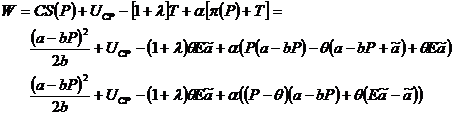
Optimal tariff thus would be:
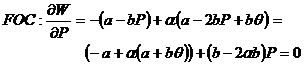
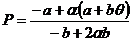
Note that the tariff represents the first-best as it is not a function of the expected number of concessionary passengers. All inputs of the solution to the social welfare maximization problem under asymmetric information are known to the regulator, implying the tariff charged is indeed socially optimal one.
Yet, expectations of the number of concessionary passengers affect the social welfare. For the purpose of separating this effect, let’s rewrite the social welfare function in the following way:

In square parenthesis, there is expression not depending on the expectation regarding the number of concessionary passengers. The expectation regarding the number of concessionary passengers defines the transfer only. However, due to the existence of social cost of public funds, as well as lower relative weight being placed on producer surplus, the lower is the transfer the better off is the society.
4.1.2 Delegated contracting
The two changes PPP establishment brings are, first, delegation of decision making to the agent whose objective function represents the weighed average of the regulator’s and the service provider’s objective functions, that is, to the agent whose objectives differ from social welfare maximization, and, second, ex post informational asymmetry elimination. Note that within this framework the effects of these two changes on social welfare are completely separable: the latter is associated with the effect of change in transfer on social welfare while the former – with the effect of change in tariff on social welfare. Indeed, the variable which represents the source of uncertainty to the regulator – the number of concessionary passengers – defines the transfer only and thus does not enter first order condition for tariff setting. Tariff defined from solving the optimization problem which is different under PPP in turn does not affect the transfer required to compensate the service provider for transporting concessionary passengers. Thus, let’s consider these two effects separately.
The tariff charged under compensatory agreement was proved to be socially optimal one, implying delegation of tariff setting to PPP will result in suboptimal level of tariff and thus will negatively affect social welfare. The effect of delegation of tariff setting to PPP is thus unambiguous.
Note that instead of defining the level of transfer on the basis of expectations regarding the number of concessionary passengers, the regulator would be able to cover the cost of providing the service to actual number of concessionary passengers as informational asymmetry is eliminated with PPP establishment. However, as decision regarding PPP establishment has to be made ex ante, expected transfer has to be involved in defining the expected effect of PPP establishment on social welfare. In other words, the effect of informational asymmetry elimination is defined by the transfer based on expected number of concessionary passengers being substituted by the expected transfer based on actual number of concessionary passengers. It depends on the specification made.
Case 1: Unlimited budget for compensation of concessionary passengers’ transportation
Under such an assumption, once the actual number of concessionary passengers is revealed, the service provider will obtain the transfer  . Expected transfer based on actual number of concessionary passengers is thus
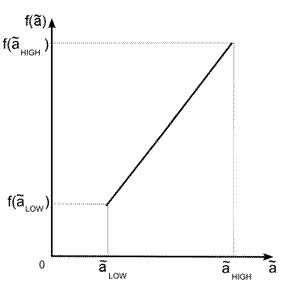
  as there is no uncertainty regarding unit product cost of providing the service defined exogenously. However, this exactly equals to transfer based on expected number of concessionary passengers, that is, one paid under compensatory agreement. Consequently, the expected effect of asymmetry of information elimination on social welfare is zero. The reason behind is that the transfer represents the linear function of the number of concessionary passengers in this case (see Graph 1).
The number of concessionary passengers is unobserved by the regulator, although the regulator has a view on the likelihood of the various outcomes of this variable. The number of concessionary passengers has discrete distribution on range  .
.
Graph 1: Transfer as a function of the number of concessionary passengers (Case 1)
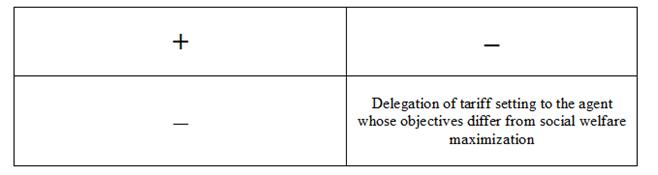
Thus, there is no stimulus for the regulator to form PPP as asymmetry of information elimination at cost of suboptimal level of tariff due to decision making being delegated to the agent with objectives different from social welfare maximization is expected to bring no change to the social welfare (see Table 6).
Table 6: Regulator’s trade-off from PPP establishment
Consequently, within this framework there is no space for PPP.
Case 2: Limited budget for compensation of concessionary passengers’ transportation
Note that under limited budget we understand the case of the regulator being unable to raise enough funds to cover the cost of transportation of concessionary passengers under those realizations of the unknown variable which have nonzero probability to occur. That is, we are interested in the case of available budget being less that  as otherwise we would effectively deal with the case of unlimited budget discussed above.
In this case, the transfer based on the expected number of concessionary passengers is higher than the expected transfer based on the actual number of concessionary passengers. Indeed, transfer represents concave function of the number of concessionary passengers (see Graph 2), and for concave function it is always true that the function of expectation is greater that the expected function.
Graph 2: Transfer as a function of the number of concessionary passengers (Case 2)
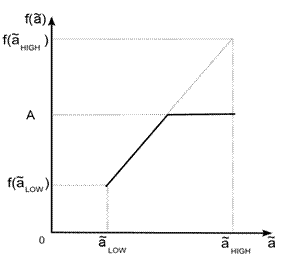
where the limit on budget is denoted by  .
.
Analytically:
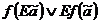

where 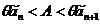 .
.
Yet, the transfer paid under compensatory agreement could either be lower than the transfer based on expected number of concessionary passengers or not, both these possibilities being further investigated.
If under compensatory agreement the service provider is fully compensated for expected number of concessionary passengers,

so that
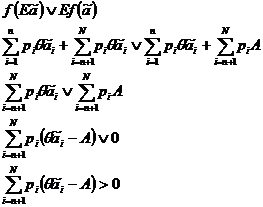
If under compensatory agreement the service provider is not fully compensated for expected number of concessionary passengers,

so that
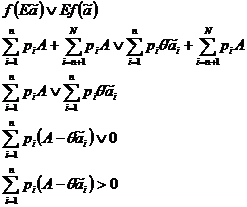
Thus, we have proved that the transfer based on the expected number of concessionary passengers is higher than the expected transfer based on the actual number of concessionary passengers, meaning PPP establishment is associated with expected reduction in transfer. Yet, as it has been demonstrated above, the lower is the transfer, the higher is social welfare. Thus, it is the positive expected effect of asymmetry of information elimination on social welfare that may serve as an incentive for the regulator to agree on PPP establishment in case of this gain to social welfare not being outweighed by the negative effect of suboptimal tariff being charged as a result of decision making being delegated to the agent with objectives different from social welfare maximization.
The ownership structure of PPP does not affect the expected positive effect of PPP establishment on social welfare that arises from the asymmetry of information elimination. As in case of the firm’s share in PPP being equal to zero the negative effect under consideration will not be presented so that PPP establishment is social welfare improving, there must exist non-empty set of possible values of , where , under which the negative effect of PPP establishment on social welfare is no greater than the corresponding positive effect. That is, there must exist non-empty set of possible values of , , where, under which PPP establishment is perceived by the regulator as social welfare improving.
Hence, there is now a space for PPP establishment (see Table 7), implying this framework is more realistic.
Table 7: Regulator’s trade-off from PPP establishment
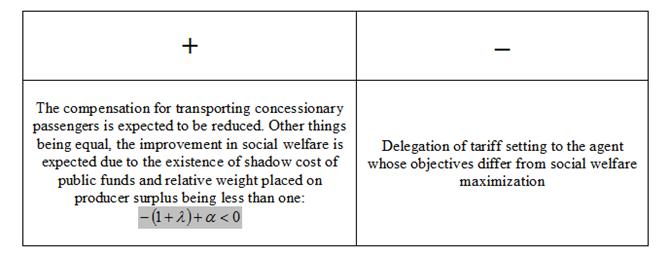
There are two effects of PPP establishment on the firm as well. One arises from the delegation of tariff setting to the agent who places greater relative weight on producer surplus than the regulator, and it affects the firm’s profit positively, as it has been proved in Section 3. The effect of asymmetry of information elimination however depends on whether the actual number of concessionary passengers is higher or lower than that the regulator compensates under compensatory agreement (see Table 8 and Table 9).
Table 8: Trade-off from PPP establishment to the firm whose compensation based on the actual number of concessionary passengers must have been lower
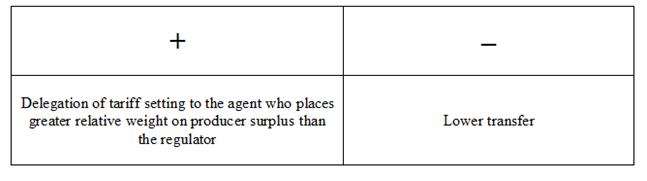
Such a firm is negatively affected by the asymmetry of information elimination as a result of PPP establishment. Consequently, nonzero share in PPP is required by the efficient firm for the positive effect of the greater relative weight being placed on producer surplus in decision-maker’s objective function to just outweigh the negative effect of the asymmetry of information elimination. There is thus a range of possible levels of , where , which could even be empty, under which increase in the firm’s profit over the status quo level is achieved. Consequently, there is a scope for no offer to be made by the service provider in case the range of those values of that correspond to the firm being not worse off from PPP establishment being empty or not overlapping with the range of those values of that correspond to social welfare improvement from the regulator’s perspective.
Table 9: Trade-off from PPP establishment to the firm whose compensation based on the actual number of concessionary passengers must have been higher
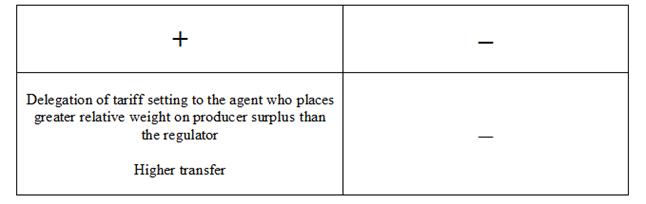
As opposed to the previous case, such a firm benefits from the asymmetry of information elimination. Consequently, even zero share in PPP makes the firm better off from PPP establishment. Thus, any share in PPP is profit-increasing for the firm. Hence, in case of inefficient firm there is no scope for the offer not to be made.
Note that in case the transfer based on expected number of concessionary passengers is fully raised under compensatory agreement, the fund that the regulator can raise to compensate the firm for transporting concessionary passengers is not known to the service provider. Thus, the firm has to make the decision regarding the share in PPP it would offer on the basis of his perception of this variable. The higher is the budget the service provider accounts for, the lower is the difference between the expected transfer based on actual number of concessionary passengers and transfer based on expected number of concessionary passengers, thus, the lower is the expected increase in social welfare from asymmetry of information elimination implying the lower is the share in PPP the service provider could retain for itself so that the regulator would accept his offer.
This conclusion implies the service provider is faced with a following trade off. On the one hand, if he overstates the budget he would loose the opportunity to offer a higher share for itself so that his offer would not be a profit-maximizing one. On the other hand, if true budget would turn out to be higher than one on the basis of which the offer has been made PPP would be rejected to be established. Hence, this framework gives rise to rejected offers.
Proposition 4: If the monopoly being compensated for servicing concessionary passengers in accordance with the regulator’s expectation of this variable, then there is a scope for rejected offers
Proposition 5: If the potential to raise funds for the purpose of compensating the service provider for concessionary passengers’ transportation is reduced, then there arises a possibility that the rejected offer will be accepted next time
It must be noted that within this framework the service provider could never loose even though there is private information on behalf of the regulator. In case of the offer being rejected he is as well of. In case of the offer being accepted he is better off. Indeed, the service provider obtains higher tariff anyway. If actual number of concessionary passengers is lower than the expected figure he could either be compensated less yet fully, what he has accounted for when deciding on optimal share in PPP, or the same in case of available budget being even lower. If actual number of concessionary passengers is higher than the expected figure he would have to be compensated more but even if not being compensated fully he would be compensated not less than before.
It must be noted that we model the case when actual number of concessionary passengers is unknown to the regulator ex ante. Indeed, even after 2006 when so called monetization of non-monetary benefits revealed actual use of public transport by almost all categories of privileged passengers, rather significant part of demand for transportation (especially from the railway workers who travel for free) remains uncertain prior to the establishment of trusting relations in the form of PPP.
There would be no incentive for monetization within the framework where there is no expected gain from informational asymmetry elimination, that is, under the assumption that the regulator could always raise funds to cover the cost of providing the service to concessionary passengers. This result adds to the conclusion that such modeling is unrealistic.
Note that monetization offers a possibility to reduce asymmetry of information on the regulator’s side at no cost. As soon as the assumption that the regulator could always raise funds to cover the cost of providing the service to concessionary passengers is avoided, monetization turns out to be purely beneficial for the society in expected terms. Consequently, within such a framework the motivation for the regulator to propose monetization is provided.
With PPP creation, informational asymmetry elimination comes at cost for the society in the form of suboptimal level of tariff. Consequently, the knowledge of future monetization that allows reducing informational asymmetry at no cost could have become the reason for the observation of the process of PPP establishment to slow down prior to the year 2006.

|
Из за большого объема этот материал размещен на нескольких страницах:
1 2 3 4 |
