

Партнерка на США и Канаду по недвижимости, выплаты в крипто
- 30% recurring commission
- Выплаты в USDT
- Вывод каждую неделю
- Комиссия до 5 лет за каждого referral
TAIT: But what 15 we’ll do if they have the new Leafieid machine guns?
VARGEZ: 16 We’ll give them time to get their guns e on, men! 17 This will be a great victory for us!
2 Future: going to
Form
be + going to + infinitive
AFFIRMATIVE NEGATIVE QUESTION
I am I am not am I
you are you are not are you
he is he is not is he
she is she is not is she
it is going to work it is not going to work is it going to work?
we are we are not are we
you are you are not are you
they are they are not are they
Contractions
‘m = am
‘re = are aren’t = are not
‘s = is isn’t = is not
USE
Sentences with going to connect the future and the present:
We use going to to talk about something in the future which we can see as a result of something in the present.
Look at those black clouds in the sky. It’s going to rain.
Those people are going to get wet.
Hurry up! It’s getting late. You’re going to miss your train.
For this reason, sentences with going to are often about the near future.
We also use going to to talk about what we intend to do in the future. We use going to when we have already decided to do something.
I’m going to have a shower.
“Why have you moved all the furniture out of this room?”
“I’m going to clean the carpet.”
Accuracy Practice
Complete the sentences using going to and the verbs in brackets.- “What _____ (you / wear) at the party on Saturday?” “I haven’t decided yet. What about you? _____ (you / wear) your new black dress?” “Why have you bought all that wallpaper? What _____ (you /do)?” “I _____ (decorate) the living room.” He’s decided that he _____ (not / leave) school this summer. He _____ (stay) on for another year. “I _____ (buy) a new motorbike.” “How _____ (you / pay) for it? You haven’t got enough money.” “I _____ (ask) my bank to lend me the money.”
2 Future: will and going to
We use both will and going to in predictions about the future, but there is a difference:
We use will to talk about what we think We use going to about something
or believe will happen in the future. in the future which we can see as a
result of something in the present.
That boat doesn’t look very safe. Look at that boat! It’s going to sink.
It’ll sink in that heavy sea.
We use both will and going to to talk about what we intend to do, but there is a differevce here:
We use will when we decide to do We use going to when we have already
something at the moment of speaking. decided to do something.
“Oh dear! I’ve spilt some wine on my “Why have you moved all the
jacket.” “Don’t worry. I’ll clean it for furniture out of this room?”
you.” “I’m going to clean the carpet.”
Accuracy Practice
Complete the sentences using going to or will and the verbs in brackets.- “Someone told me that you’re moving from London.” “That’s right. I _____ (live) in Manchester. “Would you like to come to my house this evening?” “Yes, all right. I _____ (come) at 9 o’clock.” I don’t feel very well. I think I _____ (faint). “It’s Simon’s birthday soon. I’ve decided to buy him the new Blues Brothers record.” “Oh, he doesn’t like the Blues Brothers any more.” “Oh, really? Well, I _____ (get) him something to wear.” Oh, no! Look at those cars! They _____ (crash)! “I could lend you some money if you like.” “Could you? I _____ (pay) you back on Friday.”
§ Have you cleaned the car? (tomorrow) Not yet. …………….
§ Have you phoned Sally? (later) Not yet. …………………..
§ Have you done the shopping? (this afternoon) Not yet ………….
§ Have you read the paper? (after dinner) Not ………………..
§ Have you had dinner? (just) ……………………………..
Write a question with going to for each situation.§ Your friend has won some money. You ask: (what / do with it? ……………..
§ Your friend is going to a party tonight. You ask: (what /wear?) ………………
§ Your friend has just bought a new table. You ask: (where / put it) ……………
§ Your friend has decided to have a party. You ask: (who / invite) ……………..
Read the situations and complete the dialogues. Use going to.§ You have decided to write some letters this evening.
FRIEND: Are you going out this evening? YOU: No,…………………..
§ You are a smoker but you have decided to give it up soon.
FRIEND: Smoking is very bad for you.
YOU: I know. ………………………………………………………………….
§ You have been offered a job but you have decided not to take it.
FRIEND: I hear you’ve been offered a job.
YOU: That’s right, but …………………………………………………………
§ You are in a restaurant. The food is awful and you’ve decided to complain.
FRIEND: This food is awful, isn’t it?
YOU: Yes, it’s disgusting. …………………………………………………..
What is going to happen in these situations? Use the words in brackets.§ There are a lot of black clouds in the sky. (rain) ……………………………...
§ It is 8.30. Jack is leaving his house. He has to be at work at 8.45 but the journey takes 30 minutes. (late) He …………………………………………………..
§ There is a hole in the bottom of the coat. A lot of water is coming in through the hole. (sink) The boat ………………………………………………………….
§ Emma is driving. There is very little petrol left in the tank. The nearest petrol station is a long way away. (run out) She ………………………………………
Complete the sentences with was / were going to + one of these verbs.give up have phone play travel
§ We …………………. by train but then we decided to go by car instead.
§ We …………………. tennis yesterday but it rained all day.
§ I ……………………. Jim, but I decided to write him a letter instead.
§ When I last saw Tim, he ………… his job but in the end he decided not to.
§ We ……………………….. a party last week but some of our friends couldn’t come, so we cancelled it.
Complete the sentences using will or going to.a A: Why are you turning on the television?
B: …………………………………….. the news. (I / watch)
b A: Oh, I’ve just realized. I haven’t got any money.
B: Haven’t you? Well, don’t worry. …………………………. you some. (I / lend)
c A: I’ve got a headache.
B: Have you? Wait there and …………………….an aspirin for you. (I / get)
d A: Why are you filling that bucket with water?
B: ……………………………. the car. (I / wash)
e A: I’ve decided to repaint this room.
B: Oh, have you? What colour? ………………………… it? (you / paint)
f A: Where are you going? Are you going shopping?
B: Yes, ………………………………. something for dinner. (I / buy)
g A: I don’t know how to use this camera.
B: It’s quite easy. …………………….. you. (I / show)
h A: What would you like to eat?
B: …………………………… a sandwich, please. (I / have)
i A: Did you post that letter for me?
B: Oh, I am sorry. I completely forgot. ………………………….. it now. (I / do)
j A: The ceiling in this room doesn’t look very safe, does it?
B: No, it looks as if …………………. down. (it / fall)
k A: Has George decided what to do when he leaves school?
B: Oh, yes. Everything is planned ………………………… a holiday for a few weeks and then …………………………… a computer programming course. (he / have / he / do)
Read the situations and complete the sentences using will or going to.§ The phone rings and you answer. Somebody wants to speak to Jim.
CALLER: Hello. Can I speak to Jim, please?
YOU: Just a moment. …………………….. him. (I / get)
§ It’s a nice day. You’ve decided to sit in the garden. Before going outside, you tell your friend.
YOU: The weather’s too nice to stay indoors. …………… in the garden. (I / sit)
FRIEND: That’s a good idea. I think ………………….. you. (I / join)
§ Your friend is worried because she has lost an important letter.
YOU: Don’t worry about the letter. I am sure ……………………… it. (you / find)
FRIEND: I hope so.
§ There was a job advertised in the paper recently. At first you were interested but then you decided not to apply.
FRIEND: Have you decided what to do about that job that was advertised?
YOU: Yes, …………………………………. for it. (I / not / apply)
§ You and a friend come home very late. Other people in the house are asleep. Your friend is noisy.
YOU: Shhh! Don’t make so much noise. ………… everybody up. (you / wake)
§ John has to go to the airport to catch a plane tomorrow morning.
JOHN: Ann, I need somebody to take me to the airport tomorrow morning.
ANN: That’s no problem. …………………. you. (I / take) What time is your flight?
JOHN: 10.50.
ANN: OK. …………………………………. at about 9 o’clock then. (we / leave)
Later that day, Joe offers to take John to the airport.
JOE: John, do you want me to take you to the airport?
JOHN: No, thanks, Joe. …………………………… me. (Ann / take)
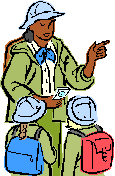
Look at the pictures below. What do you think is happening in them? Write questions with going to using the words in brackets. Then answer the questions according to your own ideas, and give a reason.
Example: (it – rain) 
QUESTION: Is it going to rain?
ANSWER: Yes, it is going to rain. There are clouds in the sky.
or No, it isn’t going to rain. The clouds are going away.

§ (rabbit – reach the egg)
______________________________________________________________________________________________________________________________________________________________________________________________________________________________
§ (they – find the treasure)
______________________________________________________________________________________________________________________________________________________________________________________________________________________________
Read the following situations. Write or complete sentences to match each situation. Use negative where necessary.§ Susan has decided to buy a new dress. What does she tell her friend?
_____________________________________________________________________
§ Her friend wants to know more. What does she ask?
What kind of ___________________________________________________________
§ Susan has decided that the dress she needs is an evening dress. How does she answer her friend?
It _____________________________________________________________________
§ Mr Butcher is a teacher at Rottenbrick School. He is determined to stop some boys from playing football in the playground. What does he tell them?
_________________________________________________________________________
in the playground, do you hear?
§ Later, he sees that someone has written a rude message about him on the blackboard. What does he say to himself?
__________________________________________________ the boy who wrote this message! __________________________________________ let him get away with it!
§ Arctica has declared war on Pacifica. The Chief of the Arctican army is getting his soldiers ready to march. What does he say to the soldiers?
Soldiers! The time has come! Tomorrow ____________________________ into Pacifica!
§ The soldiers of Africa do not want to fight. What do they say?
The people of Pacifica are our brothers. ____________________________ to fight them!
John and Carol are making plans for a day’s holiday. Form a suitable will/going to form from the words in brackets. Sometimes both forms are possible.JOHN: Look, there isn’t cloud in the sky. (1 It be) ___________________ a glorious day. (2 we go) _______________________________________ to the beach?
CAROL: (3 I go) ________________________________ to the beach, but (4 not swim) _______________________________. The weather’s still cold.
JOHN: I don’t think (5 I swim) _________________________ either. But (6 I take) __________________ my swimming things with me. If the sun gets very hot I expect (7 be glad) ______________________ to jump into the water.
CAROL: (8 I lie) ___________________ in the sun a lot this year. I need sunshine after all the rain during the winter. I know (9 there be) ___________________ me good.
JOHN: It’s a holiday today. That means (10 there be) _____________________ a big crowd of people at the seaside.
CAROL: But I’m sure (11 there not be) __________________________________ too many at Whitesands Beach. (12 We probably have ) ______________________________ the place almost to ourselves.
JOHN: What (13 we do) _____________________________ about lunch? (14 I make) ___________________________ some sandwiches?
CAROL: It’s OK. (15 I make) _____________________________ them, if you go and get the car ready.
In which blanks above are both will / shall and going to forms possible? Give three examples.
Numbers _________________________.
3 Present continuous for the future
We use the present continuous to talk about something that we have already arranged or planned to do in the future
Examples:
“What are you doing on Saturday evening?” “I’m meeting Sarah.”
Sarah is taking an exam on Monday.
We’re visiting some friends in Scotland next weekend.
When we use the present continuous in this way, we often give the future time
(eg on Saturday evening, on Monday, this afternoon, next weekend).
Accuracy Practice
Look at Sally’s diary for the next week. Then complete what she says she is doing next week. Use the words in the box.Work meet do go see |
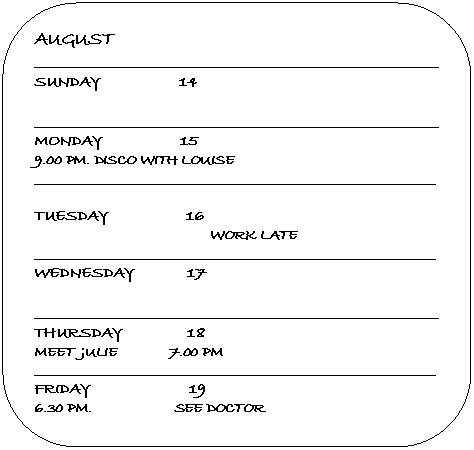
On Monday evening I’m going to a disco with my friend Louise. On Tuesday evening I 1___________ late. 2__________ (not) anything on Wednesday evening. On Thursday evening I 3__________ my friend Julie at 7 o’clock. I’ve got an appointment with the doctor on Friday evening. I 4__________ him at 6.30. Then on Saturday I 5__________ to the cinema with Peter. We 6__________ at the Espresso Café at 7.30. What about you? What 7__________ (you) next week? 8__________ (you) anything special.
A friend of yours is planning to go on holiday soon. You ask her about her plans. Use the words in brackets to make your questions.§ (where/go) …………………. Scotland.
§ (how long/stay) ……………. Ten days.
§ (when/go) ………………….. Next Friday.
§ (go/alone) ………………….. No, with a friend of mine.
§ (travel/by car) ……………… No, by train.
§ (where/ stay) ……………….. In a hotel.
Tom wants you to visit him but you are very busy. Look at your diary for the next few days and explain to him why you can’t come.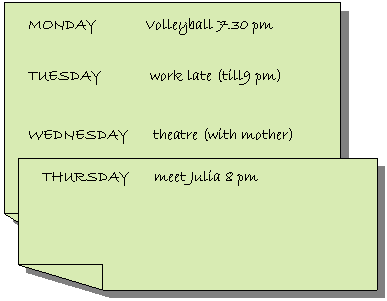 |
TOM: Can you come on Monday evening?
YOU: Sorry but 1 ……………………….. .
TOM: What about Tuesday evening then?
YOU: No, not Tuesday I 2 ……………..
TOM: And Wednesday evening?
YOU: 3 …………………………….
TOM: Well, are you free on Thursday?
YOU: I’m afraid not. 4 ………………..
4 Future: present continuous and going to
When we talk about things which we have already arranged to do or planned to do in the future, we can use the present continuous or going to.
I’m having lunch with Lynne tomorrow.
I’m going to have lunch with Lynne tomorrow.
When we make predictions about the future, we can use going to or will, but not the present continuous.
It’s going to rain tomorrow. (It’s raining tomorrow is not possible.)
Accuracy Practice
1. Complete the sentences using the present continuous or going to. Sometimes either structure is possible.
§ It (snow) later tonight.
§ She (meet) them tomorrow morning.
§ What (you / do) this afternoon?
§ Be careful! You (break) that glass.
§ He (not / come) next Saturday.
§ Look out! You (hurt) yourself with that knife.
2. Read the situations below. In most (not all) of them, you could use a present progressive form, but another form may be possible also. Choose (a), (b) or (c) and circle the letter.
§ Helen’s secretary reminds her of her intention to travel to Chicago. What does the secretary say?
a. Remember – you’ve flying to Chicago next week.
b. Remember – you’ll fly to Chicago next week.
c. Either (a) or (b).
§ Jim has invited some friends to his house for the dinner.
As a result, he cannot go to a football match. What does he say?
a. I can’t go. I’m having a meal with friends that night.
b. I can’t go. I’ll have a meal with friends that night.
c. Either (a) or (b).
§ Terry has to go away for a few days. He is worried about what will happen to his cat during his absence. His neighbour promises to help. What does the neighbour say?
a. Don’t worry. I’m feeding it while you are away.
b. Don’t worry. I’ll feed it while you are away.
c. Either (a) or (b).
§ Andrew has booked a hotel in Athens as part of a business trip. What does he say?
a. I’m spending four nights in Athens.
b. I’m going to spend four nights in Athens.
c. Either (a) or (b).
§ Marion isn’t looking forward to the arrival of workmen next week. She knows the house will be in a mess. What does she say to her friend?
a. What a nuisance! We’re getting central heating put in next week.
b. What a nuisance! We’ll get central heating put in next week.
c. Either (a) or (b).
3. Have you arranged to do anything at these times? Write true sentences about yourself.
§ (this evening) …………………………………….
§ (tomorrow morning) ……………………………..
§ (tomorrow evening) ………………………………
§ (next Sunday) …………………………………….
§ (choose another day or time) ……………………..
5 Present simple for the future
We use the present simple to talk about future events which are part of a mixed timetable or fixed programme.
Here are some of the programmes on TV tomorrow evening.
Tomorrow’s TV 6.15 TENNIS from WIMBLEDON 7.30 FILM Anne Hall with Woody Allen 9.00 THE NEWS and WEATHER
“What time does the tennis start tomorrow evening?” “At 6.15.”
The film starts at 7.30 and finishes at 9.00.

|
Из за большого объема этот материал размещен на нескольких страницах:
1 2 3 4 |
