

Партнерка на США и Канаду по недвижимости, выплаты в крипто
- 30% recurring commission
- Выплаты в USDT
- Вывод каждую неделю
- Комиссия до 5 лет за каждого referral
4. Choose the best answer in the dialogue. Circle (a), (b) or (c).
- MRS FOY: 1 a Will you be doing
b Are you doing anything special tomorrow, Bill?
c Either (a) or (b)
- BILL: Not really. I suppose 2 a I’ll be going
b I’ll go to Newton as usual in the morning and in
c Either (a) or (b)
3 a I’ll be studying
the afternoon b I’ll study for my exams.
c Either (a) or (b)
- MRS FOY: 4 a Will you be getting
b Will you get something for me from the shops in Newtown, please?
c Either (a) or (b)
- BILL: Yes, of course. I expect 5 a I’ll be doing
b I’m doing some of my own shopping anyway.
c Either (a) or (b)
- MRS FOY: You see, I need a mousetrap. Last night I heard a mouse in the house. I hate
mice! I’ve decided 6 a I’ll be catching
b I’m going to catch it.
c Either (a) or (b)
- BILL: Well, certainly 7 a I’ll be getting
b I’ll get one for you.
c Either (a) or (b)
But why don’t you buy a cat?
8 a I’ll be getting
b I’m going to get one soon. In fact 9 a I’ll be seeing
c Either (a) or (b) b I’m seeing a man
c Either (a) or (b)
about it at the weekend. Perhaps 10 a he’ll be having
b he’ll have a kitten that
would suit you, too. c Either (a) or (b)
8 Future perfect: will have + past participle
FORM
will have + past participle
AFFIRMATIVE NEGATIVE QUESTION
I I I
you you you
he he he
she will have worked she will not have worked will she have worked ?
it it it
we we we
you you you
they they they
CONTRACTIONS
“ll = will won’t = will not shan’t = shall not
USE
We use will have + past participle to talk about something that will be completed by (not later than) a certain time in the future.
I’ll have finished dinner at 8.00.
When we use this structure, we think of a future time and look back from that future time to say that something will be complete.
I’ll have worked here for a year next September.
Accuracy Practice
1.What will life be like in the year 2100? Complete the sentences using will have + past participle form.
- Life _____ (become) more automated by then. Computers _____ (take over) many of the jobs that people do today. The earth’s supplies of oil, coal and gas _____ (run out). _____ (scientists / find) other sources of energy? How _____ education _____ (change)? _____ (win / find) a way to feed all the people in the world?
2. Read about Colin. Then you have to choose the sentences which are true. In each group of sentences at leas tone is true.
Colin goes to work every day. He leaves home at 8 o’clock and arrives at work at about 8.45. He starts work immediately and continues until 12.30 when he has lunch (which takes about half an hour) . He starts work again at 1.15 and goes home at exactly 4.30. Every day he follows the same routine and tomorrow will be no exception.
AT 7.45 AT 12.45
a he’ll be leaving the house a he’ll have lunch
b he’ll have left the house b he’ll be having lunch
c he’ll be at home c he’ll have finished his lunch
d he’ll be having breakfast d he’ll have started his lunch
AT 8.15 AT 4 O’CLOCK
a he’ll be leaving the house a he’ll have finished work
b he’ll have left the house b he’ll finish work
c he’ll have arrived at work c he’ll be working
d he’ll be arriving at work d he won’t have finished work
AT 9.15 AT 4.45
a he’ll be working a he’ll leave work
b he’ll start work b he’ll be leaving work
c he’ll have started work c he’ll have left work
d he’ll be arriving at work d he’ll have arrived home
3.The president of Pacifica is making a speech on plete the blanks with a suitable future perfect or future progressive form. Use the words in brackets.
§ Citizens of Pacifica! In twelve months’ time, the average income of our people (1 rise) _____ by five per cent, while inflation (2 not rise) _____ at all.
§ By 1992, neighbouring countries (3 marvel) _____at our progress, for they (4 not equal) _____ our success.
§ In fact, by 1993, we (5 overtake) _____ Arctica and Atlantica.
§ By 1994, our factories (6 produce) _____ all the goods we need.
§ By 1995, the number of schools in our country (7 double) _____ .
§ By 1996, we (8 build) _____ 200 new hospitals.
§ By 1997, you (9 enjoy) _____ a better standard of living than at any time in our country’s history!
Put the verb into the correct for, will be doing or will have done.§ Don’t phone me between 7 and 8. _____________ (we/have) dinner then.
§ Phone me after 8 o’clock. ____________________ (we/finish) dinner by then.
§ Tomorrow afternoon we’re going to play tennis from 3 o’clock until 4.30. So at 4 o’clock, ____________________________ (we/play) tennis.
§ Can we meet tomorrow afternoon? Not in the afternoon. ______________ (I/work).
§ B has go to a meeting which begins at 10 o’clock. it will last an hour.
Will you be free at 11.30? Yes, ______________ (the meeting/finish) by that time.
§ Tom is on holiday and he is spending his money very quickly. If he continues like this _______________________ (he/spend) all his money before the end of his holiday.
§ Chuck came to Britain from the USA nearly three years ago. Next Monday it will be exactly three years. So on Monday, __________________ (he/be) in Britain for exactly three years.
§ Do you think ________________________ (you/still/do) the same job in ten years’ time?
§ Jane is from New Zealand. She is traveling around Europe at the moment. So far she has traveled about 1, 000 the end of the trip, _________________ (she/travel) more than 3,000 miles.
§ If you need to contact me, ___________________ (I/stay) at the Lion Hotel until Friday.
§ ______________________ (you/see) Laura tomorrow? Yes, probably. Why? I borrowed this book from her. Can you give it back to her?
Starting activities
This time next week
Read the conversation between Sandra and Karen and make sure you understand it. If you want to, you can read it aloud in pairs.
SANDRA: This time tomorrow I’ll be lying on a beach in the sun.
KAREN: Really. I’ll be working as usual.
SANDRA: Yes, I’ll be staying at the Ritz, in my usual room.
KAREN: Good, good. I’ll be thinking of you. Can we talk about these letters? I …
SANDRA: I’ll be meeting the usual crowd. Sometimes I wish all my friends weren’t rock stars.
KAREN: Sandra, will you have typed these letters before you go?
SANDRA: Letters? What letters? Oh, those! Yes, yes. I’ll be having dinner at one of the best restaurants in the world tomorrow evening.
KAREN: Good.
SANDRA: And I’ll be going up in a helicopter the next day.
KAREN: Sandra, about the work…
SANDRA: Don’t worry about the work, Karen. I’ll have finished it all by three o’clock.
KAREN: Will you? Look at it all. You won’t have done all that by three o’clock. What are you typing at the moment?
SANDRA: This…? Oh, it’s a letter to one of my friends. He’s a rock star. Can you post it for me?
Work in the same pairs. Underline all the future progressive sentences (will + be+ the –ing form) and all the future perfect sentences (will + have + past participle) in the dialogue.
Let’s go somewhere else
As a class, plan a timetable for moving the school where you are learning English to the next town. Start like this:
Monday 9.00 a. m. put the tables and chairs outside
Monday 9.30 a. m. put the tables and chairs in the removal van
Monday 10.00 a. m. ……………………………………..
In pairs make future perfect sentences from your timetable. Start like this: By 9.30 a. m. we will have put the tables and chairs 10.00 a. m. we will have put …………………….
9 Future in the past: was / were going to
We use was / were going to + infinitive to say that something was planned for the future at a past time.
They were going to get married, but in the end they changed their minds.
Note that when we use this structure, it often means that the planned future action did not happen
.
I was going to stay at home last night, but I decided to go out instead.
We were going to eat at the Italian restaurant, but it was full, so we ate somewhere else.
Accuracy Practice
1.Join each idea in A with an idea from B. Make sentences using was / were going to and the verbs in brackets.
A | B |
| but it rained all afternoon, so we stayed at home. |
| but my boss offered me more money, so I decided to stay |
| but I didn’t have enough money, so I had to walk. |
| but she had seen it before, so she went to bed early. |
| but her car broke down, so she went by train. |
| but we change our minds and phoned them instead. |
TEST
1. Danny is a young businessman. He is planning to open a disco – but he needs more money. He asks another man, Ned Lucas, to help him with the money.
Fill in the blanks below with a suitable form expressing the future. Use the words in brackets. Often, more than one answer is possible.
“Ned, (1 open) ____am going to open___________________ a disco. I’ve been planning this for some months now. But (2 it take) __it will take_________________ a lot of money to get it started. (3 you lend) _Will you lend_________________ me $50,000? (4 pay) _________I am going to pay________ it back soon – (5 you not have to) __you will not have to___________________ wait long.
Of course, you could join me as a partner. (6 We share) ____will share__________ the profits. This disco (7 be) __will be_____________ a great success, because there’s nothing for teenagers in this town at the moment. Every businessman in town (8 wish) _____________wishes___ he had thought of it. In six months (9 we recover) _____________we will recover____ all the money we’ve put into it.
Look, Ned. (10 You not get) _will not get______________ another chance like this! The thing is, I can buy it at a really low price! It’s a nightclub at the moment. But the owner has had trouble with the police, and (11 he not be able) _____he will not be able_______________ to continue with the club much longer. He wants to get rid of it, so (12 he sell) __he is going_to sell__________________ it to me cheap. We’ve already agreed matters on the telephone, and (13 meet) we___are going to meet___________ him tomorrow. The timetable is that (14 we sign) ____we will sing____________ the agreement tomorrow, and (15 I pay) _I will pay_____ him the money within fourteen days. I know that if I don’t pay in time, (16 he send) _________he will send__________ some of his friends round to see me. So I must get the money, somehow.”
2. Write complete sentences. Use the present progressive or going to.
- I / am going to buy / a car as soon as I have enough money. Can you meet Richard at the station, please? He /was arriving / at nine o’clock on the train from Oxford. Her boyfriend /is not going tocome\ until next week. You / are going definitely to pass / the exam. / Are you going to work / at home next week?
3.Complete the sentences. Use will, going to, the present progressive, the present simple.
- We’ve agreed that Jim _____ buys the food for the party, and I _____ cook it. Quick! The museum __is going to ___close at half past seven. It says so in the guide-book. I know!I am driving_____ (drive)Tina to the station now. We _____will not know the answer to that until next week. I’ve made an appointment at the dentist’s. I __will___ see her on Tuesday. This train _____ stops at every station between here and London. Louise can’t come with us. She is going to_____take the car to the garage at four o’clock.
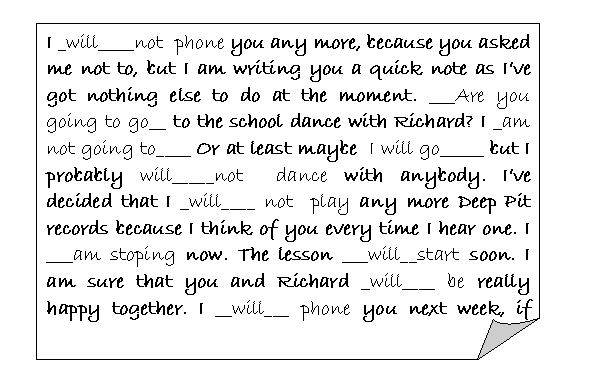
4.Two teenagers, Angela and Darren, were going out together. But then Angela found another boyfriend, plete Darren’s letter to Angela. Use will, going to or the present progressive.

BIBLIOGRAPHY:
1. Adamson, D. Practise your Tenses. Longman, 2001.
2. Beaumont, D., Granger, C. English Grammar. Heinemann, 2004.
3. Dean, M. English Grammar Lessons. O. U.P., 2004.
4. Dooley, J., Evans, V. Grammarway 3. Express Publishing, 2004.
5. Dooley, J., Evans, V. Grammarway 4. Express Publishing, 2004.
6. Murphy, R. English Grammar in Use. C. U.P., 2001.

|
Из за большого объема этот материал размещен на нескольких страницах:
1 2 3 4 |
