

Партнерка на США и Канаду по недвижимости, выплаты в крипто
- 30% recurring commission
- Выплаты в USDT
- Вывод каждую неделю
- Комиссия до 5 лет за каждого referral
What time does your plane leave tomorrow?
Next summer the school holidays begin on July 25th and end on September 10th.
We use the present simple in this way when we think of something in the future as a fact, or an arrangement or plan which cannot change.
Accuracy Practice
1.Complete the sentences using the present simple of the verbs in brackets.
The conference _____ (start) on June 3rd, and _____ (finish) on June 10th. We’ve got plenty of time. Our plane _____ (not / take off) until 9 o’clock. Tonight’s concert _____ (begin) at 8.00 and it _____ (not / end) until When _____ (the next train / leave) for Bristol? Put the verb into the more suitable form, present continuous or present simple.§ …………….. (go) to the theatre this evening.
§ ……………...(the film/begin) at 3.30 or 4.30?
§ We ………….. (have) a party next Saturday. Would you like to come?
§ The art exhibition ………………… (open) on 3 May and ……….. (finish) on 15 July.
§ I …………… (not/go) out this evening. I ………. (stay) at home.
§ “……………….. (you/do) anything tomorrow morning?” “No, I’m free. Why?”
§ We ………………. (go) to a concert tonight. It ………….. (begin) at 7.30.
§ You are on the train to London and you ask another passenger: Excuse me. What time ……….(this train/get) to London?
§ You are talking to Ann: Ann, I ………… (go) to town. ……..(you/come) with me?
§ Sue …………………….. (come) to see us tomorrow. She … (travel) by train and her train …………… (arrive) at 10.15. I ……………….. (meet) her at the station.
§ I ……………… (not/use) the car this evening, so you can have it.
§ You and your friend are watching television. You say: I’m bored with this programme. When …………….(it/finish)?
Mrs King, Director of Studies at Brightburgh College, is telling the staff about arrangements for welcoming new students to the college plete what she says by using the verbs in the box, in their correct form. Usually, the simple present is suitable, but in THREE blanks the future with going to should be used.
Assemble get meet try out visit make return give divide arrive begin have finish enjoy |
So please, everyone, listen carefully. The new students 1 _____ tomorrow at 10 o’clock. We 2 _____ them coffee and biscuits, and then at 10.45, Mr Carruthers, the Principal of the College 3 _____ the usual speech of welcome. After that we 4 _____ the students into groups to visit different parts of the building.
As some of may know, this year we 5 _____ a new examination system, including a special project using books from the college library. So part of the programme tomorrow is that at twelve o’clock the groups 6 _____ in the library for a talk from Mrs Lindsey, the librarian.
Now, as regards tomorrow afternoon: at two o’clock the bus 7 _____ to take students on a tour of Brightburgh. According to the radio, the weather 8 _____ much colder tomorrow, so we should advise students to take a coat with them. During the afternoon we 9 _____ the Roman Camp and the Cathedral, and then around five o’clock the bus 10 _____ to the college.
As far as the evening is concerned, the party for new students 11 _____ at half past seven. We 12 _____ a very nice programme arranged for this, so I know everyone 13 _____ it. The party 14 _____ around half past eleven.
6 Present simple for the future after WHEN, IF, etc
We use the present simple to refer to the future in clauses of time and condition after when, while, as soon as, after, before, until, if, unless, as/so long as and provided/providing(that).
will / won’t present simple
I’ll buy a newspaper when I go out.
We won’t go out until it stops raining.
We’ll go to the beach if the weather is fine.
I’ll go to the party provided you go too.
We can also use the present perfect (have done) after when, after, until, as soon as.
Can I borrow this book when you’ve finished it?
Don’t say anything while Ian is here. Wait until he has gone.
It is often possible to use the present simple or the present perfect:
I’ll come as soon as I finish.
or I’ll come as soon as I’ve finished.
You’ll feel better after you have something to eat.
or You’ll feel better after you’ve had something to eat.
But do not use the present perfect if two things happen together. The present perfect shows that one thing will be completely before the other.
COMPARE:
When I’ve phoned Kate, we can have dinner. (= First I’ll phone Kate and after that we can have dinner.)
When I phone Kate this evening, I’ll invite her to the party. (In this example, the two things happen together.)
After if we normally use the present simple.
We use when for things which are sure to happen. We use if for things that will possibly happen.
Accuracy Practice
1. Put one verb in each sentence into the present simple and other verb into the will/won’t form.
§ When I _____ (see) him I _____ (give) him your message.
§ I _____ (buy) a new car as soon as I _____ (have) enough money.
§ If the weather _____ (be) nice tomorrow, we _____ (go) sailing.
§ I _____ (look after) your cat while you _____ (be) on holiday.
§ He _____ (not/do) anything until he _____ (hear) from us.
§ The door _____ (not /open) unless you _____ (push) it hard.
§ We _____ (play) tennis this evening as long as it _____ (not /rain).
§ I _____ (lend) you the money provided you _____ (pay) me back tomorrow.
2. Complete these sentences using the verbs in brackets. All the sentences are about the future. Use will/won’t or the present simple.
§ ….. (phone) you when I ….. (get) home from work.
§ I want to see Margaret before she ….. (go) out.
§ We’re going on holiday tomorrow. I ….. (tell) you all about it when we ….. (come) back.
§ Brian looks very different now. When you ….. (see) him again, you ….. (not/recognize) him.
§ We must do something soon before it ….. (be) too late.
§ I don’t want to go without you. I ….. (wait) until you ….. (be) ready.
§ Sue has applied for the job but she isn’t very well qualified for it. I ….. (be) surprised if she ….. (get) it.
§ I’d like to play tennis tomottow if the weather ….. (be) nice.
§ I’m going out now. If anybody ….. (phone) while I ….. (be) out, can you take a message?
3. Make one sentence from two.
§ You will be in London again. You must come and see us then.
________________________when______________________________
§ I’ll find somewhere to live. Then I’ll give you my address.
___________________________when______________________________
§ I’ll do the shopping. Then I’ll come straight back home.
___________________________after_______________________________
§ It’s going to start raining. Let’s go home before that.
___________________________before_______________________________
§ She must apologise to me first. I won’t speak to her until then.
___________________________until____________________________________
4. Read the situations and complete the sentences.
§ A friend of yours is going to visit London. You want to know where she is going to stay. You ask: Where are you going to stay when ………………………….
§ A friend of yours is visiting you. She has to go soon but maybe there’s time for a cup of tea. You ask: Would you like a cup of tea before ………………………..
§ Your friend is reading a newspaper. You’d like it after her. You ask: Can I have the newspaper when …………………………………………………………….
§ You want to sell your car. Jim is interested in buying it but he hasn’t decided yet. You ask: Can you let me know as soon as ………………………………………..
§ There are serious traffic problems in your town but they are building a new road. You ask: I think it will be better when …………………………………………….
5. Put when or if.
§ Don’t worry ….. I’m late tonight.
§ Tom might phone while I’m out this evening. ….. he does, can you take a message?
§ I’m going to Rome next week. ….. I’m there, I hope to visit a friend of mine.
§ I think Jill will get the job. I’ll be very surprised ….. she doesn’t get it.
§ I’m going shopping. ….. you want anything, I can get it for you.
§ I’m going away for a few days. I’ll phone you ….. I get back.
§ I want you to come to the party but ….. you don’t want to come, that’s all right.
§ We can eat at home or, ….. you prefer, we can go to a restaurant.
Starting activities
She’s seeing her doctor next week
What in pairs. Think of three well-known people or three people in the room. Use present progressive sentences to tell your partner about their appointments for these times: this evening, tomorrow morning, next week, next month. Use the verbs and the ideas for appointments below to help you.
Example: Maria is seeing her doctor next week.
VERBS: go, meet, see, have a talk / meeting with
IDEAS FOR APPOINTMENTS: doctor, dentist, optician, bank manager, dress designer, tax adviser, accountant, architect, business manager, boss, the President, President of the fan club
Work as a class. Listen to other people’s suggestions for appointments. Are there any that you think are wrong?
Example: No, Maria isn’t seeing her doctor next week. She’s having her hair done.
Trapped
Work in pairs. Helen and her boyfriend John were traveling round the world together. Unfortunately, they could not get out of a certain country for six months. (Why not?) During this time they made some important decisions. When they finally got out they told their friends about their plans for the future.
Imagine that you are friends of Helen and John and make sentences about their intentions using going to or not going to. Use the ideas below to help you.
Example: They’re going to get married.
IDEAS: have a big party, get married, buy a flat in town, leave / change jobs, have a holiday, travel abroad again
Work in the same pairs. It is three months later. This time one of you is Helen or John and the other one is a friend. The friend asks questions about Helen and John’s intentions using going to. Helen or John answers with information about the couple’s firm plans using the present progressive, like this:
FRIEND: Are you going to get married?
HELEN/JOHN: Yes, we’re getting married on 15 July in London.
A fortune teller
Work in pairs. One of you is a fortune teller first, then the other one has a turn. The fortune teller looks at his or her partner’s hand and makes predictions about the future. Use will / won’t or going to / not going to. Invent your partner’s future but say only nice things! Say things about your partner’s future career, love-life, luck and money situation and at least one surprise.
Example: You will marry an Italian. You’re going to get a new car soon.
Work as a class. Tell the class some of your predictions and write down a few of the nicest predictions that other people made.
A poem kit
Work in pairs or groups. Write 4 sentences that start with When I’m old I’ll …
Cut or tear the paper so that there is only one sentence on each piece of paper.
Pass the pieces of paper around until each pair or group has four sentences that they did not write. Rewrite the sentences as a four-sentence poem. Only the first line has When I’m old … The other three lines start with I’ll. The poem does not have to rhyme but read the lines aloud for a good rhythm. Here is an example:
When I’m old I’ll have cornflakes for tea (no teeth you know).
I’ll walk carefully,
I’ll be happy, you’ll see.
I’ll play music for you and me
Our town
Work in pairs or groups. Quickly draw the main streets in the centre of the town where you are having this lesson. Draw it any important places you can think of, like the Town Hall or a park. Then draw it all again as you think it will be in a hundred years’ time. Discuss what the town will look like in a hundred years’ time and what changes there will be, using the will future only.
Examples: The Town Hall will be a computer center. There will be a helicopter landing pad in the park.
Work in pairs or groups. Using the drawing of the town in one hundred years’ time, take it in turns to be a tour guide. Imagine that you are taking your partner or the rest of your group round your town in a hundred years’ time. Tell them about everything they can see. Use some present simple sentences for future time where you can, like this: This is the helicopter landing pad. The next helicopter leaves from here in five minutes.
Improving your classroom
Work as a class. Half the class is Team A and the other half of the class is Team B. Team A and Team B have five minutes to think of possible improvements to the classroom. You can talk to anybody in your won team and write down ideas.
Example: Paint the walls blue. Have armchairs in here.
Someone from Team A says an intended improvement using going to.
Example: We’re going to paint the walls blue.
Team A gets one point if the going to sentence is correct.
Someone from Team B makes an objection or points out a problem.
Example: You can’t paint the walls blue, there’s no blue paint.
Team B gets one point if the sentence is correct.
Someone from Team A must think of something spontaneously and say a correct sentence with will.
Example: OK, we’ll paint the walls green then.
Team A gets one point if the will sentence is correct.
Then Team B has a turn to start by saying one of their intended improvements.
She’s leaving home
Work in pairs, A and B
Person A: You are a parent. Your son or daughter (B) is leaving home for the first time. B is, of course, much too young for something like this. You are, of course, worried. Ask B questions about his or her future life using the present progressive for future time, will and going to.
Examples: Are you going to look for a flat? Will you stay near here, or move away?
When you and B are ready, start asking your questions and have a conversation about B’s future life.
Person B: You are a young person leaving home for the first time. Your parent (A) is worried about you, but you have plans and ideas. Tell A about your plans and ideas using the present progressive for future time, will and going to.
Examples: I’m going to a job interview next week. I’m moving in with a friend.
When you and A are ready, A will ask you some questions about your future life.
7 Future continuous: will be + …- ing
FORM
will be + … - ing
AFFIRMATIVE NEGATIVE QUESTION
I I I
you you you
he he he
she will be working she will not be working will she be working ?
it it it
we we we
you you you
they they they
CONTRACTIONS
“ll = will won’t = will not shan’t = shall not
We can use shall instead of will with I and we.
USE
We use will be + … - ing to talk about something which will be in progress at a time in the future.
I’ll be having dinner at 7.00.
Don’t phone me at 8.00. I’ll be doing my homework then.
What will you be doing this time next week?
We also use will be + … - ing to talk about things in the future which are already planned, or which are part of a regular routine.
I’ll be driving into town later on. Do you want a lift?
“Would you like me to give Peter a message for you?” “Oh, I don’t want to trouble you.” “It’s no trouble, really. I’ll be seeing Peter tomorrow anyway.”
We often use will be + .. –ing as a polite way of asking about someone’s plans, especially when we want someone to do something for us.
“Will you be going out this morning?” “Yes, why?” “Oh, could you get me a newspaper?”
Will you be using your camera at the weekend? I wondered if I could borrow it.
When we use will be + … - ing form in this way, it often suggests that we do not want to change the other person’s plans.
Accuracy Practice
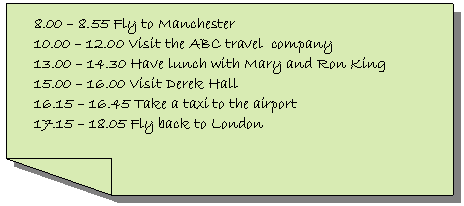 1. Lynne Carter is going from London to Manchester on business tomorrow. Look at Lynne’s plans. What will Lynne be doing at these times tomorrow?
1 11.30
__________________________________________________________________________________________________________________________________________________________________________________________________________________________________
plete the sentences in A using will be + - ing form. Find a question in B to go with each sentence.
A | B |
| Would you like to borrow it? |
| Shall we get one for you? |
| Can you give her something? |
| Could I have a lift? |
| Shall I post your letter? |
| Can you give him a message? |
3.The Tibbs family have just come back from a long trip round the world. For most of them, this means that they will go back to their ordinary routines. Ask questions about the family’s plans now.
- What (1 Sue do) _____ for the rest of this year? (2 she go back) _____ to her old school? Yes. (3 She play) _____ with her friends again. (4 She not ride) _____ on camels in Arabia. How about Tim and Tom? I expect (5 they camp) _____ with the Scouts again, won’t they? Oh yes. (6 They camp) _____ with the Scouts. (7 They not camp) _____ on the plains of Kenya. And what about your husband? (8 you have) _____ another holiday this year? No. (9 We stay) _____ in Newtown. (10 We not gaze) _____ at the Taj Mahal by moonlight! And you, yourself? (11 You come) _____ to the Women’s Club this year, won’t you? That’s right. (12 I make) _____ jam for the Women’s Club. (13 I not make) _____ birds’ nest soup unless it comes out of a tin! How about Grandpa Tibbs? I suppose (14 he have) _____ his beer sausage at the Crown Hotel, again, won’t he? Of course. (15 He eat) _____ good old British food. (16 He not eat) _____ snails in Paris. And what about Grandma Tibbs? (17 she stay) _____ in Newtown?
No, (18 she not come back) _____ to Newtown for another two years. She’s going round the world again!

|
Из за большого объема этот материал размещен на нескольких страницах:
1 2 3 4 |
