

Партнерка на США и Канаду по недвижимости, выплаты в крипто
- 30% recurring commission
- Выплаты в USDT
- Вывод каждую неделю
- Комиссия до 5 лет за каждого referral
Влияние вибраций на конвекцию тепловыделяющей жидкости во вращающейся полости
Р.Р. Сабиров, ,
Лаборатория вибрационной гидродинамики
Пермский государственный гуманитарно-педагогический университет, Пермь
Исследуется влияние поперечных вибраций на тепловую конвекцию и теплоперенос во вращающемся горизонтальном цилиндре, заполненном тепловыделяющей жидкостью. Рассматривается случай достаточно высоких скоростей вращения, когда действие силы тяжести пренебрежимо мало по сравнению с центробежной силой. Осредненная тепловая конвекция, вызываемая силой тяжести [1], при этом не проявляется. Центробежная сила инерции играет стабилизирующую роль и приводит к формированию осесимметричного распределения температуры с максимумом на оси цилиндра. При этом жидкость находится в состоянии механического равновесия. При наложении вибраций с частотой близкой частоте вращения равновесие нарушается, о чем свидетельствует снижение температуры на оси полости.
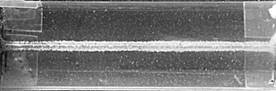
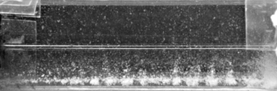
Эксперименты проводятся с жидкостями различной вязкости в полостях разного размера. Скорость вращения, амплитуда вибраций и мощность внутреннего тепловыделения также варьируются. Помимо теплопереноса исследуется структура конвективных течений. Как видно на фотографиях (Рис.1), частицы визуализатора, плотность которых несколько ниже плотности рабочего раствора, в отсутствие вибраций собираются вблизи оси цилиндра под действием центробежной силы инерции. При вибрационном воздействии с частотой, совпадающей с частотой вращения, столб частиц визуализатора смещается от оси на расстояние, величина которого зависит от амплитуды вибраций. В полости при этом формируется конвективное течение.
а |
б |
Рис.1. Распределение частиц визуализатора во вращающейся полости в отсутствие вибраций (а) и при вибрациях (б) |
Показано, что в развитии конвекции ключевую роль играют вибрационный и центробежный механизмы. Из теоретического анализа [2] следует, что при совпадении частоты вибраций с частотой вращения, в системе отсчета полости генерируется статическое силовое поле, ответственное за конвекцию и теплоперенос. Для описания осредненной конвекции используются вибрационное и центробежное числа Рэлея. По результатам экспериментальных исследований построены изолинии теплопереноса на плоскости управляющих параметров.
Работа выполнена в рамках Программы Стратегического Развития ПГГПУ (проект 029-Ф) при поддержке РФФИ (проект № а) и Министерства образования Пермского края (проект С-26/625).
ЛИТЕРАТУРА.
1. V. Kozlov, A. Vjatkin, S. Sabirov. Convection of liquid with internal heat release in a rotating container // Acta Astronautica. 2013. Vol. 89. P. 99–106.
1. 2. . Вибрационная тепловая конвекция во вращающихся полостях // Изв. РАН. МЖГ. 2004. № 1. С. 5–14.
effect of vibrations on convection of heat-generating fluid
in a rotating cavity
R. R. Sabirov, А.А. Vjatkin, V. G. Kozlov
Laboratory of Vibrational Hydromechanics
Perm State Humanitarian Pedagogical University, Perm
The effect of transversal vibrations on thermal convection and heat transfer in a rotating horizontal cylinder filled with a heat-generating fluid is investigated. The case of sufficiently high rotation velocity when the effect of gravity is negligible compared to the centrifugal force is considered. In this case the averaged thermal convection caused by gravity [1] does not manifest itself. The centrifugal force plays a stabilizing role and leads to the formation of an axisymmetric temperature distribution with a maximum at the cylinder axis. The liquid is in a state of mechanical equilibrium. The vibrations at a frequency close to the frequency of rotation results in the balance disruption, as follows from the decrease of temperature on the cavity axis.
Experiments are performed with fluids of different viscosities in the cavities of different size. The rotation velocity, vibration amplitude and power capacity of internal heat release also vary. The structure of convective flows as well as heat transfer is studied. As follows from photos (Fig.1) the visualizing particles of density lower than the density of the working solution condense near the cylinder axis under the action of centrifugal force in the absence of vibration. Under vibration with a frequency coinciding with the frequency of rotation the particles are displaced from the axis by some distance which depends on the amplitude of vibration. The convective flow is excited in the cavity.
а |
б |
Fig.1. The distribution of particles in a rotating cavity in the absence of vibration (a) and under vibration (b) |
It is shown that vibrational and centrifugal mechanisms play the governing role in the development of convection. As follows from the theoretical analysis [2] when the frequency of vibration coincides with rotation frequency the static force field responsible for the convection and heat transfer is generated in the frame cavity. The vibrational and centrifugal Rayleigh numbers are used to describe the average convection. Upon the experimental results the isolines of heat transfer are drown in the plane of the governing parameters.
The work is done in the frame of the strategic development program of PSHPU (project 029-F), with partial support from RFBR (grant а) and Ministry of Education of Perm region (project S26/625).
REFERENCES.
1. V. Kozlov, A. Vjatkin, S. Sabirov. Convection of liquid with internal heat release in a rotating container // Acta Astronautica. 2013. Vol. 89. P. 99–106.
2. V. G. Kozlov. Thermal vibrational convection in rotating cavities // Fluid Dynamics. 2004. V. 39. No 1. P. 3–11.
