


Партнерка на США и Канаду по недвижимости, выплаты в крипто
- 30% recurring commission
- Выплаты в USDT
- Вывод каждую неделю
- Комиссия до 5 лет за каждого referral
Computers have greatly facilitated the use of feedback in manufacturing puters gave rise to the development of numerically controlled machines. The motions of these machines are controlled by punched paper or magnetic tapes. In numerically controlled machining centres machine tools can perform several different machining operations.
More recently, the introduction of microprocessors and computers have made possible the development of computer-aided design and computer-aided manufacture (CAD and CAM) technologies. When using these systems a designer draws a part and indicates its dimensions with the help of a mouse, light pen, or other input device. After the drawing has been completed the computer automatically gives the instructions that direct a machining centre to machine the part.
Another development using automation are the flexible manufacturing systems (FMS). A computer in FMS can be used to monitor and control the operation of the whole factory.
Automation has also had an influence on the areas of the economy other than manufacturing. Small computers are used in systems called word processors, which are rapidly becoming a standard part of the modern office. They are used to edit texts, to type letters and so on.
Automation in Industry
Many industries are highly automated or use automation technology in some part of their operation. In communications and especially in the telephone industry dialling and transmission are all done automatically. Railways are also controlled by automatic signalling devices, which have sensors that detect carriages passing a particular point. In this way the movement and location of trains can be monitored.
Not all industries require the same degree of automation. Sales, agriculture, and some service industries are difficult to automate, though agriculture industry may become more mechanized, especially in the processing and packaging of foods.
The automation technology in manufacturing and assembly is widely used in car and other consumer product industries.
Nevertheless, each industry has its own concept of automation that answers its particular production needs.
2. General understanding:
1. How is the term automation defined in the text?
2. What is the most «familiar example» of automation given in the text?
3. What was the first step in the development of automaton?
4. What were the first robots originally designed for?
5. What was the first industry to adopt the new integrated system of production?
6. What is feedback principle?
7. What do the abbreviations CAM and CAD stand for?
8. What is FMS?
9. What industries use automation technologies?
3. Find the following words and word combinations in the text:
1. последовательность операций
2. завод по сборке автомобилей
3. непроизводственная система
4. системы автоматического управления
5. автоматические устройства
6. автоматизированное производство
7. повторяли движения рабочих
8. выполнять простые задачи
9. как легкие, так и тяжелые детали
10.интегрированная система производства
11.принцип обратной связи
12.механизм может разгоняться и тормозить
13.компьютер автоматически посылает команды
14. высокоавтоматизированная система
15. непроизводственная система
TEXT 6. TYPES OF AUTOMATION
Vocabulary
equipment— оборудование
sequence— последовательность
initial— первоначальный, начальный
investment— инвестиция, вклад
to facilitate— способствовать
rate— скорость, темп
assembly machines — сборочные машины
quantity— количество
non-productive — непроизводительный
changeover— переход, переналадка
1. Translate the text into Russian.
Applications of Automation and Robotics in Industry
Manufacturing is one of the most important application area for automation technology. There are several types of automation in manufacturing. The examples of automated systems used in manufacturing are described below.
1. Fixed automation, sometimes called «hard automation» refers to automated machines in which the equipment configuration allows fixed sequence of processing operations. These machines are programmed by their design to make only certain processing operations. They are not easily changed over from one product style to another. This form of automation needs high initial in vestments and high production rates. That is why it is suitable for products that are made in large volumes. Examples of fixed, automation are machining transfer lines found in the automobile industry, automatic assembly machines and certain chemical processes.
2. Programmable automation is a form of automation for producing products in large quantities, ranging from several dozen to several thousand units at a time. For each new product the production equipment must be re-
programmed and changed over. This reprogramming and changeover take a period of non-productive time. Production rates in programmable automation are generally lower than in fixed automation, because the equipment is designed to facilitate product changeover rather than for product specialization. A numerical-control machine-tool is a good example of programmable automation. The program is coded in computer memory for each different product style and the machine-tool is controlled by the computer programme.
3. Flexible automation is a kind of programmable automation. Programmable automation requires time to re-program and change over the production equipment for each series of new product. This is lost production time, which is expensive. In flexible automation the number of products is limited so that the changeover of the equipment can be done very quickly and automatically. The reprogramming of the equipment in flexible automation is done at a computer terminal without using the production equipment itself. Flexible automation allows a mixture of different products to be produced one right after another.
2. General understanding:
1. What is the most important application of automation?
2. What are the types of automation used in manufacturing?
3. What is fixed automation?
4. What are the limitations of hard automation?
5. What is the best example of programmable automation?
6. What are the limitations of programmable automation?
7. What are the advantages of flexible automation?
8. Is it possible to produce different products one after another using automation technology?
2. Find equivalents in English in the text:
1. сфера применения
2. фиксированная последовательность операций
3. автоматические сборочные машины
4. определенные химические процессы
5. станок с числовым программным управлением
6. потерянное производственное время
7. разнообразная продукция
4. Explain in English what does the following mean:
1. automation technology
2. fixed automation
3. assembly machines
4. non-productive time
5. programmable automation
6. computer terminal
7. numerical-control machine-tool
TEXT 7. ROBOTS IN MANUFACTURING
Vocabulary:
handling— обращение
transfer— передача, перенос
location— местонахождение
pick up — брать, подбирать
arrangement— расположение
to utilize— утилизировать, находить применение
gripper — захват
to grasp— схватывать
spot welding — точечная сварка
continuous— непрерывный
arc welding — электродуговая сварка
spray painting — окраска распылением
frame— рама
spray-painting gun — распылитель краски
grinding — шлифование
polishing — полирование
spindle — шпиндель
manual — ручной
labour— труд
hazardous— опасный
shift— смена
1. Translate the text into Russian.
Today most robots are used in manufacturing operations. The applications of robots can be divided into three categories:
1. material handling
2. processing operations
3. assembly and inspection.
Material-handling is the transfer of material and loading and unloading of machines. Material-transfer applications require the robot to move materials or work parts from one to another. Many of these tasks are relatively simple: robots pick up parts from one conveyor and place them on another. Other transfer operations are more complex, such as placing parts in an arrangement that can be calculated by the robot. Machine loading and unloading operations utilize a robot to load and unload parts. This requires the robot to be equipped with a gripper that can grasp parts. Usually the gripper must be designed specifically for the particular part geometry.
In robotic processing operations, the robot manipulates a tool to perform a process on the work part. Examples of such applications include spot welding, continuous arc welding and spray painting. Spot welding of automobile bodies is one of the most common applications of industrial robots. The robot positions a spot welder against the automobile panels and frames to join them. Arc welding is a continuous process in which robot moves the welding rod along the welding seam. Spray painting is the manipulation of a spray-painting gun over the surface of the object to be coated. Other operations in this category include grinding and polishing in which a rotating spindle serves as the robot’s tool.
The third application area of industrial robots is assembly and inspection. The use of robots in assembly is expected to increase because of the high cost of manual labour. But the design of the product is an important aspect of robotic assembly. Assembly methods that are satisfactory for humans are not always suitable for robots. Screws and nuts are widely used for fastening in manual assembly, but the same operations are extremely difficult for a one-armed robot.
Inspection is another area of factory operations in which the utilization of robots is growing. In a typical inspection job, the robot positions a sensor with respect to the work part and determines whether the part answers the quality specifications. In nearly all industrial robotic applications, the robot provides a substitute for human labour. There are certain characteristics of industrial jobs performed by humans that can be done by robots:
1. the operation is repetitive, involving the same ba
sic work motions every cycle,
2. the operation is hazardous or uncomfortable for the human worker (for example: spray painting, spot welding, arc welding, and certain machine loading and unloading tasks),
3. the workpiece or tool are too heavy and difficult to handle,
4. the operation allows the robot to be used on two or three shifts.
2. General understanding:
1. How are robots used in manufacturing?
2.What is «material handling»?
3.What does a robot need to be equipped with to do loading and unloading operations?
4.What does robot manipulate in robotic processing operation?
5. What is the most common application of robots in automobile manufacturing?
6. What operations could be done by robot in car manufacturing industry?
7. What are the main reasons to use robots in production?
8. How can robots inspect the quality of production?
9.What operations could be done by robots in hazardous or uncomfortable for the human workers conditions?
3. Translate into English:
1. Существует несколько различных сфер использования автоматизации в производстве.
2. Для использования жесткой автоматизации необходимы большие инвестиции.
3. Жесткая автоматизация широко используется в химической промышленности.
4. Станки с числовым программным управлением — хороший пример программируемой автоматизации.
5. Гибкая автоматизация делает возможным перепрограммирование оборудования.
6. Время простоя оборудования оборачивается большими убытками.
Использование гибкой автоматизации делает возможным производство
UNIT 4. EQUIPMENT. MECHANISMS.
TEXT 1. NATURE OF ELECTRIC CURRENT
Vocabulary
modern - современный
conception – концепция
constitution – строение
positive - положительный
charge – заряд
tremendous – огромный
negatively charged – отрицательно заряженный
conductor – проводник
to overlap -
to pass – проходить
wire – проволока, провод
considerably – значительно
current – ток
to flow – течь
electric circuit – электрическая цепь
1. Translate the text into Russian.
In the modem conception of the constitution of matter it is composed of atoms. The atom is made up of a positive nucleus surrounded by negative charges of electricity, called electrons, which revolve about the nucleus at tremendous speeds. The nucleus consists of a number of protons, each with a single positive charge, and, except for hydrogen, one or more neutrons, which have no charge. The atom is neutral when it contains equal numbers of electrons and protons. A negatively charged body contains more electrons than protons. A positively charged body is one which contains fewer electrons than its normal number. When the two ends of a conductor are connected to two points at different potentials, such as the terminals of a battery, we say that there is an electric current in the conductor. What actually happens?
The conductor has equal numbers of positive and negative charges in its atoms, and we want to know how the charges can be made to produce a current. The atoms in metals are packed so closely that they overlap to some extent, so that it is comparatively easy for the outer electrons to pass from one atom to another if a small force is applied to them. The battery causes a potential difference between the ends of the wire, and thus provides forces that make the negative electrons in the wire move toward the point of higher potential. This electron flow toward the positive electrode is the electric current. Naturally materials differ considerably in the ease with which electrons can be made to migrate from atom to atom.
The current will not flow unless there is an electric circuit. The magnitude of the current depends simply on the rate of flow of electrons along the conductor.
2. Retell the text.
TEXT 3. OHM'S LAW
R= V/I Resistance equals voltage divided by current
I= V/R Current equals voltage divided by resistance
V= IR Voltage equals current times resistance
Problem
V= 1V
I= 1 amp
R=?
Suppose that resistance equals one volt and current equals one ampere. How much is resistance?
Solution
R=V/I, 1V/1 amp = 1 ohm
1. Solve the following problems using the formulas of Ohm’s Law:
Model: - Current equals 5 amp; resistance equals 10 ohms. How much is the voltage? - Voltage equals current times resistance. 5 x 10 = 50 V
1) R = 80 ohms 2) R=10.25 ohms 3) V=50.05V
V=55V I=35 amp I=120 amp
I=? V=? R=?
4) I=10500 amp 5) V=20.05 V 6) I=0.24 amp
V=2000 V R=0.015 ohm R= 1.36 ohms
R=? I=? V=?
2. Pair work. Make up similar problems of your own. Ask your groupmate to solve them.
TEXT 4. CONDUCTORS AND INSULATORS
1. Translate the text into Russian.
Conductors are materials having a low resistance so that current easily passes through them. The lower the resistance of the material, the more current can pass through it.
The most common conductors are metals. Silver and copper are the best of them. The advantage of copper is that it is much cheaper than silver. Thus copper is widely used to produce wire conductors. One of the common functions of wire conductors is to connect a voltage source to a load resistance. Since copper wire conductors have a very low resistance a minimum voltage drop is produced in them. Thus, all of the applied voltage can produce current in the load resistance.
It should be taken into consideration that most materials change the value of resistance when their temperature changes.
Metals increase their resistance when the temperature increases while carbon decreases its resistance when the temperature increases. Thus metals have a positive temperature coefficient of resistance while carbon has a negative temperature coefficient. The smaller is the temperature coefficient or the less the change of resistance with the change of temperature, the more perfect is the resistance material.
Materials having a very high resistance are called insulators. Current passes through insulators with great difficulty.
The most common insulators are air, paper, rubber, plastics.
Any insulator can conduct current when a high enough voltage is applied to it. Currents of great value must be applied to insulators in order to make them conduct. The higher the resistance of an insulator, the greater the applied voltage must be.
When an insulator is connected to a voltage source, it stores electric charge and a potential is produced on the insulator. Thus, insulators have the two main functions:
to isolate conducting wires and thus to prevent a short between them and
to store electric charge when a voltage source is applied.
1. Find answers to these questions in the text above:
1. What materials are called conductors?
2. What is the advantage of copper compared with silver?
3. What is the most common function of wire conductors?
4. Why is a minimum voltage drop produced in copper conductors?
5. What is the relation between the value of resistance and the temperature in carbon?
6. What materials are called insulators?
7. What are the most common insulators?
8. What are the two main functions of insulators?
2. Complete the sentences using the correct variant:
1. Insulators are materials having a) low resistance.
b) high resistance.
2. Current passes through conductors a) easily.
b) with great difficulty.
3. Copper and silver are a) common conductors.
b) common insulators.
4. Air, paper and plastics are a) common insulators.
b) common conductors.
5. In case a high voltage is applied to. a) it does not conduct current
an insulator b) it conducts current.
6. Insulators are used a) to store electric charge.
b) to reduce voltage.
c) to prevent a short between conducting
wires
8. Carbon decreases its resistance a) when the temperature increases.
b) when the temperature decreases.
9. Metals have a) a positive temperature coefficient of
resistance
b) a negative temperature coefficient of
resistance
TEXT 5. RESISTORS
1. Translate the text into Russian.
A resistor is one of the most common elements of any circuit. Resistors are used:
1. to reduce the value of current in the circuit;
2.to produce IR voltage drop and in this way to change the value of the voltage.
When current is passing through a resistor its temperature rises high. The higher the value of current the higher is the temperature of a resistor. Each resistor has a maximum temperature to which it may be heated without a trouble. If the temperature rises higher the resistor gets open and opens the circuit.
Resistors are rated in watts. The watt is the rate at which electric energy is supplied when a current of one ampere is passing at a potential difference of one volt. A resistor is rated as a 1-W resistor if its resistance equals 1,000,000 ohms and its current-carrying capacity equals 1/1,000,000 amp, since P = E x I = IR x I = I2R where P - power is given in watts, R - resistance is given in ohms and I - current is given in amperes.
If a resistor has a resistance of only 2 ohms but its current-carrying capacity equals 2,000 amp, it is rated as a 8,000,000-W resistor.
Some resistors have a constant value - these are fixed resistors, the value of other resistors may be varied - these are variable resistors.
2.Make the plan of the text.
TEXT 6. TRANSFORMERS
1. Translate the text into Russian.
A transformer consists of two insulated coils of wire linked with a ring of iron. The coils are called high-voltage and low-voltage windings, or primary and secondary windings. The primary winding is connected to the source of energy, and the secondary is connected to the load. The high-voltage winding is designed for the higher voltage, and has the greater number of turns. The ring of iron is called the core.
Each coil consists of a number of loops of round or rectangular wire. Several strands may be used in parallel but electrically insulated from each other, from the core and from the other coil.
The core consists of thin sheets of high-grade silicon steel. The thickness depends somewhat on the frequency at which the tansformer is to operate. The thickness commonly used for 60 cycles is approximately 0.014 in.
The primary function of a transformer is to transform electrical energy from one alternating voltage to another. To transform large amounts of energy with maximum efficiency, many factors must be considered in determining the materials, design, and arrangement of the primary and secondary coils and the core.
2.Make the plan of the text.
TEXT 7. TRANSISTORS
Vocabulary
Rectifier - выпрямитель
h.f.a.c. carrier - высокочастотная несущая волна переменного тока
audio portion - низкочастотная часть
r.f. portion - высокочастотная часть
amplifier - усилитель
semiconductor - r полупроводник
crystal substance - кристаллическое вещество
silicon - кремний
crystal lattice - кристаллическая решетка
и-type germanium - /t-германий
p-type germanium - р-германий
valence electron - валентный электрон
hole - дырка
hole current - дырочный ток
junction transistor - плоскостной транзистор
point-contact transistor - точечный полупроводниковый транзистор
n-p-n transistor - n-p-n транзистор
emitter - эмиттер
base - база полупроводникового транзистора
collector - коллектор
biased positive - с положительным смещением
base-to-collector junction - переход база-коллектор
emitter-to-base junction - переход эмиттер-база
rugged construction - прочная конструкция
1.Translate into Russian:
to flow, to store, to manufacture, to weigh, to mark, to attenuate, to give off, to follow through, to utilize, to cool, to repel, to attract, to surround, to make certain.
2. Translate into Russian:
electron-emitting material, triode tube, like charges, unlike charges, n-type germanium, hole current, valence electrons, point-contact transistor, rugged construction.
3.Translate the text into Russian.
Among the most important discoveries in electronics during recent years is the invention of the transistor. The transistor is a very small device which is replacing and is doing the work of a much larger electron tube. One of its principal advantages, however, is that no current is required for a heater circuit, as the transistor works at room temperature. During operation a transistor becomes heated, and so it is necessary to make certain that the transistor circuit is not overloaded beyond its operate limits.(1)
Semiconductors. The operation of a transistor depends upon the nature and characteristics of a crystal substance such as germanium, or silicon. Pure germanium and silicon are good insulators because there are no free electrons to carry current through the material. However, when a very small percentage of an impurity is added, their crystal lattice structure remains the same, but the extra electrons brought in by the impurity remain free in the material to act as current carriers. This makes the material a semiconductor, that is, it will carry current in one direction and block the flow of current in another direction. Germanium with an impurity which leaves an excess of electrons in the material is called n - type germanium because of its negative characteristic.
Junction transistor. There are two principal types of transistors: the point-contact transistor and the junction transistor.
A junction transistor consists of three principal sections and may be manufactured as one piece. In a n-p-n transistor the crystal consists of a section of n-type germanium, and another larger section of n-type germanium. One end of this transistor is called the emitter, the small p - type section is called the base, and the other end is called the collector. The collector is biased positive with respect to the base. The positive collector will draw the electrons away from the junction and the negative base will draw the holes away (2) from the junction, and so there can be no transfer of holes or electrons at this point.
The result is that a substantial collector current will flow. This collector current will vary in accordance with the changes of the current flow across the emitter-to-base junction. Generally speaking, we may consider the operation of this transistor similar to that of a triode tube with the emitter representing the cathode,(3) the base representing the control grid and the collector representing the plate.
The advantages of a transistor are its very small size and weight, the fact that no power is necessary for heating it, and its comparatively rugged construction.
ПРИМЕЧАНИЯ:
(1) beyond its operating limits - сверх допустимых рабочих пределов
(2) to draw the holes away-«притягивать» дырки
(3) with the emitter representing the cathode - в котором эмиттер
заменяет собой катод
4.Answer the following questions:
1.Why are pure germanium and silicon good insulators? 2. Define all types of transistors.
TEXT 8. ELECTRIC GENERATORS AND MOTORS
1. Translate the text into Russian.
A device for converting mechanical energy into electric energy is called a generator. The function of a motor is just the reverse, that is, it transforms electric energy into mechanical-energy. The enormous energy of steam engines, gas engines, and water turbines can now be transformed into electricity and transmitted many miles. The generator has revolutionized modern industry by furnishing cheap electricity.
The essential parts of a generator are: a) the magnetic field, which is produced by permanent magnets or electromagnets; and b) a moving coil of copper wire, called the armature, wound on a drum.
D. c. generators are used for electrolytic processes. Large d. c. generators are used in certain manufacturing processes, such as steel making. Generators of small capacities are used for various special purposes, such as welding, automobile generators, train lighting, communication systems, etc.
Electric motors
There is a wide variety of d. c. and a. c. motors. There are shunt motors, series motors, synchronous motors, induction motors, single-, two-, and three-phase motors. They are used to drive various machines. A ball-bearing fully-enclosed fan-cooled direct-current motor is shown in Fig. 1.
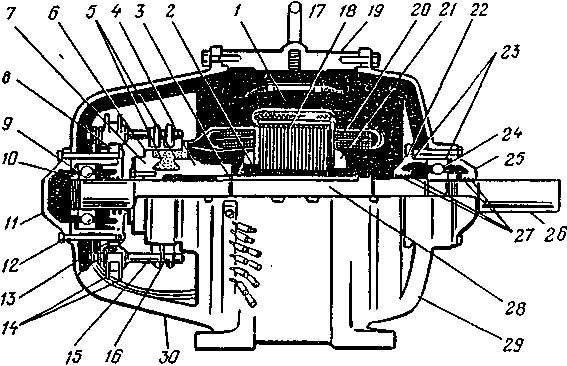
Fig. 1 Ball-Bearing Fully-Enclosed Fan-Cooled Direct-Current Motor
1. field coil; 2. armature spider; 3. commutator key; 4. commutator sleeve; mutator mica V rings; 6. commutator bars; mutator metal V ring; 8. front inner bearing cap; 9. bearing lock washer; 10. bearing lock nut; 11. front outer bearing cap; 12. bearing assembly screw; 13. brush yoke; 14. brush stud insulation; 15. brush holder stud; 16. brush holder; 17. eye bolt; IS. armature laminations; 19. frame; 20. armature coils; 21. armature end plate; 22. back inner bearing cap; 23. vellumoid gaskets; 24. ball bearing; 25. back outer bearing cap; 26. armature shaft; 27. grease seal; 28. armature key; 29. back bearing bracket; 30. front bearing bracket
Direct-current motors are of three principal kinds, and are named according to the manner in which their field coils are connected to the armature. They are named respectively: series, shunt, and compound.
In the series motors the field windings and armature are connected in series with each other. All the current which passes through the armature passes through the field coils. The field windings are therefore composed of a few turns of thick wire. Starting under heavy load, a series motor will take a large current to provide the huge torque required.
The field coils of shunt motors are connected direct across the brushes, hence they have the full voltage of the mains applied to them. The shunt motor may be called a constant speed motor, and is suitable for driving machine tools, lathes, wood-working machines and any machines requiring a steady speed.
A compound motor has both shunt and series field windings and therefore partakes of the nature of both types of motors.
2.Make the plan of the text and retell the text.
TEXT 9.
1. Translate the text into Russian.
D. c. electric motors
There is a wide variety of d. c. and a. c. motors. There are shunt motors, series motors, synchronous motors, induction motors, single-, two-, and three-phase motors. They are used to drive various machines.
Direct-current motors are of three principal kinds, and are named according to the manner in which their field coils are connected to the armature. They are named respectively: series, shunt, and compound.
In the series motors the field windings and armature are connected in series with each other. All the current which passes through the armature passes through the field coils. The field windings are therefore composed of a few turns of thick wire. Starting under heavy load, a series motor will take a large current to provide the huge torque required.
The field coils of shunt motors are connected direct across the brushes, hence they have the foil voltage of the mains applied to them. The shunt motor may be called a constant speed motor, and is suitable for driving machine tools, lathes,. wood-working machines and any machines requiring a steady speed.
A compound motor has both shunt and series field windings and therefore partakes of the nature of both types of motors.
A. c. electric motors
Motors for alternating-current circuits may be either single-phase or polyphase (two - or three-phase). They may again be divided into two kinds, named respectively: I. Synchronous; II. Non - or asynchronous, ordinarily called induction motors.
The most widely used a. c. motor is the induction motor shown in Fig. 2. It has two main parts: a) the stationary winding or stator, which sets up a rotating magnetic field, and b) the rotating part of the motor, i. e. the rotor. The rotor of a commercial a. c. motor consists of an iron core with large copper bars placed in slots around the circumference and connected at both ends to copper rings. This is called a squirrel-cage rotor. When a rotor is placed in a rotating magnetic field, a large current is induced tin it.
A. c. motors are exactly similar in construction to a. c. generators and may be called inverted alternators, since the same machine may be used as either a generator or a motor.
Synchronous motors are very suitable for large powers, where the machine can be started up without load, and once started run for long periods.
For supplying direct-current power networks, the supply comes first from an alternating-current source and is converted to direct current by synchronous converters or motor-generator sets.
2. Put English equivalents to the following:
широкое разнообразие
переводной двигатель
управлять различными механизмами
двигатель постоянного тока
трех основных видов
катушка
в соответствии с образом
комбинированный
проходит через арматуру
моток
тяжёлые нагрузки
требуется огромное вращение
двигатель постоянной скорости
неизменная скорость
двигатель переменного тока
названных соответственно
закрепленная катушка
вращательная часть
окружность, периферия
медные кольца
преобразовывается в постоянный ток
TEXT 10. TRANSMISSION LINES
1. Translate the text into Russian.
A power system is an interconnection of electric power stations by high voltage power transmission lines. Nowadays the electricity is transmitted over long distances and the length of transmitting power lines varies from area to area.
A wire system is termed a power line in case it has no parallel branches and a power network in case it has parallel branches.
According to their functions, power lines and networks are subdivided into transmission and distribution lines.
Transmission lines serve to deliver power from a station to distribution centres. Distribution lines deliver power from distribution centres to the loads.
Lines are also classed into: 1) overhead; 2) indoor; 3) cable (underground).
Overhead lines include line conductors, insulators, and supports. The conductors are connected to the insulators, and these are connected to the supports. The greater the resistance, the higher are the heating losses in the conducting wires. In order to reduce the losses, a step-down transformer can be used.
Indoor lines include conductors, cords, and buses. The conductor may include one wire or a combination of wires not insulated from one another. They deliver electric current to the consumers.
As to underground lines, they are used in city areas. Accordingly, they are used in cities and towns, and in the areas of industrial enterprises.
plete these sentences using the correct variant.
1. Electric power is transmitted a) by electric lines.
b) by power networks.
2. Lines are divided into a) overhead and underground
b) overhead, indoor, underground
3. An overhead line includes a) conductors and supports

|
Из за большого объема этот материал размещен на нескольких страницах:
1 2 3 4 5 |

|
Великобритания
соединенное королевство |
|
|
 Языки мира
Английский язык •
Немецкий язык •
Французский язык •
Итальянский язык •
Испанский язык •
Шотландский язык •
Нидерландский язык •
Исландский язык •
Датский язык •
Шведский язык •
Литовский язык •
Латышский язык
Славянские языки
Русский язык • Белорусский язык • Украинский язык
Праславянский язык • Западнославянские языки • Восточнославянские языки • Древнерусский язык • Западнорусский письменный язык • Русинский язык • Полабский язык • Лужицкий язык • Верхнелужицкий язык • Нижнелужицкий язык • Кашубский язык • Южнославянские языки • Старославянский язык • Церковнославянский язык
Польский язык •
Чешский язык •
Словацкий язык •
Болгарский язык •
Македонский язык •
Сербский язык •
Черногорский язык •
Хорватский язык •
Боснийский язык •
Словенский язык
Проекты по теме:


 Основные порталы (построено редакторами)