


Партнерка на США и Канаду по недвижимости, выплаты в крипто
- 30% recurring commission
- Выплаты в USDT
- Вывод каждую неделю
- Комиссия до 5 лет за каждого referral
b) conductors, insulators and supports
4. The insulators are connected a) to the buses
b) to the supports
5. Conductors consist of a) bare wire
b) insulated wire
6. Underground lines are used a) in cities
b) in areas of enterprises
c) in agricultural areas
3. Put down the Russian for:
interdependent city areas
interacting underground lines
interconnected overhead lines
transmitting power lines
transmission and distribution lines
overhead lines
step-down transformer
indoor lines
underground lines
4. Answer these questions:
what means is electric power system transmitted?
2. Which system has no parallel branches?
3. Into what groups are all the transmitting lines classed?
4. What components does an overhead line have?
5. What elements do conductors consist of?
6. In what areas are overhead (underground) lines used?
TEXT 11. SUBSTATIONS
1. Translate the text into Russian.
A substation is designed to receive energy from a power system, convert it and distribute it to the feeders. Thus a substation serves as a distribution bstations feed (supply) various consumers provided that their basic load characteristics are similar. Therefore the energy is distributed without transformation of the voltage supplied.
Common substations comprise isolators, switchgear buses, oil circuit breakers, fuses, power and instrument transformers and reactors.
Substations are classed into step up and step down ones. The step up substation includes transformers that increase the voltage. Connected to the busbars of the substation are the power transmission lines of power plants of the system.
As to step down substations, they reduce the voltage to 10 or 6 kV. At this voltage the power is supplied to the distribution centres and to the transformer substations of power consumers.
A transformer substation serves for transmitting and distributing electric power. It comprises a storage battery, control devices and auxiliary structures.
Transformer substations are classed into indoor and outdoor; both types are used for feeding industrial pared to other types of substations, transformer substations have certain advantages. They have flexible construction and easy and reliable operation. In case of a fault in the left-hand section, the main circuit breaker opens while the normally open section circuit breaker closes and puts the voltage of the section to normal. Power from a substation is delivered to distribution centres.
2. Complete the sentences using the correct variant:
1. A substation serves a) to consume energy.
b)to distribute energy.
c)to convert energy.
2. A substation feeds consumers a) with various load characteristics.
b) with similar load characteristics.
3. The lines of power plants are a) to the busbars. connected
b) to the switchgear.
4. A substation comprises a) the main elements.
b) the main and auxiliary elements.
5. Flexible construction is a) an advantage.
b) a disadvantage.
3. Pair work. Put these questions to your groupmate, and ask him/her to
answer them.
1. What does a substation serve for?
2. What type of consumers does a substation feed?
3. What parts are the power transmission lines connected to?
4. What components does a substation comprise?
5. What types are substations classed into?
6. What are advantages of a transformer substation?
4. Put down the Russian equivalents of these word combinations. Translate them back into English.
circuit breaker
auxiliary units
distribution centre
flexible construction
reliable operation
switch gear bus
hydraulic as well as solar sources of energy
as to phase-word motors
TEXT 12. HYDROELECTRIC POWER PLANTS
1. Translate the text into Russian.
Hydroelectric power plants are built on rivers. Large-capacity hydroelectric power plants are commonly located at considerable distances from the consumers of electric power.
The production process at these plants is rather simple: the water flows into the hydroturbine runner, acts upon the runner blades and rotates the runner and the turbine shaft.
The generator shaft is connected to the turbine runner shaft. The difference in the water level influences the power capacity of a plant, i. e. the magnitude of the water head and the daily inflow of water fluctuates considerably according to the season.
The production process is different at power plants of different constructions and of different kinds. In atomic power plants, for example, it is not so simple as in hydroelectric plants.
plete the sentences using the correct variant:
1. Hydroelectric power plants a) on rivers.
are built b) on waterfalls.
2. Large-capacity power plants a) at a short distance from consumers of power
are located b) at a considerable distance from consumers
of power
3. The production process at the a) is very complex.
plants b) is rather simple.
4. The power capacity of a plant a) remains constant.
b) changes considerably.
c) is influenced by the difference in the water
level.
5. The daily inflow of water a) fluctuates according to the
consumption.
b) fluctuates according to the season.
6. The production process a) depends upon the construction of the
plant.
b) is the same at power plants of different
constructions.
3. Pair work. Put these questions to your groupmate and ask him/her to answer them:
1. On what sites are hydroelectric power plants built?
2. Are large-capacity plants located far from consumers of power?
3. Is the production process at the plants simple or is it complex?
4. What influences the power capacity of a plant?
5. According to what factors does the daily inflow of water fluctuate?
6. Does the production process at the plant depend on its construction?
7. Do you know that a thermal power plant seldom has an efficiency more than 40%?
4. Put down the Russian equivalents of these word combinations. Then
translate them back into English.
runner blade
turbine runner
turbine shaft
water level
water head
large capacity power plant
magnitude of the water head
daily inflow of water
turbine runner shaft
TEXT 13. ATOMIC POWER PLANT
1. Translate the text into Russian.
Atomic power plants are modern installations. They consist of several main units and a great number of auxiliary ones.
In a nuclear reactor uranium is utilized as a fuel. During operation process powerful heat and radioactive radiation are produced. The nuclear reactor is cooled by water circulation. Cooling water circulates through a system of tubes, in which the water is heated to a temperature of 250-300°C. In order to prevent boiling of water, it passes into the reactor at a pressure up to 150 atmospheres.
A steam generator includes a series of heat exchangers comprising tubes. The water heated in the reactor is delivered into the heat exchanger tubes. The water to be converted into steam flows outside these tubes. The steam produced is fed into the turbogenerator.
Besides, an atomic power plant comprises a common turbogenerator, a steam condenser with circulating water and a switchboard.
Atomic power plants have their advantages as well as disadvantages. The reactors and steam generators operate in them noiselessly; the atmosphere is not polluted by dust and smoke. As to the fuel consumption, it is of no special importance and there is no problem of fuel transportation.
The disadvantage of power plants utilizing nuclear fuel is their radiation. Radioactive radiation produced in the reactors is dangerous for attending personnel. Therefore, the reactors and steam generators are installed underground. They are also shielded by thick (up to 1.5 m) concrete walls. All their controls are operated by means of automatic devices. These measures serve to protect people from radioactive radiation.
plete the sentences using the correct variant:
1. A nuclear reactor is used in a) wind-power plants.
b) atomic power plants.
2. A nuclear reactor is cooled by a) water circulating in tubes.
b) oil circulating in tubes.
3. Water is passed into the reactor a) at a low pressure.
b) at a high pressure.
4. High pressure a) activates boiling of water.
b) prevents boiling of water.
5. Atomic power plants a) pollute the air with dust and smoke.
b) do not pollute the air with dust and smoke.
6. Circulating water flows a) inside the heat exchangers.
b) outside the heat exchangers.
7. Attending personnel is a) thick concrete walls.
shielded by b) thick metal walls.
3. Pair work. Put these questions to your groupmate and ask him/her to answer them:
1. What are the main units of an atomic power plant?
what means is the nuclear reactor cooled?
3. At what pressure does the water pass into the reactor?
4. What types of power plants pollute the air with dust and smoke?
5. Why is it necessary to protect attending personnel?
what means is it done?
UNIT PPLEMENTARY READING
TEXT 1. PRACTICAL UNITS
The main units in electrical engineering are those relating to current, pressure or voltage, resistance, power and energy.
Current is that which flows along the conductors forming the electric circuit. It is measured in amperes. Pressure, potential, voltage, or electromotive force is that which causes a current to flow between two points when they are joined by a conductor. The unit is the volt.
The total pressure generated by a cell or generator is called its electromotive force (e. m.f.). The difference in pressure between any two points in a circuit is simply known as the potential difference, voltage, or pressure of the circuit. The opposition which a substance offers to the flow of current through it is called its bstances having a small resistance, such as metals and most liquids, are called conductors, those offering a high resistance are called insulators. The unit of resistance is the ohm, represented by the Greek letter fi. A megohm equals one million ohms.
When resistances are connected in succession to form a circuit, they are said to be connected in series. The total resistance of such a circuit is the sum of all the resistances. Resistances connected to the same terminals are said to be in parallel.
In a circuit in which a steady direct current is flowing there is a direct relation between the current, voltage, and resistance, temperature remaining constant, and this is expressed by what is known as Ohm's law.
The law is represented by the following equation:
| I – current in amperes R – resistance in ohms E – voltage in volts |
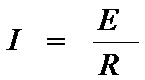
The power in a d. c. circuit is found from the product of the amperes flowing in it and the pressure at its terminals. The unit of power is the watt. It is the power in a circuit when a current of one ampere flows under a pressure of one volt. The practical unit of electrical energy is the kilowatt-hour (kW/h). It is the energy transformed in a circuit when the power is one kilowatt and the time taken is one hour. In general practice this value is spoken of as a unit, and is the basis of charges for electrical energy.
TEXT 2. MATTER AND ENERGY
Before considering the modern views in regard to composition of atoms, it is advisable to review briefly the concepts of matter and energy which are fundamental in all branches of science. A strictly accurate definition of matter is difficult to formulate. Our experience and common sense furnish us with a conception of matter. Matter occupies space; it has inertia, that is, it requires force to set it in motion; it is the stuff of which the universe is made. Energy, on the other hand, is nonmaterial; we become conscious of it only when it is associated with matter.
A stone held in the air is different from the same stone resting on the earth; for by allowing the former to drop we can obtain work from it, drive a nail, or crush grain. The stone held away from the earth is said to have potential energy, it gives it up when it falls; and to raise it from the earth back to its original position, work must be done upon it. Energy manifests itself in work. We are familiar with'other forms of energy – heat, light, electrical energy, nuclear energy and sound.
Matter and energy are always associated. When any change occurs, there is always a change in the energy; there may or may not be a change in the matter. From this point of view, we can define physical and chemical change; if the change consists solely in energy it is physical, if the matter changes it is chemical.
TEXT3. ELECTRICITY AND MAGNETISM
Much has been learned about electric currents through their effects. We all are familiar with incandescent filament in the ordinary"electric lamp bulb (heating effect), with the vibrating hammer of the electric bell when ringing (magnetic effect), with the decomposition of acidulated water into hydrogen and oxygen (chemical effect), and with the mechanical forces acting in the electric motor used for starting an automobile engine (mechanical effect).
Electricity is completely intermingled with magnetism. We must know these fundamental properties of a magnet well: a magnet attracts pieces of iron, nickel and cobalt; the magnetic property is concentrated more in the poles: if freely hung the magnetic needle sets itself with one pole toward the north; like poles repel each other, unlike poles attract each other; magnetism can be induced; a magnetic line of force is the path along which an independent north pole would tend to move; a magnetic field is a space in which there are magnetic lines; permeability refers to the ease with which lines of force may be established in any material, and reluctance is the resistance which a substance offers to magnetic lines of force, i. e. to magnetic flux.
Many practical applications have resulted from the. utilization of the magnetic effects of electric currents. These effects are employed in motors, in most electric meters (ammeters, voltmeters and galvanometers), in electromagnets, and in practically all electromechanical apparatus.
TEXT 4. BRANCHES OF ELECTRICITY
The study of electricity may be divided into three branches: magnetism, electrostatics and electrodynamics. Magnetism is the property of the molecules of iron and some other substances to store energy in a field of force. Electrostatics is the study of electricity at rest. Rubbing glass with silk produces static electricity. Electrodynamics is the study of electricity in motion, or dynamic electricity. The electric current which flows through wires is a good example of the latter type of electricity.
This flow of electricity through a conductor is analogous to the flow of water through a pipe. A difference of pressure at the two ends of the pipe is necessary in order to maintain a flow of water. A difference of electric pressure is necessary to maintain a flow of electricity in a conductor. Different substances differ in electrical conductivity because of the ease with which their atoms give up electrons. Electrical energy has intensity and quantity. Instruments have been devised which can be used to measure it in amperes and volts.
TEXT 5. WHAT IS AN INTEGRATED CIRCUIT?
What is an integrated circuit?
An integrated circuit is a complete circuit capable of doing the same job on an input signal as a discrete circuit containing a large number of active and passive components on a printed circuit board. What makes the difference is that in the case of an integrated circuit the whole circuit is one component, formed in one set of operations on a single chip of silicon such as is used to make a single transistor. The important point is that the integrated circuit is made in the same way as a single transistor, using the same type of operations, and that all the connections in the circuit are formed at the same time as the other parts of the circuit. The most important difference between an integrated circuit and discrete circuit is that the integrated circuit is very much smaller. This is often an advantage because it means that we can put integrated circuits into containers which we had never before thought could contain electronic circuits, so that we have, for example, pocket electronic calculators.
Another important point is that, because an integrated circuit is made in the same way as a transistor, it can often be made for practically the same price as the transistor. But one integrated circuit can carry out the task of several hundred transistors.
A third factor is reliability. Instead of gathering together several hundred components, testing them, soldering them into a printed circuit board, we have one component to test and to mount. No single part of the integrated circuit should be less reliable than the other parts, since it was all made in one piece. In this way we can gain tremendously in reliability since the only connections to be made are these to and from the integrated circuit.
TEXT 6. AN INTEGRATED CIRCUIT
An integrated circuit is comprised of a single silicon chip containing transistors, diodes, resistors and capacitors, suitably connected to form a complete circuit. The first successful attempt to produce an integrated circuit, in 1959, made use of mesa construction, but this method is known to be quickly replaced by the use of planar techniques.
The important feature of the planar process is the deposition of a silicon dioxide layer on the top surface of the epitaxial wafer which acts as a mask against diffusion. The process involves exposing the wafer to an oxygen atmosphere at high temperature.
After the oxidation process it is necessary to etch holes in the oxide, through which diffusion can take place. The process used is similar to that employed in the manufacture of printed circuit boards. Initially the oxidized surface is coated with a thin film of photo-sensitive emulsion (photoresist). A mask is manufactured, the pattern of which defines the area to be etched, it being opaque where etching is to be performed and transparent where the oxide is to be retained. The mask is brought into contact with the wafer and exposed to ultraviolet light. The photoresist under the transparent area of the mask being subjected to the light becomes polymerized and is not affected by the trichlorethylene developer which is subsequently used to dissolve the unexposed resist. When fixed, by baking, the remaining photoresist protects the oxide from the window where diffusion is required and, after the surface has been cleaned, the chip is ready for the first diffusion process.
For а р-type diffusion the most generally used dopant proves to be boron. This is deposited on the wafer at high temperature, and diffuses through the window into the silicon. А р-type region is thus created. The oxidization treatment is now repeated and, in this high-temperature process, the open window is sealed with an oxide layer and the base dopant is driven deeper into the silicon. A new mask is used in a second photoresist and etching stage, which opens a window for the diffusion of the emitter region.
For n-type diffusion the most generally used dopants are phosphorus and arsenic. The cycle is supposed to be repeated yet a third time. The emitter window is sealed by oxidization, the emitter dopant is driven in, and new windows are etched in the oxide layer to define the contact areas. Finally the contacts are made by the evaporation of aluminum.
In practice many devices are manufactured at the same time on a single sheet of silicon. These are separated by scribing with a diamond stylus and breaking into individual chips. They are then mounted in suitable packages which allow electrical connections to be readily made and power, dissipated as heat, to escape.
It is necessary to be able to electrically isolate individual devices from each other. This is done by surrounding each component with material of opposite polarity and reverse biasing the semiconductor junction so formed.
TEXT 7. INTEGRATED CIRCUITS
The techniques used to manufacture transistors led to the possibility of producing very small and reliable electronics circuits commonly known as integrated circuits (ICs). ICs have diodes, transistors, resistors, and all interconnecting leads formed on a single piece of semiconductor material.
The increasing trend toward miniaturization has resulted in the development of micro integrated circuitry performing the combined functions of several stages. The idea of IC envisions the eventual abandonment of the discrete component concept for electronic circuits. Instead, a complete functional package is becoming the replacement item for technicians.
An IC chip consists of the miniaturized components required for amplifier, oscillator and switching circuits and is contained in a package smaller than any of the original components in their conventional form. Integrated circuits are usually considered in three general classifications: thin-film, monolithic, and hybrid.
Thin-film class uses a nonconductive dielectric substrate such as mica or ceramics. Passive components such as resistors and capacitors in the form of thin film with connecting leads are deposited on the substrate, and the package is covered with a protective material. This type is more bulky and has a relatively high component-failure rate.
Monolithic ICs are made by a diffusion process. This class of IC consists of a semiconductor substrate with circuit components diffused into it. Monolithic ICs used extensively in computer logic systems are less bulky and more reliable than the thin-film type.
The hybrid type is a combination of thin-film and monolithic types. In the hybrid ICs passive components such as resistors are fabricated by the thin-film technique, and active components such as transistors are included by the monolithic process.
Transistors, diodes, and resistors are relatively easy to integrate, but inductors are more difficult because of the size usually required for higher values. An IC-module or chip can contain three or more interconnected stages, and complete electronic systems such as amplifiers no larger than a conventional transistor are not uncommon. Colour TV, radios, high-fidelity audio systems, transmitters, computers and space vehicle equipment all utilize integrated circuitry.
TEXT 8. CONDUCTORS, SEMICONDUCTORS AND INSULATORS
The word “semiconductor”, which features so prominently in present-day electronics, means rather generally a material which has electrical conductivity half-way between that of a metallic conductor, and that of an insulator. However, there are some specific properties that distinguish semiconductors used for electronic devices from materials which generally might be said to have semiconducting characteristics (for example, a wet insulator may very well be a semiconductor in some general sense, but it is regarded as hazardous rather than as useful electrically).
Materials can be classified in three groups according to their electrical properties — conductors, semiconductors and insulators. Metals such as silver, copper, and aluminium have many free electrons. This makes it easy for current to flow through them. Therefore, these metals are called conductors.
Materials such as glass, rubber, and many plastics have practically no free electrons. This makes it very difficult for current to flow through them. These materials are known as insulators and are used in many fields ranging from the covering on conductors to the dielectric in capacitors.
Materials such as selenium, silicon, and germanium have some free electrons— more than an insulator but fewer than a conductor. These materials are known as semiconductors.
TEXT 9. ON SEMICONDUCTORS
A semiconductor is often defined as an electric conductor that has a conductivity intermediate between that of an insulator and that of a metal. The more important semiconductors are: boron, germanium, silicon, selenium, phosphorus, gray tin and others.
The mechanical properties of semiconductors vary greatly. However, in hardness, brittleness, and fracture strength, semiconducting crystals resemble insulating crystals more than they do metals. Besides their electric properties, which in themselves may be of great variety, semiconductors vary in such physical qualities as magnetism, specific heat and thermal conductivity.
Semiconductors are widely used in electronics. They challenge vacuum tubes in many applications in the electronic industry. Engineers and physicists are going to solve many engineering problems by means of semiconductors.
TEXT 10. SEMICONDUCTORS
A transistor is an active semiconductor device with three or more active we mean that the transistor is capable of current gain, voltage, amplification and power gain. A transistor is an electron device in which electronic conduction takes place within a semiconductor.
A semiconductor is an electric conductor with resistivity in the range between metals and insulators, in which the electrical charge carrier concentration increases with increasing temperature over some temperature range.
The resistivities of semiconductors and insulators decrease rapidly with rising temperatures, while those of metals increase relatively slowly. Unlike metals and insulators, the resistivity of semiconductors depends upon the direction of current flow. The direction of easiest current flow or lowest resistivity is called the forward direction, the direction of restricted current flow or highest resistivity is known as the reverse or back direction.
Semiconductors, such as the elements germanium and silicon, possess two types of current carriers, namely, negative electrons and positive holes. A hole is a mobile vacancy in the electronic valence structure of a semiconductor which acts like a positive electronic charge with a positive mass.
TEXT 11. SILICON:THE PROSPECTS OF SEMICONDUCTOR TECHNOLOGY
The discovery and development of semiconductors made possible great advances in electronics. The most important among semiconductors is silicon.
There is a very good reason1 why silicon is used to fabricate electronic components. Next to oxygen, it is the most abundant material on the earth's surface. More important, it is very easy to grow insulating layers on silicon. But the impulse to higher performance — faster and denser devices—demands that the industry go beyond silicon in both logic and memory development. For silicon is to semiconductor technology what iron and steel have been to modern metallurgy.
Already silicon has been superseded not simply in laboratory experiment but for commercial production of memory devices with capacities at least four times higher than anything so far realized with silicon: the magnetic-bubble memory. Other technologies which include the use of gallium arsenide and the superconducting materials of Josephson junctions are on the horizon. These technologies, however, are constrained at present by processing and operating costs. For example, gallium arsenide is highly toxic, and insulating layers are also impossible to grow on it. And Josephson junctions at present must be cooled to near absolute zero to work.
The dominant role of silicon as the material for microelectronics is attributed to the properties of its oxide. Silicon dioxide is a clear glass with a softening point higher than 1,400 degrees C. It plays a major role both in the fabrication of silicon devices and in their operation.
Приложение 1.
Темы групповых или индивидуальных творческих заданий/проектов[1]
1. История транспорта
2. Интернациональные слова.
3. Заимствованная лексика.
4. Современные источники энергии
5. История электричества.
6. Автоматизация.
7. Электростанции.
Критерии оценки:
- оценка «отлично» выставляется студенту, если отсутствуют или есть незначительные грамматические ошибки; прозрачность и логика изложения мыслей, умелое использование грамматических явлений, владение лексическим материалом, использование разнообразных речевых средств, соблюдение правил письменного этикета, оформление работы, применение фантазии, творческий подход, полностью решена проблематика проекта.
- оценка «хорошо» - присутствуют незначительные грамматические ошибки, незначительное нарушение правил произношения и письменного речевого этикета в виде неверного обращения к адресату или формул приветствия, прощания, не влияющих на логику изложения и понимания содержания, правильное оформление работы, с незначительными нарушениями.
- оценка «удовлетворительно» - есть грамматические ошибки, слабо используется изученная лексика, слишком кратко излагается содержание темы, ошибки в произношении, практически отсутствует собственная точка зрения на суть проблемы, нарушены правила оформления работы, отсутствие творчества и фантазии.
- оценка «неудовлетворительно» - большое количество грамматических ошибок, неумение использовать разные виды предложений, примитивность изложения мыслей, узкий диапазон лексики, слишком краткое изложение текста, неправильное оформление работы, нераскрыта суть проекта, отсутствует творчество и фантазия.
Приложение 2.
Темы докладов, сообщений
1. Виды транспорта.
2. Преимущества и недостатки наземного транспорта
3. Преимущества и недостатки водного транспорта
4. Преимущества и недостатки воздушного транспорта
5. Создатели транспорта.
6. Термины.
7. Трудности технического перевода
8. Интернациональные слова – ложные друзья переводчика
9. Источники энергии
10. Автоматизация. Первые шаги
11. Что такое электричество?
12. Типы электростанций.
13. Принцип работы электростанций
14. Письма.
Критерии оценки:
- Оценка «отлично» ставится, если студент владеет тематикой общения, использование языковых явлений и речевых средств, отсутствие грамматических ошибок, влияющих на понимание речи, эмоциональность, спонтанность ответов, правильное оформление, использование разнообразных источников информации при подготовке доклада, тема раскрыта полностью.
- Оценка «хорошо» ставится, если есть несколько неточностей в грамматическом оформлении предложений, некоторое отклонение от поставленной задачи общения, например, аргументация высказывания или убеждения, которое отличается от обычного высказывания употреблением иных речевых средств, есть недочеты в оформлении, тема раскрыта.
- Оценка «удовлетворительно» ставится, если студент слабо владеет технологией общения, что проявляется в отсутствии спонтанности речевого высказывания, самостоятельности и активности в диалоге, наличие грамматических ошибок в высказываниях, создающих трудности в восприятии текста, имеются ошибки в оформлении, тема не полностью раскрыта, нет разнообразия в источниках информации.
- Оценка «неудовлетворительно» - неумение самостоятельно начать и поддержать разговор, слабая реакция на вопросы учителя, узкий лексический кругозор, простые фразы и невладение навыками аргументировать свою точку зрения, тема нераскрыта, неправильное оформление работы.
Приложение 3.
Темы эссе
1. Транспорт. Средства транспорта.
2. Энергия.
3. Автоматизация
4. Электростанции
5. Электродвигатели
6. Электрогенераторы
7. Линии электропередач
Критерии оценки:
- Оценка «отлично» ставится, если отсутствуют грамматические ошибки, прозрачность и логика изложения мыслей, умелое использование грамматических явлений, владение лексическим материалом, использование разнообразных речевых средств, соблюдение правил письменного этикета, оформление работы, применение фантазии.
- Оценка «хорошо» ставится, если 2-3 грамматические ошибки, незначительное нарушение правил письменного речевого этикета в виде неверного расположения обращения к адресату, даты или формул приветствия, прощания, не влияющих на логику изложения и понимания написанного
- Оценка «удовлетворительно» ставится, если 4-5 грамматические ошибки, слабо используется изученная лексика, слишком кратко излагается содержание текста, практически отсутствует собственная точка зрения на суть проблемы.
- Оценка «неудовлетворительно» ставится, если более 5 грамматических ошибок, неумение использовать разные виды предложений, примитивность изложения мыслей, узкий диапазон лексики, слишком краткое изложение текста.
Приложение 4
Клише и фразы, используемые для аннотирования текста
The text / article under review...(gives us a sort of information about...)
The article deals with the problem...
At the beginning (of the text) the author describes... (dwells on explainstouches upon analyses...; comments... ; characterizes... ; underlines... ; reveals... ; gives account of...)
The article begins with the description oja review of...,
the analysis of...
The article opens with...
Then (after that, further on, next) the author passes on to gives a detailed (thorough) analysis (description), goes on to say that...
To finish with, the author describes...
At the end of the article the author draws the conclusion that...; the author sums it all up (by saying...)
In conclusion the author...
Список использованных источников
1. Агабекян, И. П., Коваленко для технических вузов. Серия «Высшее образование» / , .- Ростов н/Д: Феникс, 2004.-352 с.
2. Айзенкоп, пособие по техническому переводу / . - Ростов н/Д.: 1996.-288 с.
3.Кабакчи, английского языка: Сборник упражнений по переводу / . – С-Пб.: 1999.
4. Карпова, для колледжей : учебное пособие / – М.: Дашков и К, 2009. – 320с.
5.Кривых, Л. Д., Рябичкина, Г. В., Смирнова, перевод: учебно-методическое пособие / , , . – М.:. Форум, 2009. – 184с.
6. Луговая язык для студентов энергетических специальностей: Учеб. пособие/ – М., 2001. – 150 с.
7., Шитов язык для программистов: Тексты и упражнения / , – М.: Память, 1992. – 96 с.
8.Радовель язык. Основы компьютерной грамотности: Учебное пособие / – Ростов н/Д: Феникс, 2005. – 224 с.
9.Полякова, Т. К.. В и др. Английский язык для инженеров / , . –М.: 1998.-463 с.
10.Письменный -русский словарь по персональным компьютерам и информатике. В двух томах. Том II. – Ростов н/Д: , 2002. – 416 с.
11.Радовель, язык для технических вузов [Текст]: учебное пособие / – М.: Дашков и К, 2009. – 444с.
Интернет источники
1. www. eng-history. ru
2. www. native-english. ru
3. www. wikipedia. org/wiki/
4. www.
5. www.

|
Из за большого объема этот материал размещен на нескольких страницах:
1 2 3 4 5 |

|
Великобритания
соединенное королевство |
|
|
 Языки мира
Английский язык •
Немецкий язык •
Французский язык •
Итальянский язык •
Испанский язык •
Шотландский язык •
Нидерландский язык •
Исландский язык •
Датский язык •
Шведский язык •
Литовский язык •
Латышский язык
Славянские языки
Русский язык • Белорусский язык • Украинский язык
Праславянский язык • Западнославянские языки • Восточнославянские языки • Древнерусский язык • Западнорусский письменный язык • Русинский язык • Полабский язык • Лужицкий язык • Верхнелужицкий язык • Нижнелужицкий язык • Кашубский язык • Южнославянские языки • Старославянский язык • Церковнославянский язык
Польский язык •
Чешский язык •
Словацкий язык •
Болгарский язык •
Македонский язык •
Сербский язык •
Черногорский язык •
Хорватский язык •
Боснийский язык •
Словенский язык
Проекты по теме:


 Основные порталы (построено редакторами)