

Партнерка на США и Канаду по недвижимости, выплаты в крипто
- 30% recurring commission
- Выплаты в USDT
- Вывод каждую неделю
- Комиссия до 5 лет за каждого referral
We attempted to map out and compare time management of the traditional lecture (low level interaction) and the SRS supported lecture (high level interaction) in table 2:
Table 2. Time Management Comparison of the Traditional Lecture vs. SRS Supported Lecture
Traditional lecture | SRS supported lecture | ||
Material presentation | 80-90 minutes | 40-50 minutes PPpresentation | |
Material Assessment and Collaboration activities | Weekly tests | - | 15 minutes |
Brainstorming | - | 0-15 minutes | |
Brief Group Discussion | - | 0-15 minutes | |
Low Context interaction | Questions for lecturer | 0-10 minutes Questions (if any) are asked orally after presentation | 0-10 minutes Questions (if any) are sent via mobile instant messaging apps (Twitter, SMS, What's up app, Google Talk) during presentation |
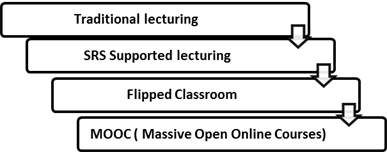
SRS is likely to become a supportive mobile tool for lecturers who would like to implement flipped classroom which is an example of substitutional and augmentative use of technologies (Tucker, 2012) because traditional content presentation is removed from classroom time. Due to the time management pattern of SRS supported lectures it is recommendable to transform the traditional design and present the material in the form of out-of-class activities and tasks - students are asked to watch video or listen lecture podcasts in their own time so the classroom time is devoted to discussion and collaboration with intensive teacher support. In other words, the challenges of learning a new content delivery system encourage faculty to think outside the box. Mobile voting system SRS enables lecturers to transform the way of the material presentation and turn the traditional lecturing into interactive SRS supported lectures, then into flipped classroom that is a valuable model of blended learning aided by open educational resources, and then, in the long run, into MOOC lecture (figure 2).
Figure 2. Traditional Lecture Course Transformation on the basis of SRS implementation
SRS Implementation Impact On Assessment And Feedback Patterns
SRS suits perfectly to evaluate group dynamics, it was primarily used in our research for formative assessment or low stake assessment which serves to give learners feedback on their performance and provides them with a gauge of how close they are to reaching a pre-specified learning goal (Sambell, Hubbard, 2004). Formative assessment is specifically intended to provide feedback on performance to improve and accelerate learning (Sadler, 1998). For the teacher, the design of formative assessment activities is motivated by wanting to increase students' desire to learn, to engage in self-evaluation and self-assessment and to take control of their own learning (Rubner, 2012).
SRS provides instructors with an opportunity for quickly determining the level of class understanding at any given point in time, without an extra burden of grading (Hodges, 2010). SRS implementation allows for significant (table 2) feedback pattern changes and material assessment re-design. We offer the following framework of SRS supported lecture (fig. 3).
Figure 3. SRS supported lecture framework
HLCE is created by initiating group discussions or brainstorming on the basis of SRS supported activities aimed to figure out the correct answer to the test statement. This kind of formative feedback that is got from peers resembles 'internal feedback' as defined by Nicol and MacFarlane-Dick (2006), in which feedback is generated in relation to peers’ perspectives rather than transmitted by the lecturer. The collaborative post-test activities as well as instant messaging apps also help highlight weak points of material presentation and transform students' approach to their own learning as a matter of active enquiry and meaning-making rather than seeing themselves as passive recipients of their lecturers’ knowledge. SRS provides deeper conceptual understanding when used with a peer instruction methodology:"Engaging students in peer discussions can challenge them to generate explanations and convincing arguments for their solution and in this way also facilitate deeper understanding of scientific phenomena" (Nielsen, 2012, p.45). But on the other hand, students need more guidance, more practice at tackling assessment-related activity and more feedback on their learning than is traditionally the case in many university courses (Sambell, 2010).
Participants
The participants of the research were 56 (12 male and 44 female) second year undergraduate Russian students enrolled at Lomonosov Moscow State University in Russia. Students aged 19-22 were Intercultural Communication Studies Majors who took part in SRS piloting as volunteers during two semesters of 2012-2013 academic year in the lecture course Introduction to American Studies.
The objectives of this course which is read in English are twofold: to help learners to develop, on the one hand, their intercultural skills by gaining a better understanding of contemporary U. S. - beliefs, values, traditions, geography, political and economic situation, education, religious and social life, and on the other hand, to develop their language skills (listening, reading, speaking). The language competence of students was B1-B2 according to the European Language Framework. Written consent was obtained for collection, analysis and publishing of learner data. Students were informed that the survey was anonymous and that they could not be identified by the answers.
Data collection
Data collection was done in three cycles that took place in the academic year 2012-2013:
1. Pre-study evaluation of ICT (mobile) competence of experimental group students and their attitude to mobile learning before SRS implementation (36 students - 30 female, 6 female);
2. Intervention of SRS supported tests (3 per lecture) as formative assessment tools and re-design of the traditional lecture patter (figure 3). Comparison of summative test results data of the control (20 students - 16 female, 4 male) and experimental groups (36 students); calculation of the average time of student speech production of the experimental group on the basis of video recording;
3. post-study evaluation of learner experience and attitude (30 students - 24 female, 6 male) to SRS supported lectures.
Reports Of Findings And Data Analysis
Cycle 1
The pre-study questionnaire was aimed to evaluate ICT (mobile) competence of 36 learners of the experimental group. The online questionnaire which consisted of 25 multiple choice questions was published on , the participants were sent a link via e-mail. It was adapted from the one used previously for our study (Titova, Talmo & Avramenko, 2013), it comprised three sections on 1. student mobile technologies skills (10 questions); 2. their experience in mobile devices and apps use in-class and out-of-class work (10 questions) and 3. their attitude to mobile devices implementation into language classroom (5 questions). The data were subjected to a descriptive statistical analysis enabling us to examine both our student mobile competence and their readiness to implement mobile devices into learning process.
The data analysis of section 1 demonstrated that the majority of students had a very advanced mobile competence and skills. We extracted some examples of student mobile technologies skills (table 3).
Table 3. Examples of students mobile technologies skills
Strongly disagree | Disagree | Agree | Strongly agree | Mean score | |
1. New lecture design prepared me well for SRS tests | 0 | 3 | 20 | 7 | 3,0 |
2. SRS tests helped me understand the topic in focus | 1 | 2 | 19 | 8 | 3,5 |
3. SRS tests helped me get ready for midterms and final a lot | 0 | 6 | 15 | 9 | 3,1 |
4. SRS tests and post-test activities made me read a lot at home | 0 | 2 | 8 | 20 | 3,6 |
5. SRS tests were frustrating, they complicated my learning a lot | 7 | 21 | 2 | 0 | 1,9 |
6. Instant feedback was very supportive and encouraging for my learning | 0 | 1 | 15 | 14 | 3,5 |
7. Activity switching kept me be involved during the lectures | 0 | 0 | 9 | 21 | 3,7 |
In response to statement 1 students averaged 3.0, a finding that indicates that a new lecture design prepared them well for midterm and final tests. The majority of students commented favorably on the fact that SRS supported tests helped them understand the topic in focus and get ready for midterms and final with responses to the second statement averaging 3,5 and to the third statement - 3,1. In response to statement 4, the average was 3,6. This suggests that a majority of the students indicated that SRS supported approach made them do required and recommended reading to complete in-class SRS tests successfully and to take part in post-test activities.

|
Из за большого объема этот материал размещен на нескольких страницах:
1 2 3 4 5 |
