


Партнерка на США и Канаду по недвижимости, выплаты в крипто
- 30% recurring commission
- Выплаты в USDT
- Вывод каждую неделю
- Комиссия до 5 лет за каждого referral
Look closely and you see the shotguns and the sad unlucky prisoners who are tasked with holding the dogs that hunt down their fellows. Chain gangs often housed poor blacks who couldn’t pay simple fines and became indentured to the state indefinitely. Slavery, as Zinn might remind us, didn’t end so suddenly as we were told. Progress has been hard, and slow. Yet who would trade today’s race relations for yesteryear’s?
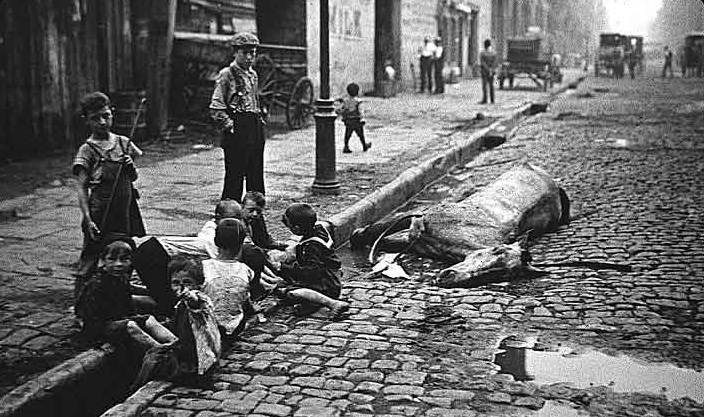
The most compelling photo from the first decade of the 20th century comes from a street in Manhattan. A dead horse, clearly malnourished, had collapsed and was awaiting collection. This was a common occurrence in cities everywhere, as horse-drawn commerce and transportation remained predominant. Indeed, there are a half dozen other carriages—not automobiles—in the background. What compels are the eight boys at play in the sewer a few feet from the dead horse. Two older boys are standing and staring at the photographer, while the younger boys are barefoot and seated along the gutter, splashing. Nearby wooden buildings are in shambles, windows wide, shutters hanging askew. The streets and sidewalks are bricked and worn down.
The germ theory of disease was barely a half-century-old when this photo was taken. Antibiotics would be discovered decades later, and widely used only when these boys were adults, assuming they survived the Great War and the plague of 1918.
LIFE, DEATH, AND EXTERNALITIES
If material progress is difficult to measure, immaterial progress is impossible to measure, yet is arguably much more valuable—things like increased health, greater liberty, and deeper social connections. Although the most common fatal conditions of 1910 have been cured, try to imagine getting a cancer diagnosis a century ago. The five-year survival rate for breast cancer today is 91 percent, according to data from the National Cancer Institute, much better than the 75 percent rate in 1975. But in 1910, the survival rate was zero. You only survived breast cancer if you were misdiagnosed.
And consider the dangers of birth in 1910. Of every 100 births, one mother died. According to the Centers of Disease Control, 10 percent of newborns died before their first birthday. In the century since, infant mortality declined by over 90 percent, while maternal mortality declined by 99 percent.
Yet how does one factor mortality into gross domestic product? That narrow economic metric ignores the real terror and insecurity of procreation before modernity. Can you imagine how much we would have to pay a pregnant, middle-class American woman today to face the mortality odds of 1910? She does not pay for medical safety in this sense. The psychological absence of mortal terror in 2010 medicine is not included in the list price.
Medical progress is what economists call a "positive externality." You may be vaguely familiar with the term externality because it is evoked often in environmental debates. When a dirty factory belches pollution into the river, or when a vulgar patron screams to himself in the library, others pay the "social cost" for the negative externality. In cases involving oil tankers and pristine coastlines, the costs are clear. Lawsuits and government regulations are meant to "internalize" such costs and make the economy run more fairly. But what about positive externalities? Those are mostly ignored as a matter of policy.
Now, to be sure, positive technological externalities are encouraged by governments—in the form of intellectual property rights. Without copyright protections that make it possible for people who produce intellectual work to prosper from it, we wouldn’t be able enjoy Downton Abbey or Guardians of the Galaxy or the music of Adele. Without patents, commercialization of inventions would be radically slower. However, allowing creators to charge monopoly rents for their creations is a far cry from giving them full compensation for the associated social gains. If a doctor invents a pill tomorrow that extends productive human life by 5 percent, will he reap 5 percent of the world’s labor income?
Piketty neglects positive externalities entirely. To be fair, there is one passage in Capital that could be interpreted as a discussion of tech externalities, but it reflects poorly on the author. He mocks the "cult of Bill Gates" and admits knowing frankly nothing about what exactly Gates did to earn so much money. His message is that Gates, and all wealthy software entrepreneurs, are riding for free on the shoulders of giants because none of their innovations would be possible without the work of thousands of hardware engineers. Piketty must be unaware how widely shared Microsoft’s stock is among its employees and how well hardware engineers have been compensated upstream and downstream from the Seattle company, including the thousands who worked at Intel, Dell, Cisco, and Hewlett-Packard, to name a few. Many became millionaires with Microsoft stock options, and many more worldwide piggy-backed on the publicly traded stock. What’s strange is that Piketty misses the irony: Capital in the Twenty-First Century was composed by his own free-riding on desktop software applications: word processing and spreadsheets. Will Piketty be sharing his royalties with Microsoft engineers?
Everyone alive today is free-riding on technology, yet none of these social gains are included in Piketty’s income data. Think about the free riding we get from medical science, and then narrow it down to just one medical innovation. Leave aside Alexander Fleming’s discovery of penicillin on September 28, 1928. Leave aside the introductions of vaccines for yellow fever in 1935, influenza in 1945, polio in 1955, and the measles, mumps, and rubella in the 1960s. Leave aside, too, the development of pretty much every painkiller known to man (except aspirin and alcohol)—all developed after 1910. Just think about blood.
Few people survived surgery at the dawn of the 20th rgery was invasive. Sepsis was common. There were was no blood supply. Indeed, the very idea of a "blood supply" is a modern one. It wasn’t until 1901 that blood types—A, B, AB, and O—were first discovered.
Blood could not be stored for transfusions in 1910, and not because refrigerators had yet to be invented. Blood naturally coagulates outside the body within minutes, so doctors had mere minutes to transfuse blood from a donor to a patient before the stuff gummed up the needle, tubes, and funnels. The very rare exception was to find a donor who would allow a major artery to be levered up out of his skin, severed, and then sewn into a wealthy patient’s vein.
Early experiments with anti-coagulants proved fatal because the chemicals were toxic. A German doctor named Richard Lewison challenged skeptics and continued to test different chemicals in different ratios to find a non-fatal blood thinner, using animal subjects to prove the concept. In 1915, he discovered the right mix—a small amount of sodium citrate—allowing donor blood to be stored for days and used on demand.
The invention was resisted by the medical establishment for years. There was a cultural bias against donors and fears about sharing blood between the races. Would just one drop make you an African? Logistics were a problem, too. Where would the blood be stored in mass quantities to accommodate dozens or hundreds of surgeries?
A century later, the United States has a vast blood infrastructure that supplies a patient in need every two seconds. The American Red Cross, which provides just under half of the blood supply in the U. S., reports that 41,000 donations are needed every day, 15.7 million donations per year. Other innovations have extended the shelf life of donated red blood cells to 5-6 weeks.
How do economists calculate the gains of all those lives? They don’t.
LET THERE BE LIGHT
The workplace in 1910 offers another stark contrast with 2010. In the crowded tenements of New York City where dozens of immigrant families toiled, men, women, and children crowded around tables near the windows and strained their eyes to see what they were sewing. The industry exploited young women with no recourse to vote for change because they had no right to vote and precious few labor rights. Much has changed between 1910 and 2010, particularly when one considers an event that riveted Americans at the time: the Triangle Shirtwaist Factory fire in Greenwich Village that killed over a hundred shirtwaist factory workers in early 1911. It was preceded by a failed strike during which many of the young factory women were beaten by paid thugs. Triangle is remembered because most doors were locked from the outside to keep girls in place during factory hours, locks that trapped them inside when the fire came.
The typical workplace in the U. S. today is much safer. And well lighted. Your office probably has four or more overhead bulbs bathing every corner with the light of the noontime sun. That light costs pennies, but how much is it worth?
After years of obsessive research into that question, William Nordhaus published a paper in 1996 that challenged this "Achilles heel" for economists: measuring incomes across times of technological change. "Estimates of real income are only as good as the price indexes are accurate," he said. And "most of the goods we consume today were not produced a century ago." Nordhaus was already a famous economist, co-author of the leading introductory textbook in the field and a distinguished critic of environmental pollution. But his 1996 paper revealed dramatic technological progress in the ways people light their homes at night, especially the acceleration during the industrial revolution.
Nordhaus opened our eyes to the advent of kerosene lamps in the 1860s (which probably saved whales from extinction). He accounted for dozens of innovations over the centuries in candle-making, lamps, and electrification. But his biggest insight was translating the nominal costs of light in terms of a day’s work, pithily concluding that "an hour’s work today will buy about 350,000 times as much illumination as could be bought in early Babylonia."

|
Из за большого объема этот материал размещен на нескольких страницах:
1 2 3 4 5 6 7 |
