


Партнерка на США и Канаду по недвижимости, выплаты в крипто
- 30% recurring commission
- Выплаты в USDT
- Вывод каждую неделю
- Комиссия до 5 лет за каждого referral
Comparing the most recent data to the Piketty baseline, Nordhaus calculates a true price of light for a filament lamp has declined to one percent of what it was in 1910. That’s not even comparing the fluorescent revolution since the 1990s, which has led to an improvement of another order of magnitude. All told, light costs less than one-tenth of one percent now than it did when Shorpy and other children were mining coal a century ago. The deeper message of Nordhaus’s research is that standard economic measures of GDP and prices were failures at measuring real progress. He wrote:
We travel in vehicles that were not yet invented that are powered by fuels not yet produced, communicate through devices not yet manufactured, enjoy cool air on the hottest days, are entertained by electronic wizardry that was not dreamed of, and receive medical treatments that were unheard of. If we are to obtain accurate estimates of the growth of real incomes over the last century, we must somehow construct price indexes that account for the vast changes in the quality and range of goods and services that we consume, that somehow compare the services of horse with automobile, of Pony Express with facsimile machine, of carbon paper with photocopier, of dark and lonely nights with nights spent watching television, and of brain surgery with magnetic resonance imaging.
Other economists have expanded upon this insight, none with more wit than Don Boudreaux. Using a 1956 Sears catalog he bought on eBay in 2012, Boudreaux applied the hours-of-work approach to pricing a dozen products over half a century. Neglecting the quality improvements entirely, Boudreaux still found that the cost reductions ran 75 to 95 percent. The cheapest television set in 1956 was six times more expensive in hours of work than the lowest priced 2012 model—and the newer one is in color, has two more inches of screen, higher resolution, lower weight, better sound quality, durability, and a remote control. Washing machines were five times more expensive during the fifties. Refrigerators, nine times more.
Refrigeration did not even exist in 1910. In fact, as I’ve spent time researching innovations that have reshaped modern living, I’ve discovered that Piketty could hardly have picked a worse year for contrast. As Wikipedia will tell you, key innovations that led to the refrigerator for domestic use occurred in 1913, 1914, and 1916. In that decade, Frigidaire was founded. Of course, a home unit in the 1920s often cost more than an automobile, but prices came down and made the refrigerator a standard appliance in middle-class homes by the middle of the 1950s.
Today, the penetration of refrigerators has reached essentially 100 percent of all homes, rich and poor, just as it has for microwave ovens and vacuum cleaners. Even poorer, developing countries such as Thailand, China, and Brazil have refrigerator penetration rates between 70 and 95 percent.
The global market for appliances was over $300 billion in 2013, according to a study published by Citi. That’s just one third the size of the market for consumer electronics, but I would wager that appliances are valued much more highly. Again, value—not only price—is the key to Piketty’s crumbs. The whole paradigm of incomes and prices leads to the false conclusion that cheap modern goods are crumbs.
How much do you personally value refrigeration? Imagine no leftovers, cheese, or produce in your home. And without a freezer, you could not enjoy ice. I found a two-door model on sale for $435. If we count the cost of electricity to power the refrigerator 24 hours a day, seven days a week, assuming a modern, efficient model running at 350 kilowatts per hour (kWh), it adds five dollars per month. Keep in mind, modern units use one quarter of the energy of models from the 1980s. All told, a refrigerator will cost you $500 this year, at most.
Here’s the vital question: Would you accept ten times that amount in cash to give up refrigeration? The reason you are likely to say no is that you value refrigeration much more than it costs. Yet it looks like a crumb to economists because income comparisons over time neglect utility. Adam Smith called this the paradox of value.
Most would say the biggest difference between 2010 and 1910 is not in medicine or lighting, or Sears appliances, but in the climate in which we live every day—the interior climate of homes, offices, and vehicles. I’m talking about air conditioning.
"Until the 20th century, Americans dealt with the hot weather as many still do around the world," writes Will Oremus in Slate. "They sweated and fanned themselves." It wasn’t until 1902 that a New Yorker named Willis Carrier invented the process of "conditioning" the humidity in air, and not until 1922 that he developed a giant system of machines that cooled air for human comfort. Far too big and expensive for home use, the invention was deployed in public for the first time in Rivoli Theater in Times Square during the summer of 1925. As the technology diffused and improved, it was primarily experienced in public venues such as hotels and movie theaters. Now air conditioning has become so ubiquitous, so common, that we take it for granted.
I asked my mother what it would take for her to give up air conditioning for a year. She lives in Florida, and she didn’t have to think long to name her price. "Nine million dollars." What does all this mean? It means the inequality debate is a slippery slope almost by design, cleverly limited to ensure that free-market advocates will never have the high ground except the one afforded by sheer common sense. The way to win the argument is simply to ask about those crumbs of progress that progressives ignore. Ask if critics of capitalism actually believe progress can happen (child labor laws, voting rights, electrification, hot showers) and can continue.
Second, it means that economic theory is falling short, because it cannot successfully measure progress over the long term. What economists call consumer surplus—the difference between what you are willing to pay for something and its actual price—is a fraction of the value we experience, but Piketty doesn’t even count consumer surplus. To paraphrase Oscar Wilde, progressive economists know the price of everything, but the value of nothing. Scholars who research income trends should no longer ignore positive externalities which are tiny year to year but extraordinarily large decade to decade. The political stakes are too high, and inequality debate too central, for us to pretend the foundations of microeconomics are firm. If Nordhaus is right, intangible gains are many multiples greater than median incomes.
For voters, this means we should pause in our rush to "fix" capitalism. Yes, modern economies in Europe, Asia, and the Americas are imperfect, but recognize that they have enriched everyone in intangible yet vital ways. Does this mean, as the sharp-witted economist Brad DeLong charges, that I am saying we shouldn’t care about inequality? Maybe a better way to frame it is that the inequality you’ve been told about is almost certainly an illusion. If poorly measured inequality is the price of progress—mothers and babies alive, blood transfusions, civil rights, ice cubes in summertime, and, yes, Facebook—it is a very small price indeed.
News Alert
Leftist Thomas Piketty, Another Economist Who Gets Historical Facts Wrong. President Herbert Hoover Raised Top Rate to 63% in 1932 Which Keynesian Economist Gets Wrong Hurting His Argument.
by Steve Bartin
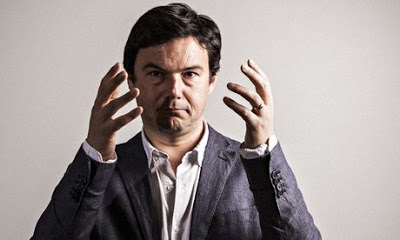
Leftist economist Thomas Piketty, is yet another of a long line of economists , who know nothing about history. Economist Robert Murphy busts Piketty for his wrong take on American economic history. Here's Thomas Piketty from his book Capital in the Twenty-First Century pages pages 506-507:
[T]he Great Depression of the 1930s struck the United States with extreme force, and many people blamed the economic and financial elites for having enriched themselves while leading the country to ruin. (Bear in mind that the share of top incomes in US national income peaked in the late 1920s, largely due to enormous capital gains on stocks.) Roosevelt came to power in 1933, when the crisis was already three years old and one-quarter of the country was unemployed. He immediately decided on a sharp increase in the top income tax rate, which had been decreased to 25 percent in the late 1920s and again under Hoover’s disastrous presidency. The top rate rose to 63 percent in 1933 and then to 79 percent in 1937, surpassing the previous record of 1919.
Economist Robert Murphy explains:
(1) The top rate was lowered to 25 percent in 1925, not exactly “the late 1920s” and certainly not by Herbert Hoover. (I think the brief 24 percent rate in 1929 was a one-off adjustment in the surtax, but I am not certain and I’m not going to go look it up right now.)
(2) The top rate was jacked up to 63 percent in 1932, not 1933, and it was done by Herbert Hoover, not by FDR. (Note that the 63 percent rate applied to the 1932 tax year, so we can’t rescue Piketty by saying he was referring to the first year of impact rather than the passage.)
(3) The top rate was raised to 79 percent in 1936, not 1937. (If you want to cross-reference another source, this page also agrees that the 79 percent rate kicked in in 1936.)
Now if there had just been one instance of Piketty being off by a single year, I would excuse it by saying maybe he got mixed up in interpreting how US tax laws work. But to say (or did he merely imply?) that Hoover was the one to lower tax rates to 25% is just crazy; Hoover wasn’t inaugurated until March 1929, and the top rate was lowered to 25% back in 1925.
Furthermore, notice that this isn’t an “arbitrary” screwup on Piketty’s part: On the contrary, it serves his narrative. It would be really great for Piketty’s story if the right-wing business-friendly Herbert Hoover slashed tax rates to boost the income of the 1%, thereby bringing in a stock bubble/crash and the Great Depression. Then FDR comes in to save the day by jacking up tax rates. Except, like I said, that’s not what actually happened.

|
Из за большого объема этот материал размещен на нескольких страницах:
1 2 3 4 5 6 7 |
