


Партнерка на США и Канаду по недвижимости, выплаты в крипто
- 30% recurring commission
- Выплаты в USDT
- Вывод каждую неделю
- Комиссия до 5 лет за каждого referral
ATOMIC NUMBER | CARBONATE | SULFIDE | SULFATE | OXIDE | HALIDE | |
sodium | 11 | halite | ||||
magnesium | 12 | dolomite | ||||
calcium | 20 | calcite aragonite | gypsum | fluorite | ||
iron | 26 | pyrite marcasite | hematite goethite | |||
cobalt | 27 | siegenite | ||||
nickel | 28 | millerite | ||||
copper | 29 | malachite | chalcopyrite | |||
zinc | 30 | smithsonite | sphalerite | |||
strontium | 38 | strontianite benstonite | celestine | |||
barium | 56 | witherite | barite | |||
lead | 82 | leadhillite | galena |
PGM AND OTHER ACCESSORY MINERALS OF HYDROGENOUS FERROMNGANESE OCEANIC CRUSTS — PACIFIC OCEAN CASE STUDY
1Torokhov M. P., 2Anikeeva L. I., 1Alexandrov P. A., 2Prasolov E. M.
1VNIIOkeangeologia, St. Petersburg, Russia, *****@***cityline. ru
21 — Centre of Isotopic Studies VSEGEI, St. Petersburg, Russia
The study of accessory minerals in ferromanganese crusts was done to determine self mineral phases of those elements that are of practical interest — Со, Ni, Cu, REE, PGE,
Te, W. Hydrogenous crusts were taken from two well-known deposits of Magellan Seamount and of Wake-Nekker (the Pacific Ocean). Extraction of heavy minerals was based on original approach in hydro environment that permits to exclude technogenic pollution of a treated sample and to separate micron-size minerals of heavy fraction. Concentration coefficient composed ca. 1:10000000, that allowed to extract phases of those minerals that hardly could be find in original crusts. Discovered mineral associations (Table 1) are represented by diagenetic paragenesis: sulfides, chlorides, sulfates, phosphates, oxides, and native metals and alloys. Mineral phases were analyzed by electronic microscope ABT-55 (Japan) with link-10000 under accelerating voltage 25 kV in the Institute of Precambrian Research (analytics M. D.Tolmachev, M. R.Pavlov). The time of impulse accumulations ranged from 30 up to 300 sec. Elements with contents exceeding 2d were taken in account. The wide of electronic beam is estimated to be 3 microns.
Table 1
Accessory minerals of hydrogenous crusts
Sulfides, tellurides | Chlorides | Sulfates | Phosphates | Oxides | Native metals and alloys |
Sphalerite | Atakamite | Barite | Apatite | Wolframite | Ni |
Chalcopyrite | Monazite | Tellurite | Bronze | ||
Galenite | Zincite | Brass | |||
Molybdenite | Gahnite | (Fe, Cr, Ni) | |||
Pyrite | (Ce, Fe)O2 | Cu | |||
Anilite | (Cu, Zn)2O | (Fe, Ni) | |||
Marmatite | (Ce, La, Fe)O2 | (Fe, Cr) | |||
Covellite | (W, Fe)O2 | (Fe, W,V, Cr) | |||
Geerite | Titanomagnetite | (Ce, La, Fe) | |||
W-Pyrite | Ta | ||||
Coloradoite | Ag | ||||
Zn |
It is necessary to stress that mentioned minerals are of autigenic nature and we do not take in account those minerals that were supplied to the crusts from other sources: basalts, sediments, cosmos.
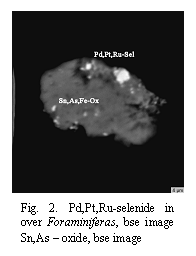
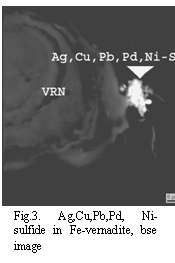
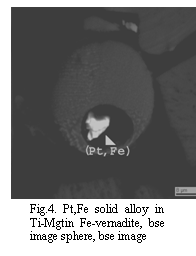
PGE-bearing mineral phases were determined in form of solid alloys Fe, Pt, Pd, Rh, as well as sulfides, stannates, and silicides (Table 2). Grain sizes are varying from 1 to 10 ppm. Pt is dominant in most part of PGM compositions that corresponds to a bulk chemical composition of PGE’s in the studied crusts. Forms of PGM grains testify to their formation in-situ (Fig.2,3,4). This idea is also supported by the presence of Fe and Mn in some PGM grains composition.
Table 2
PGE-bearing minerals of hydrogenous crusts
Mineral | Composition | Figure | REFERENCES |
unnamed | (Pd3.83Pt0.11Ru0.06)4.00(Se0.87S0.07As0.06)1.00 | 2 | this work |
unnamed | (Ag0.40Cu0.22Pb0.12Pd0.06Ni0.03)S1.00 | 3 | this work |
ferroplatinum | Pt2.25Fe1.00 | 4 | this work |
ferroplatinum | (Pt2.21Pd0.005Rh0.05)Fe1.00 | this work | |
rustenburgite | (Pt2.13Pd0.76Ni0.09Cu0.09)3.07(Sn0.87Sb0.06)0.93 | I | |
unnamed | (Cu3.51Pt0.63Fe0.50.Sn0.22Ni0.09.Mn0.04Ag0.04)5.03Si0.96 | I | |
unnamed | (Cu3.14Pt0.68Fe0.18Mn0.04)4.04Si0.96 | I | |
unnamed | (Cu3.35Pt0.61Fe0.05Mn0.05)4.06Si0.95 | I | |
bronze | (Cu0.87Sn0.05Fe0.03Si0.03Pt0.01Ag0.01)1.00 | I |
REE-bearing phases are represented by oxides, monazite, native metals, REE-bearing goethite. Predominance of Ce corresponds to that of bulk chemical REE composition in hydrogenous crusts.
Mineral phases of Te are represented by tellurite, ,Te-bearing geerite, colorodaite.
Compositions of W are represented by wolframite, (W, Fe)O2, W-bearing pyrite, solid alloys (Fe, W,V, Cr).
It is necessary to note, that separated volume of accessory minerals (micrograms) supports the idea that main part of ore elements is presented in form of cation-anionic compositions, or at least in form of submicron grains ore element clusters inaccessible for microprobe determinations (detection limit 2-3 microns). It is normally proved by separate analyses of homogenous Fe-Mn matter were Co, Ni, Cu usually have measurable meanings.
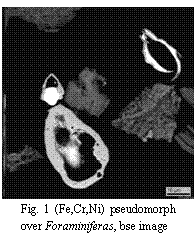
Widely manifested alloys of Fe, Cr, Ni in all types of studied crusts are of definitely autigenic character that is supported by numerous discoveries of pseudomorphs over microfossils, such as Foraminiferas etc. replaced by similar alloys (Fig.1).
Morphology of separate mineral grains as cancer-like, ovoid forms and veinlets indicate to the possibility of mineral formation from gels. In course of each-layer treatment where crust ages could differ in tens of Ma (Melnikov et. al.,1994), we did not find yet any serious quantitative difference in accessory’s amount that testifies to relatively rapid mineral formation. However, mineral compositions of accessories could significantly variable following to variations of bulk chemical composition of a layer. Separated mineral phases of metals are not interesting in technological aspect due to their small amount. However, the genetic interpretation of their formation could be of significant interest in understanding of intercrustal environments and essence of chemical reactions.
Рrocesses on mineral formation. The formation of hydrogenous crusts takes place in oxidizing, low alkaline hydrochemical conditions that determine a stability of oxide metal forms. Thermodynamical calculations, particularly, show that under a clarke contents of Fe, Mn and Co in oceanic water, the most stable mineral forms will be vernadite (Fe-vernadite) and other ferrous minerals of composition FeO(OH), where a part of iron is replaced (up to 2 wt.%) isomorphically by cobalt.
1. The specifity of mentioned accessory minerals is that they could be formed, as a rule, in rather reductant environment, that in together with mentioned facts proving their autigenic formation, point to their genesis at a stage of crust’s diagenesis. Ferromaganese hydrogenous crusts are of valuable sorption potential. In fact, the crusts are a kind of “cold chemical reactors”. Concentration coefficients of separate metal cations and anions from seawater could exceed ten ths. of magnitude what result in significant enrichment of their content in porous waters due to desorption and formation of coagulative structures of most ore minerals.
2. Their next feature is the confinement to bathymetric intervals with intensive decay of biogenic organic matter accompanied by formation of its incomplete oxidation (ammonia, chelates, cetones etc.) that could be also concentrated in porous waters of the crusts.
These two features are most probable reasons of the mentioned variety of accessory minerals in the studied crusts.
Typical feature of transitional metals of d-row (Fe, Cr, Ni, Mo, Mn, V, W, Rh, Ru) is their ability to form complexes with products of incomplete organic decay as CO, arsines, isocyanides, NO and other molecules that have delocalised p-orbitals (p-acids). The typical features of these ligands is their ability to stabilize low-valency state of metals oxidation, i. e. to promote the formation of more reductant metal forms up to native metals. Special research was undertaken to determine the gaseous content in separate crust (lower layer) that shows a possibility of reductant environment within crust layer (Table 3).
Тable 3
Chemical composition of gases from hydrogenous crust-lower layer (Wake-Nekker).
Composition,%
НЕ нашли? Не то? Что вы ищете?
Реклама
Реклама на сайте, общая информация Контент-маркетинг Поддержите проект! Copyright © 2009-2026 Pandia. Все права защищены. Мнение редакции может не совпадать с мнениями авторов. Автоответчик: +7 495 7950139 228504 Написать письмо: [email protected] 
❮
❯
|