


Партнерка на США и Канаду по недвижимости, выплаты в крипто
- 30% recurring commission
- Выплаты в USDT
- Вывод каждую неделю
- Комиссия до 5 лет за каждого referral
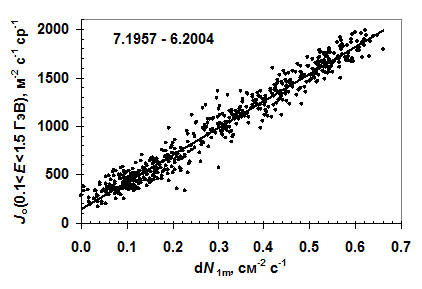
Рис. 4а. Корреляционная связь между среднемесячными значениями первичных потоков космических лучей J0(0.1 £ Е £ 1.5 ГэВ), полученными методом экстраполяции за период 07.1957–06.2004, и разностями потоков частиц dN1m по данным одиночного счетчика в максимуме высотных кривых в атмосфере на широтах с Rс = 0.6 и 2.4 ГВ. Прямая линия проведена методом наименьших квадратов.
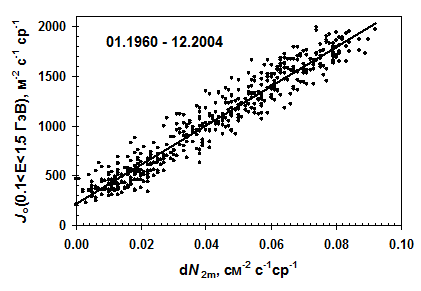
Рис. 4б. То же, что на рис. 4а, для разностей dN2m потоков космических лучей в максимумах высотных кривых в атмосфере, полученных с помощью телескопа, на широтах с Rс = 0.6 и 2.4 ГВ за период 01.1960–12.2004.
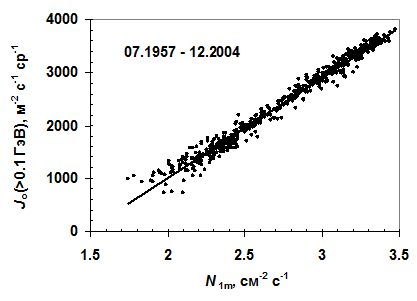
Рис. 5а. Корреляционная связь между значениями первичных потоков космических лучей J0(Е ≥ 0.1 ГэВ), полученными методом экстраполяции за период 07.1957–12.2004, и потоками частиц N1m, регистрируемыми одиночными счетчиками в максимумах высотных кривых в атмосфере на широте с Rc = 0.6 ГВ. Прямая линия проведена методом наименьших квадратов.
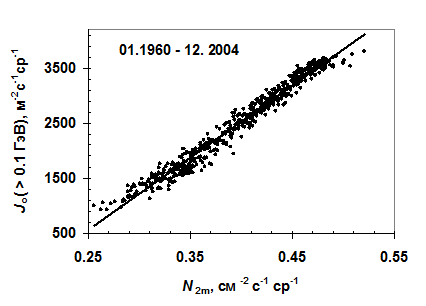
Рис. 5б. То же, что на рис. 5а, для данных, полученных с помощью телескопа на широте с Rc = 0.6 ГВ за период 01.1960–12.2004.
Аналогичные корреляционные связи между экстраполированными значениями интегральных потоков по энергии J0(Е ≥ 0.1 ГэВ) и величинами потоков космических лучей N1m и N2m в максимумах высотных кривых можно найти для полярных широт (Rc = 0.6 ГВ). Эти связи показаны на рис. 5а, б. Для данных, полученных с помощью одиночного счетчика, коэффициент корреляции r равен 0.99, и связь между J0 и N1m имеет вид:
J0(E ≥ 0.1 ГэВ) = (1893 ± 12)×N1m – (2778 ± 32), (3)
где [J0] = м–2×с–1×ср–1 и [N1m]= см–2×с–1. Для данных, полученных с помощью телескопа, коэффициент корреляции r = 0.98, и связь между J0 и N2m имеет вид:
J0(E ≥ 0.1 ГэВ) = (13051 ± 98)×N2m – (2698 ± 39), (4)
где [J0] = м–2×с–1×ср–1 и [N2m]= см–2×с–1×ср–1. Значения J0(0.1 < E < 1.5 ГэВ) и J0(E ³ 0.1 ГэВ), полученные методом экстраполяции данных одиночного счетчика и телескопа к границе атмосферы, должны в пределах ошибок совпадать со значениями, полученными из соотношений (1)–(4).
В таблицах 3–27 приведены среднемесячные значения потоков заряженных частиц, измеренных в максимумах кривых поглощения космических лучей в атмосфере, для станций и периодов наблюдений, указанных в таблице 1, в таблицах 3–15 приводятся значения потоков по данным одиночных счетчиков, в таблицах 16–27 представлены потоки по данным телескопов.
В таблицах 28–30 приведены среднемесячные значения потоков g-квантов, измеренные кристаллом NaJ(Tl).
В таблицах 31–32 представлены среднемесячные значения потоков первичных космических лучей на границе атмосферы J0 для частиц с энергией Е ³ 0.1 ГэВ и в интервале энергии 0.1 £ Е £ 1.5 ГэВ. Значения J0 получены двумя способами: 1) экстраполяцией к границе атмосферы данных одиночного счетчика и телескопа и 2) вычислением J0 по формулам (1)–(4) c использованием величины потоков частиц в максимумах кривых поглощения в атмосфере. В таблицах 31–32 даны усредненные значения J0.
Настоящий препринт и экспериментальные данные также находятся на сайте http://sites. lebedev. ru/DNS_FIAN/.
Литература
1. Чарахчьян флуктуаций интенсивности космических лучей в стратосфере, вызываемых процессами на Солнце. УФН, 1964, т. 83, вып. 1, с. 35-62.
2. , , Чарахчьян лучи в стратосфере и околоземном пространстве в период 19-го и 20-го циклов солнечной активности. Труды ФИАН, М.: Наука, 1976, т. 88, с. 3-50.
3. , , Стожков распределение интенсивности космических лучей по измерениям в стратосфере. Труды ФИАН, М.: Наука, 1980, т. 122, с. 3-14.
4. Bazilevskaya G. A., Krainev M. B., Stozhkov Yu. I., Svirzhevskaya A. K., Svirzhevsky N. S. Long-term Soviet program for the measurement of ionizing radiation in the atmosphere. Journal of Geomagnetism and Geoelectricity, 1991, v. 43, Suppl., p. 893-900.
5. , , Свиржевская космических лучей в атмосфере Арктики и Антарктики. Арктика и Антарктика. М.: Наука, 2004, вып. 3 (37), с. 114-148.
6. , , Чарахчьян компонента космических лучей в атмосфере. Труды ФИАН, М.: Наука, 1976, т. 88, с. 51-79.
7. Stozhkov Y. I., Svirzhevsky N. S., Makhmutov V. S., Svirzhevskaya A. K. Long-term cosmic ray observations in the atmosphere. Proc. 27th ICRC, Hamburg, Germany, 2001. Hamburg: Copernicus Gesellshaft, 2001, v. SH, p. 3883-3886.
8. , , Чарахчьян космических лучей в околоземном пространстве. Геомагнетизм и аэрономия, 1974, т. 14, № 3, с. 411-416.
9. , , Стожков космических лучей по измерениям в стратосфере. Изв. АН СССР, сер. физ., 1978, т. 42, № 5, с. 997-1006.
Introduction
In the 50ies of the 20th century academician S. N. Vernov suggested to perform the regular measurements of cosmic ray (CR) fluxes in the Earth’s atmosphere by means of regular radio sound launching. The main goals of this experiment included study of galactic CR modulation processes, acceleration mechanism of charged particles in powerful solar flares and their propagation in the interplanetary space. In the middle of 1957, S. N. Vernov, together with professor A. N. Charakhchyan, started this experiment. Since then till the present time the regular measurements of charged particle fluxes in the atmosphere of polar and middle latitudes have been carried out. At present about 80 thousands of radio sounds have been launched.
A large amount of experimental data on charged particle fluxes in the atmosphere at different latitudes and altitudes was obtained by the workers of Lebedev Physical Institute of Russian Academy of Sciences (LPI RAS) in cooperation with other academic and non-academic institutions. This cooperation included Skobeltsyn Institute of Nuclear Physics, Lomonosov Moscow State University (under the charge of professor T. N. Charakhchyan), Kasakh State University, Alma-Ata (charge of professor E. V. Kolomeetz), Polar Geophysical Institute, RAS, Apatity (charge of professor E. V. Vashenyik), Alikhanyan Physical Institute, Yerevan, Armenia (charge of doctor G. A. Asatryan), Cosmophysical Observatory of Shafer Institute of Cosmophysical Research and Aeronomy, RAS, Tixie (charge of head A. M. Novikov), Institute of Solar-Terrestrial Physics, RAS, Irkutsk (charge of V. P. Karpov), Leningrad branch of Institute of the Earth’s Magnetism, Ionosphere and Radio Wave Propagation, RAS, Voyeikovo (charge of professor M. I. Tyasto), Crimean Astrophysical Observatory, Crimea (Simeiz, charge of professor A. A. Stepanyan), Fedorov Institute of Applied Geophysics, Moscow, Roshydromet (charge of professor N. K. Pereyaslova), Campinas University, Campinas, Brazil (charge of professor I. M. Martin). From 1963, the measurements have been made at the Antarctic station Mirny supported by Arctic and Antarctic Scientific Research Institute, Roshydromet, St. Petersburg.
After disintegration, of the USSR, the financial support of scientific research in Russia was virtually stopped. Regular measurements of charged particles in the atmosphere were saved due to academician A. E. Chudakov efforts. He persuaded the officials of RAS to support this experiment. The management of Lebedev Physical Institute has been of inestimable value in the fulfillment of research. The financial support has been given by the Russian Foundation for Basic Research and by the special program “Neutrino Physics” of the Presidium of RAS.
Description of observations
For the CR measurements in the atmosphere the special radio sounds for the charged particle detection, ground-based receiver, and calibration stands for particle detectors and atmospheric pressure sensors were developed. A valuable contribution in development of these devices and performance of measurements was made by the engineers of Dolgoprudny scientific station of LPI: P. N. Ageshin, V. V. Bayarevich, A. E. Golenkov, A. F. Krasotkin, V. N. Makunin and others.
A gas-discharge counter of STS-6 type is used to detect omnidirectional flux of charged particles, and a telescope with two such counters is used to detect vertical flux of charged particles. A cylindrical counter of STS-6 type is 98 mm in effective length and 19 mm in diameter. The thickness of steal walls equals 50 mg×cm–2. Energy cutoff of detected particles is Еec = 200–300 keV for electrons and Еpc = 5 MeV for protons. A single counter response to g-rays is less than 0.1%. A telescope has a 7-mm aluminum absorber between counters, which gives with account of the counter walls the energy cutoff of Еec = 5 MeV for electrons and Еpc = 30 MeV for protons. The telescope does not detect g-rays at all. The distance between centers of the upper and bottom counters is 26 mm. The geometrical factors of a single counter Gc and a telescope Gt depend on the angular distribution of detected particles. For isotropic angular distribution of particles in the upper hemisphere these values equal Gc = 16.4 cm2 and Gt = 17.8 cm2×sr. The quasi isotropic distribution of charged particles is realized for the primary particles at the top of the atmosphere and for the particles in the maximum of absorption curve in the atmosphere. The experiment description is given in [1–5].

|
Из за большого объема этот материал размещен на нескольких страницах:
1 2 3 4 5 |
