


Партнерка на США и Канаду по недвижимости, выплаты в крипто
- 30% recurring commission
- Выплаты в USDT
- Вывод каждую неделю
- Комиссия до 5 лет за каждого referral
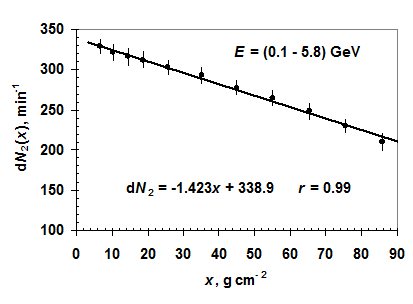
Fig. 3b. The same as in Fig. 3a but for the data obtained with a telescope at the northern polar latitude (Rc = 0.6 GV) and at the northern low one (Rc = 6.7 GV) vs. atmospheric pressure х for the period of July 1987 (differences between upper and bottom absorption curves given in Fig. 1b).
b) relation between the particle fluxes at the atmospheric boundary and fluxes in the maximum of absorption curve
High correlation between experimental data dN1(х), dN2(х) and the fitting functions is striking: the correlation coefficient r is ~1. It proves validity of the used approximation. However, high values of r are observed not for all periods under consideration. During the periods of high solar activity, the latitudinal effect (difference between absorption curves) decreases essentially, therefore, the value of dN1(х) и dN2) decrease. That leads to growth of errors and fall of correlation coefficients values r. This effect is especially important for the differences of CR fluxes measured at high and middle latitudes with Rc = 0.6 GV and Rc = 2.4 GV, respectively. In this case the method of experimental data extrapolation to the top of the atmosphere becomes inaccurate. In addition, the omnidirectional flux of CRs measured at polar latitudes N1(х) may contain a contribution from precipitating (solar and/or magnetospheric) particles.
Because of this, another technique is used to find primary CR fluxes J0(Е ³ 0.1 GeV) and J0(0.1 £ Е £ 1.5 GeV) at the top of the atmosphere, namely, the relationship between J0 obtained by extrapolation and CR fluxes in the maximum of absorption curve N1m, N2m or dN1m, dN2m. As mentioned above, the values of Nm have minimum statistical errors and do not suffer from inaccuracy of atmospheric pressure х determination. We use the values of Nm obtained at the stations with geomagnetic cutoff rigidities Rc equal to 0.6, 2.4 and 6.7 GV. The atmospheric pressure values хm where Nm are recorded, are different at these latitudes for the periods of solar activity minimum and maximum. It is also necessary to take into account the absorption of particles in the atmosphere. Therefore, CR primary particles with energy Е ³ Еmin contribute into Nm value, Еmin being defined by the values Rc or Ra. In Table 2, the values of хm and Еmin are given for solar activity minimum and maximum periods and aforementioned geomagnetic cutoffs. Values of Еmin for atmospheric pressure xm were calculated from the expression  , where R = Ra = 4×10⁻²×
 , if Ra > Rc, otherwise R = Rc if Ra £ Rc, mp is proton mass, xm is the atmospheric pressure in g×cm–2 [7].
Table 2. Values of хm in g×cm–2 and Еmin in GeV (for protons) calculated for solar activity minimum and maximum periods according to data of a single counter at the stations with the geomagnetic cutoff rigidities Rc, equal to 0.6, 2.4 and 6.7 GV
Rc, GV (Еc, GeV) | 0.6 (0.18) | 2.4 (1.6) | 6.7 (5.8) | |
Solar activity minimum | хm, g×cm–2 | 30 | 50 | 80 |
Еmin, GeV | 0.18* | 1.6* | 5.8* | |
Solar activity maximum | хm, g×cm–2 | 60 | 60 | 85 |
Еmin, GeV | 0.5 | 1.6* | 5.8* |
* – the values of Еmin are defined by geomagnetic cutoff rigidity Rc.
As it is seen from Table 2 the values of Еmin are defined by atmospheric thickness x only for polar latitudes in the maximum of solar activity. At the middle and low latitudes, the values of Еmin at the top of the atmosphere are defined by the geomagnetic cutoff Rc.
In Figs. 4a, b relationship between primary CR fluxes at the top of the atmosphere obtained by extrapolation technique J0(0.1 £ Е £ 1.5 GeV) and differences between the CR fluxes detected by a single counter and a telescope in the maximum of absorption curve in the atmosphere dN1m = N1m(0.6) – N1m(2.4) and dN2m = N2m(0.6) – N2m(2.4) at the latitudes with Rc = 0.6 and 2.4 GV are shown. Here N1m(0.6), N1m(2.4), N2m(0.6) and N2m(2.4) are the CR fluxes in the maximum of absorption curve. Correlation between J0 and dN1m is high (correlation coefficient r = 0.95) and regression can be expressed as
J0(0.1 < E < 1.5 GeV) = (2773 ± 25)×dN1m + (154 ± 9), (1)
where J0 is in m–2×s–1×sr–1 and dN1m is in cm–2×s–1.
The correlation coefficient for data presented in Fig. 4b r = 0.93 and the relationship between J0 and dN2m is expressed as
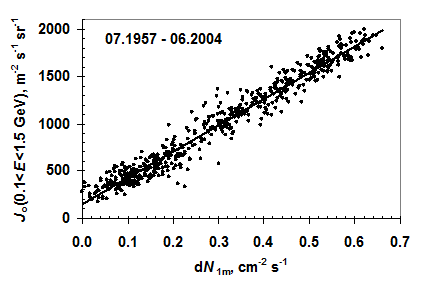
Fig. 4a. Relationship between monthly averaged primary CR fluxes at the top of the atmosphere obtained by extrapolation technique J0(0.1 £ Е £ 1.5 GeV) and differences of CR fluxes detected by a single counter in the maximum of particle absorption curve in the atmosphere dN1m = N1m(0.6) – N1m(2.4) at the latitudes with Rc = 0.6 and 2.4 GV in the period 07.1957–06.2004. The straight line was calculated by the least-squares technique.
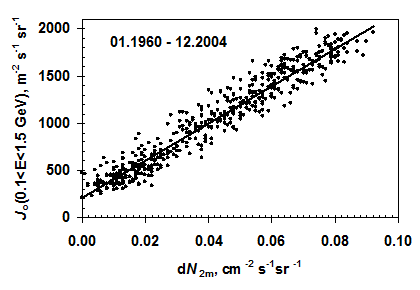
Fig. 4b. The same as in Fig. 4a but for data obtained with telescope in the period from 01.1960 (start of measurement with a telescope) to 12.2004.
J0(0.1< E < 1.5 GeV) = (19715 ± 239)×dN2m + (216 ± 11), (2)
where J0 is m–2×s–1×sr–1 and dN2m is in сm–2s–1sr–1. The contribution of albedo particles to J0 defined from telescope data is small. Angular distribution of particles in the maximum of absorption curve is isotropic in the upper hemisphere [3]. The geometrical factor of a telescope in this case is 17.8 cm2×sr.
Similar regressions can be found between the extrapolated values of primary CR fluxes J0(Е ≥ 0.1 GeV) and the CR fluxes detected by a single counter N1m and a telescope N2m in the maximum of absorption curve in the atmosphere of polar latitudes with Rc = 0.6 GV. The relations are presented in Figs. 5a, b.
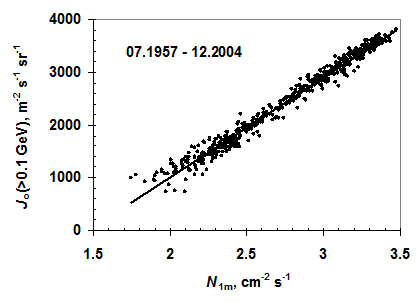
Fig. 5a. Relationship between the primary CR fluxes at the top of the atmosphere obtained by extrapolation method J0(Е ≥ 0.1 GeV) and the CR fluxes detected by a single counter in the maximum of particle absorption curve in the atmosphere N1m at the latitudes with Rc = 0.6 GV for the period 07.1957–12.2004. The straight line was calculated by the least-squares technique.
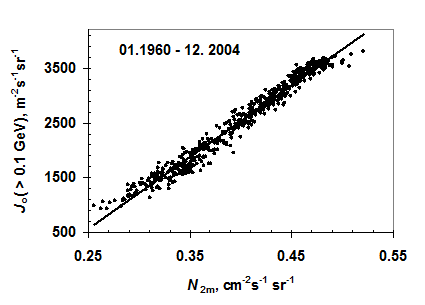
Fig. 5b. The same as in Fig. 5a but for the data obtained with a telescope in 01.1960–12.2004.
For a single counter data in Fig. 5a the correlation coefficient r amounts to 0.99. The relationship between J0(E ≥ 0.1 GeV) and N1m can be expressed as
J0(E ≥ 0.1 GeV) = (1893 ± 12)×N1m – (2778 ± 32), (3)
where J0 is in m–2×s–1×sr–1 and N1m is in сm–2×s–1. For the telescope data in Fig. 5b the correlation coefficient r amounts to 0.98. The relationship between J0(E ≥ 0.1 GeV) and N2m can be expressed as
J0(E ≥ 0.1 GeV) = (13051 ± 98)×N2m – (2698 ± 39), (4)
where J0 is in m–2×s–1×sr–1 and N2m is in сm–2×s–1×sr–1.
The values of J0(0.1 < E < 1.5 GeV) and J0(E ³ 0.1 GeV) obtained with the extrapolation technique of a single counter and a telescope data have to coincide with the values obtained from the expressions (1)–(4) within the errors.
In Tables 3–30, monthly averaged charged particle and g-ray fluxes measured in maximum of absorption curve in the atmosphere are presented for the sites and periods indicated in Table 1. Tables 3–15 give monthly averaged charged particle fluxes measured with a single counter N1m. Tables 16–27 give monthly averaged charged particle fluxes measured with a telescope N2m. Tables 28–30 give monthly averaged g-ray fluxes Ng measured with a crystal NaJ(Tl). Tables 31–32 give monthly averaged primary CR fluxes J0 at the top of the atmosphere for energies Е ³ 0.1 GeV and 0.1 £ Е £ 1.5 GeV. The values of J0 were obtained by the both techniques: 1) averaging data of a single counter and a telescope extrapolated to the top of the atmosphere and 2) using the expressions (1)–(4).
This preprint and Tables of the observational data are also presented at the address http://sites. lebedev. ru/DNS_FIAN/.
References
1. Charakhchyan A. N. Investigations of CR intensity fluctuations in the stratosphere caused by processes on the Sun. Uspechi physicheskich nauk, 1964, v. 83, vypusk 1, p. 35-62 (in Russian).
2. Charakhchyan A. N., Bazilevskaya G. A., Stozhkov Y. I., Charakhchyan T. N. CRs in the stratosphere and nearby Earth space in the 19th and 20th solar activity cycles. Trudy FIAH, Moscow: Nauka, 1976, v. 88, p.3-50 (in Russian).
3. Golenkov A. E., Okhlopkov V. P., Svirzhevskaya A. K., Svirzhevsky N. S., Stozhkov Y. I. CR albedo according to the measurements in the stratosphere. Izvestia Academii Nauk USSR, ser. phys., 1978, v. 42, № 5, pp. 997-1006 (in Russian).
4. Bazilevskaya G. A., Krainev M. B., Stozhkov Yu. I., Svirzhevskaya A. K., Svirzhevsky N. S. Long-term Soviet program for the measurement of ionizing radiation in the atmosphere. Journal of Geomagnetism and Geoelectricity, 1991, v. 43, Suppl., p. 893-900.
5. Stozhkov Yu. I., Svirzhevsky N. S., Bazilevskaya G. A., Makhmutov V. S., Svirzhevskaya A. K. Investigations of cosmic rays in the atmosphere of the Arctic and Antarctic. Arctic and Antarctic Moscow: Nauka, 2004, 2004, vol. 3 (37), pp. 114-148 (in Russian).
6. Charakhchyan A. N., Bazilevskaya G. A., Kvashnin A. N., Charakhchyan T. N. Photon component of CRs in the atmosphere. Trudy FIAH, Moscow: Nauka, 1976, v. 88, p. 51-79 (in Russian).
7. Stozhkov Y. I., Svirzhevsky N. S., Makhmutov V. S., Svirzhevskaya A. K. Long-term CR observations in the atmosphere. Proc. 27th ICRC, Hamburg, Germany, 2001, v. SH, p. 3883-3886.
8. Charakhchyan A. N., Bazilevskaya G. A., Stozhkov Y. I., Charakhchyan T. N. CR albedo in the nearby Earth space. Geomagnetism and aeronomy, 1974, v. 14, № 3, pp. 411-416 (in Russian).
9. Golenkov A. E., Okhlopkov V. P., Svirzhevskaya A. K., Svirzhevsky N. S., Stozhkov Y. I. Planetary distribution of CR fluxes according to measurements in the stratosphere. Trudy FIAH, Moscow: Nauka, 1980, v. 122, p. 3-14 (in Russian).

|
Из за большого объема этот материал размещен на нескольких страницах:
1 2 3 4 5 |
