


Партнерка на США и Канаду по недвижимости, выплаты в крипто
- 30% recurring commission
- Выплаты в USDT
- Вывод каждую неделю
- Комиссия до 5 лет за каждого referral
Full optimization of the structures of cis- and trans-isomeric forms of peroxynitrene was performed. The structure of the transition states of conformational transitions were optimized. Correspondence of the structures found to the minima on the potential energy surface was ascertained by the absence of negative elements in the diagonalized Hessian matrix, while correspondence to the transition states was identified by the only negative element. Reaction and activation enthalpies were calculated as the difference between the absolute enthalpies of the final (or transition) and initial states of a transformation of interest. The absolute enthalpies were calculated as the sum of the total energy, zero point vibration energy, and thermal correction for enthalpy change from zero to 298 K. Recent values obtained from the calculation of frequencies from the known equations of statistical thermodynamics.
Results and discussion
A wide range of density functionals was studied, both nonhybrid (GGA, mGGA) and hybrid ones (GH-GGA, GH-mGGA, RSH-GGA) . The computational results for the key geometrical and spectral parameters of trans-HNOO are provided in the table 1. As one can see, the O3LYP, M06, M11-L, and MN12-L functionals underestimate the O-O and N-O bond lengths in the trans-form of nitroso oxide, whereas wB97, B971, B98, BMK, M06-2X, mPW1LYP, TPSSh, LC-wPBE, and wB97XD incorrectly reproduce the positions of absorption bands in the IR spectrum but well describe the geometrical parameters of the structure in question. Of the DFT methods studied, the M06-L, mPWPW91, OLYP, and HCTH functionals describe the structure and IR spectrum of trans-HNOO most reliably (table 1).
Table 1. Geometrical parameters and frequencies of stretching vibrations of peroxynitrene
Method | rN‑O | rO‑O | rN‑O ‑rO‑O | νN‑O | νO‑O | νN‑O ‑ νO‑O | |
Å | cm‑1 | ||||||
trans‑HNOO | |||||||
CCSDT-3(Qf) | 1.306 | 1.286 | 0.020 | 1126 | 1071 | 55 | |
MR-AQCC(8;7) | 1.309 | 1.297 | 0.012 | – | – | – | |
CCSD(T)/6‑311+G(d, p) | 1.304 | 1.293 | 0.011 | 1200 | 1063 | 137 | |
CASSCF(18;13)/ 6‑311+G(d, p) | 1.317 | 1.297 | 0.020 | 1118 | 1044 | 72 | |
Experiment | – | – | – | 1092.3 | 1054.5 | 38 | |
GH-GGA | |||||||
B3LYP/6-31G(d) | 1.311 | 1.299 | 0.012 | 985 | 1147 | -162 | |
B98 | 1.294 | 1.287 | 0.007 | 986 | 1159 | -173 | |
mPW1LYP | 1.304 | 1.292 | 0.012 | 970 | 1133 | -163 | |
O3LYP | 1.278 | 1.276 | 0.002 | 1001 | 1186 | -185 | |
BMK | 1.300 | 1.283 | 0.017 | 1005 | 1241 | -236 | |
B971 | 1.292 | 1.288 | 0.004 | 988 | 1157 | -169 | |
GH-mGGA | |||||||
M06 | 1.273 | 1.270 | 0.003 | 995 | 1196 | -201 | |
M06-2X | 1.282 | 1.275 | 0.007 | 1017 | 1 231 | -214 | |
TPSSh | 1.301 | 1.295 | 0.006 | 955 | 1108 | -153 | |
RSH-GGA | |||||||
wB97X | 1.295 | 1.277 | 0.018 | 1020 | 1230 | -210 | |
LC-wPBE | 1.297 | 1.273 | 0.024 | 1049 | 1258 | -209 | |
wB97XD | 1.288 | 1.277 | 0.011 | 1015 | 1213 | -198 | |
GGA | |||||||
HCTH | 1.282 | 1.272 | 0.009 | 1191 | 1134 | 57 | |
mPWPW91 | 1.297 | 1.294 | 0.003 | 1139 | 1086 | 53 | |
OLYP | 1.294 | 1.285 | 0.009 | 1156 | 1115 | 41 | |
mGGA | |||||||
M06‑L | 1.282 | 1.278 | 0.004 | 1211 | 1136 | 75 | |
M11-L | 1.252 | 1.249 | 0.003 | 1305 | 1208 | 97 | |
mNGA | |||||||
MN12-L | 1.255 | 1.276 | -0.021 | 1329 | 1134 | 195 | |
cis‑HNOO | |||||||
MR-AQCC(8;7) | 1.288 | 1.318 | ‑0.030 | ||||
CCSD(T)/6‑311+G(d, p) | 1.287 | 1.306 | -0.019 | 1224 | 1057 | 167 | |
CASSCF(18;13)/ 6‑311+G(d, p) | 1.296 | 1.312 | ‑0.016 | 1131 | 1049 | 82 | |
M06‑L | 1.262 | 1.296 | ‑0.034 | 1267 | 1096 | 171 | |
mPWPW91 | 1.277 | 1.313 | ‑0.036 | 1291 | 1048 | 243 | |
OLYP | 1.275 | 1.303 | ‑0.028 | 1209 | 1081 | 128 | |
HCTH | 1.263 | 1.290 | ‑0.027 | 1249 | 1095 | 154 | |
UB3LYP/6-31G(d) | 1.266 | 1.303 | ‑0.038 | 1321 | 1120 | 201 |
Interatomic distances r are expressed in Angstroms and the stretching vibration frequencies ν are in
cm-1. The cc-pVTZ basis set was used in all the cases except where specified otherwise.
The methods that we chose show good applicability to calculations of the properties of trans-HNOO in terms of both selected criteria: bond lengths and position of absorption lines in the IR spectra. The use of these methods for calculation of the properties of cis-HNOO is also characterized by satisfactory agreement with the data of the reference methods: a correct order of r and ν values is observed. The deviation of rN-O values from the reference methods by 0.01 ÷ 0.02 Å and the corresponding overestimation of the N-O stretching vibration frequency by ca. 100 cm-1 should be noted. The length of the peroxide bond in the cis-form consistently increases in comparison with trans-HNOO, and all four methods give the same elongation of the O-O bond by 0.018 Å. The origin of the observed effect lies in non-valent orbital interaction that can occur only in cis-HNOO and can be described as partial electron density transfer from the lone electron pair of nitrogen to the antibonding orbital of the peroxide bond, nN → σ*O–O (Scheme 3). Partial population of the antibonding orbital of the O–O bond destabilizes the peroxide bond and causes its elongation . For the same reason, additional π-bonding between N and O atoms occurs in cis-HNOO. It results in shortening of the N-O bond and sign inversion of the rN-O – rO-O difference (Table 1).
Scheme 3. Non-valent (anomeric) interaction in cis-HNOO
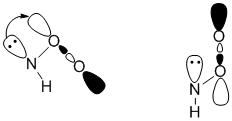
It is also necessary to be sure that, along with geometrical parameters, the selected methods adequately reproduce the energy of nitroso oxide isomers and transition states between them. Previously , the enthalpy ∆H° activation energy ΔH¹ of conformational transformation for peroxynitrene were determined using high-level approximation MR‑CISD(18;13)+Q which is used as a reference. These values were calculated by four selected functionals using the Pople or Dunning basis sets of triple valence splitting (table 2).

|
Из за большого объема этот материал размещен на нескольких страницах:
1 2 3 4 5 |
