

Партнерка на США и Канаду по недвижимости, выплаты в крипто
- 30% recurring commission
- Выплаты в USDT
- Вывод каждую неделю
- Комиссия до 5 лет за каждого referral
Methods
Research of dynamic stability of elements at influence of the wave parametric load
Structural design of the bar element a complementary model and conclusion of differential equalizations of vibration processes are presented on the Figure 1.
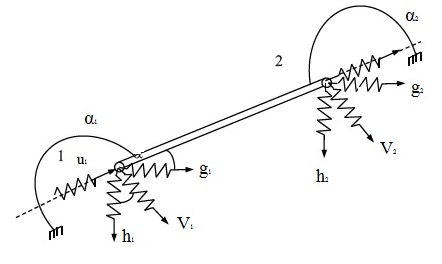
Figure 1. Structural design [1]: V1; V2 – transverse components of the displacement of nodes 1 and 2, g1; g2 – horizontal components of the displacement of nodes 1 and 2,
u1; u2 – longitudinal components of the displacement of nodes 1 and 2;
h1; h2 – vertical components of the displacement of nodes 1 and 2,
б1; б2 – spring stiffness characteristic
In the case of a rod of a trellis truss loaded with a longitudinal force S(t) consisting of the static component S0 and the dynamic component St, whose nodes make the transverse motion v1(t) and v2(t) in the first approximation, a differential equation describing the dynamic processes is obtained:
| (1) |
 ,
,where 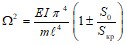 ,
,  , a sign "+" behaves to the case of the stretched bar, sign of "-" to the case of the compressed bar;
 – Euler’s critical force;
 – bar length;
q – generalized coordinate;
m – linear mass of bar.
Homogeneous equalization corresponding to equalization (1) on condition of  is Mathieu equation and describes the parametric vibrations of the bar element of construction:
| (2) |
 .
.It is known [2] that at the value of frequency of excitation:
| (3) |
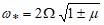 ,
, there can be main parametric resonance.
Taking into account this condition amplitude of parametrik vibrations increases in time on an exponential law:
| (4) |
 .
.In the absence of resistance, the maximum value of the exponent is:  .
.
Taking into account all the above equations, it follows that:
| (5) |
 .
. If to take into account influence of viscid resistance Mathieu differential equation assumes a next form:
| (6) |
 .
.The values of the critical frequencies corresponding to the boundaries of the first (main) region of dynamic instability at parametric resonance:
| (7) |
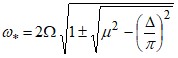 ,
,where  – logarithmic decrement of local free vibrations of bar.
Value of exponential index of growth of amplitude in this case:
| (8) |
 ,
,where  – the critical value of the excitation coefficient, when it exceeds the phenomenon of dynamic instability.
In case of periodic character of coefficient µ(t) presented by Fourier's series 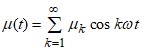 the critical frequencies corresponding to parametric resonances are given by [3]:
| (9) |
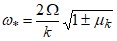 .
.In case of polyharmonic excitation:
| (10) |
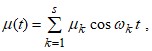
at that the values of  are not multiple
  .
.
| (11) |
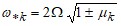 .
.In last In the latter case, the influence of higher forms of oscillations and combination parametric resonances is neglected.
At the stationary applying of the harmonic loading in the nodes of truss bar stress of oscillation of that examined on a decouple drawing determined by expression:
| (12) |
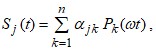
where  – coefficients of influence taking into account influences in k-node of truss;
Sj – force in the bar element;
Pk – force impact profile.
Taking into account character of form of vibrations of truss (Figure 2) of value  quasistatic is determined.
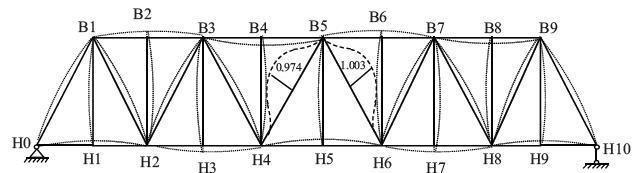
Figure 2. Higher form (mode) of vibrations of truss [1]
It is like possible to expect value  in case of the periodic key loading of general view presented through the Fourier series.
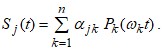
If node loads (forces) are applied at different nodes of the truss varying according to a harmonic law with different frequencies  , then the force in the j-th bar of the truss is described by a polyharmonic process:
| (13) |
At excitation of parametric vibrations stationary forces attached in the nodes of truss and operating during the indefinite interval of time the only method of protection against vibrations there is an exception of possibility of origin of parametric vibrations by the increase of parameters of damping (coefficient of fading of n) with that inequality was provided:
| (14) |

From a vibration can such methods of protecting become, for example, application of paint coat for the bars materials possessing the high degree of absorption of energy of vibrations in a superficial layer and also perfection of constructions of nodes – connection of the truss bars in the nodes on high-strength bolts instead of riveted joints.
In the case of the action of the mobile load, the force at the nodes of the truss is determined by the expression:
| (15) |
 ,
,where  – ordinate of the force influence line in the truss bar from the amplitude value of the moving variable force P(t).
We expand the equation of the line of influence  in a Fourier series with respect to
  continuing the function in an odd manner:
| (16) |
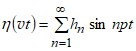 ,
,where,  ;
;
 – truss span;
 – load speed.
The values of the Fourier coefficients:
- for a single-valued influence line
| (17) |
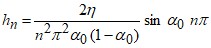 ;
;- for a two-digit influence line
| (18) |

In equals (17) and (18): з, з1, з2 – absolute values of the ordinates of the vertices of the influence line,  ,
,  ,
,  and
and  – abscissas of corresponding vertices.

|
Из за большого объема этот материал размещен на нескольких страницах:
1 2 3 4 |
